6.8
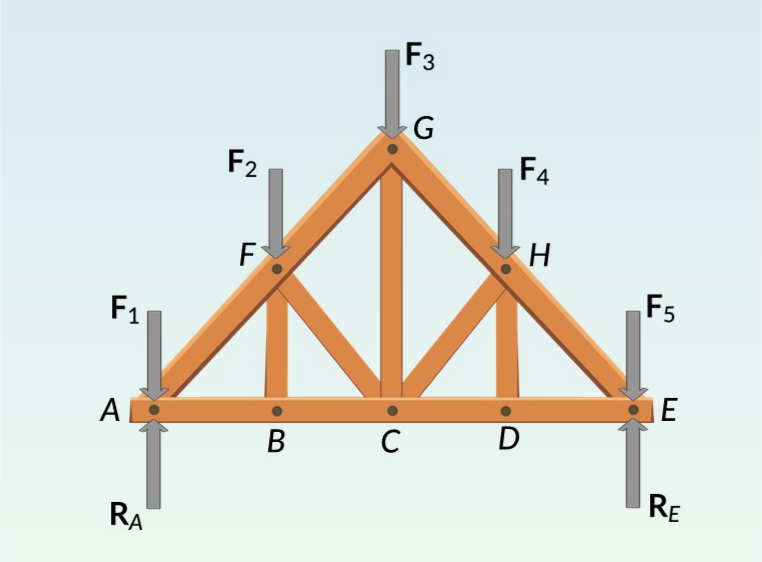
対称な屋根トラス構造を考えます。垂直、対角、水平のメンバーで構成されています。各水平メンバーの長さは4mです。垂直メンバーFBとHDの長さは4mであり、メンバーGCの長さは6mです。ジョイントF、G、Hでの負荷は2kNであり、ジョイントAとEでの負荷は1kNです。
断面法を使用してメンバーDCおよび…
垂直、斜め、および水平の部材で構成される対称的な屋根トラス構造を考えてみましょう。
自由体図を描き、断面法を使用してDCおよびHCメンバーにかかる力を解析します。
ここでは、水平および垂直メンバーの荷重と長さが既知のパラメータです。
まず、点Aの周りのモーメントを合計して、Eでの反力を計算します。
また、トラスに対する力平衡条件を用いて、Aにおける反力を求める。
トラスの対称性により、両方の反力が等しくなります。
ここで、DC、HC、HGメンバーと交差する平面に沿ってカットが行われ、小さい方のセクションのフリーボディ図が描画されます。
Hに関するモーメントの総和を取ると、DCに沿った力が得られます。正の符号は引張力を示します。
HCに沿った力は、その正弦成分と余弦成分に分解され、三角法を使用して角度θを推定します。
Eでのモーメント平衡状態はHCに力を生じさせ、負の符号は圧縮力を示します。
Q1: How do you calculate reaction forces in a symmetrical roof truss using the method of sections?
For a symmetrical roof truss, apply moment equilibrium about a support point, substituting known loads and distances into the moment equation. This yields the reaction force at one support. Then use vertical force equilibrium to find the reaction at the other support. Due to symmetry, both reaction forces are equal. In the example, both reaction forces equal 4 kN.
Q2: What does a positive force value indicate when analyzing truss members?
A positive force value indicates a tensile force, meaning the member is being pulled or stretched. Conversely, a negative force value indicates a compressive force, where the member is being pushed or compressed. In the roof truss example, member DC experiences a tensile force of 3 kN, while member CH experiences a compressive force of -1.41 kN.
Q3: How does the method of sections isolate forces on specific truss members?
The method of sections involves making a cut through a truss along a plane that intersects the members you want to analyze. A free-body diagram is drawn for the smaller section created by this cut. Moment and force equilibrium equations are then applied to this isolated section to calculate internal forces on the cut members without analyzing the entire truss.
Q4: Why is moment equilibrium applied at specific points when using the method of sections?
Moment equilibrium is applied at points where unknown forces intersect or align, eliminating those unknowns from the equation. For example, taking moments about point H eliminates the force at H from the calculation, allowing you to solve directly for the force on member DC. This strategic point selection simplifies the analysis and reduces the number of simultaneous equations needed.
Q5: What role does trigonometry play in analyzing diagonal truss members?
Trigonometry is used to resolve diagonal member forces into horizontal and vertical components and to determine the angle between members and the horizontal axis. In the roof truss example, trigonometry revealed that member CH makes a 45-degree angle with the horizontal. This angle information is essential for applying force equilibrium conditions and calculating accurate member forces.
Q6: How does truss symmetry simplify the analysis process?
Truss symmetry ensures that reaction forces and member forces are equal on both sides of the centerline, reducing calculation work. In a symmetrical roof truss, once you calculate the reaction force at one support, you immediately know the reaction force at the opposite support is identical. This property eliminates redundant calculations and provides a quick verification check for your results.
Q7: What information must be known before applying the method of sections to a truss?
You must know the loads acting at each joint, the lengths of all members, and the geometry of the truss structure. These known parameters allow you to set up moment and force equilibrium equations. Additionally, you need to identify which members you want to analyze and determine an appropriate cutting plane that intersects those members without cutting through more than three unknowns.