7.9
梁が分布荷重、集中荷重、カップルモーメントなどのさまざまな荷重にさらされると、剪断力と曲げモーメントが発生します。これら2つの力の関係を理解するためには、梁の元素区間を分析し、自由物体図を描くことができます。
梁の元素区間が平衡状態にあるためには、区間の右側に作用するモーメントが左側よりもわずかに有…
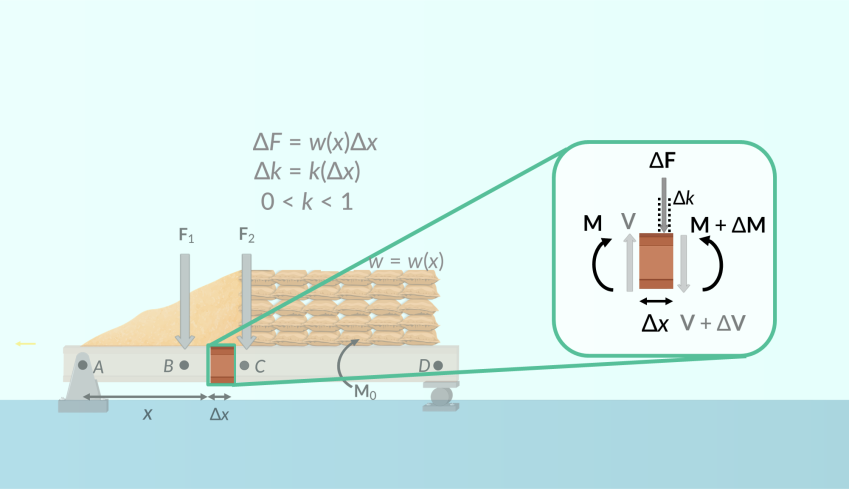
ビームが分布荷重、2つの集中荷重、および2つのモーメントを受けるとします。せん断と曲げモーメントの関係を確立します。
ビームの要素セクションを考え、そのセクションの自由体図を描きます。
セクションが平衡状態にあるためには、セクションの右側に作用するモーメントが小さく有限の量だけ高くなければなりません。
分布荷重の合力は、断面の右端からわずかな距離で加えられます。
モーメントの平衡方程式を用いると、モーメントとせん断の関係を求めることができます。
さらに、それをΔxで割ってΔxをゼロに近づけることで、モーメント図の傾きが決定され、これがせん断に相当します。
最大曲げモーメントは、モーメントの傾きとせん断がゼロになる点で発生します。
2つの任意の点の間にある要素セクション上の分布荷重を統合すると、曲げモーメントの変化とせん断図の下の面積との間に相関関係が得られます。
View the full transcript and gain access to JoVE Core videos
Q1: How do you establish the relationship between shear and bending moment in a beam?
To establish the relationship, analyze an elemental section of the beam using a free-body diagram. Apply equilibrium equations for moments, noting that the moment on the right side should be higher by a small amount. By dividing the moment equation by Δx and letting Δx approach zero, you determine the slope of the moment diagram, which equals the shear force.
Q2: What does the slope of the moment diagram represent?
The slope of the moment diagram is equivalent to the shear force acting on the beam. This relationship is derived by dividing the moment equilibrium equation by the elemental length Δx and taking the limit as Δx approaches zero, establishing a direct mathematical connection between moment and shear.
Q3: Where does the maximum bending moment occur on a beam?
The maximum bending moment occurs at the point where both the slope of the moment diagram and the shear force are zero. This critical location represents a transition point where the shear changes sign, making it essential for structural design and analysis.
Q4: How does the area under the shear diagram relate to bending moment?
By integrating the distributed load over an elemental section between two arbitrary points, a correlation emerges: the change in bending moment equals the area under the shear diagram. This relationship provides a graphical method for determining moment variations along the beam's length.
Q5: Why must the moment on the right side of an elemental section be higher than on the left?
For the elemental section to remain in equilibrium, the moment on the right side must be higher by a small finite amount to balance the effects of shear forces and distributed loads acting on the section. This moment difference is essential for maintaining rotational equilibrium of the infinitesimal element.
Q6: What role does the distributed load play in the shear-moment relationship?
The distributed load exerts a resultant force at a fractional distance from the section's right end, creating the moment differential needed for equilibrium. When integrated over the elemental section, the distributed load determines how shear and moment vary along the beam, directly influencing the shape of both diagrams.
Q7: How do concentrated loads and couple moments affect the shear-moment relationship?
Concentrated loads and couple moments contribute to the overall loading condition on the beam, affecting both shear and bending moment distributions. These loads must be included in the free-body diagram analysis to accurately establish the relationship between shear and moment throughout the beam.