7.11
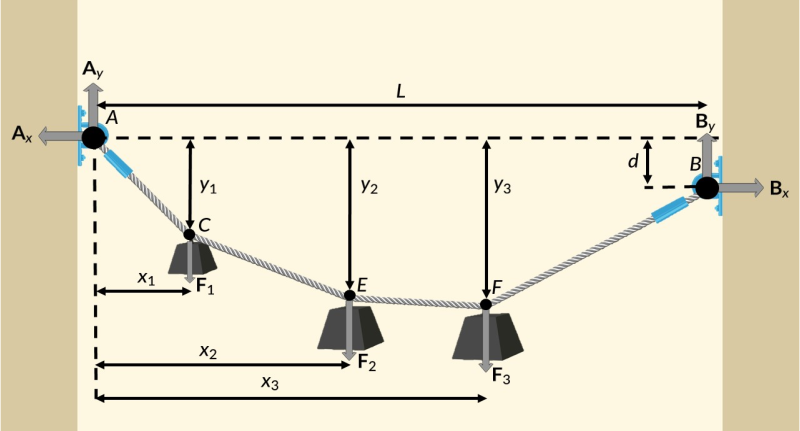
伸縮性のあるケーブルは、さまざまな応用でサポートと負荷伝達に一般的に使用されています。2つのポイントで固定され、複数の垂直集中荷重にさらされるケーブルを考えます。荷重とサポート間の水平距離が与えられた場合、ケーブルの形状とケーブルの各部分の張力を求めます。
解析のために、ケーブルは以下の特性を持つと…
フレキシブルケーブルは、さまざまなアプリケーションでのサポートと負荷伝送に使用されます。
ケーブルABが2点に固定されており、複数の垂直集中荷重が発生するとします。
ケーブルの形状とケーブルの各部分の張力を決定し、負荷とサポートの間の水平距離を把握します。
分析のために、ケーブルは柔軟性があり、伸びず、重量が無視できると仮定します。
ケーブルはいくつかの直線セグメントで構成されており、それぞれが一定の引張力を受けます。
ケーブルの自由体線図を描画して、サポートの反力を決定します。ここでは、未知の反応成分の数が平衡方程式を超えています。
既知の距離にあるケーブル上の点 D を考慮し、セグメント AD のフリーボディ図を描きます。点Dでのモーメント平衡方程式を使用すると、追加の方程式が得られます。
平衡方程式を呼び戻し、反力を使用することにより、支持体Aと各集中荷重との間の垂直距離が得られます。
同様に、各セグメントの張力を得ることができ、これはセグメントの傾斜角が最大の場合に最大になります。
View the full transcript and gain access to JoVE Core videos
Q1: What assumptions are made when analyzing a cable subjected to concentrated loads?
Cables are assumed to be flexible, allowing them to change shape under applied loads, and inextensible, meaning their length does not change under tension. Additionally, the cable's weight is assumed negligible, so it does not significantly impact the cable's behavior during analysis of concentrated loads.
Q2: Why is a free-body diagram of a cable segment necessary for solving concentrated load problems?
A free-body diagram of the entire cable often yields more unknown reaction components than available equilibrium equations. By isolating a segment at a known distance and applying the moment equilibrium equation at that point, an additional equation is obtained, allowing the system to be solved for reaction forces and tensions.
Q3: How does the shape of a cable change when subjected to multiple concentrated loads?
A cable subjected to concentrated loads forms several straight-line segments between load points and supports. Each segment maintains constant tensile force and connects at the load application points, creating a polygonal shape that reflects the distribution and magnitude of the applied vertical loads.
Q4: What is the relationship between cable segment inclination and tension magnitude?
Tension in a cable segment is maximum when the segment has the largest inclination angle relative to the horizontal. Segments with steeper angles experience greater tensile forces because they must support larger vertical load components while maintaining static equilibrium across the cable system.
Q5: How are vertical distances from support to load points determined in cable analysis?
Once reaction forces are known from equilibrium equations, vertical distances from support A to each concentrated load are determined by recalling the equilibrium equation that states the sum of vertical forces acting on the cable must equal zero. This allows calculation of the cable's vertical geometry.
Q6: What information is needed to determine tension in each cable segment?
To calculate tension in each cable segment, you need the reaction forces at supports, the horizontal distances between loads, and the vertical distances from support to each load point. With these values, the tension in each segment can be computed, with maximum tension occurring in segments with the largest inclination angle.
Q7: How does the moment equilibrium equation help solve indeterminate cable systems?
When the number of unknown reaction components exceeds available equilibrium equations, applying the moment equilibrium equation at a point on the cable segment provides an additional independent equation. This transforms the indeterminate system into a determinate one, enabling complete solution for all reaction forces and segment tensions.