8.15
軸受は、回転軸における軸方向の荷重を支えるために設計されたさまざまな機械で必要不可欠です。特定のアプリケーションや要件に応じて、単一または複数の軸受を備えているものがあります。
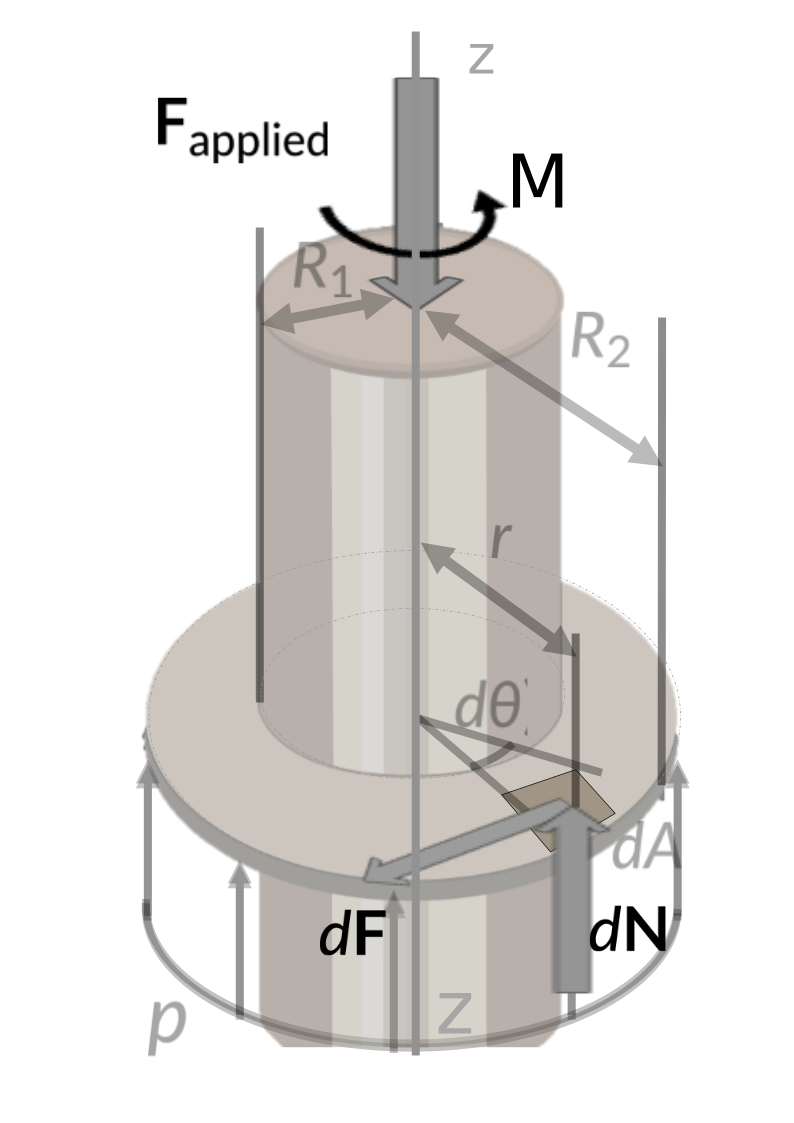
軸方向荷重がかかる単一の軸受けを考えてみましょう。襟部の外半径と内半径の間の領域が軸受の接触面積全体です。軸受けが均一な支…
カラーベアリングは、回転シャフトの軸方向荷重を支えるために機械で使用されるベアリングの一種で、単一または複数のカラーを持つことができます。
アキシアル荷重を受けるシングルカラーベアリングを考えてみましょう。カラーの外部半径と内部半径の間の領域は、ベアリングの総接触面積です。
軸受の支持が均一であると仮定すると、均一な垂直圧力は、軸受領域に対する力の比として表すことができます。
ベアリング上の無限小の面積要素について考えます。微分領域に作用する力は、摩擦係数、圧力、および微分領域の積として表すことができます。
シャフトの差し迫った回転を引き起こすために必要なモーメントは、回転軸に関するモーメント平衡方程式から決定されます。
次に、積分を使用して、すべての摩擦力を克服するために必要な印加モーメントを決定します。
最後に、微分力と微分面積の値を代入し、方程式を全軸受面積に積分することにより、シャフトのモーメントを推定できます。
View the full transcript and gain access to JoVE Core videos
Q1: What is the bearing contact area in a collar bearing?
The bearing contact area is the region between the external and internal radius of the collar. This annular surface is where the collar makes contact with the shaft. Understanding this area is essential for calculating uniform normal pressure, which equals the applied axial force divided by the total bearing contact area.
Q2: How is uniform normal pressure calculated in a collar bearing?
Uniform normal pressure is calculated by dividing the applied axial force by the total bearing contact area. This assumes even support across the collar surface. The resulting pressure value represents the average force distribution per unit area acting on the bearing surface during shaft loading.
Q3: What factors determine the frictional force on a differential area element?
The frictional force on a differential area element is determined by three factors: the friction coefficient, the uniform normal pressure, and the differential area itself. These variables are multiplied together to express the force acting on any infinitesimal element of the bearing surface.
Q4: How is the moment required for shaft rotation determined?
The moment required for shaft rotation is determined using moment equilibrium equations about the rotational axis. Integration is applied to sum all frictional forces acting across the total bearing area. By substituting differential force and area values into the integrated equation, the applied moment needed to overcome all frictional resistance can be estimated.
Q5: Can collar bearings support loads with multiple collars?
Yes, collar bearings can be designed with either single or multiple collars depending on application requirements. Multiple collars increase the total bearing contact area and load-carrying capacity. This design flexibility allows engineers to optimize collar bearings for various machine applications supporting axial loads on rotating shafts.
Q6: Why is integration necessary in collar bearing analysis?
Integration is necessary because frictional forces vary across the bearing surface due to changing radius values. By integrating the differential force equation over the entire bearing area, engineers can accurately calculate the total moment required for impending rotation. This mathematical approach accounts for all frictional contributions across the collar surface.
Q7: What role does the friction coefficient play in collar bearing performance?
The friction coefficient is a key variable in calculating frictional forces on the bearing surface. It is multiplied by pressure and differential area to determine force on each element. The friction coefficient directly influences the moment required to initiate shaft rotation and is essential for predicting bearing performance under axial loading conditions.