9.15
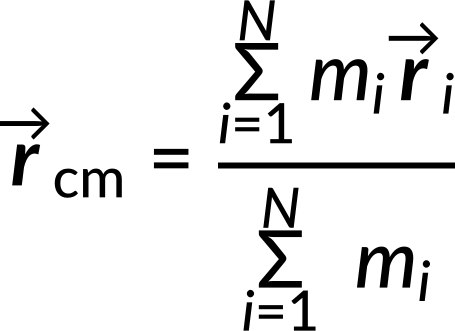
いくつかの点質量で構成される系を考えてみましょう。 この系の質量中心の座標は、各質量とその位置ベクトルの積を総質量で割った値の合計として表すことができます。
点質量が均一に分布した質量を持つ拡張物体に置き換えられたとします。 この物体の質量中心の座標は、質量中心の方程式の質量点を微分質量要素に置き換…
点質量のコレクションの場合、重心の位置ベクトルは、各質量の積とその位置ベクトルをすべての粒子の総質量で割った合計として記述されます。
質量分布が均一な拡張オブジェクトの場合、点質量は微分質量要素に置き換えられ、合計は積分に置き換えられて重心座標が取得されます。
重力による均一な加速度の下でy軸に沿って自由落下する伸長物体を考えてみましょう。この物体の総位置エネルギーは、各質量要素による位置エネルギーの合計です。
重心を式に置き換えると、総質量、重力による加速度、および重心のy座標の積として、総位置エネルギーが得られます。
これは、拡張された物体の重力ポテンシャルエネルギーは、物体の全質量がその重心に集中していると考えることによって推定できることを意味します。
View the full transcript and gain access to JoVE Core videos
Q1: How do you calculate the center of mass for an extended object?
For extended objects with uniform mass distribution, replace point masses with differential mass elements and replace summation with integration. The center of mass coordinates are obtained by integrating the product of each differential mass element and its position vector, then dividing by the total mass. This mathematical approach extends the point-mass formula to continuous objects.
Q2: Why can gravitational potential energy of extended objects be found using the center of mass?
The total gravitational potential energy of an extended object equals the sum of potential energy contributions from all mass elements. When substituting the center of mass expression, this sum simplifies to the product of total mass, gravitational acceleration, and the center of mass y-coordinate. Therefore, the entire object's mass can be treated as concentrated at its center of mass for potential energy calculations.
Q3: What is the relationship between differential mass elements and linear mass density?
For objects with uniform mass distribution, the differential mass element equals the product of linear mass density and the differential length element. Linear mass density is constant throughout the object and equals total mass divided by total length. This relationship allows integration of mass distribution across the object's geometry.
Q4: Where is the center of mass located for a ring with uniform mass distribution?
For a ring with uniform mass distribution, the center of mass is located at the ring's geometric center. Circular symmetry ensures that when integrating the position vectors of all mass elements around the ring from θ = 0 to θ = 2π, the x and y components both equal zero, placing the center of mass at the origin.
Q5: How does converting from summation to integration change the center of mass calculation?
Converting from point masses to extended objects replaces discrete summation with continuous integration. Point masses become differential mass elements, and position vectors are integrated across the object's geometry. This transformation allows precise center of mass determination for objects with continuous mass distributions rather than discrete point masses.
Q6: What role does circular symmetry play in determining a ring's center of mass?
Circular symmetry ensures that mass is distributed equally in all radial directions from the geometric center. When integrating position vectors around the complete ring circumference, symmetric contributions from opposite sides cancel out. This symmetry guarantees that the center of mass coincides with the ring's geometric center.
Q7: How does the significance of center of mass apply to gravitational potential energy calculations?
The significance of center of mass lies in simplifying complex calculations for extended objects. By treating all mass as concentrated at the center of mass, gravitational potential energy calculations become straightforward, using the same formula as for point masses. This principle applies universally to any extended object with uniform mass distribution.