9.6
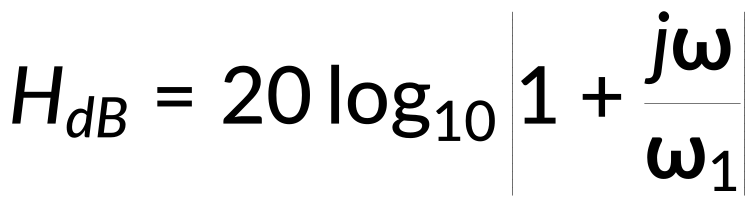
標準形式では、伝達関数は、一定のゲイン、原点の極/ゼロ、単純な極/ゼロ、および 2 次極/ゼロで示され、それぞれがシステムの全体的な応答に独自に貢献します。項は単純なゼロの振幅を表します:
ボード振幅プロットは、低周波数 (0 dB に近づく) では平坦なままで、コーナーまたはブレーク周波数 ω_1…
伝達関数を、極と零点を含む標準形式で考えてみましょう
単純なゼロをもつ伝達関数の場合、小さな周波数値での振幅ゲインは傾きがゼロの直線となり、位相はゼロに近づきます。
コーナー周波数では、漸近の大きさはゼロスロープ線から逸脱し、位相は45度に近づきます。
より高い周波数では、振幅プロットは+20dB/ディケードの線を形成し、位相は90度です。
単純極は、単純なゼロの逆数です。つまり、極ベースのボード線図は、水平軸を中心に反射する単純なゼロ プロットを反映します。
2 次極伝達関数について考えます。
周波数が低いと、ゲイン角と位相角はゼロに近づきます。
コーナー周波数では、漸近的な大きさの偏差は減衰係数に依存し、位相角はほぼ-90度です。
より高い周波数では、振幅プロットは-40 dB/decadeの傾きと-180度の位相を持つ直線を形成します。
2 次極が複数ある場合、ラインの傾きと位相シフトに極の数が乗算されます。
View the full transcript and gain access to JoVE Core videos
Q1: What happens to the magnitude and phase of a simple zero at the corner frequency?
At the corner frequency, the asymptotic magnitude deviates from the zero-slope line, and the phase approaches 45 degrees. Below this frequency, the magnitude plot remains flat with zero slope and phase near zero. Above the corner frequency, the magnitude increases at 20 dB/decade with phase approaching 90 degrees.
Q2: How does a simple pole Bode plot differ from a simple zero plot?
A simple pole is the reciprocal of a simple zero, meaning pole-based Bode plots mirror the simple zero plot reflected about the horizontal axis. Where zeros show positive magnitude slopes and phase increases, poles display negative magnitude slopes and phase decreases by the same magnitude.
Q3: What is the slope and phase response of a quadratic pole at higher frequencies?
At higher frequencies, a quadratic pole magnitude plot forms a straight line with a slope of -40 dB/decade and a phase of -180 degrees. This response is twice as steep as a simple pole because quadratic poles have two poles contributing to the overall system response.
Q4: How does the damping factor affect the quadratic pole response near the natural frequency?
The damping factor influences the peak amplitude and phase transition of a quadratic pole near the natural frequency. The actual plot's peak varies with the damping factor, and the phase plot slope is affected by this factor as it transitions from zero to -180 degrees across the frequency range.
Q5: What is the -3 dB point and why is it significant in Bode plots?
The -3 dB point occurs at the corner frequency where the magnitude plot's slope changes and the actual response begins to deviate from the straight-line approximation. This deviation quantifies where the system's gain transitions from flat response to the ascending or descending slope characteristic of poles or zeros.
Q6: How do multiple quadratic poles affect the overall Bode plot slope and phase shift?
For more than one quadratic pole, the slope of the magnitude line and phase shift are multiplied by the number of poles. This means two quadratic poles produce a -80 dB/decade slope and -360 degrees phase shift at high frequencies, compared to -40 dB/decade and -180 degrees for a single quadratic pole.
Q7: Why does the phase angle of a simple zero approach 90 degrees at high frequencies?
At high frequencies, the jω term in the transfer function dominates, making the simple zero behave like a pure differentiator. This causes the phase to approach 90 degrees asymptotically, representing the maximum phase lead that a simple zero can contribute to the system's frequency response.