18.15
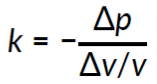
体積弾性率は、均一な圧縮に対する材料の抵抗を説明するために使用される科学用語です。 これは、圧力の変化とその結果として生じる相対体積の変化を結び付ける比例定数です。
この概念は、等方性材料を単位体積の立方体として視覚化するとより明確になります。 この立方体に垂直応力が加わると変形し、体積の異なる直方…
体積弾性率は、均一な圧縮に対する材料の抵抗を測定します。これは、圧力の変化とその結果生じる相対的な体積変化との間の比例定数として定義されます。
単位体積の等方性立方体を考えてみましょう。垂直応力を受けると、新しい体積を持つ直方体に変形します。
この新しいボリュームと元のボリュームの違いは、資料の拡張と呼ばれます。拡張は、3つの方向すべてのひずみの合計として表すことができます。
均一な静水圧にさらされる物体の場合、応力の各成分は静水圧の負に等しくなります。
これらの値を膨張方程式に代入すると、弾性率と同じ単位で表される体積弾性率と呼ばれる定数を導入する式が得られます。
静水圧下での安定した材料は体積が減少し、膨張が負になり、体積弾性率が正になります。
ポアソン比がゼロの理想的な材料は、横方向の収縮なしに伸縮できます。逆に、ポアソン比が0.5であることは、完全な非圧縮性を意味します。
View the full transcript and gain access to JoVE Core videos
Q1: What does bulk modulus measure in materials?
Bulk modulus measures a material's resistance to uniform compression. It is defined as the proportionality constant between a change in pressure and the resulting relative volume change. Materials with higher bulk modulus values resist compression more effectively than those with lower values.
Q2: How is dilatation related to bulk modulus?
Dilatation represents the total volume change of a material and is calculated as the sum of strains in all three directions. When a material undergoes uniform hydrostatic pressure, the dilatation becomes negative for stable materials. The bulk modulus is derived by substituting stress components into the dilatation equation.
Q3: What happens to an isotropic cube under hydrostatic pressure?
An isotropic cube of unit volume deforms into a rectangular parallelepiped when subjected to normal stresses. The difference between the new volume and original volume is termed dilatation. Under uniform hydrostatic pressure, each stress component equals the negative of the pressure applied.
Q4: How does Poisson's ratio affect material incompressibility?
Poisson's ratio determines lateral contraction behavior during deformation. A material with zero Poisson's ratio can stretch without lateral contraction. Conversely, a Poisson's ratio of 0.5 signifies perfect incompressibility, meaning the material maintains constant volume during deformation under the relation between Poisson's ratio, modulus of elasticity and modulus of rigidity.
Q5: Why is bulk modulus always positive for stable materials?
Stable materials decrease in volume when subjected to hydrostatic pressure, making dilatation negative. Since bulk modulus is the proportionality constant relating pressure change to relative volume change, the negative dilatation combined with negative pressure results in a positive bulk modulus value.
Q6: What units does bulk modulus use?
Bulk modulus is expressed in the same units as the modulus of elasticity, typically pascals (Pa) or megapascals (MPa). This consistency in units allows for direct comparison between bulk modulus and other elastic constants when analyzing material behavior under various loading conditions.
Q7: How does bulk modulus differ from other elastic constants?
Bulk modulus specifically measures resistance to uniform volumetric compression, while other elastic constants address different deformation modes. The modulus of elasticity measures resistance to axial loading, and modulus of rigidity measures resistance to shear. Bulk modulus uniquely characterizes material behavior under hydrostatic pressure.