19.3
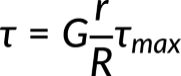
円形シャフトがフックの法則の範囲内に留まるトルクを受け、永久変形を回避するシナリオを考えてみましょう。 そこで、せん断ひずみの公式を再考します。 この式に剛性係数を乗じて、せん断応力とひずみのフックの法則が適用されます。 その結果、シャフト内のせん断応力の方程式を導くことができます。
さらに、シャフ…
円形シャフトに加えられるトルクがフックの法則制限内にあるため、永久的な変形がない場合を考えてみましょう。
ここで、せん断ひずみの表現を思い出してください。これに剛性係数を掛け、せん断応力とひずみにフックの法則を使用すると、シャフトのせん断応力の式を決定できます。
シャフトの任意の断面に加えられる基本力のモーメントの合計は、シャフトに加えられるトルクの大きさに等しくなければならないことを思い出してください。
せん断応力を代入し、項を並べ替えると、積分項を持つ式が得られ、これはその中心に対する断面の極性慣性モーメントを表します。
さらに再配置し、最大せん断応力を置換すると、剛性のある均一な円形シャフトのせん断応力の弾性ねじり式が得られます。
ただし、内側半径と外側半径がr1とr2である中空シャフトの場合、極慣性モーメントは2つの半径の4乗の差として表されます。
View the full transcript and gain access to JoVE Core videos
Q1: What is the elastic torsion formula for shearing stress in a circular shaft?
The elastic torsion formula determines shearing stress in a rigid uniform circular shaft by combining Hooke's Law with the polar moment of inertia. It derives from multiplying shearing strain by the modulus of rigidity, then ensuring the sum of moments on any cross-section equals the applied torque. This formula applies when torque remains within Hooke's law limit, preventing permanent deformation.
Q2: How does the polar moment of inertia differ between solid and hollow circular shafts?
For a solid circular shaft, the polar moment of inertia is calculated from the fourth power of the radius. For a hollow shaft with inner radius r1 and outer radius r2, the polar moment of inertia is expressed as the difference in the fourth power of both radii. This difference accounts for the removed material in the hollow center.
Q3: Why is the modulus of rigidity important in deriving shaft stress equations?
The modulus of rigidity relates shearing stress to shearing strain through Hooke's Law. When multiplied by the shearing strain expression, it enables derivation of the shearing stress equation for the shaft. This material property is essential for connecting elastic deformation behavior to the applied torque.
Q4: What role does the sum of moments play in the elastic torsion formula?
The sum of moments of elementary forces exerted on any cross-section of the shaft must equal the magnitude of the applied torque. This equilibrium condition is fundamental to deriving the elastic torsion formula. Substituting this relationship into the stress equation produces the integral term representing polar moment of inertia.
Q5: When can the elastic torsion formula be applied to a circular shaft?
The elastic torsion formula applies when torque remains within Hooke's law limit, ensuring no permanent deformation occurs. Under these conditions, the shaft exhibits linear elastic behavior, and shearing stress is directly proportional to shearing strain. This linear range assumption is critical for formula validity.
Q6: How does maximum shearing stress relate to the polar moment of inertia in torsion?
Maximum shearing stress is inversely proportional to the polar moment of inertia. After substituting for maximum shearing stress in the equilibrium equation, the polar moment of inertia emerges as a key geometric property. Larger polar moments of inertia reduce maximum stress for the same applied torque, which is why hollow shafts are often preferred in design of transmission shafts.
Q7: What assumptions must be satisfied for the elastic torsion formula to hold?
The shaft must be rigid and uniform with constant cross-section. Torque must remain within Hooke's law limit to prevent plastic deformation. The formula assumes linear elastic material behavior where shearing stress is proportional to shearing strain. These conditions ensure the derived relationships between torque, stress, and geometric properties remain valid.