2.2
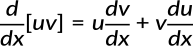
微積分学において、積の微分法は2つの関数の積である式を微分するための方法を与えます。これは、2つの微分可能な関数の積の導関数は、最初の関数と2番目の関数の変化率の積に、2番目の関数と最初の関数の変化率の積を加えたものに等しいことを述べています。
この法則は、積の変化率が両方の関数の同時変化を確実に反映…
積則は、2つの関数の積によって形成される関数を区別します。
これは、2つの関数Uとvの微分が、uの和とvの微分、vの微分の和であると言います。
なぜそうなるのかを理解するために、スクリーン上の長方形ウィンドウのサイズをリサイズすることを想像してください。その面積は幅と高さに等しい。
幅と高さが時間とともに変化するにつれて、総面積も変化します。この変化は、エッジやコーナーに新しいピクセルブロックが追加されることで視覚化できます。
総面積の表現は幅から、高さから、そして角から3つの部分から成ります。変化率を求めるには、総面積の変化を時間区間で割ります。
時間間隔がゼロに近づくにつれて極限を取ると、最初の部分は高さに幅の変化率を掛けたものになります。2は幅に高さの変化率を掛けたものです。
角の部分は幅のわずかな変化と高さのわずかな変化の積を示しています。極限がゼロに近づくと、時間に依存する角の部分は消えます。
結果は積の法則と一致し、各関数が互いの微分を掛けたものを示します。
View the full transcript and gain access to JoVE Core videos
Q1: What does the Product Rule state about differentiating products of functions?
The Product Rule states that the derivative of a product of two functions equals the first function times the derivative of the second, plus the second function times the derivative of the first. Mathematically, if u and v are differentiable functions, then d/dx(uv) = u(dv/dx) + v(du/dx). This ensures the rate of change accounts for simultaneous variation of both functions.
Q2: How does the rectangular window analogy explain the Product Rule?
Imagine a rectangular window with changing width and height over time. The area equals width times height. As both dimensions change, the total area change consists of three parts: a strip along the width, a strip along the height, and a small corner square. The corner term vanishes as the time interval approaches zero, leaving only the two linear contributions that match the Product Rule formula.
Q3: Why does the corner term disappear when applying the Product Rule?
The corner term represents the product of tiny changes in both width and height simultaneously. As the time interval approaches zero in the limit, this corner term becomes infinitesimally small relative to the linear contributions and vanishes. This is why the final Product Rule formula contains only the two linear terms, not the corner component.
Q4: What are the three components of area change in the geometric model?
The three components are: a strip along the width representing change from increasing width alone, a strip along the height representing change from increasing height alone, and a small square at the corner representing combined increase in both dimensions. When divided by the time interval and taking the limit, only the first two strips contribute to the final derivative.
Q5: How does the Product Rule relate to rates of change?
The Product Rule captures how the rate of change of a product depends on both individual rates of change. Each function contributes to the overall rate through its own derivative multiplied by the other function's value. This relationship ensures that application of rates of change accounts for both functions' simultaneous variation in the product.
Q6: What happens to the limit as the time interval approaches zero in the Product Rule derivation?
As the time interval approaches zero, the first part becomes height times the rate of change of width, and the second becomes width times the rate of change of height. The corner part, which depends on the product of infinitesimal changes, becomes negligible and vanishes. This limiting process yields the complete Product Rule formula.
Q7: Why is the Product Rule necessary instead of differentiating each function separately?
The Product Rule is necessary because the derivative of a product is not simply the product of the derivatives. The rule accounts for how both functions change simultaneously and their interaction. Without it, you would miss the cross-terms that arise from the simultaneous variation of both u and v in the product uv.