このコンテンツを表示するには、JoVEへの購読が必要です。 または、無料トライアルをお申し込みください。

方法論記事

Hypoxia-Induced Climbing Behavior of Drosophila melanogaster

511 回視聴

⸱

2026年7月1日

この記事について

要約

Source:
Siddarth Gunnala1, Nafisa M. Jadavji2,3,4

1Department of Biomedical Sciences, Midwestern University, Glendale, AZ, USA
2Division of Integrative and Molecular Physiology, Department of Biomedical Sciences, Southern University of Illinois, Carbondale, IL, USA
3Department of Child Health, College of Medicine Phoenix, University of Arizona, Phoenix, AZ, USA
4Department of Neuroscience, Carleton University, Ottawa, ON, Canada

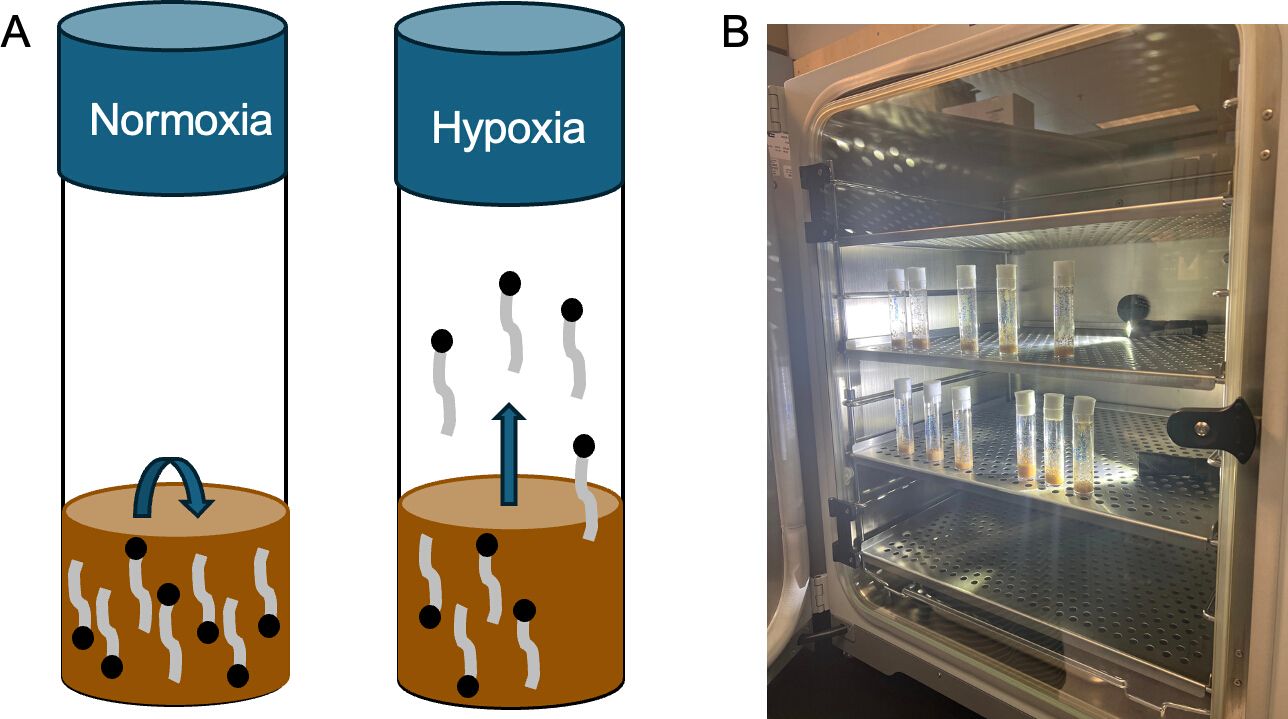
This video demonstrates hypoxia-induced climbing behavior in Drosophila melanogaster larvae. When oxygen availability decreases, larvae shift from burrowing and feeding within the food to climbing the vial walls. Increased wall-climbing behavior under sustained low-oxygen conditions serves as an indicator of a hypoxia-induced behavioral shift.
プロトコル

1. Experimental preparation

  1. Prepare fly food ahead of time and add it in equal portions to fly vials.
  2. Store the portioned fly food vials in a designated fridge until the beginning of the experiment.
    NOTE: Standard fly food consists of a mixture of corn syrup, molasses, agar, soy flour, and yeast.
  3. Set up experimental Drosophila melanogaster in a controlled environment that has standard temperature, humidity, and light-dark cycles.
  4. Place Drosophila melanogaster flies in vials with food for at least 7 days to a maximum of 9 days in the incubator.
    NOTE: This gives adequate time for larvae to develop in the fly food at the bottom of the vial. Flies in the same vial for more than 10 days cannot be used, as the progeny will likely be mixed with parents.

2. Hypoxia incubator preparation

  1. Prior to incubator calibration of oxygen levels, place flies with their food vials into the chamber.
  2. Place LED flashlights in the chamber to illuminate the incubator
    NOTE: This is to help visualize the escape behavior within the chamber, as well as regulate the Drosophila melanogaster's circadian rhythm.

3. Hypoxia chamber calibration

  1. Pre-set the hypoxia chamber to a temperature of 26 °C and a carbon dioxide concentration of 0% to 0.1% CO2.
  2. Set the desired oxygen concentration to 1% O2.
  3. Allow the hypoxia chamber to equilibrate the selected parameters.
    NOTE: It can take approximately 20-30 min for the chamber to reach 1% oxygen, as nitrogen gas needs to be pumped into the chamber to reduce the levels of oxygen.

4. Larvae escape visualization

  1. Once the chamber reaches 1% O2, open the outer chamber door.
    NOTE: The O2 levels will not decrease with the main chamber door being opened, as there is an inner transparent door that maintains the oxygen levels in the chamber.
  2. Start a timer when the chamber door opens; this will be time 0 min.
    NOTE: The beginning of the experiment (time 0) starts post-calibration of the chamber when the desired oxygen (1%) concentration is present.
  3. While using the transparent door to maintain hypoxia in the chamber, count the number of larvae climbing out of the fly food along the walls of the vial.
    NOTE: The fly food has a fairly flat surface and can be used as a border to distinguish between larvae out of the food and in the food.
  4. Through the use of the timer, count the number of larvae again at the 10 min mark.

5. Normoxia experiment

  1. Repeat step 1 and step 2.
  2. Do not activate the hypoxia chamber and allow it to sit in normal atmospheric conditions (21% O2 levels).
  3. Wait the same amount of time as it takes for the chamber to equilibrate to hypoxia.
  4. Perform larvae counts at time 0 and time 10, similar to before.

アクセスが制限されています。このコンテンツを表示するにはログインするか、トライアルを開始してください。

結果

figure-results-1

Figure 1: Representative images of flies in vials and a chamber. Flies in vials with food under normoxic (A) and hypoxic (B) conditions. Image of larvae in the hypoxia chamber during hypoxia experiments using the clear transparent door to take me...

アクセスが制限されています。このコンテンツを表示するにはログインするか、トライアルを開始してください。

材料

この記事で使用された材料の一覧
名前会社カタログ番号コメント
C170i, Std, Right, O2, 120 V US/JPEppendorfNC1942454 
Narrow Plastic Vials, Drosophila ClosuresGenesee49-102 
Narrow Drosophila Vials,Genesee32-116 
LED Pocket LightFisher Scientific19012018 
Four Channel TimerFisher Science1464917 

さらに記事を探す

低酸素誘発行動低酸素チャンバー幼虫の壁登り行動酸素欠乏行動変化感覚ニューロン回避行動制御環境