ここでは、nTMSと拡散テンソルイメージング(DTI)に基づく皮質脊髄路(CST)再建を組み合わせた運動マッピングの標準化プロトコルを説明します。このプロトコルは再現性が高く、臨床的に実現可能であり、日常的な臨床ワークフローに容易に統合できるため、運動経路評価、神経可塑性研究、リハビリテーション計画のための堅牢で価値ある枠組みを提供します。
この記事について
サマリー
要約
ナビゲーション経頭蓋磁気刺激(nTMS)は、個々の脳画像データを統合して刺激コイルの正確な位置を特定し、解剖学的に誘導された皮質標的刺激を可能にします。ニューロナビゲーションシステムの関心は、反復TMS(rTMS)治療におけるコイル位置の最適化においてよく知られています。さらに、nTMSは腫瘍切除前の雄弁な運動領域や言語領域の特定・区分など、脳領域の機能的マッピングにもますます応用されています。神経外科的手技の最適化に有用であることに加え、nTMSマッピングは皮質可塑性の監視や、さまざまな神経疾患における運動系の完全性を定量化するためのツールとしても活用できます。本方法論論文は、nTMSを用いた運動マッピングの標準化プロトコルと、広散テンソルイメージング(DTI)に基づく皮質脊髄路(CST)再建を組み合わせて提示します。このアプローチにより、雄弁な運動皮質領域とその皮質下投射を正確に区分し、隣接病変を持つ患者における機能的再編成の検出が可能になります。術前計画に組み込むことで、運動機能を維持しつつ病変切除を最大化することを目指す個別化された手術戦略の指針を提供します。ここで提示するプロトコルは再現性が高く、臨床的に応用可能であり、日常的なワークフローへの統合に適しています。これは神経可塑性の研究とリハビリテーション計画において有望なツールとなっています。
概要
運動発音型脳腫瘍における切除の範囲を最大化しつつ、術後の運動障害を最小限に抑えることは、脳神経外科における中心的な課題です。術中直接電気刺激(DES)マッピングは、運動経路1,2,3,4,5の皮質および皮質下の表象に関する信頼性の高い解剖機能情報を提供する「ゴールドスタンダード」技術です。しかし、術前の計画、リスクの階層化、最適な患者カウンセリングのためには、手術前に個々の機能解剖学を明確にしておくことが重要です。脳腫瘍は運動ネットワークの解剖学的歪みや可塑性再編成を引き起こす可能性があるため、従来の構造的脳磁気共鳴画像法(MRI)からは推定できません。
経頭蓋磁気刺激(TMS)は非侵襲的に運動皮質6を探査する方法として導入され、その後運動皮質7,8の機能的マッピングにも適応され、術前検査では表面筋電図9,10,11を用いて異なる筋肉の運動誘発電位(MEP)を記録しました.初期の非ナビゲートTMSプロトコルは技術的に要求が高く、解剖学的な正確さに欠けていました。その後、個々のMRIデータと電場ベースのナビゲーションとの統合により、刺激部位の正確な誘導が可能となり、解剖機能的精度12,13,14および再現性15,16が向上しました。MEPを直接誘導することで、ナビテッドTMS(nTMS)はミリ秒スケールの時間分解能と皮質脊髄出力のサブセンチメートル空間定位を提供し、術中のDES 17,18,19と良好に整合します。画像誘導型nTMSは安全で良好に耐容性があり、食品医薬品局(FDA)により15年以上にわたり運動皮質の術前機能マッピングに承認されています。
運動マッピングでは、標的刺激部位のMEP振幅をサンプリングすることで皮質表象を区分し、患者特異的な運動マップを構築します。タスクベースの機能性MRI(fMRI)と比較して、nTMSは術中DES 24,25,26と空間的により密接に一致を示します。病変が運動領域に接触または侵入した場合の術中の意思決定は最終的にDESに依存しますが、術前nTMSは刺激陽性部位を拡散テンソルイメージング(DTI)皮質脊髄路(CST)再建のためのシードとして輸出することで貴重な補完情報を提供します。このアプローチは、腫瘍が主に皮質下白質の運動路に影響を与える場合に皮質脊髄の完全性を評価するのに特に有用です(27,28)。さらに、術前のnTMS運動マッピングでは良好な陽性中率29,30,30と高い陰性命中率29,30,31を示し、手術結果の改善は17,18,19,32となっている。また、術後の運動機能を評価する効果的なツールとしても最近証明されています31,33。これらの理由から、nTMS運動マッピングは脳神経外科における術前評価および術後のフォローアップの両方にますます利用されています。nTMSによる皮質マッピングの方法論的推奨は2017年に発表されています。これらの最近の研究と現代の画像診断技術の統合を踏まえ、この方法論は臨床および研究実践により正確な指針を提供するよう洗練されるようになりました。
本論文では、nTMSを用いた運動マッピングを行う標準化されたプロトコルを提示し、実際の臨床条件下での腫瘍切除計画における運動経路の術前皮質および皮質下の表象を評価するための異なる手法を組み合わせています。
プロトコル
本研究は、人間研究に関する国内外の倫理ガイドラインに従って実施されました。通常ケア中に収集された匿名化された患者データの後ろ向き分析は、フランスの規制に従い、ケア時にインフォームドコンセントを得て実施されました。論文の共著者である健康被験者の実証データを含み、参加およびデータおよび画像の公開に関する書面によるインフォームド同意が記載されました。これは、現在フランス・クレテイユのアンリ・モンドール病院およびデンマークのオーフス大学病院で脳腫瘍手術の術前計画に用いられているプロトコルです。
1. ニューロナビゲーションのための神経画像データの取得
- 頭蓋内強磁性装置、制御不能てんかん、ペースメーカー、妊娠、授乳など、医療記録および患者面談を用いてnTMSおよびMRIの禁忌がないことを確認する35。
- MRIヘッドホンによる折り目や変形のない耳と頭蓋頂点を含む高解像度の解剖学的脳画像を取得し、神経ナビゲーションシステムによる正確な脳再構築を可能にします。
- MRIシーケンスには以下の推奨事項をご利用ください:
3D T1加重(T1w)解剖学的勾配エコー
1 mm等方性ボクセル(またはそれ以下)
≥1.5-テスラMRIシステム(3T推奨)。 - あるいは、以下の許容される列を使用します:
3Dフレア
コントラスト強調3D T1w
- MRIシーケンスには以下の推奨事項をご利用ください:
- その後の拡大テンソルイメージング(DTI)に基づくトラクトグラフィーのために造影剤注射前に拡散加重画像(DWI)を取得してください。36。
- 以下の最低取得パラメータ37を使用します:
等方性2mmボクセル
拡散符号化の方向:≥ 25
B値:≈ 800 s/mm²
拡散加重みなし画像:3 b0 ≥ ボリューム(b = 0 s/mm²) - テンソル推定とトラクショングラフィーの改善のために、以下の推奨パラメータを用いてください:
拡散符号化方向:≥ 64
B値:1000 s/mm2
より高い空間分解能(≤2 mm等方性)
- 以下の最低取得パラメータ37を使用します:
2. 科目の準備
- 被験者の解剖学的MRI画像をニューロナビゲーションシステムにインポートし、3D脳再構築を生成します。
- ニューロナビゲーションソフトウェア内のMRIの主要な解剖学的ポイント(鼻、右耳、左耳)をマークしてください。
- より高精度のためにクルスヘリシスの根を使いましょう。
- あるいはトラガスを使う方法もありますが、その広い面積は共登録の不一致を悪化させる可能性があります。
注意:モーターマッピングを短縮するために、被験者を部屋に設置する前にこれらの準備作業を行うことができます。
- 被験者を快適なアームチェアに座らせ、わずかにリクライニング(20〜30°)して背中の張力を下げます。ヘッドレストを調整して、イニオンで頭と首を支えてください。
- 頭や首の部分に金属製品(イヤリング、ヘアピン、ピアスなど)がないか確認し、処置開始前にそれらを取り外してください。
- 額の皮膚をヘッドトラッカーの設置準備をしてください。
- アルコールナプキンや軽い研磨剤で肌を洗浄してください。
- トラッカーを置く前に、皮膚が完全に乾いていることを確認してください。
- ヘッドトラッカーを額に置いて、刺激セッション中ずっと安定させてください。
- 眉の上、生え際の下に位置付けます。
- 中央か少し横に置いてください。
- トラッカーは接着面かゴムバンドで固定します。
- 患者の主要な解剖学的ポイントをインポートした画像とニューロナビゲーションソフトウェアで共同登録します( 図1参照)。
- デジタルペンを使って解剖学的なランドマークをマークしてください。
- 耳たぶがヘッドレストから離れていることを確認し、耳のランドマークのずれを防ぎましょう。
- MRIで耳の解剖学が歪んでいるように見える場合(例:耳の折りたたみなど)、デジタル化する前に画像上の対応するポイントを再定義してください。
- 完了後、不一致誤差が3mm未満の場合、ソフトウェアは3つのフィデューシャルポイントを検証します。ミスマッチ誤差が大きすぎる場合は、次の手順を順に試してください。
- 患者の主要な解剖学的ポイントをもう一度デジタル化します。
- MRIの左耳と右耳の解剖学的ポイントを再定義します。
- 耳たぶのらせんを優しく押しながらデジタル化してください。MRIヘッドホンは耳を数ミリずれさせている可能性があります。
- 追加の頭皮ポイントをデジタル化してレジストレーションを洗練させ(頭皮と表面のマッチング)。
- 共同登録を検証し、共同登録誤差が3mm未満(2mmが望ましい)を適用します。ミスマッチが3mmを超える場合は、ステップ2.7〜2.9を繰り返します。
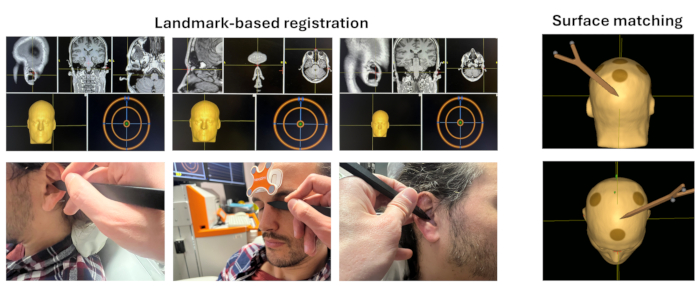
図1:患者の頭部と解剖学的MRIの共同登録。 左側:ランドマークベースの登録。上部パネル:ニューロナビゲーションソフトウェア内でMRI上の解剖学的ランドマーク(左耳、鼻、右耳)の識別。下部パネル:患者のランドマークをデジタル化ペンでデジタル化。右側:追加の頭皮ポイントを使った表面合わせの精細化。この図の拡大版はこちらをクリックしてご覧ください。
3. マッピングされた筋肉の準備
- 被験者に耳栓を装着し、刺激時には保護用のイヤーマフを着用してください。
- ターゲット筋肉の皮膚を、アルコールパッドやコットンパッドで優しく擦り、穏やかな研磨性ジェルで準備します。
- 通常の臨床MEPと同様に、腹部腱モンタージュで関心のある筋肉に表面電極を置きます。最大6つの異なる筋肉を同時にマッピングできます。
- 接地電極は肩の切断部、背側手の表面、または脛骨内側の面など中立部位に置きます。
- すべての電極をEMGアンプに接続してください。
- EMG取得を開始し、全チャネルの連続的なEMG表示と筋肉の安静状態を確認します。
- EMGチャンネルに過剰な50/60 Hzノイズ(<50 μV)がないか確認してください。電気的なハム音が過剰な場合は、次の手順を順に試してください。
- 電極が皮膚にしっかり固定され、剥がれていないことを確認してください。
- 電極ケーブルを椅子の内部に再配置し、金属部品や床との接触を避けてください。
- 電極の遠位部分をニューロナビゲーションシステムや交流電源から離して動かしてください。
- 電極を交換し、ケーブルの向きを変えて再接続してください(手順3.7.2および3.7.3参照)。
- 椅子を電源から切り離してください。
- グラウンド電極をマッピングされた筋肉と同じ四肢に置きます。
- ノイズが閾値以下になるまで順番に手順を繰り返します。
- 50/60Hzのノイズが最小化したら、EMG記録を再開してベースラインをリセットします。
- これらの準備工程が完了したら、選択した筋肉の粗いマッピングを進めます。
注意:標準的なマッピングセッションでは、上肢の各節に少なくとも1つの筋肉と下肢の筋肉2つを含めるべきです。表1は、病変部位や患者の臨床症状に応じて適応すべきよくマッピングされる筋肉を示しています。
| 肢体 | 筋肉 | 代替案 |
| 手 | 第一背骨間骨(FDI) | アブダクター・ポリシス・ブレビス(APB) |
| 誘拐者ディジティ・ミニミ(ADM) | ||
| 前腕 | 橈骨筋屈筋(FCR) | 橈骨腕伸筋(ECR) |
| 腕/肩 | 上腕二頭筋 | - |
| 三角筋 | ||
| 脚 | 脛骨前筋(TA) | シレウス(SOL) |
| 足 | 幻覚外転(AH) | メディアル・プランター(国会議員) |
| 顔 | Orbicularis Oris | 鼻音 |
表1:運動マッピングに推奨される筋肉。
4. ホットスポットを特定し、安静運動閾値(RMT)を決定するための粗いマッピング
- ソフトウェアでレンダリングされた脳のボリュームでは、皮質解剖学を最もよく分かるように、頭皮までの15〜25mmの深さをケースバイケースで調整します。目的は、前中心回および後中心回、中央溝、上前頭溝と下前頭溝を可視化することです。
注:被験者が「オメガ型」の手のノブを示すと、中心前回の識別が容易になります40,41。しかし、このランドマークは不一定です42,43。このような場合、前中心回43,44,45を特定するためにいくつかの方法が推奨されます。 - 刺激装置を起動しろ。
- 刺激(フィギュアオブエイト)コイルを頭皮に接線的に配置してください( 図2参照)。
- コイルを片手でハンドルに、もう片手をコイルに置いて安定させ、再配置時に頭皮との安定な接触を保ちます。
- 神経ナビゲーション支援(コイル角度、コイルと頭部の距離、チルトインジケーター)を使って、各刺激部位のコイル位置を正確に把握してください。
- コイルの傾きを避けて安定した誘導電場(EF, V/m)を維持します。
- コイルは重いことがあるので、快適な姿勢を取ってください。ケーブル保持アームを使ってケーブルの張力を軽減しつつ、コイルを自由に動かすように保ちましょう。
- 刺激強度を調整し、100-500 μV(ピーク間)振幅範囲46に反応を誘導します。
注:これは通常、上肢の最大刺激出力(MSO)の35%から45%、下肢のMSOの50%から80%の間で達成されます。しかし、この値の範囲は健康な被験者に適用され、腫瘍が運動領域に浸潤するとさらに高くなることがあります。 - 粗い写像(および細かい写像)のコイル向きは、写像されたリム(図 3参照)によって異なります。
- 上肢と顔については、中心溝に垂直にコイルを配置し(溝に合わせ)、前後方向への誘導電流を維持する47。
- 上肢については、ハンドノブの後壁の上部(肩)または中央部(前腕と手の筋肉)を刺激し、上前頭溝に向かって刺激を始めます。
- 顔の場合:前中心回の後壁、下前頭溝に面して刺激を始めます。反応遅延が皮質脳幹経路から発信されているか確認してください。顔面MEPのレイテンシーは7〜13msですが、nTMSによって誘発される直接的な筋肉反応(顎の跳ね返り)は約3〜4msです。
- 下肢については、矢状面正中線に垂直なコイルの向きを維持し、中間から外側方向に誘導電流を流します。別のコイル向きには、矢状体正中線に平行な48、49、50 および/または副中心小葉および前中心回の褶皺に垂直な方向があります。
- 上肢と顔については、中心溝に垂直にコイルを配置し(溝に合わせ)、前後方向への誘導電流を維持する47。
- 前中心回に刺激を行います。
- 空間刺激は2〜5mm間隔で点を合わせ、視覚的または刺激グリッドを用います。
- 視覚的に行う場合は、回を横切る3本の平行線をサンプリングします。これで通常は十分です。
- 各刺激の間隔を少なくとも1.5秒空け、できればランダム化された刺激間間を設けてください。
- 反応が得られない場合は、刺激の強度を開始値に対して10%増やし、前回と同じように繰り返します。
- 1つの筋肉に20〜30回の反応が記録されたら、粗いマッピングを止めてください。
- すべてのMEPを見直し、汚染された録音を除外してください。
- 各筋肉の「ホットスポット」を特定しましょう。「ホットスポット」とは、MEPを最大の振幅で引き出す刺激点のことです。信頼できるホットスポット定義51を保証するために
- 各筋肉の記録を正規化されたカラースケールで表示します。
- 振幅が最も大きいMEPを含む領域を特定してください。
- MEPを振幅で、高い順から小さい順に並べ替えましょう。
- この領域内で最も振幅の高いMEPを選択し、異常に高い単一応答(通常は最初の2つのMEP)を避けます。
- 各筋肉ごとに ホットスポットを選択して安静運動閾値 (RMT)を算出します。これにより、RMT測定プロセス全体を通じてコイルの位置と向きが保存され、信頼性の高い測定52が保証されます。
- 各筋肉のRMTを個別に算出してください。しきい値ハンティング技術(53 )を用いるか、10回連続試験のうち5回で50μV≥MEPを誘発する最低刺激強度(%MSO)を特定する(ロッシーニ・ロスウェル法)54。各筋肉のRMTを基準にして、微細マッピング中の刺激強度を設定します。
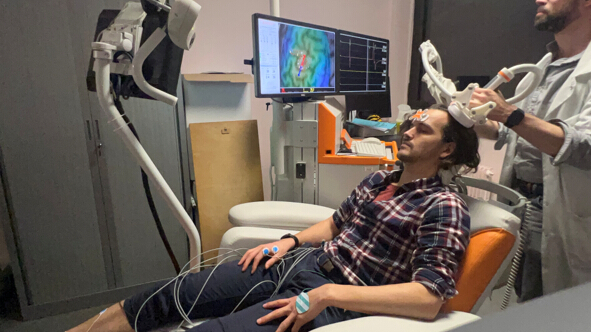
図2:実験的なnTMSセットアップ。 被験者はわずかにリクライニングし腕を支えて座り、EMG電極が標的筋肉の上に置かれます。オペレーターは8字コイルを持ち、接線方向の頭皮接触を維持するために安定化させ、誘導電場(矢印:方向、円:強度)と誘導されたMEPを監視します。 この図の拡大版はこちらをクリックしてご覧ください。
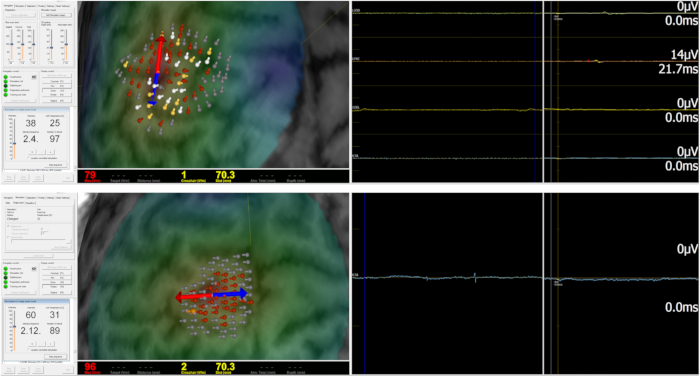
図3:マッピング中のニューロナビゲーションインターフェース。 コイル位置(青と赤の矢印の接合部)、コイルの傾き、電界の方向(青から赤の矢印)、および周囲の色付きリングの電界強度に対するリアルタイムフィードバックにより、各皮質部位で正確な刺激が保証されます。上部パネル:上部肢の粗いマッピングで、コイルは中央溝に垂直に配置されています。下部パネル:脛骨前筋の細かいマッピングで、コイルは矢状体正中線に垂直に配置されています。 この図の拡大版はこちらをクリックしてご覧ください。
5. 精細なマッピング
- 被験者が完全にリラックスし、不随意な筋肉収縮がないことを確認してください。
- 各筋肉に対して、そのRMTの105〜110%で刺激を行います。
- 粗いマッピング時と同じコイル向きを使用してください(ステップ4.5および4.6参照)。
- 刺激ポイント間の間隔を狭め(1回あたり4〜6本の平行線)を減らしましょう。
- 刺激間隔≥1.5秒、できればランダム化で維持してください。
- nTMSが50 μV(ピーク・トゥ・ピーク)のMEPを生成する皮質領域として機能的運動マップを区切る≥。
注:下肢マッピングでは、上肢RMTの110%から始め、EFを± 10 V/mの段階で調整し、安定したMEP34が得られるまで調整する方法があります。 - 運動マップの縁取りが1本または2本連続した陰性部位の線で囲まれ、MEPを誘発しないまで刺激を続けます。
- 明確な負の境界線が得られない場合は、同じ間隔を維持してサンプリングを延長し、応答が確実に消えるまで続けます。
- 異常な領域で正の反応が拡大した場合は、コイル角、EF、RMTをチェック・適応します。
注意:筋肉のポイント数は、筋皮質の表象や腫瘍による脳シフトの度合いによって30から100パルスで変動します。
- 異常なMEP位置や振幅を生み出すコイルの向きは避けてください。特に、正中線に対して45°の向きは上肢のMEPが非常に前方に現れることがあり、正確な運動皮質表象を代表しない可能性があります47。
- モーターマップは楕円形で、内部にいくつかのネガティブサイトがあることを確認してください。運動マップ内のネガティブ刺激ポイントについては、評価の異なるタイミングで追加の刺激を行い、運動皮質の興奮性の一時的な変化を制御します。
- マッピング中に多数の負の応答(<50 μV)が発生した場合は、以下の手順を順に試してください。
- 被験者に起きているよう促してください。なぜなら、それは警戒状態の低下を反映することが多いからです。
- 刺激の強さが減っていないか確認してください。
- RMTを繰り返してみては、初期値が一時的な過興奮状態の影響を受けている可能性がある。
- 異常に高振幅のMEPが多数(>1000μV)出現し、マップが過度に拡大した場合は、以下の手順を順番に試してください。
- 必要に応じて筋肉活動を継続して示す(信号フィードバック)も含めて、被験者に手足をリラックスさせるよう求めてください。
- 筋肉活動が続く場合は、被験者に手足を振るか、よりリラックスした姿勢で動かすよう促します。必要に応じて、テストされた筋肉に対して同心円状の受動的な動き(例:手の筋肉と外転筋の対象、または脛骨前部の足支えなど)を適用します。
- RMTの繰り返しを検討してください。初期値は運動皮質の一時的な低興奮状態の影響を受けた可能性があります。
6. MEPデータの後処理分析とエクスポート
- 各筋肉のMEPを見直し、調整してください。
- ニューロナビゲーションソフトウェアのMEPレビューパネルまたは信号ビューアを開きます。
- 記録された各MEPを点検して振幅や遅延を補正し、必要に応じてマーカーを調整してください。
- 偽物や異常な刺激ポイントを除外する。
- ソフトウェアで刺激リストまたはマッピングワークスペースを開きます。
- アーティファクトや誤ったコイル位置を含む刺激試行( 図4参照)を除去してください。
- 各筋肉の運動マップを二進形式(正負、50μVの上下)で表示します。
- 正刺激点は15、20、25mm深さの二値DICOM形式でエクスポートします。これらのファイルを線維追跡に用いてCSTを再構築し、正の刺激点をトラクトグラフィーの種子として活用します。
- 他の皮質マップパラメータ(重心、マップ密度、運動マップサイズ)を測定するには、刺激剥がれ深さまたは20mm(標準剥離深度)25,55,56,57,58でデータをエクスポートします。
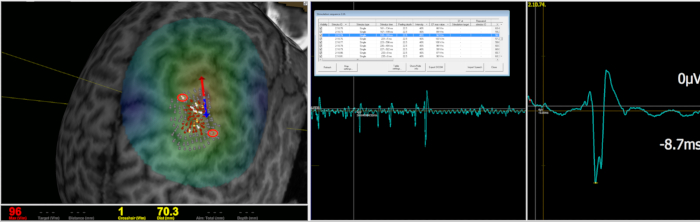
図4:MEPデータの後処理解析。 MEP痕跡は振幅および遅延マーカーの補正および人工物試験の除外のためにレビューされます(右パネル:進行中のEMG活動に汚染された試験の例)。2つの刺激(赤い円)は、陰性領域で起こる「異常反応」を示しており、これはコイル向き効果に関連していると考えられます。 この図の拡大版はこちらをクリックしてご覧ください。
7. モーターマッピングの後処理解析
- 脳腫瘍除去のための脳神経外科的神経ナビゲーションに適した画像解析ソフトウェアに、運動マップのDICOMをインポートします。
- 解剖画像(T1w)をモーターマップのDICOMとDWIに登録します。必要に応じて追加の画像(例:FLAIRw、SWI、T1w-ガドリナム強化)をインポート・登録してください。
- モーターマップDICOMから物体を生成し、感度を向上させるために2〜3mm拡大します。
- 繊維トラッキング中の異常な線維再建を防ぐために、耳と鼻を除去するためにモーターマップをトリミングしてください。
- 下橋のレベルで、マッピングされた半球の同側に終端ROIを手動で描きます。
- 運動マップのROIを種子、橋のROIをエンドポイントとして線維トラッキングを行います。一般的に用いられるトラクトグラフィーアルゴリズムには、臨床課題や繊維トラッキングの結果に応じて決定論的ストリームライントラッキングや確率的トラクトグラフィーがあります。
注:オープンソースのディフュージョンソフトウェアを使用する場合、トラクトグラフィーの前にいくつかの前処理ステップ(ノイズ除去、Gibbsアーティファクト補正、移動・歪み補正、B1バイアス場補正、テンソルフィッティング、FAマップ生成)が必要です。 - ケースバイケースの分析でファイバートラッキングのパラメータを調整してください。推奨されるパラメータは、最小110〜120mmの長さ、最大角度30°、FA閾値(FAT、CST繊維が最初に見えるFAに対応する)の75%に設定されていることです。60,61。
- 脳腫瘍を他の画像(例:FLAIR、ガドリニウムT1w)で分割し、対応する物体を作成します。
- CSTは各肢の部位ごとに(色違いで)またはモーターマッピング全体で表示してください。
- 脳神経外科の手術室ナビゲーションソフトウェアにすべてのデータ(皮質種子、CST、脳腫瘍対象)を統合してください。
結果
私たちは、神経ナビゲートTMSシステムを用いて、臨床環境で運動マッピングを受けた患者および健康な被験者に対して得られた代表的なステップと結果を提示します。CST再建は、脳神経外科計画に適した画像処理ソフトウェアを用いて行われ、マルチモーダル画像登録およびDTIベースのトラクトグラフィーが可能でした。このニューロナビゲーションシステムは、ナビゲーション可能な8字コイル、立体定位カメラ、EMG増幅器を統合し、個別の多球頭部モデルを用いて3D脳再建時に誘導される電気場のリアルタイム可視化を提供します。
図5 は粗いマッピングから得られたホットスポットでのRMT決定を示しています。神経ナビゲーションターゲットの助けを借りて、コイルの位置と向きは全過程で同じ位置に保たれます。 図6 は健康な被験者の運動マッピングを示しています。左下肢(太もも、脚、足)、上肢(肩、前腕、手)、顔がマッピングされました。正刺激部位(MEP振幅で色分け)と陰刺激部位(灰色)が運動皮質表象を示します。 図7 は、前運動領域に転移し、上肢の運動障害によって明らかになる肺がん患者の運動マッピングおよびCST再建を示しています。
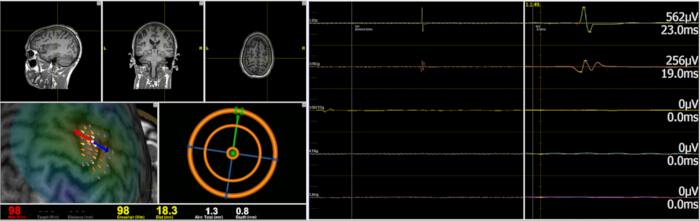
図5:健康被験者のホットスポット(第一背骨間盤)における神経ナビゲーションTMSを用いた粗いマッピングとRMT決定。 粗いマッピング(左下パネル)で特定されたホットスポットがRMT決定のターゲットとして選ばれます。コイルの位置と向きは、ニューロナビゲーションターゲット(右下パネル)の助けを借りて、手順全体を通じてまったく同じ位置に保たれます。運動誘発電位(MEP)は連続的なEMGトレースとエポック応答で獲得されます。 この図の拡大版はこちらをクリックしてご覧ください。
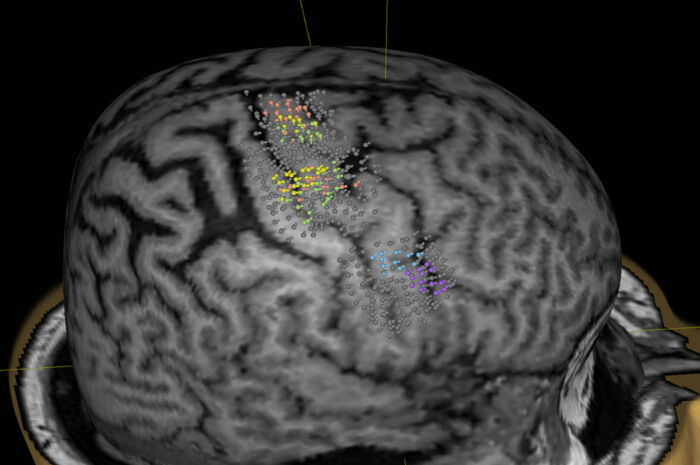
図6:神経ナビゲーションTMSを用いた下肢、上肢、顔面筋の運動皮質マッピング。 下肢に記録された筋肉:大腿四頭筋(緑)、前脛骨筋(オレンジ)、外転筋(黄色)。上肢に記録された筋肉:小外転筋(緑)、橈骨手根屈筋(オレンジ)、三角筋(黄色)。顔に記録された筋肉:鼻筋(青)、三角筋(紫)。 この図の拡大版はこちらをクリックしてご覧ください。
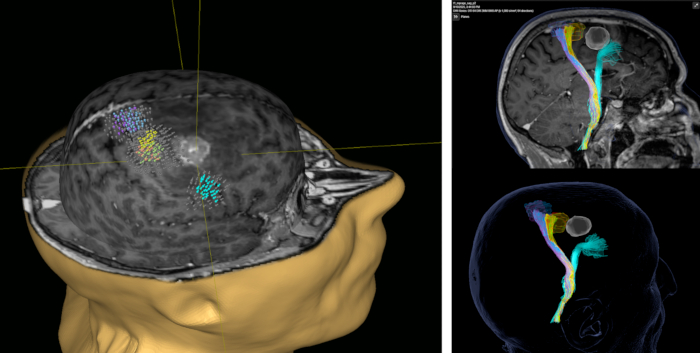
図7:脳神経外科計画のための運動皮質マッピングおよびCST再建。 nTMS運動マッピング(左パネル)およびnTMSガイド下の皮質脊髄管再建(右パネル)は、肺がんによる脳転移(白色)患者にて実施されています。記録された筋肉:外転筋(紫)、脛骨前筋(青)、三角筋(黄)、橈骨手腕屈筋(赤)、第一背骨間筋(緑)、円環筋(青色)。 この図の拡大版はこちらをクリックしてご覧ください。
ディスカッション
本論文では、nTMSを用いた機能的運動皮質マッピングのための標準化かつ再現性のあるプロトコルを術前手術計画に直接適用することを提示します。神経ナビゲーションと被験者の解剖学的脳再建を組み合わせることで、この標準化されたプロトコルにより、90分未満の検査でも、研究する筋肉の数に応じて運動発音能力の高い皮質領域を特定し明確にすることが可能になります。このアプローチは特に運動発音型腫瘍患者に関連し、CSTの解剖学的再建はしばしば2つの要因によって制限されます。すなわち、(i) 質量効果や浮腫による解剖学的置位、(ii) 運動表象の機能的再編成です。したがって、固定された解剖学的ランドマークに基づく解剖学的シーディングトラクトグラフィーは、皮質起源を特定したり、繊維トラッキング全体に誤差を伝播させたりする際に誤解を招くことがあります。機能的運動皮質マッピングは、nTMS陽性部位を皮質シードとして用い、トラクトグラフィーを患者の現在の運動マップに固定し、皮質脊髄出力を駆動することでこの問題に対処します。後処理解析中、運動マップから導き出される皮質ROIを2〜3mm拡大し、融合関連の不一致を緩和し、ROI体積を標準化するために(0.9 ± 0.1cm3)することで、操作者および被験者間の変動を低減し、CSTトラクトグラフィーの比較性を向上させる59。ランドマークベースのトラクトグラフィーと比較して、nTMSシドトラクトグラフィーはより妥当で体性的に一貫したCST再構築を得られ、異常な流線が少なく、評価者間変動も低くなります27,61,62。fMRIに基づくシーディングと比較して、nTMSベースのトラクトグラフィーはCST25隣接腫瘍患者において、より妥当な再構築とより高いインターラクター一貫性をもたらします。また、nTMS運動マッピングやnTMSシッドCSTから複数の指標を抽出でき、術後の運動結果の予測因子となり得ます。皮質レベルでは、腫瘍内にnTMS応答部位の存在は運動障害のリスク増加と関連しており、陽性的中率は50〜90%の範囲です。30,63,64,65。一方、nTMS陰性部位の切除は安全とされており、高い陰性中率は90%から100%の範囲です。30,31,65。皮質下レベルでは、腫瘍が中心前回を侵襲しない限り、腫瘍から経路までの距離<8-12 mmが術後欠損リスクの上昇に関連する臨界閾値として特定されています。66,67,68,69,70,71 .さらに、nTMS種子化されたCSTの微細構造的変化(分数異方性の低下と平均拡散率の増加)も術後欠損のさらなるリスク要因として提案されています。最後に、nTMSベースのトラクトグラフィーの使用は、切除の幅を広げ、生存期間を延ばし運動機能を維持できることと関連しており、術前計画への統合を支持しています。
運動マッピングにおいて、MEPの空間分布や運動マップの解釈可能性に強く影響する重要なパラメータの一つが刺激強度(SI)です。SIが高いほど反応確率と空間的広がり(偽陽性のリスクあり)が増加し、SIが不足すると偽陰性反応のリスクが高まります。このバイアスを最小化するために、SIはRMTに対してスケールし、可能な限り安定した目標EFを維持するよう調整する必要があります。実際には、閾値SIは感度と特異度のバランスを取り、直接的な電気刺激マッピングに近い保守的なマップを提供します。一方で、臨床的安全がマップマージンの感度を優先し、高いSIが運動マップ73を体系的に拡大することを認め、閾値を超えるSI(例:120% RMT)を選択することは正当化されます。複数の筋肉をマッピングする文脈では、単一のSIを使うことで、隣接する筋肉が異なる興奮性プロファイルを持つ可能性があるため、最も閾値の低い筋肉にマッピングが偏る可能性があります。したがって、RMTは各筋肉に対して推定されるべきです。一方で、運動マッピングセッション中にMEP振幅の予期せぬ変化に反映される皮質興奮性の有意な変化が起こることがあり、RMTの再推定とSIの調整が必要となることがあります。
運動マッピング時に刺激グリッドを使用することで、間隔の標準化や地図の定量化(すなわちアクティブな正方形のカウント)が容易になります。しかし、グリッドサイズは結果に直接影響します。大きな正方形はマップサイズを過大評価する可能性があり、小さな正方形はアンダーサンプリングのリスクを高めます。最近の証拠は、解剖学的ランドマークや地図の縁付近により密度の高い刺激を用いた解剖学的誘導アプローチを用いて、グリッドを使わずにnTMSマッピングが可能であることを示唆しています。
運動マッピングからは重心(CoG)、運動マップ面積、体積などいくつかの定量的パラメータが導出されます。CoGは振幅加重座標上の位置として定義され、モーター表現58の中心を表します。連続検査では脳腫瘍患者のCoGが76、77、78に変化し、運動皮質における機能再編成の証拠が見られました。運動マップの面積と体積は、運動表現の空間的範囲を表します。面積は一般的に刺激グリッド上のアクティブな正方形を数えるか、グリッドフリー刺激におけるスプライン補間を用いて、正の刺激点を滑らかな多項式曲線で結びつけて連続曲面または体積56を生成することで導出されます。これらの指標は縦断的(フォローアップ研究や介入の評価)でモニタリングしたり、対損傷半球と比較して皮質運動可塑性79,80,81,82を調査することができます。定量的な運動マッピング指標は神経腫瘍学を超えて拡張され、神経疾患における運動系の完全性や疾患関連の可塑性のバイオマーカーを提供する可能性があります55,83。
nTMSは術前運動マッピングにおいてすでに確立されていますが、いくつかの制限を認めるべきです。第一に、共登録と皮質マッピングの精度は部分的にオペレーターに依存します。コイル操作、ヘッドトラッカーの安定性、刺激の迅速な調整に関する適切な訓練が、技術の信頼性と再現性を確保するために必要ですが、過去の研究ではnTMSが専門家と初心者の試験官間で良好な操作者間一致と信頼性の高い運動トポグラフィーを提供することが示されています84。第二の制限は、病変周囲浮腫および腫瘤の影響がトラルグラフィーに与える影響に関するものである。過度の病変周囲浮腫は、特に病変85に隣接するボクセルにおいて、nTMSに基づくCST再建の精度を低下させる可能性があります。同様に、術前データセットと実際の術中解剖学との間に不一致が生じることは、術中の脳シフトにより生じることがあります86,87。脳シフトは完全に防ぐことはできないため、特に重要な腫瘤ではなおさら、nTMS由来の運動領域(皮質および皮質下の両方)の正確性は切除の後半段階で低下する可能性があります。これらの不正確さを軽減するためには、不要な皮質曝露の制限、表層解剖学的ランドマークの繰り返しチェック(88)、MRI、超音波、CTなどの術中画像検査と脳変形矯正の組み合わせ(89,90,91,92)などがあります.最後に安全性に関しては、腫瘍関連てんかん患者において良好な安全性プロファイルが示されています。大規模なシリーズでは、刺激誘発発作は術前マッピング93でまれまたは発生しないため、適切な予防措置が取られればこの技術の安全性が支持されます。
全体として、nTMSは外科計画に臨床的に役立つ機能情報を提供し、さまざまな神経系または精神疾患における運動系可塑性の縦断的研究への道を開きます。
開示事項
著者たちは何も明かすことはありません。
謝辞
この研究はデンマーク独立研究基金(助成金番号:3165-00230B)、アーゲ&ヨハンネ・ルイ・ハンセン財団(助成金番号:25-1-17926)、およびマスケルスヴィンドフォンデン(助成金番号:2025-0010)によって支援されました。
材料
| 名前 | 会社 | カタログ番号 | コメント |
|---|---|---|---|
| Elementsソフトウェア | BrainLAB AG、ミュンヘン、ドイツ | 画像処理ソフトウェアおよびORニューロナビゲーションソフトウェア | |
| ニューロナビゲーションTMSシステム | ネクスティム、ヘルシンキ、フィンランド | NBS 5.1システム | 8字コイルとEMGアンプを用いたナビゲーションTMSシステム |
| EMG記録用の表面電極など; | アメリカ合衆国ウィスコンシン州ミドルトン、ナタス | 9013L0453 | EMG記録のために |
参考文献
- Berger, M. S., Ojemann, G. A., Lettich, E. Neurophysiological monitoring during astrocytoma surgery. Neurosurg Clin N Am. 1 (1), 65-80 (1990).
- Kombos, T., Suess, O., Funk, T., Kern, B. C., Brock, M. Intra-operative mapping of the motor cortex during surgery in and around the motor cortex. Acta Neurochir. 142 (3), 263-268 (2000).
- Keles, G. E., Lundin, D. A., Lamborn, K. R., Chang, E. F., Ojemann, G., Berger, M. S. Intraoperative subcortical stimulation mapping for hemispherical perirolandic gliomas located within or adjacent to the descending motor pathways: evaluation of morbidity and assessment of functional outcome in 294 patients. J Neurosurg. 100 (3), 369-375 (2004).
- Duffau, H., et al. Contribution of intraoperative electrical stimulations in surgery of low grade gliomas: a comparative study between two series without (1985-96) and with (1996-2003) functional mapping in the same institution. J Neurol Neurosurg Psychiatry. 76 (6), 845-851 (2005).
- De Witt Hamer, P. C., Robles, S. G., Zwinderman, A. H., Duffau, H., Berger, M. S. Impact of intraoperative stimulation brain mapping on glioma surgery outcome: a meta-analysis. J Clin Oncol. 30 (20), 2559-2565 (2012).
- Barker, A. T., Jalinous, R., Freeston, I. L. Non-invasive magnetic stimulation of human motor cortex. Lancet. 1 (8437), 1106-1107 (1985).
- Cohen, L. G., Bandinelli, S., Topka, H. R., Fuhr, P., Roth, B. J., Hallett, M. Topographic maps of human motor cortex in normal and pathological conditions: mirror movements, amputations and spinal cord injuries. Electroencephalogr Clin Neurophysiol Suppl. 43 (1), 36-50 (1991).
- Levy, W. J., Amassian, V. E., Schmid, U. D., Jungreis, C. Mapping of motor cortex gyral sites non-invasively by transcranial magnetic stimulation in normal subjects and patients. Electroencephalogr Clin Neurophysiol Suppl. 43 (1), 51-75 (1991).
- Asakura, T., Tokimura, H., Hirahara, K., Baba, K. Identification of the cerebral motor cortex by focal magnetic stimulation: clinical application to neurosurgical patients. Stereotact Funct Neurosurg. 63 (1-4), 177-181 (1994).
- Krings, T., et al. Functional magnetic resonance imaging and transcranial magnetic stimulation: complementary approaches in the evaluation of cortical motor function. Neurology. 48 (5), 1406-1416 (1997).
- Krings, T., et al. Stereotactic transcranial magnetic stimulation: correlation with direct electrical cortical stimulation. Neurosurgery. 41 (6), 1319-1325 (1997).
- Krings, T., Chiappa, K. H., Foltys, H., Reinges, M. H., Cosgrove, G. R., Thron, A. Introducing navigated transcranial magnetic stimulation as a refined brain mapping methodology. Neurosurg Rev. 24 (4), 171-179 (2001).
- Lefaucheur, J. -P. Why image-guided navigation becomes essential in the practice of transcranial magnetic stimulation. Neurophysiol Clin. 40 (1), 1-5 (2010).
- Ruohonen, J., Karhu, J. Navigated transcranial magnetic stimulation. Neurophysiol Clin. 40 (1), 7-17 (2010).
- Gugino, L. D., et al. Transcranial magnetic stimulation coregistered with MRI: a comparison of a guided versus blind stimulation technique and its effect on evoked compound muscle action potentials. Clin Neurophysiol. 112 (10), 1781-1792 (2001).
- Cavaleri, R., Schabrun, S. M., Chipchase, L. S. The reliability and validity of rapid transcranial magnetic stimulation mapping. Brain Stimul. 11 (6), 1291-1295 (2018).
- Frey, D., et al. Navigated transcranial magnetic stimulation improves the treatment outcome in patients with brain tumors in motor eloquent locations. Neuro Oncol. 16 (10), 1365-1372 (2014).
- Krieg, S. M., et al. Utility of presurgical navigated transcranial magnetic brain stimulation for the resection of tumors in eloquent motor areas. J Neurosurg. 116 (5), 994-1001 (2012).
- Picht, T., et al. Preoperative functional mapping for rolandic brain tumor surgery: comparison of navigated transcranial magnetic stimulation to direct cortical stimulation. Neurosurgery. 69 (3), 581-588 (2011).
- Tarapore, P. E., et al. Safety and tolerability of navigated TMS in healthy volunteers. Clin Neurophysiol. 127 (3), 1916-1918 (2016).
- Rossi, S., et al. Safety and recommendations for TMS use in healthy subjects and patient populations, with updates on training, ethical and regulatory issues: Expert Guidelines. Clin Neurophysiol. 132 (1), 269-306 (2021).
- Cohen, S. L., Bikson, M., Badran, B. W., George, M. S. A visual and narrative timeline of US FDA milestones for transcranial magnetic stimulation (TMS) devices. Brain Stimul. 15 (1), 73-75 (2022).
- Nahas, Z. Handbook of Transcranial Magnetic Stimulation. J Psychiatry Neurosci. 28 (5), 373-375 (2003).
- Mangraviti, A., et al. Practical assessment of preoperative functional mapping techniques: navigated transcranial magnetic stimulation and functional magnetic resonance imaging. Neurol Sci. 34 (9), 1551-1557 (2013).
- Weiss Lucas, C., et al. Functional MRI vs. navigated TMS to optimize M1 seed volume delineation for DTI tractography. A prospective study in patients with brain tumours adjacent to the corticospinal tract. Neuroimage Clin. 13, 297-309 (2017).
- Weiss Lucas, C., et al. Invasive versus non-invasive mapping of the motor cortex. Hum Brain Mapp. 41 (14), 3970-3983 (2020).
- Krieg, S. M., Buchmann, N. H., Gempt, J., Shiban, E., Meyer, B., Ringel, F. Diffusion tensor imaging fiber tracking using navigated brain stimulation-a feasibility study. Acta Neurochir. 154 (3), 555-563 (2012).
- Picht, T., Frey, D., Thieme, S., Kliesch, S., Vajkoczy, P. Presurgical navigated TMS motor cortex mapping improves outcome in glioblastoma surgery: a controlled observational study. J Neurooncol. 126 (3), 535-543 (2016).
- Raffa, G., et al. Multimodal surgical treatment of high-grade gliomas in the motor area: the impact of the combination of navigated transcranial magnetic stimulation and fluorescein-guided resection. World Neurosurg. 128, e378-e390 (2019).
- Eibl, T., et al. Significance of navigated transcranial magnetic stimulation and tractography to preserve motor function in patients undergoing surgery for motor eloquent gliomas. Heliyon. 10 (6), e28115(2024).
- Seidel, K., et al. Postoperative navigated transcranial magnetic stimulation to predict motor recovery after surgery of tumors in motor eloquent areas. Clin Neurophysiol. 130 (6), 952-959 (2019).
- Picht, T., Schulz, J., Hanna, M., Schmidt, S., Suess, O., Vajkoczy, P. Assessment of the influence of navigated transcranial magnetic stimulation on surgical planning for tumors in or near the motor cortex. Neurosurgery. 70 (5), 1248-1256 (2012).
- Eibl, T., Liebert, A., Ritter, L., Schebesch, K. -M. Evaluating postoperative motor function using postoperative navigated transcranial magnetic stimulation motor mapping. Neurophysiol Clin. 55 (4), 103072(2025).
- Krieg, S. M., et al. Protocol for motor and language mapping by navigated TMS in patients and healthy volunteers; workshop report. Acta Neurochir. 159 (7), 1187-1195 (2017).
- Rossi, S., Hallett, M., Rossini, P. M., Pascual-Leone, A. Safety of TMS Consensus Group. Safety, ethical considerations, and application guidelines for the use of transcranial magnetic stimulation in clinical practice and research. Clin Neurophysiol. 120 (12), 2008-2039 (2009).
- Zolal, A., et al. The effect of a gadolinium-based contrast agent on diffusion tensor imaging. Eur J Radiol. 81 (8), 1877-1882 (2012).
- Sanvito, F., Kaufmann, T. J., Cloughesy, T. F., Wen, P. Y., Ellingson, B. M. Standardized brain tumor imaging protocols for clinical trials: current recommendations and tips for integration. Front Radiol. 3, (2023).
- Stinson, M. D., Porter-Armstrong, A., Eakin, P. Seat-interface pressure: a pilot study of the relationship to gender, body mass index, and seating position. Arch Phys Med Rehabil. 84 (3), 405-409 (2003).
- Nieminen, A. E., et al. Accuracy and precision of navigated transcranial magnetic stimulation. J Neural Eng. 19 (6), 066037(2022).
- Yousry, T. A., et al. Localization of the motor hand area to a knob on the precentral gyrus. A new landmark. Brain. 120 (1), 141-157 (1997).
- Caulo, M., et al. New morphologic variants of the hand motor cortex as seen with MR imaging in a large study population. AJNR Am J Neuroradiol. 28 (8), 1480-1485 (2007).
- Wu, R., et al. The new morphologic classification of the hand motor cortex with magnetic resonance imaging in glioma patients. Heliyon. 10 (7), e28548(2024).
- Berger, M. S., Cohen, W. A., Ojemann, G. A. Correlation of motor cortex brain mapping data with magnetic resonance imaging. J Neurosurg. 72 (3), 383-387 (1990).
- Boling, W., Olivier, A., Bittar, R. G., Reutens, D. Localization of hand motor activation in Broca's pli de passage moyen. J Neurosurg. 91 (6), 903-910 (1999).
- Kido, D. K., LeMay, M., Levinson, A. W., Benson, W. E. Computed tomographic localization of the precentral gyrus. Radiology. 135 (2), 373-377 (1980).
- Sartori, L., et al. Selective stimulus intensity during hotspot search ensures faster and more accurate preoperative motor mapping with nTMS. Brain Sci. 13 (2), 285(2023).
- Raffin, E., Pellegrino, G., Di Lazzaro, V., Thielscher, A., Siebner, H. R. Bringing transcranial mapping into shape: sulcus-aligned mapping captures motor somatotopy in human primary motor hand area. Neuroimage. 120, 164-175 (2015).
- Cacchio, A., Cimini, N., Alosi, P., Santilli, V., Marrelli, A. Reliability of transcranial magnetic stimulation-related measurements of tibialis anterior muscle in healthy subjects. Clin Neurophysiol. 120 (2), 414-419 (2009).
- Cacchio, A., et al. Reliability of TMS-related measures of tibialis anterior muscle in patients with chronic stroke and healthy subjects. J Neurol Sci. 303 (1), 90-94 (2011).
- Sondergaard, R. E., Martino, D., Kiss, Z. H. T., Condliffe, E. G. TMS motor mapping methodology and reliability: a structured review. Front Neurosci. 15, (2021).
- Reijonen, J., Pitkänen, M., Kallioniemi, E., Mohammadi, A., Ilmoniemi, R. J., Julkunen, P. Spatial extent of cortical motor hotspot in navigated transcranial magnetic stimulation. J Neurosci Methods. 346, 108893(2020).
- Julkunen, P., et al. Comparison of navigated and non-navigated transcranial magnetic stimulation for motor cortex mapping, motor threshold and motor evoked potentials. Neuroimage. 44 (3), 790-795 (2009).
- Awiszus, F. TMS and threshold hunting. Suppl Clin Neurophysiol. 56, 13-23 (2003).
- Rossini, P. M., et al. Non-invasive electrical and magnetic stimulation of the brain, spinal cord, roots and peripheral nerves: basic principles and procedures for routine clinical and research application. An updated report from an I.F.C.N. committee. Clin Neurophysiol. 126 (6), 1071-1107 (2015).
- Bardel, B., et al. Motor function in multiple sclerosis assessed by navigated transcranial magnetic stimulation mapping. J Neurol. 271 (7), 4513-4528 (2024).
- Julkunen, P. Methods for estimating cortical motor representation size and location in navigated transcranial magnetic stimulation. J Neurosci Methods. 232, 125-133 (2014).
- Sinitsyn, D. O., Chernyavskiy, A. Y., Poydasheva, A. G., Bakulin, I. S., Suponeva, N. A., Piradov, M. A. Optimization of the navigated TMS mapping algorithm for accurate estimation of cortical muscle representation characteristics. Brain Sci. 9 (4), 88(2019).
- Sollmann, N., Krieg, S. M., Säisänen, L., Julkunen, P. Mapping of motor function with neuronavigated transcranial magnetic stimulation: a review on clinical application in brain tumors and methods for ensuring feasible accuracy. Brain Sci. 11 (7), 897(2021).
- Weiss, C., et al. Improved nTMS- and DTI-derived CST tractography through anatomical ROI seeding on anterior pontine level compared to internal capsule. Neuroimage Clin. 7, 424-437 (2015).
- Frey, D., Strack, V., Wiener, E., Jussen, D., Vajkoczy, P., Picht, T. A new approach for corticospinal tract reconstruction based on navigated transcranial stimulation and standardized fractional anisotropy values. Neuroimage. 62 (3), 1600-1609 (2012).
- Ivren, M., et al. Comparison of anatomical-based vs. nTMS-based risk stratification model for predicting postoperative motor outcome and extent of resection in brain tumor surgery. Neuroimage Clin. 38, 103436(2023).
- Rosenstock, T., et al. Specific DTI seeding and diffusivity-analysis improve the quality and prognostic value of TMS-based deterministic DTI of the pyramidal tract. Neuroimage Clin. 16, 276-285 (2017).
- Muir, M., et al. TMS seeded diffusion tensor imaging tractography predicts permanent neurological deficits. Cancers. 14 (2), 340(2022).
- Moser, T., et al. Resection of navigated transcranial magnetic stimulation-positive prerolandic motor areas causes permanent impairment of motor function. Neurosurgery. 81 (1), 99-110 (2017).
- Raffa, G., et al. The role of navigated transcranial magnetic stimulation for surgery of motor-eloquent brain tumors: a systematic review and meta-analysis. Clin Neurol Neurosurg. 180, 7-17 (2019).
- Eibl, T., et al. Tumor-specific alterations in motor cortex excitability and tractography of the corticospinal tract-a navigated transcranial magnetic stimulation study. J Integr Neurosci. 23 (7), 132(2024).
- Ivren, M., et al. Comparison of anatomical-based vs. nTMS-based risk stratification model for predicting postoperative motor outcome and extent of resection in brain tumor surgery. Neuroimage Clin. 38, 103436(2023).
- Rosenstock, T., Tuncer, M. S., Münch, M. R., Vajkoczy, P., Picht, T., Faust, K. Preoperative nTMS and intraoperative neurophysiology-a comparative analysis in patients with motor-eloquent glioma. Front Oncol. 11, 676626(2021).
- Rosenstock, T., et al. Risk stratification in motor area-related glioma surgery based on navigated transcranial magnetic stimulation data. J Neurosurg. 126 (4), 1227-1237 (2017).
- Rosenstock, T., et al. Bicentric validation of the navigated transcranial magnetic stimulation motor risk stratification model. J Neurosurg. 136 (4), 1194-1206 (2022).
- Sollmann, N., et al. Associations between clinical outcome and navigated transcranial magnetic stimulation characteristics in patients with motor-eloquent brain lesions: a combined navigated transcranial magnetic stimulation-diffusion tensor imaging fiber tracking approach. J Neurosurg. 128 (3), 800-810 (2018).
- Weiss Lucas, C., et al. Surgery of motor eloquent glioblastoma guided by TMS-informed tractography: driving resection completeness towards prolonged survival. Front Oncol. 12, (2022).
- Kallioniemi, E., Julkunen, P. Alternative stimulation intensities for mapping cortical motor area with navigated TMS. Brain Topogr. 29 (3), 395-404 (2016).
- Nazarova, M., Novikov, P., Ivanina, E., Kozlova, K., Dobrynina, L., Nikulin, V. V. Mapping of multiple muscles with transcranial magnetic stimulation: absolute and relative test-retest reliability. Hum Brain Mapp. 42 (8), 2508-2528 (2021).
- Pitkänen, M., Kallioniemi, E., Julkunen, P. Extent and location of the excitatory and inhibitory cortical hand representation maps: a navigated transcranial magnetic stimulation study. Brain Topogr. 28 (5), 657-665 (2015).
- Bulubas, L., Sollmann, N., Tanigawa, N., Zimmer, C., Meyer, B., Krieg, S. M. Reorganization of motor representations in patients with brain lesions: a navigated transcranial magnetic stimulation study. Brain Topogr. 31 (2), 288-299 (2018).
- Conway, N., et al. Cortical plasticity of motor-eloquent areas measured by navigated transcranial magnetic stimulation in patients with glioma. J Neurosurg. 127 (5), 981-991 (2017).
- Forster, M. -T., Senft, C., Hattingen, E., Lorei, M., Seifert, V., Szelényi, A. Motor cortex evaluation by nTMS after surgery of central region tumors: a feasibility study. Acta Neurochir. 154 (8), 1351-1359 (2012).
- Cirillo, S., Caulo, M., Pieri, V., Falini, A., Castellano, A. Role of functional imaging techniques to assess motor and language cortical plasticity in glioma patients: a systematic review. Neural Plast. 2019, 4056436(2019).
- de Almeida, C. C., et al. Quantification of tumor induced motor cortical plasticity using navigated transcranial magnetic stimulation in patients with adult-type diffuse gliomas. Front Neurosci. 17, 1143072(2023).
- Moser, I., et al. Analysis of neuronal excitability profiles for motor-eloquent brain tumor entities using nTMS in 800 patients. Cancers. 17 (6), 935(2025).
- Onyiriuka, L., et al. Identifying functional cortical plasticity after spinal tumour resection using navigated transcranial magnetic stimulation. Ann R Coll Surg Engl. 107 (6), 446-450 (2025).
- Durner, G., et al. Mapping motor neuroplasticity after successful surgical brachial plexus reconstruction using navigated transcranial magnetic stimulation (nTMS). Neurol Int. 16 (1), 239-252 (2024).
- Zdunczyk, A., Fleischmann, R., Schulz, J., Vajkoczy, P., Picht, T. The reliability of topographic measurements from navigated transcranial magnetic stimulation in healthy volunteers and tumor patients. Acta Neurochir. 155 (7), 1309-1317 (2013).
- Henderson, F., Abdullah, K. G., Verma, R., Brem, S. Tractography and the connectome in neurosurgical treatment of gliomas: the premise, the progress, and the potential. Neurosurg Focus. 48 (2), E6(2020).
- Gerard, I. J., Kersten-Oertel, M., Petrecca, K., Sirhan, D., Hall, J. A., Collins, D. L. Brain shift in neuronavigation of brain tumors: a review. Med Image Anal. 35, 403-420 (2017).
- Romano, A., et al. Pre- and intraoperative tractographic evaluation of corticospinal tract shift. Neurosurgery. 69 (3), 696-704 (2011).
- Bello, L., et al. Intraoperative use of diffusion tensor imaging fiber tractography and subcortical mapping for resection of gliomas: technical considerations. Neurosurg Focus. 28 (2), E6(2010).
- Senova, S., et al. Case report: multimodal functional and structural evaluation combining preoperative nTMS mapping and neuroimaging with intraoperative CT-scan and brain shift correction for brain tumor surgical resection. Front Hum Neurosci. 15, 646268(2021).
- Morin, F., et al. Brain-shift compensation using intraoperative ultrasound and constraint-based biomechanical simulation. Med Image Anal. 40, 133-153 (2017).
- Valencia, A., Blas, B., Ortega, J. Modeling of brain shift phenomenon for different craniotomies and solid models. J Appl Math. , (2012).
- Chowdhury, T., et al. The role of intraoperative MRI in awake neurosurgical procedures: a systematic review. Front Oncol. 8, 434(2018).
- Tarapore, P. E., et al. Safety and tolerability of navigated TMS for preoperative mapping in neurosurgical patients. Clin Neurophysiol. 127 (3), 1895-1900 (2016).
再版と許可
