仙尾骨ないしpilonidal disease(毛嚢炎性嚢胞)に関する1,014件の論文(2000–2025年)を対象とした本ビブリオメトリクス分析では、世界的な研究トレンド、協力ネットワーク、テーマの変遷、および新たな研究領域をマッピングし、低侵襲技術およびエビデンスに基づいた予防戦略へと研究の重点が移行していることを明らかにしています。
研究記事
仙骨尾骨部毛様嚢胞症研究のビブリオメトリクスおよびナレッジマッピング分析(2000–2025年)
* These authors contributed equally
この記事について
サマリー
要約
仙尾骨毛嚢胞性疾患(SPD)は、主に若年成人と青年層に影響を及ぼす後天性炎症性疾患であり、発症率の上昇と多大な臨床的負担が認められている。研究活動は活発化しているものの、研究成果、共著パターン、知見の拡散経路、テーマの変遷、および新たな研究領域を含むSPDの世界的な科学的概況について、査読付き文献を用いた系統的な分析は行われていない。本研究では、マルチツールによるビブリオメトリック分析を用いて、この空白を埋めることを目的とした。主要な特徴を要約し可視化するために、ビブリオメトリックツール(VOSviewer、CiteSpace、Pajek)を使用した。2000年から2025年の間に発表されたSPDに関する論文およびレビューをWeb of Science Core Collectionから抽出した。その結果、72カ国、1,387機関から計1,014編の論文が抽出された。研究成果は着実に増加しており、特に2018年以降に顕著な加速が見られた。出版 productivity と引用インパクトではトルコがリードしており、一方でドイツ、イングランド、米国が国際共同研究の主要な拠点となっていた。ナポリ・フェデリコ2世大学が最多の論文を出版し、ミュンヘン工業大学が最多の引用数を記録した。Dietrich Dollがこの分野で最も著名かつ多作な研究者として浮上した。結腸疾患 & 直腸に関する雑誌が最も影響力があった。従来の手術アプローチへの継続的な関心と併せて、低侵襲技術への研究関心の高まりが認められた。現在の研究上の関心は、低侵襲戦略、病因論的な予防、およびエビデンスの統合に重点が置かれている。本研究は、臨床医や研究者がSPDの現在の世界的な状況をより深く理解し、新たな研究テーマを認識し、将来的な調査および共同研究の潜在的な領域を特定するための貴重な情報を提供する。
概要
仙尾骨毛様嚢胞症(SPD)は、無症状の中央部ピット、急性膿瘍、または疼痛を伴う瘻管を特徴とする後天性の炎症性疾患であり、主にティーンエージャーや若年成人に影響を及ぼします1,2,3。その発生率は臨床現場において、特に欧州諸国で増加しています4,5,6。ドイツでは、2005年から2017年の間に、男性10万pessoaあたりのSPD入院回数の平均が43回から56回に、女性10万pessoaあたりでは14回から18回に増加しました5。一般的に外科的介入が必要であり、労働年齢の患者においては生産性の低下と多額の治療費を招く経済的負担の大きい疾患であり、世界的にヘルスケアシステムへの負担を増大させています7。思春期において、SPDは重大な身体的および心理的負担を強い、臀裂部の疼痛と分泌物が日常生活、スポーツ、および登校を妨げ、さらに高い再発率と慢性的な経過がQOL(生活の質)を低下させ、心理社会的発達を阻害します1,8。
フェノール注入などの保存的な非手術的選択肢が管理において重要な位置を占めているが、1,9潜在的な合併症や再発のリスクがあるものの、有症状のSPDに対しては、依然として手術が標準的な治療アプローチである。10毛様嚢胞膿瘍に対しては、切開および排膿が推奨される。11, また、症候性の慢性副鼻腔炎に対しては、数多くの外科的治療法が報告されている。1,10, 具体的な選択は、主に疾患の特性および術者の習熟度に依存します。4歴史的に、慢性のSPDに対しては、一次縫合を伴う切除または二次治癒が一般的な外科的アプローチとして用いられてきましたが、それぞれの戦略には明確な利点と限界がありました。3,12,13Karydakisフラップ、Limbergフラップ、Bascom裂溝挙上術(cleft-lift)を含む正中線外閉鎖術は、良好な治癒結果、正中線閉鎖と比較して低い創傷罹患率、および許容可能な再発率が得られることから、一次閉鎖を選択する場合の再建オプションとして採用が増えている。4過去10年間にわたり、サイナセクトミー(例:Gips法)などの限定的な切除術や内視鏡的治療アプローチを含む低侵襲手術手技は、従来の切除術に代わる低侵襲な選択肢として、臨床および研究における関心が高まっている。1,2,14それにもかかわらず、SPDに対する最適な外科的戦略は、依然として疾患の特性、患者因子、および術者の好みに影響されており、利用可能なアプローチ間の比較有効性について継続的な調査が行われている。
これらの進展にもかかわらず、SPDに関する科学文献には、系統的な調査が必要ないくつかのマクロ的な課題が存在します。具体的には、この領域の研究成果は急速に増加していますが15、研究トピックの進化の軌跡や新たなフロンティアについては定量的な観点からの特性評価が不十分であり、知識拡散の経路も系統的に探索されていません。さらに、研究生産性は地域によって著しく異なり16、分野内の連携は科学的交流と知識の進展を促進するために不可欠であるものの17、寄稿者間の協力ネットワークに関する包括的な分析は依然として限定的です。ビブリオメトリクス分析は、これらの課題に対処可能な堅牢なアプローチとして台頭し、痔核18,19、肛門周囲瘻20、直腸脱21を含む多様な肛門直腸疾患の調査に用いられてきました。SPDに関連する先行研究では、臨床エビデンスのマッピング15、出版生産性16、引用特性22、および手法の動向23など、文献の特定の側面について貴重な知見が提供されています。しかし、これらの調査は主に、臨床エビデンス領域、国レベルの生産性、高引用論文、あるいは研究デザインの特性といった、SPD研究の個別の次元に焦点を当てたものであり、グローバルな連携ネットワーク、知的構造、およびテーマの進化を統合した包括的な評価は不足しています。したがって、本研究は、ビブリオメトリクスおよびサイエンスマッピングのアプローチを用いて、SPD研究の最新のグローバルな概況を提供することを目的としており、具体的には知識構造の特性評価、主要な寄稿者の特定、国際的な連携パターンの解明、新たな研究ホットスポットの検出、および将来の調査に向けた潜在的な方向性の提示を行います。本論文の報告はBIBLIOチェックリスト24に従っています。
プロトコル
データソース
本研究では、主要なデータソースとしてWeb of Science (WoS) Core Collection(Clarivate Analytics提供)を使用した。WoS Core Collectionは、広く利用されている多分野の科学データベースであり、ビブリオメトリクス分析のデータソースとして頻繁に採用されている25。本データベースから取得したレコードは、VOSviewerなどのビブリオメトリクスツールと直接互換性のある形式でエクスポートできる。SPDに関連する出版物を特定するため、包括的な検索戦略を適用した。文献の網羅性を最大限に高め、関連する可能性のある出版物を見落とすリスクを最小限に抑えるため、特定のインデックスに限定せず、WoS Core Collection(材料表を参照)内で検索を実施した。
検索戦略
潜在的に関連するすべての文献を特定するため、まずWoS Core Collectionのトピック(TS)フィールドを用いて、以下の検索クエリで検索を行った:TS = (“pilonidal sinus” OR “pilonidal cyst” OR “pilonidal fistula” OR “pilonidal abscess” OR “pilonidal disease” OR “pilonidal tract” OR “sacrococcygeal cyst” OR “sacrococcygeal sinus” OR “sacrococcygeal fistula” OR “sacrococcygeal tract” OR “sacrococcygeal abscess” OR “sacrococcygeal pilonidal disease” OR “pilonidal cyst disease” OR “pilonidal sinus disease” OR “pilonidal fistula disease” OR “pilonidal tract disease” OR “pilonidal abscess disease” OR “jeep disease”)。2名の研究者(LCおよびWZ)が、あらかじめ定義された検索戦略に従い、2026年2月1日に独立して文献検索を実施し、不一致が生じた場合は3人目の研究者(YL)との協議により解決した。初回検索後、出版年(2000–2025年)、言語(英語)、およびドキュメントタイプ(ArticleまたはReview)について、定義済みのフィルターを順次適用した。この初回フィルタリングプロセスの後、残ったレコードについて、定義済みの適格性基準に基づき、タイトルと抄録のレビューによる第2段階のスクリーニングを行った。WoS Core Collectionでは、一部の症例報告や症例シリーズが依然としてArticleとして索引付けされている可能性があるため、これらの出版形式は本スクリーニングプロセスにおいてさらに特定された。
適格性基準
仙尾骨部毛嚢性嚢胞(sacrococcygeal pilonidal disease)に焦点を当て、病因、病態生理、疫学、診断、外科的または保存的管理、治療成績、あるいは悪性転化を含む、SPDに関連する適切な科学的情報を提供している出版物を適格と見なしました。本ビブリオメトリクス分析の定義された範囲外の出版物は不適格と見なしました。本研究は、分野レベルでの出版傾向、協力パターン、および知識構造を特徴づけることを目的としており、個々の症例に基づく出版物は研究開発全体の代表性が低い可能性があるため、症例報告およびケースシリーズは除外しました。
研究の選定
WoS Core Collectionの初期検索により、SPDに関連する可能性のある2,600件のレコードが特定されました。あらかじめ定義したフィルターを適用した結果、その後のタイトルおよび抄録の審査対象として1,354件のレコードが保持されました。このプロセスにおいて、仙骨尾骨以外の部位のpilonidal diseaseに関する研究、遺体研究、および撤回された論文など、適格基準に合致しないレコードが除外されました。最終的に、1,014件の適格な論文がその後のビブリオメトリクス分析の対象として含まれました。組み込まれた論文の完全なレコードと引用情報は、その後のデータ処理および可視化のためにプレーンテキスト(.txt)形式でエクスポートされました。文献検索およびスクリーニングプロセスの詳細なフローチャートを図1Aに示します。
分析方法
タイトル、出版年、被引用数、キーワード、著者、国・地域、所属機関、掲載誌、および参考文献リストを含むビブリオメトリクス情報は、組み入れられた論文およびエクスポートされたレコードから取得した。データの整理、表作成、および年間の論文数や出版傾向を含むビブリオメトリクス情報の基本的な要約には、Microsoft Excel 2024を使用した。年平均成長率は、年平均成長率 = (最終論文数 / 開始論文数)^(1/n) − 1 として算出した。ビブリオメトリクス分析および可視化には、VOSviewer (version 1.6.20)26、CiteSpace (version 6.3.R3)27、およびPajek (version 6.02)28の3つの分析ツールを用いた。ネットワーク構築の前に、国名、機関名、著者名、誌名、およびキーワードにおける表記の揺れや重複を、エクスポートされたWoSレコードおよび元の出版情報に基づいて手動で確認し、標準化した。キーワードの統一にあたっては、綴りの違い、ハイフンの有無、単数形・複数形の違い、略語、および密接に関連する表現を含む、同義または形式的な差異がわずかな用語を統一された用語に統合した。詳細なキーワード統一の手順および対応する変更内容は、付随表1 (Supplementary Table 1)に示している。
VOSviewerを用いて、国、機関、および著者の間の共著ネットワークを構築し、寄与雑誌の引用ネットワークおよび引用文献の共引用ネットワークを可視化しました。すべてのVOSviewer分析において、フルカウント法(Full counting)と関連強度正規化(association strength normalization)を適用しました。共著ネットワークでは、リンク強度は接続された2つの項目の間の共著論文数として定義し、直接的な協力の強度を反映させました。総リンク強度(TLS)は、ネットワーク内の他のすべての接続項目との累積リンク強度を表し、国、機関、および著者の全体的な協力強度の評価に使用しました。ネットワーククラスタリングは、解像度パラメータを1.0に設定したVOSviewerクラスタリングアルゴリズムを用いて行いました。可視化には、あらかじめ定義した最小論文数しきい値を満たす項目を含め、しきい値は国で≥ 10件、機関および雑誌で≥ 5件、著者で≥ 2件に設定しました。引用文献の可視化では、引用数が≥ 50件の文献を含めました。CiteSpaceを用いて、キーワードのクラスタリング、タイムライン可視化、およびキーワードと引用文献の引用バースト検出を行いました。分析期間は2000年1月から2025年12月までとし、1年間隔で設定しました。キーワードおよび引用文献の分析は、上位N件の選択基準を20として実施しました。ネットワーク構造を最適化するため、パスファインダー法による枝刈り(Pathfinder pruning)、スライスネットワークの枝刈り、および統合ネットワークの枝刈りを適用しました。キーワードクラスターは、対数尤度比(LLR)アルゴリズムを用いて特定しました。引用バースト検出は、最小バースト期間を2年として、CiteSpaceのデフォルトのKleinbergバースト検出モデルを用いて行いました。最後に、Pajekソフトウェアを用いてVOSviewerで生成されたネットワークのグラフィカルレイアウトを微調整し、可視化の品質と解釈性を向上させました。
結果
Bibliometric analysis of global publication output
Based on a predefined search strategy and inclusion criteria, 1,014 relevant publications were retrieved from the WoS Core Collection database, originating from 255 peer-reviewed journals. These comprised 916 articles and 98 reviews, with a total of 18,036 citations and an average of 17.79 citations per publication. In total, 3,942 authors from 72 countries and 1,387 institutions contributed to publications on SPD. Figure 1B illustrates the annual and cumulative publication output in this field from 2000–2025, with publication counts rising from nine in 2000 to a peak of 87 in 2025, a nearly tenfold increase, indicating a growing research interest in this topic. A compound annual growth rate of 9.52% was calculated using the geometric mean approach. From 2018 onwards, annual publication output has increased noticeably, while cumulative output has followed a stable upward trajectory, reaching 1,014 publications by 2025, indicating a robust and persistent expansion of research output in this area.
Contributions and collaboration of countries/regions
A total of 72 countries (and regions) contributed to the field of SPD from 2000 to 2025. Table 1 shows the top 10 most productive countries ranked by publications. Among these, Turkey leads with 294 publications (28.99%), followed by the United States (114, 11.24%), England (80, 7.89%), Germany (76, 7.50%), and Italy (76, 7.50%). In terms of total citations, Turkey ranked first with 5,282 citations, with an average of 17.97 citations per publication, followed by the United States (1,996, 17.51), Germany (1,783, 23.46), England (1,548, 19.35), and Italy (1,488, 19.58). Notably, Scotland achieved an outstanding average of 66.80 citations per publication despite having only 10 publications, indicating relatively high-impact research from this country. A network visualization of 21 countries (each with at least 10 publications) was generated using VOSviewer (Figure 2A). In this network, node size reflects publication volume, line thickness indicates link strength between connected countries, and colors denote clusters of similar collaboration patterns. Despite Turkey’s leading productivity, cooperation occurred more frequently between the United States and several European countries (e.g., Germany, England, Italy, Switzerland, and the Netherlands). Regarding TLS, a measure of collaborative intensity in co-authorship networks, Germany ranked first (TLS = 46), followed by the United States (TLS = 38), England (TLS = 33), Italy (TLS = 29), and Switzerland (TLS = 29), reflecting their central position in international collaboration.
Contributions and collaboration of institutions
In this analysis, a total of 1,387 institutions were involved in research pertaining to SPD, with 68 institutions contributing five or more articles. Table 2 presents the top 10 most prolific and most collaborative institutions. Regarding publication volume, the University of Naples Federico II is the leading contributor to SPD research with 28 publications and 615 citations, followed by Technical University of Munich (17, 674) and University of Bern (15, 608). As for collaborative intensity, the University of Sheffield has the strongest inter‑institutional collaboration (TLS = 70), followed by the University of Bern (TLS = 66) and St Mark’s Hospital (TLS = 61). Notably, six of the top 10 institutions by TLS are located in England, highlighting its central role in collaborative networks. A network of key institutions and their collaborative relationships is illustrated using VOSviewer (Figure 2B).
Contributions and collaboration of authors
Overall, 3,942 authors contributed to studies on SPD in this analysis. Table 3 offers an overview of the top 10 authors ranked by publication count, total citations, and TLS. Notably, Dietrich Doll from Germany ranks highest in publication volume, total citations, and collaborative intensity during the study period (2000–2025). With respect to publication output, following Doll (48 papers), other highly prolific authors are Marco Milone (18 papers) from Italy and Markus M. Luedi (16 papers) from Switzerland. Regarding total citations, Sven Petersen (660 citations), Markus M. Luedi (620 citations), and Iain J. D. McCallum (574 citations) also demonstrate strong scholarly impact. Figure 3A depicts collaborative relationships among authors with more than one publication, where node size represents publication volume, node color denotes cluster affiliation, and line thickness reflects link strength between connected authors. Most collaborative ties are concentrated among European researchers, particularly from Germany, Italy, and England. However, among the 544 authors who published at least two articles, only 132 formed large‑scale collaborations, represented as nodes scattered across 11 clusters of different colors in the network. The network shows several core collaborative groups, whereas many authors remained isolated or belonged to smaller collaborative teams.
Analysis of contributing journals
From 2000–2025, 255 academic journals have published articles in the realm of SPD. Table 4 lists the top 10 contributing journals with the most publications. The most prolific journal is Diseases of the Colon & Rectum from the United States, ranking first with 55 papers and 2,667 citations. This journal, with an impact factor (IF) of 3.7 and a Q1 Journal Citation Reports (JCR) ranking, has consistently served as the leading journal and is ranked among the major journals in colorectal surgery. Other productive journals include Techniques in Coloproctology (42 papers, 945 citations, IF 2.9, Q1), Colorectal Disease (41 papers, 829 citations, IF 2.7, Q1), and International Journal of Colorectal Disease (34 papers, 942 citations, IF 2.3, Q2), all of which have a strong reputation in this domain. In addition, the Journal of Pediatric Surgery has a considerable number of publications (33 papers, 781 citations, IF 2.5, Q1), highlighting current attention to the pediatric population affected by this disease.
A citation network of journals (Figure 3B) was constructed using VOSviewer software, with each node representing a journal, and the link strength between two journals reflecting the number of times that one journal has cited articles from the other. Nodes with higher link strength indicate journals that are heavily cited by others and play a central role in knowledge dissemination. A total of 50 journals with at least five papers were included in this network, and the above productive journals occupied central positions and were highly interconnected with other sources. Figure 3C presents an overlay visualization of the journal citation network, where node colors indicate the average publication year of relevant articles in each journal. In this overlay map, a color gradient ranging from white to red is used, with white nodes representing journals with earlier average years. For instance, Diseases of the Colon & Rectum and American Journal of Surgery have earlier average years than 2010, highlighting their foundational significance in this research period.
Analysis of keywords
Supplementary Table 2 lists the top 30 most frequently occurring keywords in SPD research from 2000–2025. Apart from the core terms “pilonidal sinus” and “disease”, keywords such as “primary closure”, “excision”, and “surgery” also appeared prominently in the literature, highlighting the importance of surgical treatment in this condition. The CiteSpace software to generate a keyword clustering network and timeline map to identify research topics and their evolution in SPD research. The parameter settings were as follows: the time slicing was from January 2000 to December 2025 with one-year intervals per slice, and the node type was “keyword”. To simplify the network structure and concentrate on core hotspots, the selection criterion was set to the top 20 items per slice. Network pruning and clustering were performed according to the predefined CiteSpace settings. The resulting network comprised 231 nodes and 1,011 links, forming 15 clusters labeled by the log likelihood ratio (LLR) method. The modularity Q value was 0.8134, indicating a significant clustering structure ( > 0.3), and the weighted mean silhouette S value was 0.9203, suggesting reliable clustering results ( > 0.7). Figure 4A presents the keyword clustering network generated by CiteSpace, while Figure 4B shows the timeline visualization of keyword clustering results, illustrating the temporal progression of focal topics in this research area. A total of 10 major clusters were retained in the clustering network, each labeled by a cluster number (0–9) and its top LLR term, representing distinct research themes in the SPD literature. As shown in Supplementary Table 3, the largest clusters are Cluster 0 “pilonidal disease” (size = 31, S = 0.984), followed by Cluster 1 “recurrence rate” (26, 0.861), Cluster 2 “Limberg flap” (20, 0.814), and Cluster 3 “Karydakis flap” (19, 0.777). Notably, seven clusters have S values above 0.9 (Cluster 0, 4–9), indicating high internal homogeneity and strong alignment with their assigned thematic labels. Supplementary Table 4 displays all keywords and their frequency of occurrence in each cluster. In the timeline map, each horizontal line corresponds to a keyword cluster, with its color indicating the cluster identity. The nodes on each line represent individual keywords, and their positions along the line indicate the year when the keyword first appeared in the literature.
Figure 5 shows the top 25 keywords with the strongest citation bursts, which reflect the thematic evolution and research hotspots in this field. The leftmost side of the dark blue bars in the map corresponds to the year when the keyword first appeared, while the red bars represent the duration of keyword bursts. The keyword with the highest burst strength was “minimally invasive treatment” (strength 14.35, 2019–2025), followed by “risk factors” (12.60, 2019–2025) and “video-assisted ablation” (10.63, 2017–2023). Research on this topic has experienced a two-phase trajectory. In the early period (2000–2013), bursts were mainly associated with surgical techniques such as “rhomboid flap”, “y‑advancement flap”, “z‑plasty”, “transposition”, and “follicle removal”, along with the keyword “randomized trial”, suggesting that the initial focus likely centered on evaluating a variety of asymmetric closure and full‑thickness flap techniques (also referred to collectively as “flattening procedures”) through clinical trials. In the latter period (2014–2025), keywords such as “video-assisted ablation”, “crystallized phenol”, and “minimally invasive treatment” experienced strong and relatively recent bursts, indicating an evolving research focus with increasing attention toward less invasive techniques. Furthermore, the most recent and ongoing hotspots include “risk factors”, “hair”, “guidelines”, and “society”, reflecting growing interest in etiological and preventive aspects, as well as increasing attention toward evidence synthesis and guideline-related research.
Analysis of cited references
Table 5 lists the top 10 most cited publications in this analysis. The most frequently cited article is “Easy and successful treatment of pilonidal sinus after explanation of its causative process” published in ANZ Journal of Surgery by Karydakis GE in 1992. Karydakis also authored the paper “New approach to the problem of pilonidal sinus,” published in The Lancet in 1973, which is the earliest publication in this list. The second most cited article is “Patient characteristics and symptoms in chronic pilonidal sinus disease,” published in the International Journal of Colorectal Disease by Sondenaa K in 1995. Of note, although all other highly cited references were published before 2010, the article “Common surgical procedures in pilonidal sinus disease: A meta-analysis, merged data analysis, and comprehensive study on recurrence” (Scientific Reports, Stauffer VK et al, 2018) ranks seventh with 165 citations.
Figure 6A displays the top 25 references with the strongest citation bursts, where the red bars correspond to the duration of reference bursts. Among these publications, the article by Stauffer VK et al published in Scientific Reports in 2018 exhibits the highest burst strength (40.61), reflecting its influence within the field. Figure 6B presents the co-citation network visualization of cited references, comprising 83 articles that met the 50-citation threshold. In the network, nodes represent cited references, and their sizes reflect citation frequency. Connections between nodes indicate that the two references have been co‑cited by the same later publication, with thicker lines representing stronger co‑citation relationships. Node colors indicate cluster membership, with nodes sharing the same color belonging to the same thematic cluster.
DATA AVAILABILITY:
The datasets generated and analyzed during the current study are included in this article as supplementary materials. The bibliographic records used for this analysis were retrieved from the Web of Science Core Collection, and the relevant search strategy and screening process are described in the manuscript. All data necessary to reproduce the analyses and interpret the findings are provided within this article and its Supplementary Tables 1–4 and Supplementary File 1.
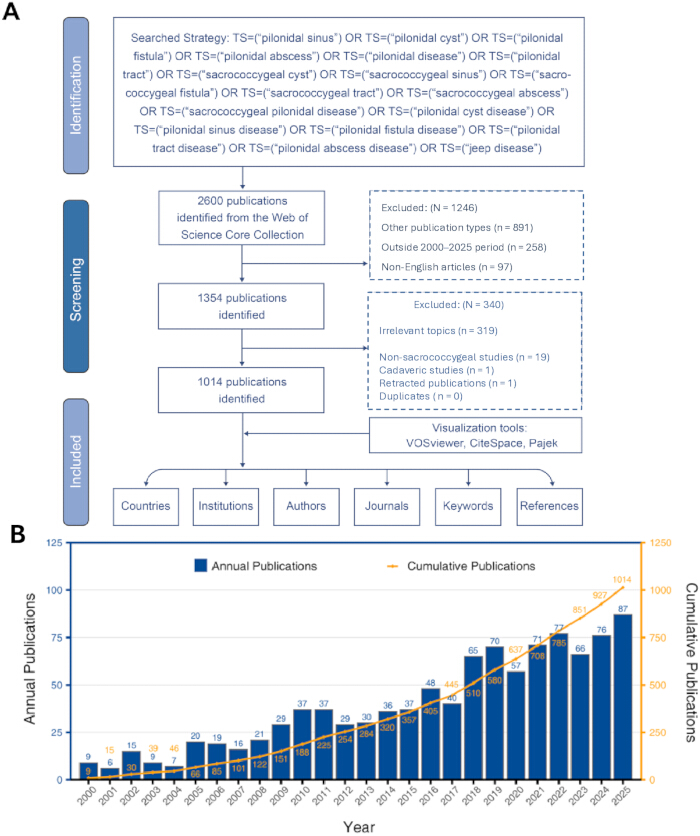
Figure 1: Study selection and publication trends. (A) Flow diagram illustrating the stepwise screening and inclusion process based on the WoS Core Collection, resulting in a final curated dataset of 1,014 original English-language publications on SPD. (B) Annual and cumulative numbers of publications on sacrococcygeal pilonidal disease between 2000 and 2025. Please click here to view a larger version of this figure.
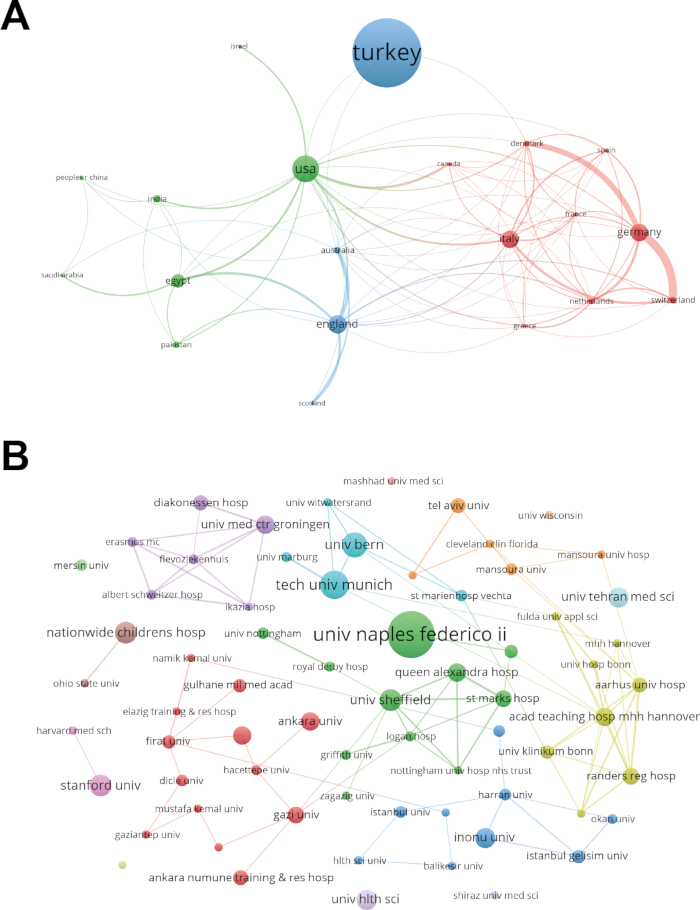
Figure 2: Network maps of the productive countries and institutions. (A) Collaborative network of countries. (B) Collaborative network of institutions. In both networks, larger nodes represent higher publication volume, node colors indicate different clusters, and thicker lines indicate stronger links between connected nodes. Please click here to view a larger version of this figure.
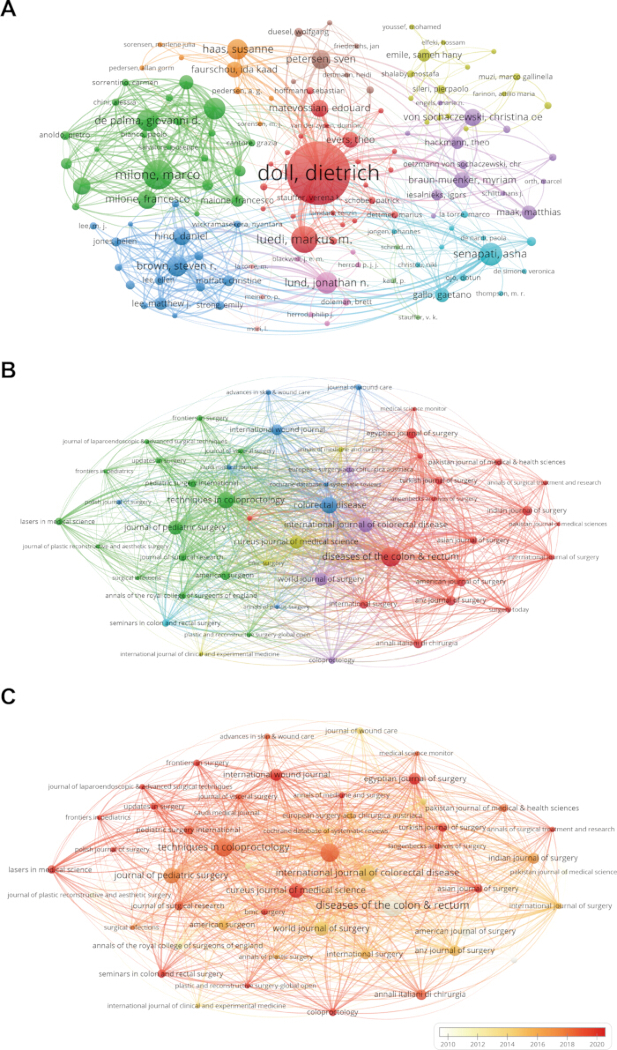
Figure 3: Network maps of prolific authors and journals. (A) Collaborative network visualization of authors. (B) Citation network visualization of contributing journals. (C) Overlay visualization of contributing journals. In (A) and (B), larger nodes represent higher publication volume, node colors indicate different clusters, and thicker lines indicate higher link strength between connected items. In (C), node colors indicate the average publication year of articles in each journal, using a gradient from white (earlier years) to red (later years). Please click here to view a larger version of this figure.
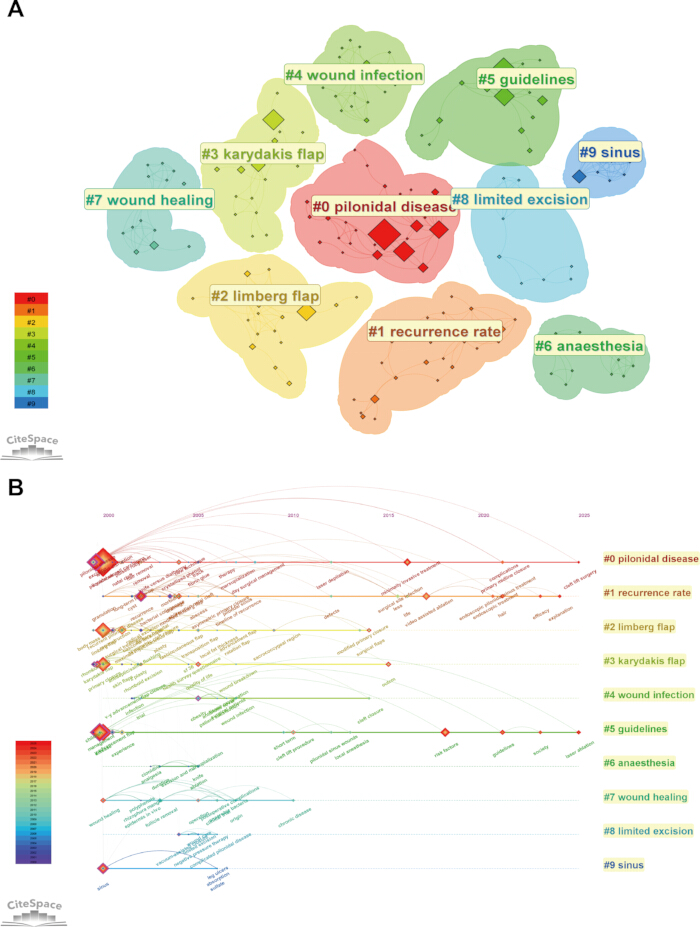
Figure 4: Keyword clustering and temporal evolution. (A) Keyword clustering network generated by CiteSpace, with clusters labeled by the log likelihood ratio (LLR) method. (B) Timeline visualization of keyword clustering analysis, showing the temporal progression of research topics from 2000–2025. Please click here to view a larger version of this figure.
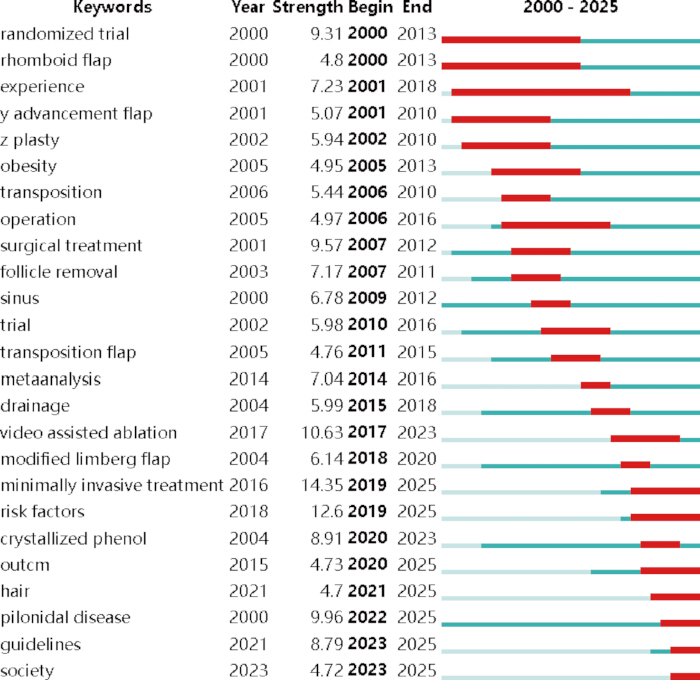
Figure 5: Top 25 keywords with the strongest citation bursts. The dark blue bars indicate the temporal distribution of each keyword, and the red bars denote burst duration. Please click here to view a larger version of this figure.
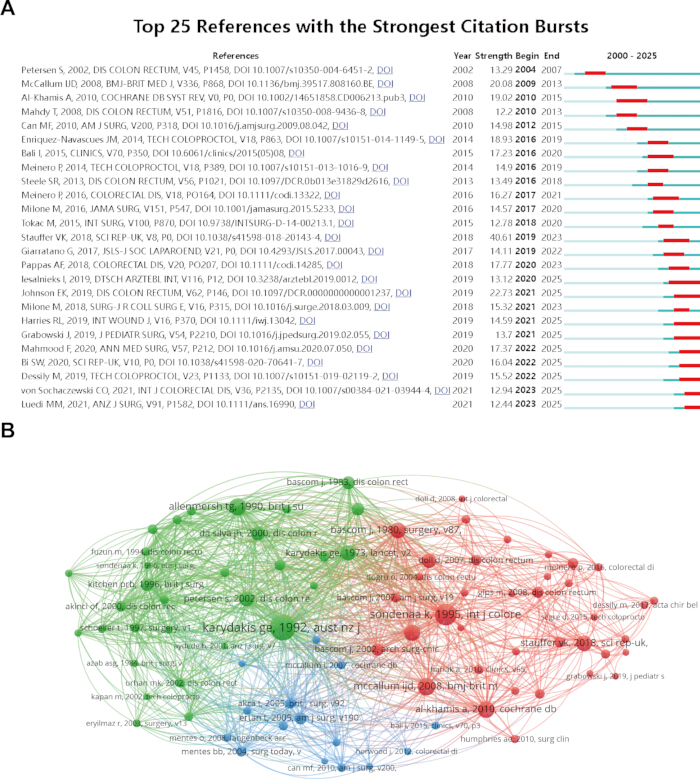
Figure 6: Visualization of references. (A) Top 25 references with the strongest citation bursts. (B) Co-citation network visualization of cited references. In this network, each node represents a cited reference; node size reflects citation frequency; line thickness denotes co‑citation strength; and colors represent thematic clusters. Please click here to view a larger version of this figure.
Table 1: Top 10 most productive countries in SPD research. This table presents country rankings by publication count, total citations, and total link strength. Abbreviations: ACPP = average citations per publication; TC = total citations; TLS = total link strength. Please click here to download this file.
Table 2: Top 10 most prolific institutions in SPD research. This table presents the top 10 institutions ranked according to total citations and total link strength, respectively. Abbreviations: TC = total citations; TLS = total link strength. Please click here to download this file.
Table 3: Top 10 highest-impact authors in SPD research. This table presents the top 10 authors ranked by publication count, total citations, and total link strength. Abbreviations: TC = total citations; TLS = total link strength. Please click here to download this file.
Table 4: Top 10 most productive journals. This table presents the top 10 journals ranked by publication count, with corresponding total citations, average citations per publication, Journal Citation Reports quartile, and impact factor. Abbreviations: ACPP = average citations per publication; IF = impact factor; JCR = Journal Citation Reports; TC = total citations. Please click here to download this file.
Table 5: Top 10 most cited references. This table presents the top 10 references ranked by citation count, including title, first author, journal, and publication year. Please click here to download this file.
Supplementary Table 1: Keywords harmonization. Keyword harmonization and standardization are applied during bibliometric data preprocessing.Please click here to download this file.
Supplementary Table 2: Keywords. The top 30 most frequently occurring keywords in SPD research from 2000 to 2025. Keywords with a greater log-likelihood ratio are more representative of the clusters. Abbreviations: LLR, log-likelihood ratio. Please click here to download this file.
Supplementary Table 3: Keyword clusters. The 10 largest keyword clusters and the top 5 label terms (by log-likelihood ratio) for each cluster.Please click here to download this file.
Supplementary Table 4: Frequency of keywords. All keywords and their frequency of occurrence in each cluster.Please click here to download this file.
Supplementary File 1: Completed BIBLIO checklist for reporting bibliometric reviews.
The checklist details the manuscript page, line, and section corresponding to each BIBLIO reporting item.Please click here to download this file.
ディスカッション
1,014件の出版物を対象としたこの包括的なビブリオメトリクス合成解析は、21世紀の第1四半期におけるSPD研究の軌跡を描き出し、出版活動の活発化、テーマの多様化、および研究関心の変遷を明らかにしています。本研究では、科学的成果の拡大を記録するだけでなく、より重要な点として、現代のSPD研究を特徴づける基礎的な知的構造、共同研究のダイナミクス、および進化する研究テーマを解体するためのマクロ的かつ定量的な枠組みを提案します16,22。記述統計を超え、パフォーマンス分析、サイエンスマッピング、バースト検出を統合したこのマルチツール的なビブリオメトリクスアプローチにより、膨大かつ断片的な文献のユニークで体系的な合成が可能となりました。ナレッジネットワークを可視化することで、主要な寄与者、特定ジャーナルの中心性29、およびグローバルな共同研究ネットワークの不均一な構造30を特徴づけ、これにより研究トレンドの把握と将来の共同研究の方向性を検討するための有用なリファレンスを提供しました。他の肛門直腸領域18,19,20,21ですでに有効性が証明されているこの手法により、研究トレンドの客観的な評価が可能となり、主に手術手技に焦点を当てた研究から、予防、エビデンス合成、および患者中心のアウトカムを取り入れたより広範な調査への進化に関する洞察が得られました1,31。
分析結果から、従来の外科的アプローチへの研究が継続される一方で、低侵襲の手法や病因論的な予防へと研究の関心が移行するという、大幅なテーマの変遷が明らかになりました。キーワードのクラスター分析およびバースト検出分析により、この分野における研究優先順位の変化が裏付けられており1,2,14、近年では「低侵襲治療」や「ビデオ補助下切除」といった用語において、持続的な高強度のバーストが確認されています。こうした低侵襲アプローチの台頭は、治療負担の軽減および患者中心のアウトカム改善への関心の高まりを反映している可能性があります14,30,31。しかし、ビブリオメトリクスの結果は主に研究優先順位のシフトを示すものであり、既存の外科的手法の間で臨床的な優位性があることを決定づける証拠となるものではありません。同時に、「リスク要因」、「毛髪」、「ガイドライン」などのキーワードの急増は、疾患の発症における毛髪挿入の役割などの病因論的要因の探索32,33が進み、研究領域が成熟していることを示しています。また、エビデンスの統合および将来的なガイドライン策定への関心が高まっていることも反映されています4,34。このようなテーマの多様化は、SPD研究が術式にとどまらず、病因、予防、およびエビデンス統合の視点へとますます拡大していることを示唆しています。
この分析により、SPD研究領域における国際共同研究パターンの変動が明らかになり、SPD研究コミュニティ内での国際的な連携を強化する機会が浮き彫りとなりました。出版数ではトルコが圧倒的である一方で16、国際共同研究のパターンは国によって大きく異なり、西欧のいくつかの国では国境を越えたより強力な連携が見られました。これらの相違は、SPD研究におけるグローバルな共同研究ネットワークの構造が不均一であることを示しています。共同研究ネットワークのこのような不均衡な分布は、今後のエビデンス創出に向けたより広範な多国間協力の潜在的な利点を強調しています30。これまでの手法的な分析では、この分野がいまだに単一施設での後方視的コホートや不均一なデータのメタ解析に依存しており、ランダム化比較試験(RCT)の割合が懸念されるほど低下していることが報告されています23。今後の研究では、さらなる国際協力に加え、多様な集団や医療環境において異なる手術アプローチを比較可能な、適切に設計された前向き研究が有益であると考えられます34。
これらの知見がもたらす潜在的な意義は2点あります。第一に、研究者や臨床医に現在のSPD研究領域の構造的な概況を提供することであり、第二に、知識の欠落、台頭しつつあるテーマ、および今後の研究における潜在的な領域を特定するのに役立つことです。中核となるジャーナル29や影響力のある著者の特定は、研究者が分野内の確立された知識の貢献者や、潜在的な共同研究ネットワークを認識する際にも有用であると考えられます。研究者や学術団体にとって、「guidelines」や「society」といったバーストキーワードの出現は、研究上の関心が高まっている領域を浮き彫りにしており、エビデンスの統合や多施設共同研究11,34を含む、今後の研究の潜在的な方向性を提示しています。今後の研究方向としては、記述的な外科的症例シリーズを超え、仮説駆動型の共同研究へと移行することが有益であると考えられます。現在の文献状況から示唆される潜在的な優先事項には、以下が含まれます。(1) 5〜10年後の再発を主要エンドポイントとし、最も有望な低侵襲手技と確立された正中外皮弁術を比較する、十分な検出力を持つRCTを実施すること34。(2) 特に思春期の集団において、治療がQOLや心理社会的ウェルビーイングに及ぼす影響を包括的に捉える、標準化された患者報告アウトカム尺度を開発し、検証すること1,8。(3) 高リスク集団におけるレーザー脱毛などの予防的介入の役割を、堅牢な長期コホート研究を通じて探索し、原発性および再発性疾患の予防における費用対効果を評価すること。
これらの知見を文脈化するためには、本合成研究における手法上の限界を認める必要があります。第一に、単一のデータベース(WoS Core Collection)に依存し、英語で出版された論文に限定したため、他の主要な科学データベースや英語以外の言語で発表された重要な研究を不注意に除外した可能性があります。第二に、すべてのビブリオメトリクス分析と同様に、引用指標は時間の経過とともに自然に蓄積される引用数に影響されるため、本質的に古い出版物が有利となり、最近のイノベーションによる現代的な影響を完全には捉えきれていない可能性があります。最後に、引用数と出版頻度は科学的な注目度や活動を示す代理指標であり、手法の厳密さや臨床的有用性を直接的に測定するものではありません。今後の研究では、複数のデータベースを組み込み、altmetricsを用いてより広範な社会的および臨床的な影響を捉えることで、これらの限界を軽減でき、従来の引用ベースの分析を補完して、この分野の進化についてより包括的な視点を提供できると考えられます。
1,014本の出版物を対象としたこのビブリオメトリック分析は、2000年から2025年までの仙尾骨化膿性嚢胞(SPD)研究に関する包括的かつ体系的な概観を提供し、世界の状況、共同研究ネットワーク、テーマの変遷、および新たな研究領域を明らかにしています。この分野の研究成果は著しく持続的に増加しており、トルコが最も生産性の高い国として台頭した一方、ドイツ、イングランド、および米国は国際的な共同研究ネットワークにおいて比較的顕著な役割を示しました。Dietrich Doll教授は、この分野で最も生産性が高く、引用数の多い研究者として際立っています。テーマの変遷からは、従来の外科的手法への調査が継続される一方で、低侵襲手技への研究重点が高まっていることが分かり、再発は依然として文献における中心的なアウトカム指標となっています。「低侵襲治療」、「リスク因子」、「毛髪」、「ガイドライン」などのバーストキーワードに代表される新興の研究テーマは、より侵襲性の低い戦略、病因的予防、およびエビデンスの統合に対する関心が高まっていることを示唆しています。世界的な生産性パターン、共同構造、およびテーマの変遷を統合することで、本研究はSPD研究における知識の空白、新たな研究の優先事項、および潜在的な共同研究の機会を特定するための定量的な参照枠組みを提供します。
開示事項
著者らは、競合する利益がないことを宣言します。データの収集、データ解析、結果の解釈、または図の作成に人工知能ツールは使用されませんでした。ChatGPT (OpenAI) は、言語編集および原稿の推敲にのみ使用されました。
謝辞
著者らに申告すべき謝辞はありません。
材料
| 名前 | 会社 | カタログ番号 | コメント |
|---|---|---|---|
| CiteSpace | ドレクセル大学 | バージョン 6.3.R3 | https://citespace.podia.com/ |
| Microsoft Excel | Microsoft Corporation | 2024年版 | Microsoft Excel:データ分析と共同作業のための強力なスプレッドシート Excelを使って、データの整理、分析、可視化を行いましょう。高度な関数、動的なグラフ、そして強力なデータ処理ツールにより、複雑な数値データから有益なインサイトを導き出し、チーム全体で効率的に共有することが可能です。 主な機能: ・高度なデータ分析:強力な関数とピボットテーブルを用いて、膨大なデータを瞬時に集計・分析します。 ・視覚的なデータ提示:多彩なチャートやグラフにより、トレンドやパターンを明確に可視化します。 ・リアルタイム共同編集:クラウド上でファイルを共有し、チームメンバーと同時に編集・更新が可能です。 ・自動化と効率化:定型業務を自動化し、入力ミスの削減と作業時間の短縮を実現します。 Microsoft 365の一部として、あらゆるデバイスでシームレスに利用でき、常に最新の機能が提供されます。 |
| Pajek | リュブリャナ大学 | バージョン 6.02 | https://mrvar.fdv.uni-lj.si/pajek/ |
| VOSviewer | ライデン大学 | バージョン 1.6.20 | https://www.vosviewer.com/ |
| Web of Science コアコレクション | Clarivate | 該当なし | https://www.webofscience.com/ |
参考文献
- Gil LA, Deans KJ, Minneci PC. Management of Pilonidal Disease: A Review. JAMA Surg. 2023;158(8):875-883.
- Di Castro A, Guerra F, Levi Sandri GB, Ettorre GM. Minimally invasive surgery for the treatment of pilonidal disease. The Gips procedure on 2347 patients. Int J Surg. 2016;36(Pt A):201-205.
- McCallum IJ, King PM, Bruce J. Healing by primary closure versus open healing after surgery for pilonidal sinus: systematic review and meta-analysis. BMJ. 2008;336(7649):868-871.
- Wiinblad IM, Ulrichsen J, Brandstrup B. Outcome After Surgical Treatment for Chronic Pilonidal Sinus Disease: A Systematic Review of Common Surgical Techniques. Dis Colon Rectum. 2025;68(5):515-529.
- Oetzmann von Sochaczewski C, Gödeke J. Pilonidal sinus disease on the rise: a one-third incidence increase in inpatients in 13 years with substantial regional variation in Germany. Int J Colorectal Dis. 2021;36(10):2135-2145.
- Faurschou IK, Erichsen R, Doll D, Haas S. Time trends in incidence of pilonidal sinus disease from 1996 to 2021: A Danish population-based cohort study. Colorectal Dis. 2024;27(1):e17227.
- Brown SR et al. Real-world practice and outcomes in pilonidal surgery: Pilonidal Sinus Treatment Studying The Options (PITSTOP) cohort. Br J Surg. 2024;111(3):znae009.
- Salimi-Jazi F et al. Burden of pilonidal disease and improvement in quality of life after treatment in adolescents. Pediatr Surg Int. 2022;38(10):1453-1459.
- Calikoglu I et al. Phenol Injection Versus Excision With Open Healing in Pilonidal Disease: A Prospective Randomized Trial. Dis Colon Rectum. 2017;60(2):161-169.
- Walker H, Hamid O, Ramirez J, Glancy D. Diagnosis and management of sacrococcygeal pilonidal disease in primary care. BMJ. 2023;382:e071511.
- Johnson EK, Vogel JD, Cowan ML, Feingold DL, Steele SR. Clinical Practice Guidelines Committee of the American Society of Colon and Rectal Surgeons. The American Society of Colon and Rectal Surgeons’ Clinical Practice Guidelines for the Management of Pilonidal Disease. Dis Colon Rectum. 2019;62(2):146-157.
- Vartanian E, Gould DJ, Lee SW, Patel KM. Pilonidal Disease: Classic and Contemporary Concepts for Surgical Management. Ann Plast Surg. 2018;81(6):e12-e19.
- Al-Khamis A, McCallum I, King PM, Bruce J. Healing by primary versus secondary intention after surgical treatment for pilonidal sinus. Cochrane Database Syst Rev. 2010;2010(1):CD006213.
- Tien T, Athem R, Arulampalam T. Outcomes of endoscopic pilonidal sinus treatment (EPSiT): a systematic review. Tech Coloproctol. 2018;22(5):325-331.
- Kumar M, Clay WH, Lee MJ, Brown SR, Hind D. A mapping review of sacrococcygeal pilonidal sinus disease. Tech Coloproctol. 2021;25(6):675-682.
- Doll D, Stauffer V, Diekann M, Van Wyk P, Luedi MM. Turkey is leading in the 21st century pilonidal sinus disease research. Turk J Surg. 2020;36(3):284-290.
- Dhole S, Mahakalkar C. Advancements and Innovations in the Surgical Management of Sacrococcygeal Pilonidal Sinus: A Comprehensive Review. Cureus. 2024;16(5):e61141.
- Chen X. Global knowledge mapping and technological evolution in hemorrhoid therapy: a multi-tool bibliometric analysis. Updates Surg. 2025. doi:10.1007/s13304-025-02460-2.
- Wang Z et al. Top 100 most-cited articles on hemorrhoids: A bibliometric analysis and visualized study. Front Surg. 2022;9:1021534.
- Chen Q, Li Y, Wang X, Li H. Hot topics in global perianal fistula research: A SCOPUS-based bibliometric analysis. Medicine (Baltimore). 2020;99(17):e19659.
- Feng L, Wang M, Li X, Yang Q. A bibliometric analysis of surgical treatment for rectal prolapse. Medicine (Baltimore). 2025;104(32):e43763.
- Şahin A, Şimşek G. The One Hundred Most Cited Articles from Turkey about Pilonidal Disease: A Bibliometric Study. Turk J Colorectal Dis. 2022;32:123-133.
- Doll D et al. One century of pilonidal sinus research: trends in study size and the declining share of randomized controlled trials. Coloproctology. 2025;47:353-359.
- Montazeri A et al. Preliminary guideline for reporting bibliometric reviews of the biomedical literature (BIBLIO): a minimum requirements. Systematic Reviews. 2023;12(1):239.
- Thelwall M. Bibliometrics to webometrics. J Inf Sci. 2008;34(4):605-621.
- van Eck NJ, Waltman L. Software survey: VOSviewer, a computer program for bibliometric mapping. Scientometrics. 2010;84(2):523-538.
- Chen C. Searching for intellectual turning points: progressive knowledge domain visualization. Proc Natl Acad Sci U S A. 2004;101 Suppl 1(Suppl 1):5303-5310.
- Mrvar A, Batagelj V. Analysis and visualization of large networks with program package Pajek. Complex Adapt Syst Model. 2016;4:6.
- Becerra AZ et al. A New Bibliometric Index: The Top 100 Most Disruptive and Developmental Publications in Colorectal Surgery Journals. Dis Colon Rectum. 2022;65(3):429-443.
- Wagner CS, Leydesdorff L. Network structure, self-organization, and the growth of international collaboration in science. Res Policy. 2005;34(10):1608-1618.
- Esposito C et al. Quality of life of pediatric patients operated for pilonidal sinus disease. Eur J Pediatr. 2023;182(1):25-30.
- Halleran DR et al. Recurrence of Pilonidal Disease: Our Best is Not Good Enough. J Surg Res. 2018;232:430-436.
- Karydakis GE. Easy and successful treatment of pilonidal sinus after explanation of its causative process. Aust N Z J Surg. 1992;62(5):385-389.
- Stauffer VK et al. Common surgical procedures in pilonidal sinus disease: A meta-analysis, merged data analysis, and comprehensive study on recurrence. Sci Rep. 2018;8(1):3058.