10.6
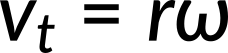
원형 운동의 경우 회전축으로부터 반경에 있는 입자의 선형 접선 속도는 다음 관계에 의해 각속도와 관련됩니다.

이는 고정 축을 중심으로 회전하는 강체의 점에도 적용될 수 있습니다. 균일하거나 불균일한 원 운동에는 구심 가속도가 존재합니다. 구심 가속도 벡터는 회전축을 향…
물체가 불균일한 원 운동으로 이동할 때 선형 가속도는 구심성 및 접선 구성 요소로 표시됩니다.
구심성 또는 방사형 구성 요소는 원의 속도와 반지름으로 표현되는 속도 방향의 변화와 관련이 있습니다. 속도를 오메가 곱하기 반지름으로 대체하면 구심 가속도와 각속도 사이의 관계가 얻어집니다.
접선 가속도 구성 요소는 순간 속도와 평행하며 속도 크기의 변화와 관련이 있습니다. 속도를 오메가 곱하기 반경으로 대체하면 접선 가속도와 각가속도 사이의 관계가 얻어집니다.
접선 가속도는 운동 방향이 아닌 속도와만 연관되기 때문에 각속도가 증가할 때 각가속도는 양수이고 각속도가 감소할 때 음수입니다.
View the full transcript and gain access to JoVE Core videos
Q1: What is the difference between centripetal and tangential acceleration in circular motion?
Centripetal acceleration is the radial component associated with changes in velocity direction, pointing inward toward the axis of rotation. Tangential acceleration is parallel to instantaneous velocity and relates to changes in speed magnitude. These two components are always perpendicular to each other and together form the total linear acceleration in nonuniform circular motion.
Q2: How do you relate centripetal acceleration to angular velocity?
Centripetal acceleration can be expressed in terms of angular velocity by replacing linear velocity with omega times radius. This relationship shows that centripetal acceleration depends on both the angular velocity and the distance from the axis of rotation. The resulting formula connects the radial acceleration component directly to rotational motion parameters.
Q3: What does tangential acceleration tell you about angular acceleration?
Tangential acceleration is associated only with changes in speed, not direction, making it directly related to angular acceleration. Angular acceleration is positive when angular velocity increases, causing positive tangential acceleration, and negative when angular velocity decreases. This relationship shows how rotational acceleration manifests as linear acceleration along the circular path.
Q4: Why does uniform circular motion have only centripetal acceleration?
In uniform circular motion, angular velocity is constant and angular acceleration is zero, so tangential acceleration is absent. The only linear acceleration present is centripetal acceleration, which continuously changes the velocity direction while maintaining constant speed. This occurs because there is no change in the magnitude of tangential velocity, only its direction.
Q5: How is total linear acceleration calculated in nonuniform circular motion?
Total linear acceleration is the vector sum of centripetal and tangential acceleration components. Since these components are perpendicular, the resultant vector points at an angle between them. This combined acceleration vector describes the complete change in velocity for a point on a rotating rigid body or particle executing nonuniform circular motion.
Q6: What is the relationship between tangential speed and angular velocity?
The linear tangential speed of a particle at a radius from the axis of rotation is related to angular velocity by the relation v equals omega times r. This relationship applies to both individual particles and points on rigid bodies rotating about a fixed axis. Replacing velocity with this expression allows conversion between linear and angular motion quantities.
Q7: How do centripetal and tangential accelerations differ in uniform versus nonuniform circular motion?
Uniform circular motion exhibits only centripetal acceleration because angular velocity remains constant. Nonuniform circular motion has both centripetal and tangential acceleration components due to angular acceleration. The presence of tangential acceleration in nonuniform motion indicates that the rotating system is speeding up or slowing down while changing direction.