16.16
열 고리첨가는 반응을 시작하는 데 필요한 활성화 에너지원이 열의 형태로 제공되는 반응입니다. 열적으로 허용되는 고리첨가의 전형적인 예는 [4 + 2] 고리첨가인 딜스-알더 반응입니다. 대조적으로, [2 + 2] 고리첨가는 열로 인해 발생하지 않습니다.
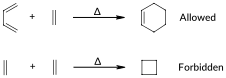
반응은 한 π 성…
일부 cycloaddition reaction은 열적으로 허용되고 다른 reaction은 금지되는 이유는 무엇입니까?
반응하는 구성 요소인 HOMO와 LUMO 사이의 프론티어 궤도 간의 상호 작용을 조사하는 것으로 시작하겠습니다.
열 조건에서 순환 추가는 바닥 상태 HOMO 및 LUMO를 통해 진행됩니다.
동시 본딩 오버랩은 두 π 구성 요소의 말단 로브가 위상이 같은 경우에만 가능합니다.
[4 + 2] 순환 추가에서 반응 끝은 대면 접합 상호 작용에 대해 일치하는 대칭을 갖습니다. 두 개의 π 구성 요소는 양쪽 끝에서 초면적으로 상호 작용하여 조화로운 대칭 허용 프로세스라고합니다.
그러나 [2 + 2] 순환 추가에서 대칭 불일치는 하나의 결합과 하나의 반결합 상호 작용을 일으킵니다.
여기서 결합 형성은 한쪽 끝에서 같은 얼굴, 초안면, 한쪽 끝에서 일어나고 반대쪽 면은 전방안면으로 다른 쪽 면에서 발생합니다. 상호 작용은 대칭이 허용되지만 기하학적 제약 조건으로 인해 이 프로세스는 열적으로 금지됩니다.
View the full transcript and gain access to JoVE Core videos
Q1: What determines whether a cycloaddition reaction is thermally allowed or forbidden?
Thermal cycloadditions are allowed or forbidden based on frontier molecular orbital (HOMO-LUMO) symmetry. In a [4+2] cycloaddition, terminal lobes of both π components are in phase, enabling suprafacial bonding on both ends—a symmetry-allowed process. In contrast, [2+2] cycloadditions exhibit a symmetry mismatch creating one bonding and one antibonding interaction, making them thermally forbidden despite geometric constraints.
Q2: How do frontier orbitals control cycloaddition reactivity under thermal conditions?
Under thermal conditions, cycloadditions proceed through ground state HOMO and LUMO interactions between reacting π components. A simultaneous bonding overlap occurs only when terminal lobes have matching symmetries. This frontier orbital interaction determines whether the reaction proceeds as a concerted, symmetry-allowed process or remains forbidden due to orbital phase mismatches.
Q3: What is the difference between suprafacial and antarafacial bonding in cycloadditions?
Suprafacial bonding occurs on the same face of a π system, while antarafacial bonding occurs on opposite faces. In [4+2] cycloadditions, both ends interact suprafacially, allowing thermal reactivity. In [2+2] cycloadditions, one end bonds suprafacially and the other antarafacially, creating geometric constraints that make the reaction thermally forbidden despite orbital symmetry allowance.
Q4: Why is the Diels-Alder reaction a typical example of a thermally allowed cycloaddition?
The Diels-Alder reaction is a [4+2] cycloaddition where the terminal lobes of the 4π diene and 2π dienophile components are in phase. This phase matching enables suprafacial interaction on both ends, satisfying orbital symmetry requirements and making it a concerted, thermally allowed process that proceeds readily under heat activation.
Q5: What role does symmetry mismatch play in making [2+2] cycloadditions thermally forbidden?
In [2+2] cycloadditions, symmetry mismatch between the two π components creates one bonding and one antibonding orbital interaction. Although orbital overlap technically occurs, the geometric constraint requiring suprafacial bonding on one end and antarafacial on the other makes simultaneous bond formation impossible under thermal conditions, rendering the reaction forbidden.
Q6: How does heat activation relate to ground state HOMO-LUMO interactions in cycloadditions?
Heat provides activation energy that allows cycloadditions to proceed via ground state HOMO and LUMO interactions. Under thermal conditions, the reacting components access their lowest energy molecular orbitals, enabling concerted bond formation when terminal lobes are in phase. This contrasts with photochemical activation, which uses excited state orbitals.
Q7: What makes a cycloaddition concerted and symmetry-allowed?
A cycloaddition is concerted and symmetry-allowed when terminal lobes of reacting π components have matching symmetries, enabling simultaneous bonding overlap. This phase alignment allows both ends to interact suprafacially in a single step without breaking or forming intermediate bonds. The [4+2] cycloaddition exemplifies this symmetry-allowed concerted mechanism.