7.9
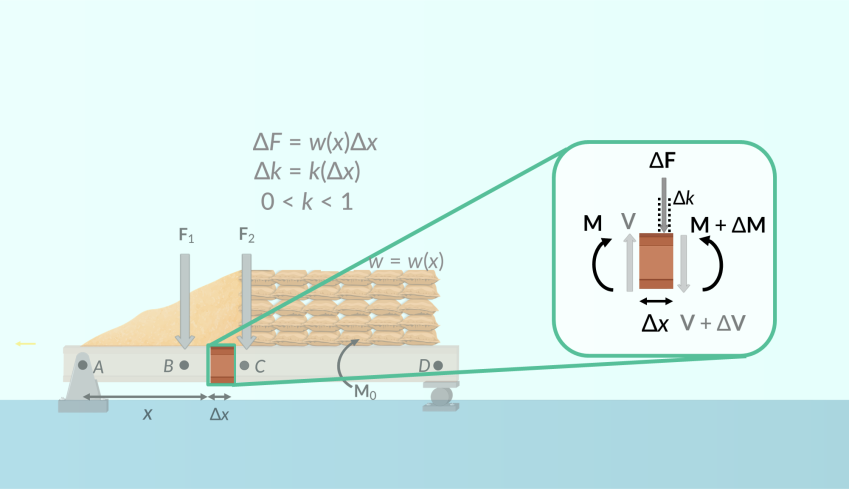
보가 분산하중, 집중하중, 그리고 우력 모멘트와 같은 다양한 하중을 받으면 전단력과 굽힘모멘트를 모두 경험합니다. 이 두 힘 사이의 관계를 이해하기 위해 보의 요소단면을 분석하여 자유물체도를 그릴 수 있습니다.
보의 요소 단면이 평형을 이루기 위해서는 단면의 오른쪽에…
빔이 분산 하중, 두 개의 집중 하중 및 몇 번의 모멘트를 받는다고 가정합니다. 전단과 굽힘 모멘트 사이의 관계를 설정합니다.
빔의 원소 단면을 고려하고 단면의 자유물체 다이어그램을 그립니다.
단면이 평형 상태가 되려면 단면의 오른쪽에 작용하는 모멘트가 작고 유한한 양만큼 높아야 합니다.
분산 하중의 결과 힘은 단면의 오른쪽 끝에서 분수 거리에서 가해집니다.
모멘트에 대한 평형 방정식을 사용하여 모멘트와 전단 사이의 관계를 얻을 수 있습니다.
또한 Δx로 나누고 Δx가 0에 가까워지도록 하면 전단력과 동일한 모멘트 다이어그램의 기울기가 결정됩니다.
최대 굽힘 모멘트는 모멘트와 전단의 기울기가 0인 점에서 발생합니다.
두 개의 임의의 점 사이에 있는 원소 단면에 분산된 하중을 통합하면 굽힘 모멘트의 변화와 전단 다이어그램 아래 면적 사이의 상관 관계가 얻어집니다.
View the full transcript and gain access to JoVE Core videos
Q1: How do you establish the relationship between shear and bending moment in a beam?
To establish the relationship, analyze an elemental section of the beam using a free-body diagram. Apply equilibrium equations for moments, noting that the moment on the right side should be higher by a small amount. By dividing the moment equation by Δx and letting Δx approach zero, you determine the slope of the moment diagram, which equals the shear force.
Q2: What does the slope of the moment diagram represent?
The slope of the moment diagram is equivalent to the shear force acting on the beam. This relationship is derived by dividing the moment equilibrium equation by the elemental length Δx and taking the limit as Δx approaches zero, establishing a direct mathematical connection between moment and shear.
Q3: Where does the maximum bending moment occur on a beam?
The maximum bending moment occurs at the point where both the slope of the moment diagram and the shear force are zero. This critical location represents a transition point where the shear changes sign, making it essential for structural design and analysis.
Q4: How does the area under the shear diagram relate to bending moment?
By integrating the distributed load over an elemental section between two arbitrary points, a correlation emerges: the change in bending moment equals the area under the shear diagram. This relationship provides a graphical method for determining moment variations along the beam's length.
Q5: Why must the moment on the right side of an elemental section be higher than on the left?
For the elemental section to remain in equilibrium, the moment on the right side must be higher by a small finite amount to balance the effects of shear forces and distributed loads acting on the section. This moment difference is essential for maintaining rotational equilibrium of the infinitesimal element.
Q6: What role does the distributed load play in the shear-moment relationship?
The distributed load exerts a resultant force at a fractional distance from the section's right end, creating the moment differential needed for equilibrium. When integrated over the elemental section, the distributed load determines how shear and moment vary along the beam, directly influencing the shape of both diagrams.
Q7: How do concentrated loads and couple moments affect the shear-moment relationship?
Concentrated loads and couple moments contribute to the overall loading condition on the beam, affecting both shear and bending moment distributions. These loads must be included in the free-body diagram analysis to accurately establish the relationship between shear and moment throughout the beam.