7.11
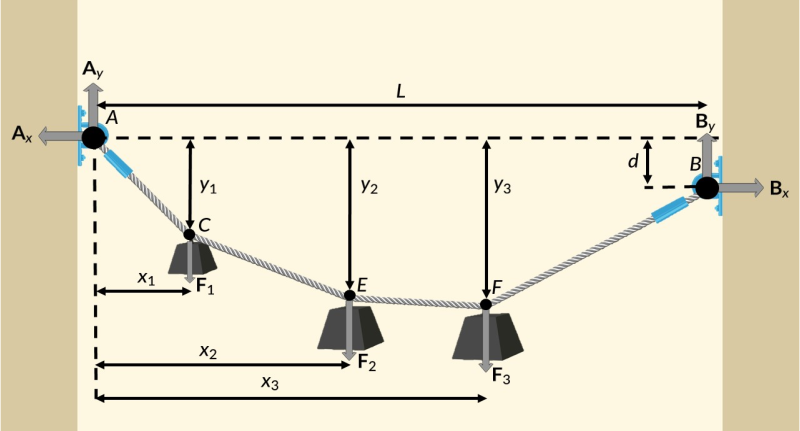
유연한 케이블은 지지 및 하중 전달을 위해 다양한 응용 분야에서 일반적으로 사용됩니다. 두 지점에 고정되어 있고 수직으로 집중된 여러 하중을 받는 케이블을 생각해 보세요. 하중과 지지대 사이의 수평 거리를 고려하여 케이블의 모양과 케이블 각 부분의 장력을 결정합니다.
…
플렉시블 케이블은 다양한 응용 분야에서 지원 및 부하 전달에 사용됩니다.
두 지점에 고정된 케이블 AB에서 여러 수직 집중 부하가 발생한다고 가정해 보십시오.
케이블의 모양과 케이블의 각 부분의 장력을 결정하고 하중과 지지대 사이의 수평 거리를 파악하십시오.
분석을 위해 케이블은 유연하고 확장할 수 없으며 무게가 무시할 수 있는 것으로 가정합니다.
케이블은 여러 직선 세그먼트로 구성되며 각 세그먼트는 일정한 인장력을 받습니다.
케이블의 자유물체 다이어그램을 그려 지지부에서의 반력을 결정합니다. 여기서, 알려지지 않은 반응 성분의 수는 평형 방정식을 초과합니다.
알려진 거리 에서 케이블의 D 지점을 고려하고 세그먼트 AD의 자유체 다이어그램을 그립니다. 점 D에서 모멘트 평형 방정식을 사용하면 추가 방정식을 얻을 수 있습니다.
평형 방정식을 상기하고 반력을 사용함으로써 각 집중 하중에 대한 지지 A 사이의 수직 거리를 얻습니다.
유사하게, 각 세그먼트의 장력을 얻을 수 있으며, 이는 세그먼트가 가장 큰 경사각을 가질 때 최대입니다.
View the full transcript and gain access to JoVE Core videos
Q1: What assumptions are made when analyzing a cable subjected to concentrated loads?
Cables are assumed to be flexible, allowing them to change shape under applied loads, and inextensible, meaning their length does not change under tension. Additionally, the cable's weight is assumed negligible, so it does not significantly impact the cable's behavior during analysis of concentrated loads.
Q2: Why is a free-body diagram of a cable segment necessary for solving concentrated load problems?
A free-body diagram of the entire cable often yields more unknown reaction components than available equilibrium equations. By isolating a segment at a known distance and applying the moment equilibrium equation at that point, an additional equation is obtained, allowing the system to be solved for reaction forces and tensions.
Q3: How does the shape of a cable change when subjected to multiple concentrated loads?
A cable subjected to concentrated loads forms several straight-line segments between load points and supports. Each segment maintains constant tensile force and connects at the load application points, creating a polygonal shape that reflects the distribution and magnitude of the applied vertical loads.
Q4: What is the relationship between cable segment inclination and tension magnitude?
Tension in a cable segment is maximum when the segment has the largest inclination angle relative to the horizontal. Segments with steeper angles experience greater tensile forces because they must support larger vertical load components while maintaining static equilibrium across the cable system.
Q5: How are vertical distances from support to load points determined in cable analysis?
Once reaction forces are known from equilibrium equations, vertical distances from support A to each concentrated load are determined by recalling the equilibrium equation that states the sum of vertical forces acting on the cable must equal zero. This allows calculation of the cable's vertical geometry.
Q6: What information is needed to determine tension in each cable segment?
To calculate tension in each cable segment, you need the reaction forces at supports, the horizontal distances between loads, and the vertical distances from support to each load point. With these values, the tension in each segment can be computed, with maximum tension occurring in segments with the largest inclination angle.
Q7: How does the moment equilibrium equation help solve indeterminate cable systems?
When the number of unknown reaction components exceeds available equilibrium equations, applying the moment equilibrium equation at a point on the cable segment provides an additional independent equation. This transforms the indeterminate system into a determinate one, enabling complete solution for all reaction forces and segment tensions.