7.14
두 개의 지지대에 고정되어 균일한 하중을 받는 케이블을 다룰 때 케이블의 최대 장력을 결정하는 것이 중요합니다. 이 과정은 다음과 같이 몇 가지 주요 단계로 나눌 수 있습니다:
문제 분석: 주어진 시나리오와 케이블의 상태를 이해하는 것으로 시작합니다. 지지대, 적재 유…
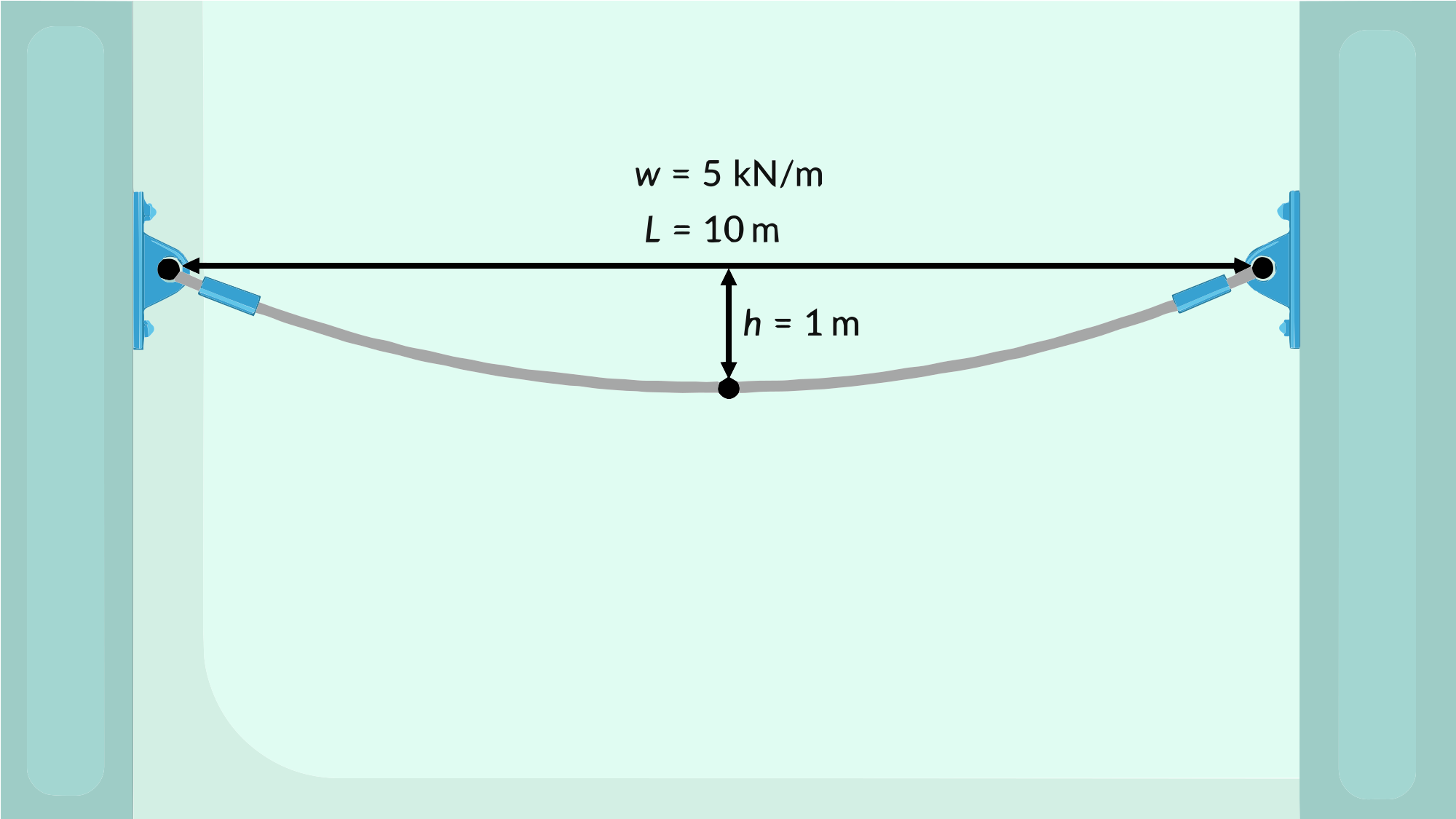
균일한 하중을 받는 두 개의 지지대에 고정된 케이블을 고려하십시오. 케이블의 최대 장력을 결정합니다.
분석을 위해 대칭으로 인한 케이블 중심의 원점을 고려하십시오.
분산 부하에 대한 케이블의 형상 방정식을 상기하고 알려진 일정한 부하 값을 대체합니다.
다음으로 방정식을 적분하고 원점에 경계 조건을 적용하여 상수 C2 를 결정합니다.
케이블 형상 방정식의 1차 도함수를 취하여 기울기를 결정할 수 있습니다. 원점에서의 경사에 대한 경계 조건을 적용하면 C1이 얻어집니다.
지지부의 적분 상수와 위치 좌표를 대입하고 방정식을 재배열함으로써, 수평 인장력을 얻을 수 있다.
기울기 방정식을 떠올리고 각도가 최대인 지지부에서 x 좌표 값을 대체합니다.
Cabel의 장력은 최대 근거리 지지선인 각도에 따라 변합니다.
삼각법 관계를 적용하고 항을 재배열하면 최대 인장 방정식이 얻어집니다.
마지막으로, 수평 장력 방정식과 알려진 값을 대체하여 케이블의 최대 장력을 얻습니다.
View the full transcript and gain access to JoVE Core videos
Q1: How do you set up the coordinate system when analyzing a cable fixed at two supports?
Place the origin at the cable's center to leverage its symmetry. This positioning simplifies calculations by allowing you to apply boundary conditions at a single point. The symmetric setup reduces the complexity of the shape equation and integration constants, making the analysis more efficient and manageable for determining cable behavior under uniform loading.
Q2: What role does the cable's shape equation play in finding maximum tension?
The shape equation describes how the cable curves under uniform loading and relates the cable's geometry to applied forces. By integrating this equation and applying boundary conditions, you obtain integration constants that define the cable's exact profile. These constants are essential for calculating the horizontal tensile force and ultimately determining where maximum tension occurs along the cable.
Q3: Why is the slope of the cable important when calculating maximum tension?
The slope, found by taking the first derivative of the shape equation, determines the cable's angle at each point. Maximum tension occurs where this angle is greatest, typically near the supports. Using trigonometric relationships between the slope angle and horizontal tensile force allows you to express and calculate the maximum tension value accurately.
Q4: How do boundary conditions help determine integration constants?
Boundary conditions specify known values at particular locations, such as zero slope at the cable's center. Applying these conditions to the integrated shape equation and slope equation yields the integration constants C1 and C2. These constants are then substituted back into equations to find the horizontal tensile force and ultimately the maximum tension in the cable.
Q5: What is the relationship between horizontal tensile force and maximum tension?
Horizontal tensile force is the constant tension component acting along the cable's length. Maximum tension combines this horizontal force with the vertical component created by the cable's angle at the support. Using trigonometric relations, maximum tension equals the horizontal force divided by the cosine of the maximum angle, making it always greater than the horizontal component.
Q6: Where does maximum tension occur in a uniformly loaded cable, and why?
Maximum tension occurs near the cable's supports where the slope angle reaches its maximum value. At these locations, the cable must support both the accumulated load and resist the steepest angle, creating the highest combined tensile stress. The symmetric loading ensures maximum angles occur symmetrically at both supports.
Q7: How do you calculate the horizontal tensile force from the cable's support coordinates?
Substitute the support's position coordinates and integration constants into the rearranged shape equation to isolate the horizontal tensile force. This force remains constant throughout the cable under uniform loading and serves as the foundation for calculating maximum tension. Once determined, it combines with the angle at the support to yield the final maximum tension value.