9.15
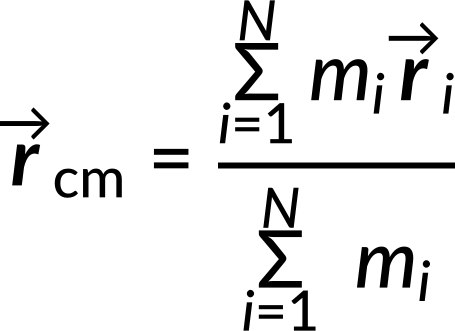
여러 점질량으로 구성된 시스템을 생각해 보세요. 이 시스템의 질량 중심 좌표는 각 질량과 해당 위치 벡터의 곱을 총 질량으로 나눈 값의 합으로 표현될 수 있습니다.
점 질량이 균일하게 분포된 질량을 가진 확장된 객체로 대체되었다고 가정합니다. 이 물체의 질량 중심 좌표…
점 질량 집합의 경우, 질량 중심에 대한 위치 벡터는 각 질량의 곱과 위치 벡터를 모든 입자의 총 질량으로 나눈 값의 합으로 작성됩니다.
균일한 질량 분포를 가진 확장된 물체의 경우, 점 질량은 차동 질량 요소로 대체되고 합계는 적분으로 대체되어 질량 중심 좌표를 얻습니다.
중력으로 인해 균일한 가속도 하에서 y축을 따라 자유 낙하하는 확장 물체를 생각해 보십시오. 이 물체의 총 위치 에너지는 각 질량 요소로 인한 위치 에너지의 합입니다.
질량 중심이라는 표현을 대입하면 총 위치 에너지는 총 질량, 중력으로 인한 가속도 및 질량 중심의 y 좌표의 곱으로 제공됩니다.
이것은 확장된 물체의 중력 위치 에너지가 물체의 전체 질량이 질량 중심에 집중되어 있다고 간주하여 추정할 수 있음을 의미합니다.
View the full transcript and gain access to JoVE Core videos
Q1: How do you calculate the center of mass for an extended object?
For extended objects with uniform mass distribution, replace point masses with differential mass elements and replace summation with integration. The center of mass coordinates are obtained by integrating the product of each differential mass element and its position vector, then dividing by the total mass. This mathematical approach extends the point-mass formula to continuous objects.
Q2: Why can gravitational potential energy of extended objects be found using the center of mass?
The total gravitational potential energy of an extended object equals the sum of potential energy contributions from all mass elements. When substituting the center of mass expression, this sum simplifies to the product of total mass, gravitational acceleration, and the center of mass y-coordinate. Therefore, the entire object's mass can be treated as concentrated at its center of mass for potential energy calculations.
Q3: What is the relationship between differential mass elements and linear mass density?
For objects with uniform mass distribution, the differential mass element equals the product of linear mass density and the differential length element. Linear mass density is constant throughout the object and equals total mass divided by total length. This relationship allows integration of mass distribution across the object's geometry.
Q4: Where is the center of mass located for a ring with uniform mass distribution?
For a ring with uniform mass distribution, the center of mass is located at the ring's geometric center. Circular symmetry ensures that when integrating the position vectors of all mass elements around the ring from θ = 0 to θ = 2π, the x and y components both equal zero, placing the center of mass at the origin.
Q5: How does converting from summation to integration change the center of mass calculation?
Converting from point masses to extended objects replaces discrete summation with continuous integration. Point masses become differential mass elements, and position vectors are integrated across the object's geometry. This transformation allows precise center of mass determination for objects with continuous mass distributions rather than discrete point masses.
Q6: What role does circular symmetry play in determining a ring's center of mass?
Circular symmetry ensures that mass is distributed equally in all radial directions from the geometric center. When integrating position vectors around the complete ring circumference, symmetric contributions from opposite sides cancel out. This symmetry guarantees that the center of mass coincides with the ring's geometric center.
Q7: How does the significance of center of mass apply to gravitational potential energy calculations?
The significance of center of mass lies in simplifying complex calculations for extended objects. By treating all mass as concentrated at the center of mass, gravitational potential energy calculations become straightforward, using the same formula as for point masses. This principle applies universally to any extended object with uniform mass distribution.