3.3
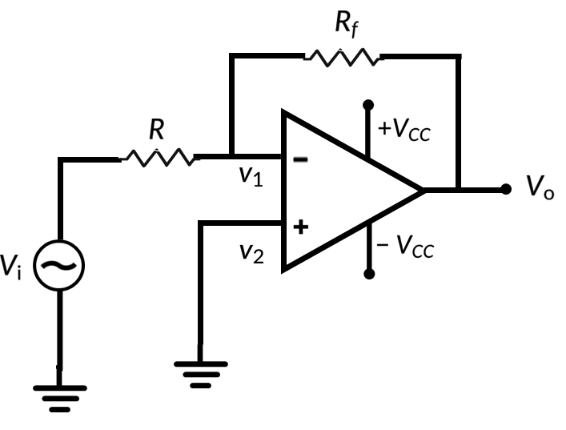
반전 증폭기에서는 입력 전압이 저항을 통해 반전 단자에 연결됩니다. 한편, Figure 1과 같이 비반전 단자는 접지되고 반전 단자와 출력 단자 사이에 피드백 저항이 설정됩니다.
Figure 1: 반전 증폭기
목표는 입력 전압(v_i)과 출력 전압(과정) 사이의 관계를…
반전 증폭기는 저항을 통해 입력 전압을 반전 단자에 연결하고, 비반전 단자를 접지하며, 반전 단자와 출력 단자 사이에 피드백 저항을 가지고 있습니다.
KCL을 적용하고 연산 증폭기가 이상적이라고 가정하면 이득에 대한 표현이 결정됩니다.
반전 증폭기는 입력 신호의 극성을 역전시키는 동시에 증폭하여 잡음 제거에 유용합니다.
마이크는 입력 잡음 신호를 선택하고 취소 회로의 신호를 반전시켜 잡음을 제거합니다.
반전 연산 증폭기는 신호 증폭, 변환 및 필터링을 위한 오디오 처리에 적용됩니다.
비반전 증폭기는 입력 전압이 비반전 단자에 직접 적용되고, 접지와 반전 단자 사이의 저항기, 음의 피드백용 저항기가 있습니다.
반전 단자에 KCL을 적용하고 전압 값을 대체하면 전압 이득에 대한 표현을 제공합니다.
피드백 저항이 단락되거나 입력 저항이 개방 회로인 경우 이득이 통일되어 전압 팔로워가 생성됩니다.
이 컨버터는 고임피던스 입력을 저임피던스 출력으로 변환하여 저임피던스 부하로 효율적인 신호 전송을 가능하게 합니다.
View the full transcript and gain access to JoVE Core videos
Q1: How does an inverting amplifier circuit configuration work?
An inverting amplifier connects the input voltage through a resistor to the inverting terminal, grounds the non-inverting terminal, and uses a feedback resistor between the inverting and output terminals. By applying Kirchhoff's Current Law and assuming an ideal operational amplifier, the voltage gain expression is derived. The gain depends solely on the external resistors: feedback resistance divided by input resistance.
Q2: What is the primary function of an inverting amplifier in signal processing?
Inverting amplifiers reverse the input signal's polarity while simultaneously amplifying it. This capability makes them valuable for noise cancellation applications, where the inverted signal eliminates unwanted noise in audio processing. They are also used for signal amplification, conversion, and filtering in various audio systems.
Q3: How does a non-inverting amplifier differ from an inverting amplifier?
A non-inverting amplifier applies input voltage directly to the non-inverting terminal, with a resistor connecting the inverting terminal to ground and a feedback resistor for negative feedback. Unlike inverting amplifiers, non-inverting amplifiers maintain signal polarity while amplifying. Applying KCL at the inverting terminal yields the voltage gain expression, which again depends on the feedback and input resistances.
Q4: What is a voltage follower and when is it used?
A voltage follower, or unity gain amplifier, forms when the feedback resistor is short-circuited or the input resistor is open-circuited in a non-inverting amplifier, resulting in a gain of one. It possesses high input impedance and functions as a buffer amplifier to segregate one circuit from another. This configuration efficiently converts high-impedance inputs to low-impedance outputs for signal transfer to low-impedance loads.
Q5: Why is input impedance important in non-inverting amplifier applications?
Non-inverting amplifiers have high input impedance, making them ideal intermediate-stage buffer amplifiers. This high impedance allows efficient signal transfer to low-impedance loads while minimizing loading effects on source circuits. The voltage follower configuration particularly leverages this characteristic to isolate circuit stages and preserve signal integrity across cascaded systems.
Q6: How does gain calculation differ between inverting and non-inverting amplifiers?
Both inverting and non-inverting amplifiers calculate gain using external resistor values through KCL analysis. For inverting amplifiers, gain equals negative feedback resistance divided by input resistance. For non-inverting amplifiers, gain equals one plus feedback resistance divided by input resistance. In both cases, the operational amplifier's characteristics of practical op amps determine the circuit's overall performance and accuracy.
Q7: What role does negative feedback play in op-amp amplifier circuits?
Negative feedback, established through the feedback resistor in both inverting and non-inverting configurations, stabilizes the amplifier gain and determines the amplification factor. The feedback path allows KCL analysis to derive predictable gain expressions independent of the op-amp's internal characteristics. This feedback mechanism ensures that gain depends solely on external resistor values, making amplifier performance reliable and controllable.