9.6
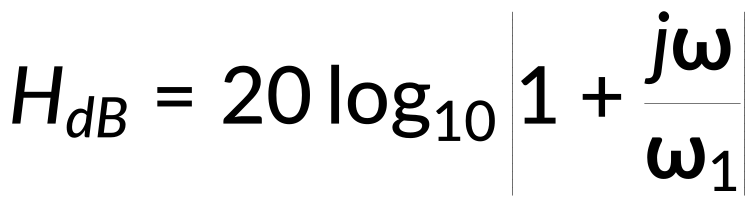
표준 형식에서 전달 함수는 상수 이득, 원점의 극점/영점, 단순 극점/영점 및 2차 극점/0으로 표시됩니다. 각각은 시스템의 전반적인 응답에 고유하게 기여합니다. 이 항은 단순 0의 크기를 나타냅니다.
보드 크기 플롯은 낮은 주파수(0dB에 접근)에서 평탄한 상태를 유…
전달 함수(transfer function)를 극점(poles)과 영점(zeros)이 있는 표준 형식으로 생각해 보십시오
단순 0을 갖는 전달 함수의 경우, 작은 주파수 값에서의 크기 이득은 기울기가 0인 직선이고 위상은 0에 가깝습니다.
코너 주파수에서 점근 크기는 0 기울기 선에서 벗어나고 위상은 45도에 접근합니다.
더 높은 주파수에서 크기 플롯은 +20dB/decade 선을 형성하고 위상은 90도입니다.
단순 극점은 단순 0의 역수입니다. 이는 극 기반 보드 플롯이 수평 축에 대해 반영된 단순 0 플롯을 반영한다는 것을 의미합니다.
2차 극점 전달 함수가 있다고 가정하겠습니다.
더 낮은 주파수에서는 이득 및 위상각이 0에 가깝습니다.
코너 주파수에서 점근 크기 편차는 감쇠 계수에 따라 달라지며 위상각은 거의 -90도입니다.
더 높은 주파수에서 크기 플롯은 기울기가 -40dB/decade이고 위상이 -180도인 직선을 형성합니다.
하나 이상의 2차 극점에 대해, 선의 기울기와 위상 변이에 극의 수를 곱합니다.
View the full transcript and gain access to JoVE Core videos
Q1: What happens to the magnitude and phase of a simple zero at the corner frequency?
At the corner frequency, the asymptotic magnitude deviates from the zero-slope line, and the phase approaches 45 degrees. Below this frequency, the magnitude plot remains flat with zero slope and phase near zero. Above the corner frequency, the magnitude increases at 20 dB/decade with phase approaching 90 degrees.
Q2: How does a simple pole Bode plot differ from a simple zero plot?
A simple pole is the reciprocal of a simple zero, meaning pole-based Bode plots mirror the simple zero plot reflected about the horizontal axis. Where zeros show positive magnitude slopes and phase increases, poles display negative magnitude slopes and phase decreases by the same magnitude.
Q3: What is the slope and phase response of a quadratic pole at higher frequencies?
At higher frequencies, a quadratic pole magnitude plot forms a straight line with a slope of -40 dB/decade and a phase of -180 degrees. This response is twice as steep as a simple pole because quadratic poles have two poles contributing to the overall system response.
Q4: How does the damping factor affect the quadratic pole response near the natural frequency?
The damping factor influences the peak amplitude and phase transition of a quadratic pole near the natural frequency. The actual plot's peak varies with the damping factor, and the phase plot slope is affected by this factor as it transitions from zero to -180 degrees across the frequency range.
Q5: What is the -3 dB point and why is it significant in Bode plots?
The -3 dB point occurs at the corner frequency where the magnitude plot's slope changes and the actual response begins to deviate from the straight-line approximation. This deviation quantifies where the system's gain transitions from flat response to the ascending or descending slope characteristic of poles or zeros.
Q6: How do multiple quadratic poles affect the overall Bode plot slope and phase shift?
For more than one quadratic pole, the slope of the magnitude line and phase shift are multiplied by the number of poles. This means two quadratic poles produce a -80 dB/decade slope and -360 degrees phase shift at high frequencies, compared to -40 dB/decade and -180 degrees for a single quadratic pole.
Q7: Why does the phase angle of a simple zero approach 90 degrees at high frequencies?
At high frequencies, the jω term in the transfer function dominates, making the simple zero behave like a pure differentiator. This causes the phase to approach 90 degrees asymptotically, representing the maximum phase lead that a simple zero can contribute to the system's frequency response.