18.6
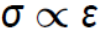
재료 과학의 중추적인 원리인 훅의 법칙은 재료가 겪는 변형이 탄성 계수 또는 영률이라는 요소로 정의되는 적용된 응력에 직접적으로 비례한다는 사실을 입증합니다.
훅의 법칙은 물질이 비례한계에 도달할 때까지 적용됩니다. 이 지점을 넘어서면 응력-변형률 관계는 비선형이 됩니…
Hooke의 법칙에 따르면 재료에 가해지는 응력은 탄성 한계 내에서 발생하는 변형에 정비례합니다. 연성 재료의 경우 탄성 한계가 항복점과 정렬되는 경우가 많습니다.
탄성 계수(modulus of elasticity)로 알려진 비례 상수는 변형률이 무차원 수량이기 때문에 응력의 단위와 동일한 단위를 갖습니다.
구조용 금속의 물리적 특성은 사용된 제조 공정의 영향을 받습니다. 순철과 세 가지 다른 등급의 강철의 응력-변형률 다이어그램은 항복 강도, 극한 강도 및 파열점의 상당한 변화를 보여줍니다.
그러나 그들은 동일한 탄성 계수를 가지고 있습니다 : 선형 범위 내의 강성은 동일합니다. 따라서 동일한 치수를 가진 구조에서 고강도 강철을 저강도 강철로 대체하면 하중 전달 능력이 증가합니다.
금속과 같은 등방성 재료에서 응력-변형률 관계는 하중 방향과 무관합니다. 그러나 섬유 강화 복합재와 같은 이방성 재료의 경우 탄성 계수는 섬유에 평행하고 수직인 방향에서 크게 다르기 때문에 하중에 대한 저항이 다릅니다.
View the full transcript and gain access to JoVE Core videos
Q1: What does Hooke's law state about the relationship between stress and strain?
Hooke's law states that stress applied to a material is directly proportional to the strain it experiences within the elastic limit. The proportionality constant is the modulus of elasticity, which has the same units as stress since strain is dimensionless. This linear relationship holds until the material reaches its proportional limit, beyond which the stress-strain relationship becomes nonlinear.
Q2: Why do different steel grades have the same modulus of elasticity despite different yield strengths?
Different grades of steel possess the same modulus of elasticity because stiffness within the linear elastic range depends on the material's atomic structure rather than its strength grade. Manufacturing processes affect yield strength, ultimate strength, and rupture point, but not the initial elastic stiffness. This means high-strength steel substituted for lower-strength steel in a structure with identical dimensions increases load-carrying capacity without changing elastic behavior.
Q3: How does material type affect the stress-strain relationship?
Isotropic materials like metals exhibit consistent stress-strain relationships independent of load direction, maintaining constant modulus of elasticity in all directions. Anisotropic materials such as fiber-reinforced composites display direction-dependent properties, with significantly different elasticity moduli parallel and perpendicular to fibers. Maximum strength in anisotropic materials is achieved when fibers align with the applied load direction.
Q4: What is the proportional limit and how does it relate to the yield point?
The proportional limit is the stress level beyond which the stress-strain relationship becomes nonlinear. For ductile materials, the proportional limit often aligns with the yield point, making them easier to identify. For other material types, identifying this limit can be challenging due to the non-linearity of the stress-strain relationship beyond this threshold.
Q5: Why is the modulus of elasticity dimensionless when strain is dimensionless?
The modulus of elasticity is not dimensionless; it has the same units as stress. Since strain is a dimensionless ratio of deformation to original length, the modulus of elasticity must carry stress units to maintain dimensional consistency in Hooke's law. This allows the modulus to represent the material's stiffness in terms of stress per unit strain.
Q6: How does manufacturing process influence the mechanical properties of structural metals?
Manufacturing processes significantly affect the physical properties of structural metals, particularly yield strength, ultimate strength, and rupture point. Stress-strain diagrams of pure iron and different steel grades demonstrate these variations resulting from processing methods. However, the modulus of elasticity remains consistent across grades, indicating that manufacturing influences strength characteristics but not elastic stiffness.
Q7: What advantages does substituting high-strength steel provide in structural design?
Substituting high-strength steel for lower-strength steel in a structure with identical dimensions increases load-carrying capacity while maintaining the same elastic behavior and modulus of elasticity. Since both materials have equivalent stiffness within the linear range, the high-strength alternative can support greater loads without additional deformation, improving structural efficiency and performance.