This video demonstrates how escalating cefazidime exposure is used to compare the survival of three E. coli strains with different copies of the ampicillin resistance gene. It shows that only the strain with a multicopy plasmid survives at higher drug levels, highlighting how increased gene copy number accelerates resistance evolution.
이 콘텐츠를 보려면 JoVE 구독이 필요합니다. 로그인하거나 오늘 무료 평가판을 시작하세요.
방법 논문
Assessing the Role of Gene Copy Number in the Evolution of Bacterial Antibiotic Resistance
138 조회수
⸱
2026년 7월 1일
이 논문에서
초록
프로토콜
1. Evolutionary Rescue Approach to Experimentally Evolve Antibiotic Resistance
- Streak out the strains under study on LB plates: MG1655::resA and MG1655/pRESA plus the susceptible parental strain, MG1655.
NOTE: Plasmid pRESA should be stable in MG1655, so there is no need to add antibiotics to the LB plates. Mutation rates in E. coli are low enough so once the construction is verified it is not necessary to verify plasmid sequence at each step. - Prepare 96-well plates with 200 µL of LB in each well and inoculate 48 isolated colonies of each strain in independent wells (one plate per strain). Incubate the plates overnight at 37 °C and 200 rpm. Keep a frozen stock of these founder populations.
NOTE: To prevent and control for culture cross-contamination in the 96-well plates, use a checkerboard plate design by intercalating inoculated wells with bacteria-free medium throughout the 96-well plate. Use this plate design during the entire experimental evolution. - Start the evolutionary rescue experiment by inoculating 2 µL from each well of the plates with the founder populations in new 96-well plates with 198 µL of LB in each well with a sub-inhibitory concentration of the antibiotic under study. For the evolutionary rescue approach start with 1/4 or 1/8 of the minimal inhibitory concentration (MIC, determined previously) of the antibiotic in LB for each of the three strains and double the concentration of the antibiotic daily. Use this approach to maximize the chances of populations to acquire resistance mutations. Incubate the plates at 37 °C and 200 rpm for 20 h.
NOTE: Measure the overnight OD of the founder populations. If there are significant differences in OD among strains, correct the initial inoculum to start the experiment with the same number of cells per well. - Every day, measure the OD of each population after overnight culture and perform a transfer of the cultures, as described in 1.3, to new 96-well plates with double the concentration of the antibiotic than the day before. Incubate the plates 20 h at 37 °C and 200 rpm.
NOTE: The 1:100 dilution factor produces approximately 6-7 generations per day. - In parallel, propagate control populations of each strain in the same conditions as described in 1.3 and 1.4, but in the absence of antibiotics.
NOTE: Control populations will help discriminate between mutations arising due to the presence of the antibiotics and general mutations helping bacteria to adapt to the experimental conditions. Parallel mutations arising in the absence of antibiotics are likely to be helping bacteria to adapt to the experimental conditions and not related to antibiotic resistance. - Track the number of surviving populations every day by measuring the absorbance at a wavelength of 600 nm (OD) of the cultures using a plate reader.
NOTE: Optical density values lower than 0.1 indicate the extinction of the population. See Figure 1 for an example of survival curves. - Keep a frozen stock of all of the populations periodically (every 3-5 days).
- Use log-rank tests [package "survival" in RStudio (Version 0.99.486)] to determine statistical differences in the survival of populations of the different strains over time under increasing concentration of antibiotics.
NOTE: This experiment will determine if multicopy plasmids potentiate the evolution of antibiotic resistance for the particular antibiotic and gene under study.
액세스가 제한되었습니다. 이 콘텐츠를 보려면 로그인하거나 체험판을 시작하세요.
결과
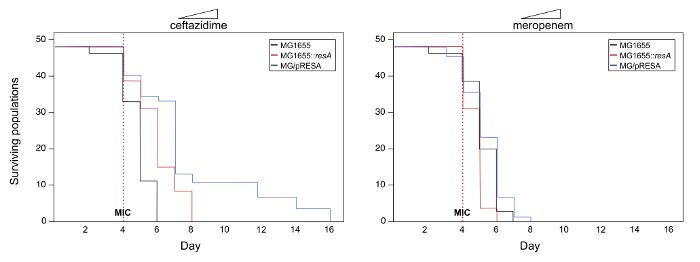
Figure 1. Survival curves with increasing concentrations of antibiotics. Representation of the number of viable populations belonging to strains MG1655, MG1655::resA, and MG1655/pRESA over time. 48 populations of each...
액세스가 제한되었습니다. 이 콘텐츠를 보려면 로그인하거나 체험판을 시작하세요.
재료
| 이름 | 회사 | 카탈로그 번호 | 댓글 |
|---|---|---|---|
| Incubator | Memmert | UF1060 | |
| Incubator (shaker) | Cole-Parmer Ltd | SI500 | |
| Pippettes | Biohit | 725020, 725050, 725060, 725070 | |
| Multi-channel pippetes | Biohit | 728220, 728230,728240 | |
| Plate reader Synergy HTX | BioTek | BTS1LF | |
| Inoculating loops | Sigma-Aldrich | I8388 | |
| 96-well plates | Falcon | 351172 | |
| LB | BD Difco | DF0446-17-3 | |
| LB agar | Fisher scientific | BP1425-500 | |
| Antibiotics | Sigma-Aldrich | ||
| Petri dishes | Sigma-Aldrich | D9054 | |
| Cryotubes | ClearLine | 390701 | |
| 96-well plates | Thermo Fisher Scientific | 249945 |
