여기서는 nTMS와 확산 텐서 영상(DTI) 기반 피질척수로(CST) 재건을 결합한 운동 매핑 표준화 프로토콜을 설명합니다. 이 프로토콜은 재현 가능하고 임상적으로 실현 가능하며 일상적인 임상 업무 흐름에 쉽게 통합되어 운동 경로 평가, 신경가소성 연구, 재활 계획에 대한 견고하고 가치 있는 틀을 제공합니다.
이 논문에서
요약
초록
내비게이션 경두개신경 자기 자극(nTMS)은 개별 뇌 영상 데이터를 통합하여 자극 코일의 정확한 위치를 결정하는 데 기반하며, 이를 통해 피질 표적에 대한 해부학적 유도 자극을 가능하게 합니다. 신경내비게이션 시스템의 관심은 반복 TMS(rTMS) 치료 중 코일 위치 최적화에 잘 알려져 있습니다. 더 나아가, nTMS는 종양 절제 전 유창한 운동 및 언어 영역의 식별 및 구분 등 다양한 응용 분야에서 뇌 영역의 기능적 지도화에 점점 더 많이 적용되고 있습니다. 신경외과 수술 절차 최적화에 유용할 뿐만 아니라, nTMS 매핑은 다양한 신경학적 질환에서 피질 가소성 모니터링과 운동계의 완전성을 정량화하는 도구로도 활용될 수 있습니다. 이 방법론 논문은 nTMS를 이용한 운동 매핑을 표준화된 프로토콜과 확산 텐서 영상(DTI) 기반 피질척수로(CST) 재건을 결합하여 제시합니다. 이 접근법은 유명한 운동 피질 영역과 그 피질하 투사를 정밀하게 구분하고, 인접 병변이 있는 환자에서 기능적 재조직을 탐지할 수 있게 합니다. 수술 전 계획에 통합될 경우, 이 방법은 병변 절제를 극대화하면서 운동 기능을 유지할 수 있도록 개별화된 수술 전략에 대한 지침을 제공합니다. 여기서 제시된 프로토콜은 재현 가능하고 임상적으로 적용 가능하며 일상적인 업무 흐름에 통합하기에 적합합니다. 이는 신경가소성 연구와 재활 계획에 유망한 도구입니다.
서론
운동 발음이 뛰어난 뇌종양에서 절제 범위를 극대화하면서 수술 후 운동 결손을 최소화하는 것은 신경외과에서 여전히 핵심적인 과제로 남아 있습니다. 수술 중 직접 전기 자극(DES) 매핑은 운동 경로 1,2,3,4,5의 피질 및 피질하 표현에 관한 신뢰할 수 있는 해부학적 기능 정보를 제공하는 '골드 스탠다드' 기법입니다. 그러나 수술 전 계획, 위험 계층화, 최적의 환자 상담을 위해서는 수술 전에 개별 기능적 해부학을 명확히 하는 것이 매우 중요합니다. 뇌종양이 운동 네트워크의 해부학적 왜곡이나 가소성 재조직을 유발할 수 있기 때문에, 피질 운동 영역에서 해부학과 기능 간의 관계는 기존의 구조적 뇌 자기공명영상(MRI)으로는 추론할 수 없습니다.
경두개자기 자극(TMS)은 운동 피질6을 탐색하는 비침습적 방법으로 도입되었으며, 이후 운동 피질 7,8의 기능적 지도화에 적응되었으며, 수술 전 검사에서 표면근전도 9,10,11로 다양한 근육의 운동 유도 전위(MEP)를 기록하는 등 다양한 운동 피질의 기능적 지도화에 적용되었습니다. 초기 비내비게이션 TMS 프로토콜은 기술적으로 까다로웠고 해부학적 정확성이 부족했습니다. 이후 개별 MRI 데이터와 전기장 기반 내비게이션의 통합을 통해 자극 부위의 정밀한 유도가 가능해져 해부기능적 정확도12,13,14 및 재현성15,16이 향상되었다. MEP를 직접 유도함으로써 내비게이션 TMS(nTMS)는 수술 중 DES17, 18, 19와 잘 일치하는 피질척수 출력의 밀리초 규모 시간 해상도와 1센티미터 이하 공간 위치 확인을 제공합니다. 영상 유도 nTMS는 안전하고 잘 견디며(20,21), 식품의약국(FDA)으로부터 15년 이상 수술 전 운동 피질의 기능 지도 작성을 승인받았습니다22.
운동 매핑에서는 목표 자극 부위 전반에 걸친 MEP 진폭을 샘플링하여 피질 표상을 구분하여 환자별 운동 지도를 구성합니다23. 과제 기반 기능 MRI(fMRI)와 비교할 때, nTMS는 수술 중 DES 24,25,26과 공간적으로 더 가깝게 일치합니다. 수술 중 의사결정은 궁극적으로 병변이 운동 영역에 인접하거나 침범할 때 DES에 의존하지만, 수술 전 nTMS는 자극 양성 부위를 피질척수로(CST) 확산 텐서 영상(DTI) 재건의 시드로 내보내 귀중한 보완 정보를 제공합니다. 이 접근법은 종양이 주로 피질하 백질의 운동 경로에 영향을 미칠 때 피질척수 완전성을 평가하는 데 특히 유용하다27,28. 또한 수술 전 nTMS 운동 매핑에서 양성 예측값29,30, 음성 예측 수치가높은 29,30,31을 보였으며, 수술 결과 개선된 결과 17,18,19,32를 보였습니다. 최근에는 수술 후 운동 기능을 평가하는 효과적인 도구로 입증되었습니다31,33. 이러한 이유로 nTMS 운동 매핑은 신경외과에서 수술 전 평가와 수술 후 추적 관찰 모두에 점점 더 많이 사용되고 있습니다. nTMS를 이용한 피질 지도 작성에 대한 방법론적 권고는 2017년에 발표되었습니다. 최근 연구들과 현대 영상 기법의 통합을 고려할 때, 이 방법론은 임상 및 연구 실무에 더 정확한 지침을 제공할 수 있도록 개선될 수 있습니다.
본 논문에서는 nTMS를 이용한 운동 매핑을 수행하는 표준화된 프로토콜을 제시하며, 실제 임상 조건에서 종양 절제 계획 계획을 위한 수술 전 피질 및 피질 하 운동 경로 표현을 평가하는 다양한 기법을 결합합니다.
프로토콜
이 연구는 인간 연구를 위한 국내외 윤리 지침에 따라 수행되었습니다. 일상 치료 중 수집된 익명화된 환자 데이터에 대한 회후적 분석은 프랑스 규정에 따라 치료 시점에 사전 동의를 받아 수행되었습니다. 원고의 공동 저자인 건강한 대상자들의 시범 데이터를 포함하였으며, 참여 및 데이터 및 이미지 출판에 대한 서면 동의가 있었습니다. 이 프로토콜은 현재 뇌종양 수술 수술 전 계획에 사용되는 앙리 몽도르 병원(프랑스 크레테이유)과 오르후스 대학교 병원(덴마크)에서 사용되고 있습니다.
1. 신경내비게이션을 위한 신경영상 데이터 획득
- 의무기록과 환자 면담(두개내 강자성 장치, 통제 불능 간질, 심박조율기, 임신, 모유 수유 등)을 통해 nTMS 및 MRI에 대한 금기사항이 없음을 확인하라.
- MRI 헤드폰으로 인한 접힘이나 변형 없이 귀와 두개골 꼭짓점을 포함한 고해상도 해부학적 뇌 이미지를 획득하여 신경내비게이션 시스템에 의한 정확한 뇌 재구성을 가능하게 합니다.
- MRI 시퀀스에 대해 다음 권장사항을 사용하세요:
3D T1 가중치(T1w) 해부학적 그라디언트 에코
1mm 등방성 복셀(또는 그 이하)
≥1.5-테슬라 MRI 시스템 (3 T 선호). - 또는 다음과 같은 허용 가능한 수열을 사용할 수 있습니다:
3D 플레어
대비 강화 3D T1w
- MRI 시퀀스에 대해 다음 권장사항을 사용하세요:
- 조영제 주입 전에 확산 텐서 영상(DTI) 기반 트루토그래피를 위해 확산 가중 영상(DWI)을 획득하세요36.
- 다음 최소 획득 매개변수37을 사용하세요:
등방성 2mm 복셀
확산 부호화 방향: ≥ 25
B-값: ≈ 800 s/mm²
비확산 가중 이미지: ≥ 3 b0 볼륨 (b = 0 s/mm²) - 다음 권장 매개변수를 사용하세요(향상된 텐서 추정 및 트랙그래피를 위해):
확산 부호화 방향: ≥ 64
B-값: 1000 s/mm2
더 높은 공간 해상도 (≤ 2mm 등방성)
- 다음 최소 획득 매개변수37을 사용하세요:
2. 주제 준비
- 피험자의 해부학적 MRI 이미지를 신경내비게이션 시스템에 가져오면 3D 뇌 재구성을 생성하세요.
- 신경내비게이션 소프트웨어에서 MRI의 주요 해부학적 지점(비귀, 오른쪽 귀, 왼쪽 귀)을 표시하세요.
- 더 정밀하게 크루스 헬리시스의 뿌리를 사용하세요.
- 또는 트라거스를 사용하되, 트라거스의 넓은 면적은 공동 등록 불일치를 증가시킬 수 있습니다.
참고: 모터 매핑을 단축하기 위해, 이 준비 단계는 피실험체를 방에 설치하기 전에 수행할 수 있습니다.
- 피험자를 편안한 안락의자에 위치시키고, 약간 뒤로 젖혀진 상태(20-30°)를 하여 등 긴장38을 줄이세요. 머리와 목을 이니온에서 지지하도록 헤드레스트를 조정하세요.
- 머리와 목 부위에 귀걸이, 머리핀, 피어싱 등 금속 물체가 있는지 확인하고 제거한 후 시술을 시작하세요.
- 이마 피부를 머리 추적기 부착을 준비하세요.
- 알코올 패드나 순한 연마 젤로 피부를 깨끗이 닦으세요.
- 트래커를 붙이기 전에 피부가 완전히 마른 상태인지 확인하세요.
- 헤드 트래커를 이마에 올려 자극 세션 내내 안정적으로 유지하세요.
- 눈썹 위, 헤어라인 아래에 위치하세요.
- 가운데나 약간 옆에 두세요.
- 트래커는 접착면이나 탄성 밴드로 고정하세요.
- 신경내비게이션 소프트웨어에서 환자의 주요 해부학적 지점과 가져온 이미지에 동일 등록합니다( 그림 1 참조).
- 디지타이징 펜을 사용해 해부학적 랜드마크를 표시하세요.
- 귀 돌이 헤드레스트에서 분리되어 귀 모양 지점이 이동하지 않도록하세요.
- MRI에서 귀 해부학이 왜곡되어 보이면(예: 귀 지하엽이 접힌 상태), 디지털화하기 전에 해당 지점을 재정의하세요.
- 완료 후, 불일치 오차가 3mm 미만일 경우 소프트웨어가 세 개의 기준점을 검증합니다. 불일치 오차가 너무 크면 다음 단계를 순서대로 시도해 보세요:
- 환자의 주요 해부학적 지점을 두 번째로 디지털화하세요.
- MRI에서 왼쪽과 오른쪽 귀의 해부학적 지점을 재정의하세요.
- MRI 헤드폰이 귀를 몇 밀리미터 정도 이동시켰을 수 있으니, 귓불의 나선을 부드럽게 누르면서 디지타이징하세요.
- 추가 두피 지점을 디지털화하여 등록을 정교하게 만듭니다(두피-표면 매칭).
- 공동 등록을 검증하며, 공동 등록 오차가 3 mm 미만일 때(2 mm 이상) 확인합니다. 불일치가 3mm를 초과하면 2.7-2.9단계를 반복합니다.
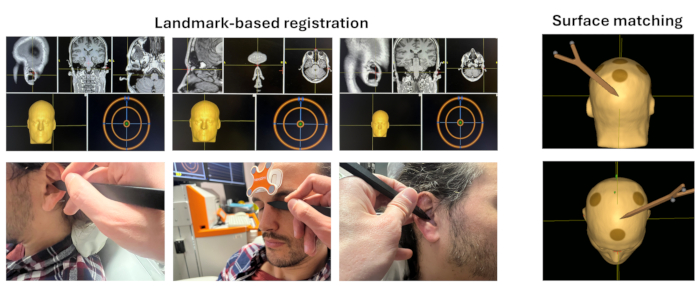
그림 1: 환자의 머리와 해부학적 MRI의 공동 등록. 왼쪽: 랜드마크 기반 등록. 상단 패널: 신경내비게이션 소프트웨어 내에서 MRI에서 해부학적 랜드마크(왼쪽 귀, 비쪽, 오른쪽 귀)를 식별합니다. 하단 패널: 디지털화 펜을 이용해 환자의 랜드마크를 디지털화하는 과정. 오른쪽: 추가 두피 포인트를 이용한 표면 매칭 정제. 이 그림의 더 큰 버전을 보시려면 여기를 클릭해 주세요.
3. 맵 근육의 준비
- 피실험자에게 귀마개를 착용하고 자극 시 보호용 귀마개를 착용하세요.
- 알코올 패드나 면사대 위에 부드러운 연마성 젤을 사용해 피부를 부드럽게 긁어 준비하세요.
- 임상 MEP와 마찬가지로 복부 힘줄 몽타주에서 관심 있는 근육에 표면 전극을 배치합니다. 최대 여섯 개의 서로 다른 근육을 동시에 매핑할 수 있습니다.
- 접지 전극을 어깨 절단 부위, 등쪽 손면, 또는 내측 경골 표면과 같은 중성 부위에 놓으세요.
- 모든 전극을 EMG 증폭기에 연결하세요.
- 모든 채널의 연속 EMG를 보여주고 근육이 휴식 상태인지 확인하기 위해 EMG 획득을 시작하세요.
- EMG 채널에 과도한 50/60 Hz 잡음(< 50 μV)이 없는지 확인하세요. 전기 윙윙거림이 과도하다면, 다음 단계를 순서대로 시도해 보세요:
- 전극이 피부에 단단히 부착되어 있는지, 분리되지 않았는지 확인하세요.
- 전극 케이블을 의자 안쪽에서 금속 부품이나 바닥과 접촉하지 않도록 재배치하세요.
- 전극의 원위 부분을 신경내비게이션 시스템과 AC 전원에서 멀리 옮기세요.
- 전극을 교체하고 케이블 방향을 바꿔서 다시 적용하세요(3.7.2 및 3.7.3 단계 참조).
- 의자를 전원 공급에서 분리하세요.
- 접지 전극을 지도된 근육과 같은 다리에 놓으세요.
- 노이즈가 임계값 이하로 줄어들 때까지 순서대로 반복합니다.
- 50/60 Hz 잡음이 최소화되면 EMG 기록을 재시작해 기준선을 초기화하세요.
- 이 준비 단계들이 완료되면, 선택한 근육에 대한 거친 매핑을 진행합니다.
참고: 표준 매핑 세션에는 상지 마디당 최소 한 근육과 하체 근육 두 개가 포함되어야 합니다. 표 1은 병변 위치와 환자의 임상 증상에 따라 적응해야 하는 흔히 지도화된 근육들을 나열합니다34.
| 팔다리 | 근육 | 대안 |
| 손 | 제1 등골 내간(FDI) | 유괴 경찰 수령 (APB) |
| 납치관 디지티 미니미 (ADM) | ||
| 팔뚝 | 근근 수근근 굴곡근 (FCR) | 방근 신전근(ECR) |
| 팔 / 어깨 | 이두근 | - |
| 삼각근 | ||
| 다리 | 전경골 전경골 (TA) | 솔레우스 (SOL) |
| 발 | 환각 외전성 (AH) | 내측 발바닥 (국회의원) |
| 얼굴 | 오르비큘라리스 오리스 | 비음 |
표 1: 운동 지도 작성을 위한 권장 근육.
4. 핫스팟을 식별하고 휴식 운동 임계값(RMT)을 결정하기 위한 거친 매핑
- 소프트웨어에서 렌더링된 뇌 볼륨에서 두피까지 15-25mm 깊이의 벗겨진 깊이를 케이스별로 조정하여 피질 해부학을 가장 잘 드러내도록 하세요. 목표는 전중심회와 후중심회, 중앙 고랑, 상전두랑과 하전두설을 시각화하는 것입니다.
참고: 대상자가 '오메가 모양' 손 손잡이를 제시할 때 중심 전회를 식별하기 쉽습니다40,41. 하지만 이 이정표는 변하지 않습니다42,43. 이러한 경우에는 전중심회(43,44,45)를 식별하기 위해 여러 방법이 권장됩니다. - 자극기 장치 작동해.
- 자극(8자 모양) 코일을 두피에 접선으로 위치시키세요( 그림 2 참조).
- 한 손으로는 손잡이를, 다른 손으로는 코일을 잡아 두피와 안정적으로 접촉하도록 하세요.
- 신경 탐색 보조(코일 각도, 코일-머리 거리, 틸트 표시기)를 사용하여 각 자극 부위 위의 코일 위치를 정확히 하세요.
- 코일 틸팅을 피하여 안정적인 유도 전기장(EF, V/m)을 유지하세요.
- 코일이 무거울 수 있으니 편안한 자세를 취하세요. 케이블 고정 암을 사용해 케이블 장력을 줄이면서도 코일을 자유롭게 움직일 수 있게 하세요.
- 100-500 μV(피크 대 피크) 진폭 범위 내에서 반응을 유도하도록 조정된 강도로 자극합니다46.
참고: 이는 보통 상지의 최대 자극기 출력(MSO)의 35%에서 45% 사이에서, 하체의 경우 MSO의 50%에서 80% 사이에서 달성됩니다. 하지만 이 수치 범위는 건강한 환자에게 적용되며, 종양이 운동 부위로 침투할 경우 더 높을 수 있습니다. - 거친 매핑(및 미세 매핑)의 코일 방향은 매핑된 림브에 따라 달라진다는 점에 유의하세요( 그림 3 참조):
- 상지와 얼굴의 경우: 중심 고랑에 수직(설커스 정렬)으로 코일 방향을 유지하여 후방에서 앞쪽으로 유도된 전류를 유지하세요47.
- 상지의 경우: 손돌잡이 뒤벽의 윗부분(어깨) 또는 중간부(팔뚝과 손 근육) 위에서 자극을 시작하세요. 이 부분은 상앞 고랑을 향해 보면서요.
- 얼굴의 경우: 전중심회의 후벽을 자극하기 시작하고, 하전두랑을 향해 접근하세요. 반응 지연 시간을 확인하여 피질뇌부 경로에서 시작되는지 확인하세요. 얼굴 MEP의 잠시는 7-13ms인 반면, nTMS에 의해 유도되는 직접적인 근육 반응(턱 경련)은 약 3-4ms의 잠시성입니다.
- 하지의 경우: 시상선 중앙선에 수직으로 코일 방향을 유지하고, 중간에서 옆으로 유도된 전류를 유도하세요34. 대체 코일 방향으로는 시상 중심선에 평행한48, 49, 50 또는 중심 엽 주름과 전중심회에 수직인 방향이 있습니다.
- 상지와 얼굴의 경우: 중심 고랑에 수직(설커스 정렬)으로 코일 방향을 유지하여 후방에서 앞쪽으로 유도된 전류를 유지하세요47.
- 중심전회를 자극합니다.
- 공간 자극은 시각적으로나 자극 그리드를 사용해 2-5mm 간격으로 점들을 배치합니다.
- 시각적으로 수행할 때는 회를 가로지르는 세 개의 평행선을 샘플링하세요. 이 정도면 보통 충분합니다.
- 각 자극마다 최소 1.5초 간격을 두고, 가능하면 무작위 자극 간격을 두세요.
- 응답이 없으면 자극 강도를 시작 값에 비해 10% 증가시키고 이전과 같이 반복합니다.
- 근육당 20-30개의 반응이 기록되면 거친 매핑을 중단하세요.
- 오염된 녹음을 제외하기 위해 모든 MEP를 검토하세요.
- 각 근육의 '핫스팟'을 식별하세요. "핫스팟"은 MEP가 가장 큰 진폭을 유발하는 자극점입니다. 신뢰할 수 있는 핫스팟 정의51을 보장하기 위해
- 각 근육의 기록을 정규화된 색상 척도로 표시하세요.
- 가장 큰 진폭의 MEP가 있는 구역을 찾아보세요.
- MEP를 진폭별로 높음부터 낮은 순서로 정렬하세요.
- 이 영역 내에서 가장 진폭이 높은 MEP를 선택하여 비정상적으로 높은 단일 반응(보통 처음 2개의 MEP)을 피합니다.
- 각 근육에 대해 휴면 운동 임계값(RMT)을 결정하는 핫스팟을 선택 하세요. 이렇게 하면 RMT 결정 과정에서 코일 위치와 방향이 저장되어 신뢰할 수있는 측정 52를 보장합니다.
- 각 근육의 RMT를 별도로 결정하라. 임계값 헌팅 기법53 또는 10회 연속 시험 중 5회 연속 시험에서 50μV ≥ MEP를 유발하는 가장 낮은 자극강도(% MSO)를 식별하는 방법(Rossini-Rothwell 방법)54. 각 근육의 RMT를 참고하여 미세 매핑 시 자극 강도를 설정하세요.
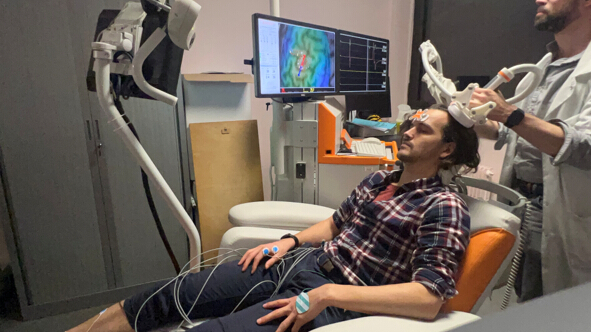
그림 2: 실험적 nTMS 설정. 피실험자는 약간 기대어 팔을 지지하며 앉아 있으며, EMG 전극이 목표 근육 위에 놓여 있습니다. 조작자는 8자 코일을 잡아 두피 접촉을 안정화시키고, 유도된 전기장(화살표: 방향, 원: 강도)과 유도된 MEP를 모니터링합니다. 이 그림의 더 큰 버전을 보시려면 여기를 클릭해 주세요.
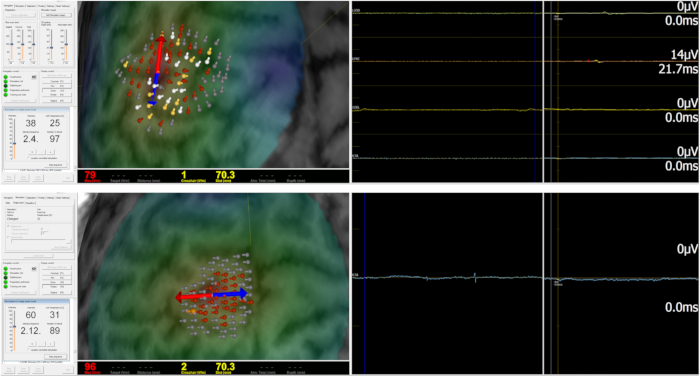
그림 3: 지도 작성 중 신경내비게이션 인터페이스. 코일 위치(파란색과 빨간색 화살표의 접합부), 코일 기울기, 전기장 방향(파란색에서 빨간색 화살표), 그리고 색으로 표시된 주변 링의 자기장 세기에 대한 실시간 피드백을 제공하여 각 피질 부위에서 정확한 자극을 보장합니다. 상단 패널: 상부 사지의 거친 지도화, 코일이 중앙 설과 수직으로 배치되어 있습니다. 하단 패널: 경골 전근의 미세한 지도화, 코일이 시상 중앙선에 수직으로 배치되어 있습니다. 이 그림의 더 큰 버전을 보시려면 여기를 클릭해 주세요.
5. 정밀 지도 작성
- 피험자가 완전히 이완되어 있고 무의식적인 근육 수축이 없도록 하세요.
- 각 근육에 대해 RMT의 105-110%에서 자극을 수행합니다.
- 거친 매핑 시와 동일한 코일 방향을 사용하세요(4.5 및 4.6 단계 참조).
- 자극 지점 간 간격을 줄이세요(회에 4-6개의 평행선).
- 자극 간 간격을 1.5초≥ 유지하며, 가능하면 무작위 시간으로 설정하세요.
- 기능적 운동 지도를 50 μV(피크 투 피크) ≥ MEP를 생성하는 피질 영역으로 구분합니다.
참고: 하체 매핑의 대안으로는 상지 RMT의 110%에서 시작하여 EF를 10 V/m 단위로 ± 조정하여 일관된 MEP34가 얻을 때까지 조절하는 방법이 있습니다. - 운동 지도가 MEP를 유발하지 못하는 음성 부위 선이 하나 또는 두 개 연속적으로 둘러싸일 때까지 자극을 수행합니다.
- 명확한 음의 경계가 나오지 않으면, 동일한 간격을 유지하며 샘플링을 연장하여 응답이 안정적으로 사라질 때까지 진행합니다.
- 비정상적인 영역에서 양성 반응이 확장되면 코일 각도, EF, RMT를 확인하고 적응하세요.
참고: 근육당 점의 수는 근육 피질 표현과 종양으로 인한 뇌 이동 정도에 따라 달라질 수 있습니다(30번에서 100번 정도).
- 비정상적인 MEP 위치나 진폭을 유발하는 코일 방향은 피해야 합니다. 특히, 정중선에 대해 45° 방향은 상지 MEP를 매우 앞쪽에 형성할 수 있으며, 이는 정확한 운동 피질 표현을 대표하지 않을 수 있습니다47.
- 모터 맵이 타원형이고, 내부에 몇 개의 음정 사이트가 있는지 확인하세요. 운동 지도 내 음성 자극점에 대해서는 평가 중 여러 시점에 추가 자극을 수행하여 운동 피질의 과도적 흥분성 변화를 조절합니다.
- 매핑 중에 많은 부정적 응답(<50 μV)이 발생하면 다음 단계를 순서대로 시도해 보십시오:
- 대상자에게 깨어 있으라고 요청하세요. 이는 경계 상태가 감소하는 경우가 많기 때문입니다.
- 자극 강도가 줄지 않았는지 확인하세요.
- 초기 값이 과도적 과흥분 상태에 의해 영향을 받았을 수 있으므로, RMT를 반복하는 것을 고려해 보십시오.
- 비정상적으로 높은 진폭의 MEP가 많이 나타나(> 1000 μV) 맵이 과도하게 확장된다면, 다음 단계를 순서대로 시도해 보세요:
- 필요하다면 지속적인 근육 활동(신호 피드백)을 보여주고, 사지를 이완시키라고 요청하세요.
- 근육 활동이 계속된다면, 피험자에게 팔다리를 흔들거나 더 편안한 자세로 움직이라고 요청하세요. 필요하다면 검사된 근육에 동심원 수동 운동을 적용하세요(예: 손 근육과 환외근을 위한 물체, 또는 전경골근을 위한 발 지지대를 사용).
- 초기 값이 운동 피질 저흥분성 상태의 일과적 상태에 의해 영향을 받았을 수 있으므로, RMT를 반복하는 것을 고려해 보십시오.
6. MEP 데이터의 후처리 분석 및 내보내기
- 각 근육별로 MEP를 검토하고 조정하세요.
- 신경내비게이션 소프트웨어에서 MEP 검토 패널이나 신호 뷰어를 열어보세요.
- 녹화된 각 MEP를 점검하여 진폭과 지연을 보정하고 필요 시 마커를 조정하세요.
- 인위적이거나 비정상적인 자극 지점은 제외합니다.
- 소프트웨어에서 자극 목록이나 매핑 작업 공간을 열어보세요.
- 아티팩트나 잘못된 코일 위치가 있는 자극 시험을 제거하세요( 그림 4 참조).
- 각 근육의 운동 지도를 이진 형식(양수/음수; 50 μV 상/이하)으로 표시하세요.
- 15, 20, 25mm 깊이의 양성 자극 포인트를 내보내는 바이나리화 DICOM 포맷입니다. 이 파일들을 섬유 추적에 사용해 CST를 재구성하고, 양성 자극점을 트랙그래피의 씨앗으로 삼으세요.
- 다른 피질 지도 매개변수(무게중심, 지도 밀도, 운동 지도 크기)를 측정하려면 자극 박람 깊이 또는 20mm(표준 박지 깊이)에서 데이터를 내보내세요.
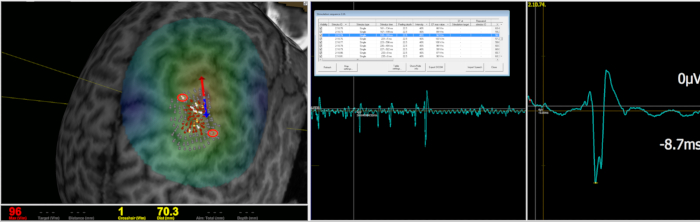
그림 4: MEP 데이터의 후처리 분석. MEP 흔적은 진폭 및 잠복 마커를 보정하고 인공 실험을 제외하기 위해 검토됩니다(오른쪽 패널: 지속적인 EMG 활동으로 오염된 시험 예시). 두 가지 자극(빨간 원)은 음성 영역에서 발생하는 "비정상적인 반응"을 나타내며, 이는 코일 방향 효과와 관련이 있을 가능성이 큽니다. 이 그림의 더 큰 버전을 보시려면 여기를 클릭해 주세요.
7. 운동 매핑의 후처리 분석
- 운동 지도의 DICOM을 뇌종양 제거를 위한 신경외과적 신경내비게이션에 적합한 영상 분석 소프트웨어로 가져오세요.
- 해부학적 이미지(T1w)를 모터 맵 DICOM과 DWI에 등록하세요. 필요 시 추가 이미지를 가져오고 등록하세요(예: FLAIRw, SWI, T1w-가돌리눔 증진).
- 모터 맵 DICOM에서 객체를 생성하고 2-3mm 확대하여 감수성을 향상시키세요.
- 섬유 추적 중 비정상적인 섬유 재구성을 방지하기 위해 귀와 비귀를 제거하기 위해 모터 맵을 잘라내세요.
- 하교 뇌부 수준, 즉 매핑된 반구에 맞춰 같은 방향에서 종료 ROI를 수동으로 그려보세요.
- 섬유 추적을 수행하며, 운동 지도 ROI를 시드로, 폰틴 ROI를 종말점으로 사용합니다. 일반적으로 사용되는 트랙그래피 알고리즘에는 임상 질문과 섬유 추적 결과에 따라 결정론적 스트림라인 추적 또는 확률적 트랙그래피가 있습니다.
참고: 오픈소스 확산 소프트웨어를 사용할 경우, 트랙그래피 전에 여러 전처리 단계(노이징 제거, 깁스 아티팩트 보정, 이동 및 왜곡 보정, B1 바이어스-필드 보정, 텐서 적합, FA 맵 생성)가 필요합니다. - 섬유 추적의 매개변수를 개별 사례별 분석에서 조정하세요. 권장 매개변수는 최소 길이 110-120 mm, 최대 각도 30°, 그리고 FA 임계값(FAT, 첫 CST 섬유가 보이기 시작하는 FA에 해당)의 75% 기준으로 설정하는 60,61입니다.
- 다른 이미지(예: FLAIR, 가돌리늄 T1w)에서 뇌종양을 분할하여 해당 객체를 만드세요.
- CST는 각 사지의 부위별로 (색상이 다르게) 또는 전체 모터 매핑에 대해 표시하세요.
- 모든 데이터(피질 씨앗, CST, 뇌종양 객체)를 신경외과 수술실 내비게이션 소프트웨어에 통합하세요.
결과
우리는 신경항법 TMS 시스템을 사용하여 임상 환경에서 운동 지도를 받은 환자와 건강한 대상자에서 얻은 대표적인 단계와 운동 지도화 결과를 제시합니다. CST 재건은 신경외과 계획에 적합한 영상 처리 소프트웨어를 사용하여 수행되었으며, 다중 모달 영상 등록과 DTI 기반 트랙그래피가 가능했습니다. 이 신경내비게이션 시스템은 항법 8자 코일, 입체 유도 카메라, EMG 증폭기를 통합하며, 개별 다중 구체 머리 모델을 사용해 3D 뇌 재구성에서 유도된 전기장을 실시간으로 시각화합니다.
그림 5 는 거친 매핑을 통해 핫스팟에서 결정된 RMT 결정 결과를 보여줍니다. 코일 위치와 방향은 신경내비게이션 타겟의 도움으로 전체 절차 내내 동일한 위치에 유지됩니다. 그림6 은 건강한 피험자의 운동 지도를 보여줍니다. 왼쪽 하지(허벅지, 다리, 발), 상지(어깨, 팔뚝, 손), 그리고 얼굴이 지도화되었습니다. 양성 자극 부위(MEP 진폭로 색상 구분)와 음성 부위(회색)는 운동 피질 표현을 구분합니다. 그림7 은 전운동 영역에 전이가 있는 폐암 환자의 운동 매핑과 CST 재건 현상을 보여줍니다.
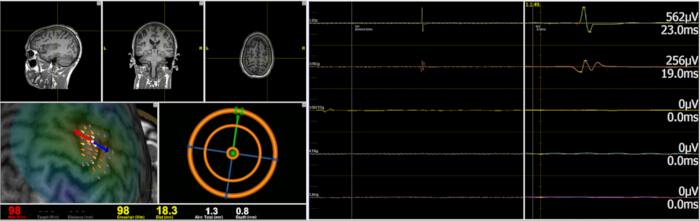
그림 5: 건강한 피험자의 신경 탐색 TMS를 이용한 핫스팟(First Interosseus Dorsalis)에서의 대략적인 매핑 및 RMT 결정. 조잡한 매핑(왼쪽 아래 패널)을 통해 확인된 핫스팟이 RMT 결정의 타깃으로 선택됩니다. 코일 위치와 방향은 신경내비게이션 표적(오른쪽 아래 패널)의 도움으로 시술 전 과정 내내 동일한 위치에 유지됩니다. 운동 유발 전위(MEP)는 연속적인 EMG 추적과 에포크 반응으로 획득됩니다. 이 그림의 더 큰 버전을 보시려면 여기를 클릭해 주세요.
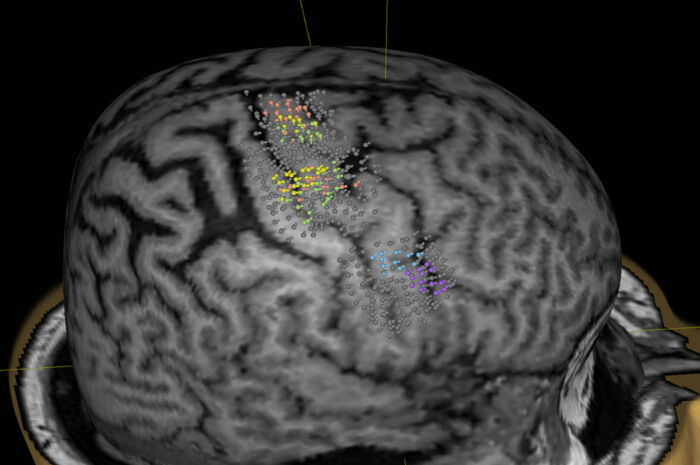
그림 6: 신경항법 TMS를 이용한 하지, 상지, 얼굴 근육의 운동 피질 매핑. 하지에 기록된 근육: 대퇴사두근(녹색), 앞경골근(주황색), 환외전근(노란색). 상지에 기록된 근육: 소외전근(녹색), 방근(주황색), 삼각근(노란색). 얼굴에 기록된 근육: 비강(파란색), 삼각형(보라색). 이 그림의 더 큰 버전을 보시려면 여기를 클릭해 주세요.
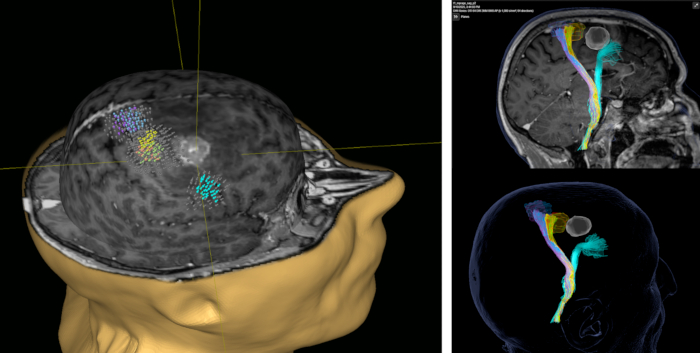
그림 7: 신경외과 계획을 위한 운동 피질 매핑 및 CST 재건. 폐암으로 인한 뇌전이(흰색) 환자의 피질척수로의 nTMS-운동 지도(왼쪽 패널) 및 nTMS 유도 피질척수로 재건(오른쪽 패널). 기록된 근육: 환외전근(보라색), 전경골근(파란색), 삼각근(노란색), 손근근(빨간색), 제1배골간근(녹색), 안리두근(청록색). 이 그림의 더 큰 버전을 보시려면 여기를 클릭해 주세요.
토론
본 논문에서는 nTMS를 이용한 기능적 운동 피질 매핑을 위한 표준화되고 재현 가능한 프로토콜을 수술 전 수술 계획에 직접 적용할 수 있음을 제시합니다. 신경내비게이션과 피험자의 해부학적 뇌 재건을 결합함으로써, 이 표준화된 프로토콜은 검사 중인 근육 수에 따라 90분 미만의 검사 시간에도 운동 발음이 가능한 피질 영역을 식별하고 구분할 수 있게 합니다. 이 접근법은 특히 운동 발음 종양 환자에서 중요한데, CST의 해부학적 재건은 두 가지 요인에 의해 제한됩니다: (i) 질량 효과 및/또는 부종에 의한 해부학적 변위와 (ii) 운동 표현의 기능적 재조직. 따라서 고정된 해부학적 랜드마크에 기반한 해부학적 파종 트랙그래피는 피질 기원을 위치시키고 섬유 추적 전반에 걸쳐 오류를 전파시키는 데 오해의 소지가 있을 수 있습니다. 기능적 운동 피질 매핑은 nTMS 양성 부위를 피질 시드로 사용하여 견인 촬영을 환자의 현재 운동 지도에 고정시켜 피질척수 출력을 담당합니다. 후처리 분석 중, 운동 지도에서 도출된 피질 ROI는 융합 관련 불일치를 완화하고 ROI 부피(0.9 ± 0.1 cm3)를 표준화하기 위해 2-3mm 확대하여 운영자 및 피험자 간 변동성을 줄이고 CST 트랙그래피 비교 가능성을 개선해야 합니다. 랜드마크 기반 트랙그래피와 비교할 때, nTMS 시드 트랙그래피는 더 그럴듯하고 체성적으로 일관된 CST 재구성을 제공하며, 이상 스트림라인이 적고 평가자 간 변이가 낮아집니다 27,61,62. fMRI 기반 시딩과 비교할 때, nTMS 기반 트랙토그래피는 CST25 인접 종양 환자에서 더 그럴듯한 재구성과 더 높은 인터래터 일관성을 제공합니다. 또한 nTMS-운동 매핑과 nTMS 시드 CST에서 여러 지표를 추출할 수 있어, 이는 수술 후 운동 결과를 예측하는 요인으로 활용될 수 있습니다. 피질 수준에서는 종양 내 nTMS 반응 부위의 존재가 운동 결손 위험 증가와 연관되어 있으며, 양성 예측 수치는 50-90% 범위입니다. 30, 63, 64, 65. 반면, nTMS 음성 부위의 절제는 안전하다고 여겨지며, 높은 음성 예측 수치는 90%에서 100%까지 다양합니다30,31,65. 피질하 수준에서는 종양이 전중심회를 침범하지 않는 한 수술 후 결손 위험이 높아지는 임계값으로 종양과 종양 간 거리 <8-12 mm가 확인되었습니다 66,67,68,69,70,71. 또한, nTMS 시드 CST의 미세구조적 변화(평균 확산계수 증가와 함께 분별 이방성 감소)도 수술 후 결핍의 추가 위험 요인으로 제안되었습니다. 마지막으로, nTMS 기반 견인 촬영술의 사용은 더 넓은 절제와 운동 기능 보존 및 생존 연장과 연관되어 있어 수술 전 계획에 통합되는 것을 지지한다72.
운동 매핑 과정에서 MEP의 공간적 분포와 운동 지도의 해석 가능성에 큰 영향을 미치는 핵심 매개변수는 자극 강도(SI)입니다. SI가 높을수록 반응 확률과 공간적 확산이 증가하여 거짓 양성 반응 위험이 발생하고, SI가 부족하면 위음성 반응 위험이 증가합니다. 이 편향을 최소화하기 위해 SI는 RMT에 대해 척도화되어야 하며, 가능하다면 안정적인 목표 EF를 유지하도록 조정해야 합니다. 실제로 근접 임계값 SI는 민감도와 특이성 사이의 균형을 맞추며, 직접적인 전기 자극 매핑에 가까운 보수적 지도를 제공합니다. 반면, 임상적 안전성이 지도 경계의 민감도를 우선시할 때 초임계값 SI(예: 120% RMT)를 선택하는 것은 정당화될 수 있으며, 높은 SI가 운동 맵73을 체계적으로 확장한다는 점을 인정합니다. 여러 근육을 매핑할 때, 단일 SI를 사용하면 인접한 근육들이 서로 다른 흥분성 프로필을 가질 수 있어 매핑이 가장 낮은 임계값 근육 쪽으로 편향될 수 있습니다. 따라서 각 근육74에 대해 RMT를 추정해야 합니다. 반면, 운동 매핑 세션 중에 MEP 진폭의 예상치 못한 변화로 나타나는 피질 흥분성 변화가 발생할 수 있어 RMT의 재추정과 SI 조정이 필요합니다.
모터 매핑 중 자극 그리드를 사용하면 간격을 표준화하고 지도 정량화(즉, 활성 칸 수를 세는 방식)가 용이해집니다. 하지만 격자 크기는 결과를 직접 좌우합니다: 큰 정사각형은 지도 크기를 과대평가할 수 있고, 작은 정사각형은 과소 샘플링 위험을 증가시킵니다. 최근 증거는 해부학적 지형과 지도 가장자리75 근처의 더 밀도 높은 자극을 사용하여 격자 없이 nTMS 매핑이 가능함을 시사합니다.
운동 지도에서 무게중심(CoG), 운동 지도 면적, 부피 등 여러 정량적 매개변수를 도출할 수 있습니다. CoG는 운동 표현58의 중심을 나타내는 좌표 내 진폭 가중치 위치로 정의됩니다. 연속 검사에서는 뇌종양 환자에서 CoG 변화가76, 77, 78로 나타나 운동 피질에서 시간이 지남에 따라 기능적 재조직의 증거를 포착했습니다. 모터 맵의 면적과 부피는 모터 표현의 공간적 범위를 나타냅니다. 면적은 일반적으로 자극 격자의 활성 칸을 세거나, 격자 없는 자극에서 양의 자극점을 매끄러운 다항식 곡선으로 연결하여 연속적인 표면 또는부피 56을 생성하는 스플라인 보간을 사용하여 도출됩니다. 이 지표들은 종단적으로 모니터링(추적 연구 또는 중재 평가)으로 또는 대뇌반구와 비교하여 피질 운동 가소성 79,80,81,82를 조사할 수 있습니다. 정량적 운동 매핑 지표는 신경종양학을 넘어 신경 질환에서 운동계의 완전성과 질병 관련 가소성에 대한 바이오마커를 제공할 잠재력을 가지고 있습니다55,83.
nTMS는 현재 수술 전 운동 지도 작성에 잘 자리 잡았으나, 몇 가지 한계점이 인정되어야 합니다. 첫째, 공동 등록과 피질 매핑의 정확도는 여전히 연산자에 따라 부분적으로 달라집니다. 코일 조작, 헤드 트래커 안정성, 자극의 신속한 조정 교육이 이 기술의 신뢰성과 재현성을 보장하기 위해 필요하지만, 이전 연구에서는 nTMS가 전문가와 초보자 검사자 간에 좋은 조작자 간 일치를 이루는 신뢰할 수 있는 운동 지형을 제공한다는 것을 보여주었습니다84. 두 번째 제한은 병변 주변 부종과 종양 효과가 견인술에 미치는 영향과 관련이 있습니다. 과도한 병변 주변 부종은 특히 병변85 인접 복셀에서 nTMS 기반 CST 재건의 정확도를 떨어뜨릴 수 있습니다. 마찬가지로, 수술 전 데이터셋과 실제 수술 중 해부학 간의 불일치는 수술 중 뇌 이동으로 인해 발생할 수 있습니다86,87. 뇌 이동은 특히 중요한 덩크효과가 있는 종양에서 완전히 예방할 수 없기 때문에, nTMS에서 유래한 운동 영역(피질 및 피하 모두)의 정확도가 절제 후반부에서 감소할 수 있습니다. 불필요한 피질 노출 제한, 피상 해부학적랜드마크 반복 확인, MRI, 초음파, CT 등 수술 중 영상 검사와 뇌 변형 교정 89,90,91,92 등 다양한 전략이 이러한 부정확성을 완화할 수 있습니다. 마지막으로 안전성에 관해서는, nTMS가 종양 관련 간질 환자에서 긍정적인 안전성 프로필을 입증했습니다. 대규모 시리즈에서는 자극 유발 발작은 수술 전 매핑93 단계에서 드물거나 없으며, 적절한 예방 조치가 취해졌을 때 이 기법의 안전성을 뒷받침합니다.
전반적으로 nTMS는 수술 계획에 임상적으로 유용한 기능적 정보를 제공하며, 다양한 신경학적 또는 정신질환에서 운동계 가소성에 대한 종단적 연구의 길을 열어줍니다.
공개 사항
저자들은 공개할 것이 없습니다.
감사의 글
이 연구는 덴마크 독립연구기금(Independent Research Fund Denmark, 보조금: 3165-00230B), 아게 & 요한네 루이스-한센스 재단(Aage & Johanne Louis-Hansens Foundation, 보조금 번호: 25-17926), 무스켈스빈드폰덴(Muskelsvindfonden, 보조금 번호: 2025-0010)의 지원을 받았습니다.
재료
| 이름 | 회사 | 카탈로그 번호 | 댓글 |
|---|---|---|---|
| 엘리먼트 소프트웨어 | BrainLAB AG, 뮌헨, 독일 | 이미지 처리 소프트웨어 및 OR 신경내비게이션 소프트웨어 | |
| 신경내비게이션 TMS 시스템 | 넥스팀, 헬싱키, 핀란드 | NBS 5.1 시스템 | 피겨 오브 에잇 코일과 EMG 증폭기를 갖춘 내비게이션 TMS 시스템 |
| 근전도 기록을 위한 표면 전극 등; | 미국 위스콘신주 미들턴, 네이터스 | 9013L0453 | 근전도 기록을 위해 |
참고문헌
- Berger, M. S., Ojemann, G. A., Lettich, E. Neurophysiological monitoring during astrocytoma surgery. Neurosurg Clin N Am. 1 (1), 65-80 (1990).
- Kombos, T., Suess, O., Funk, T., Kern, B. C., Brock, M. Intra-operative mapping of the motor cortex during surgery in and around the motor cortex. Acta Neurochir. 142 (3), 263-268 (2000).
- Keles, G. E., Lundin, D. A., Lamborn, K. R., Chang, E. F., Ojemann, G., Berger, M. S. Intraoperative subcortical stimulation mapping for hemispherical perirolandic gliomas located within or adjacent to the descending motor pathways: evaluation of morbidity and assessment of functional outcome in 294 patients. J Neurosurg. 100 (3), 369-375 (2004).
- Duffau, H., et al. Contribution of intraoperative electrical stimulations in surgery of low grade gliomas: a comparative study between two series without (1985-96) and with (1996-2003) functional mapping in the same institution. J Neurol Neurosurg Psychiatry. 76 (6), 845-851 (2005).
- De Witt Hamer, P. C., Robles, S. G., Zwinderman, A. H., Duffau, H., Berger, M. S. Impact of intraoperative stimulation brain mapping on glioma surgery outcome: a meta-analysis. J Clin Oncol. 30 (20), 2559-2565 (2012).
- Barker, A. T., Jalinous, R., Freeston, I. L. Non-invasive magnetic stimulation of human motor cortex. Lancet. 1 (8437), 1106-1107 (1985).
- Cohen, L. G., Bandinelli, S., Topka, H. R., Fuhr, P., Roth, B. J., Hallett, M. Topographic maps of human motor cortex in normal and pathological conditions: mirror movements, amputations and spinal cord injuries. Electroencephalogr Clin Neurophysiol Suppl. 43 (1), 36-50 (1991).
- Levy, W. J., Amassian, V. E., Schmid, U. D., Jungreis, C. Mapping of motor cortex gyral sites non-invasively by transcranial magnetic stimulation in normal subjects and patients. Electroencephalogr Clin Neurophysiol Suppl. 43 (1), 51-75 (1991).
- Asakura, T., Tokimura, H., Hirahara, K., Baba, K. Identification of the cerebral motor cortex by focal magnetic stimulation: clinical application to neurosurgical patients. Stereotact Funct Neurosurg. 63 (1-4), 177-181 (1994).
- Krings, T., et al. Functional magnetic resonance imaging and transcranial magnetic stimulation: complementary approaches in the evaluation of cortical motor function. Neurology. 48 (5), 1406-1416 (1997).
- Krings, T., et al. Stereotactic transcranial magnetic stimulation: correlation with direct electrical cortical stimulation. Neurosurgery. 41 (6), 1319-1325 (1997).
- Krings, T., Chiappa, K. H., Foltys, H., Reinges, M. H., Cosgrove, G. R., Thron, A. Introducing navigated transcranial magnetic stimulation as a refined brain mapping methodology. Neurosurg Rev. 24 (4), 171-179 (2001).
- Lefaucheur, J. -P. Why image-guided navigation becomes essential in the practice of transcranial magnetic stimulation. Neurophysiol Clin. 40 (1), 1-5 (2010).
- Ruohonen, J., Karhu, J. Navigated transcranial magnetic stimulation. Neurophysiol Clin. 40 (1), 7-17 (2010).
- Gugino, L. D., et al. Transcranial magnetic stimulation coregistered with MRI: a comparison of a guided versus blind stimulation technique and its effect on evoked compound muscle action potentials. Clin Neurophysiol. 112 (10), 1781-1792 (2001).
- Cavaleri, R., Schabrun, S. M., Chipchase, L. S. The reliability and validity of rapid transcranial magnetic stimulation mapping. Brain Stimul. 11 (6), 1291-1295 (2018).
- Frey, D., et al. Navigated transcranial magnetic stimulation improves the treatment outcome in patients with brain tumors in motor eloquent locations. Neuro Oncol. 16 (10), 1365-1372 (2014).
- Krieg, S. M., et al. Utility of presurgical navigated transcranial magnetic brain stimulation for the resection of tumors in eloquent motor areas. J Neurosurg. 116 (5), 994-1001 (2012).
- Picht, T., et al. Preoperative functional mapping for rolandic brain tumor surgery: comparison of navigated transcranial magnetic stimulation to direct cortical stimulation. Neurosurgery. 69 (3), 581-588 (2011).
- Tarapore, P. E., et al. Safety and tolerability of navigated TMS in healthy volunteers. Clin Neurophysiol. 127 (3), 1916-1918 (2016).
- Rossi, S., et al. Safety and recommendations for TMS use in healthy subjects and patient populations, with updates on training, ethical and regulatory issues: Expert Guidelines. Clin Neurophysiol. 132 (1), 269-306 (2021).
- Cohen, S. L., Bikson, M., Badran, B. W., George, M. S. A visual and narrative timeline of US FDA milestones for transcranial magnetic stimulation (TMS) devices. Brain Stimul. 15 (1), 73-75 (2022).
- Nahas, Z. Handbook of Transcranial Magnetic Stimulation. J Psychiatry Neurosci. 28 (5), 373-375 (2003).
- Mangraviti, A., et al. Practical assessment of preoperative functional mapping techniques: navigated transcranial magnetic stimulation and functional magnetic resonance imaging. Neurol Sci. 34 (9), 1551-1557 (2013).
- Weiss Lucas, C., et al. Functional MRI vs. navigated TMS to optimize M1 seed volume delineation for DTI tractography. A prospective study in patients with brain tumours adjacent to the corticospinal tract. Neuroimage Clin. 13, 297-309 (2017).
- Weiss Lucas, C., et al. Invasive versus non-invasive mapping of the motor cortex. Hum Brain Mapp. 41 (14), 3970-3983 (2020).
- Krieg, S. M., Buchmann, N. H., Gempt, J., Shiban, E., Meyer, B., Ringel, F. Diffusion tensor imaging fiber tracking using navigated brain stimulation-a feasibility study. Acta Neurochir. 154 (3), 555-563 (2012).
- Picht, T., Frey, D., Thieme, S., Kliesch, S., Vajkoczy, P. Presurgical navigated TMS motor cortex mapping improves outcome in glioblastoma surgery: a controlled observational study. J Neurooncol. 126 (3), 535-543 (2016).
- Raffa, G., et al. Multimodal surgical treatment of high-grade gliomas in the motor area: the impact of the combination of navigated transcranial magnetic stimulation and fluorescein-guided resection. World Neurosurg. 128, e378-e390 (2019).
- Eibl, T., et al. Significance of navigated transcranial magnetic stimulation and tractography to preserve motor function in patients undergoing surgery for motor eloquent gliomas. Heliyon. 10 (6), e28115(2024).
- Seidel, K., et al. Postoperative navigated transcranial magnetic stimulation to predict motor recovery after surgery of tumors in motor eloquent areas. Clin Neurophysiol. 130 (6), 952-959 (2019).
- Picht, T., Schulz, J., Hanna, M., Schmidt, S., Suess, O., Vajkoczy, P. Assessment of the influence of navigated transcranial magnetic stimulation on surgical planning for tumors in or near the motor cortex. Neurosurgery. 70 (5), 1248-1256 (2012).
- Eibl, T., Liebert, A., Ritter, L., Schebesch, K. -M. Evaluating postoperative motor function using postoperative navigated transcranial magnetic stimulation motor mapping. Neurophysiol Clin. 55 (4), 103072(2025).
- Krieg, S. M., et al. Protocol for motor and language mapping by navigated TMS in patients and healthy volunteers; workshop report. Acta Neurochir. 159 (7), 1187-1195 (2017).
- Rossi, S., Hallett, M., Rossini, P. M., Pascual-Leone, A. Safety of TMS Consensus Group. Safety, ethical considerations, and application guidelines for the use of transcranial magnetic stimulation in clinical practice and research. Clin Neurophysiol. 120 (12), 2008-2039 (2009).
- Zolal, A., et al. The effect of a gadolinium-based contrast agent on diffusion tensor imaging. Eur J Radiol. 81 (8), 1877-1882 (2012).
- Sanvito, F., Kaufmann, T. J., Cloughesy, T. F., Wen, P. Y., Ellingson, B. M. Standardized brain tumor imaging protocols for clinical trials: current recommendations and tips for integration. Front Radiol. 3, (2023).
- Stinson, M. D., Porter-Armstrong, A., Eakin, P. Seat-interface pressure: a pilot study of the relationship to gender, body mass index, and seating position. Arch Phys Med Rehabil. 84 (3), 405-409 (2003).
- Nieminen, A. E., et al. Accuracy and precision of navigated transcranial magnetic stimulation. J Neural Eng. 19 (6), 066037(2022).
- Yousry, T. A., et al. Localization of the motor hand area to a knob on the precentral gyrus. A new landmark. Brain. 120 (1), 141-157 (1997).
- Caulo, M., et al. New morphologic variants of the hand motor cortex as seen with MR imaging in a large study population. AJNR Am J Neuroradiol. 28 (8), 1480-1485 (2007).
- Wu, R., et al. The new morphologic classification of the hand motor cortex with magnetic resonance imaging in glioma patients. Heliyon. 10 (7), e28548(2024).
- Berger, M. S., Cohen, W. A., Ojemann, G. A. Correlation of motor cortex brain mapping data with magnetic resonance imaging. J Neurosurg. 72 (3), 383-387 (1990).
- Boling, W., Olivier, A., Bittar, R. G., Reutens, D. Localization of hand motor activation in Broca's pli de passage moyen. J Neurosurg. 91 (6), 903-910 (1999).
- Kido, D. K., LeMay, M., Levinson, A. W., Benson, W. E. Computed tomographic localization of the precentral gyrus. Radiology. 135 (2), 373-377 (1980).
- Sartori, L., et al. Selective stimulus intensity during hotspot search ensures faster and more accurate preoperative motor mapping with nTMS. Brain Sci. 13 (2), 285(2023).
- Raffin, E., Pellegrino, G., Di Lazzaro, V., Thielscher, A., Siebner, H. R. Bringing transcranial mapping into shape: sulcus-aligned mapping captures motor somatotopy in human primary motor hand area. Neuroimage. 120, 164-175 (2015).
- Cacchio, A., Cimini, N., Alosi, P., Santilli, V., Marrelli, A. Reliability of transcranial magnetic stimulation-related measurements of tibialis anterior muscle in healthy subjects. Clin Neurophysiol. 120 (2), 414-419 (2009).
- Cacchio, A., et al. Reliability of TMS-related measures of tibialis anterior muscle in patients with chronic stroke and healthy subjects. J Neurol Sci. 303 (1), 90-94 (2011).
- Sondergaard, R. E., Martino, D., Kiss, Z. H. T., Condliffe, E. G. TMS motor mapping methodology and reliability: a structured review. Front Neurosci. 15, (2021).
- Reijonen, J., Pitkänen, M., Kallioniemi, E., Mohammadi, A., Ilmoniemi, R. J., Julkunen, P. Spatial extent of cortical motor hotspot in navigated transcranial magnetic stimulation. J Neurosci Methods. 346, 108893(2020).
- Julkunen, P., et al. Comparison of navigated and non-navigated transcranial magnetic stimulation for motor cortex mapping, motor threshold and motor evoked potentials. Neuroimage. 44 (3), 790-795 (2009).
- Awiszus, F. TMS and threshold hunting. Suppl Clin Neurophysiol. 56, 13-23 (2003).
- Rossini, P. M., et al. Non-invasive electrical and magnetic stimulation of the brain, spinal cord, roots and peripheral nerves: basic principles and procedures for routine clinical and research application. An updated report from an I.F.C.N. committee. Clin Neurophysiol. 126 (6), 1071-1107 (2015).
- Bardel, B., et al. Motor function in multiple sclerosis assessed by navigated transcranial magnetic stimulation mapping. J Neurol. 271 (7), 4513-4528 (2024).
- Julkunen, P. Methods for estimating cortical motor representation size and location in navigated transcranial magnetic stimulation. J Neurosci Methods. 232, 125-133 (2014).
- Sinitsyn, D. O., Chernyavskiy, A. Y., Poydasheva, A. G., Bakulin, I. S., Suponeva, N. A., Piradov, M. A. Optimization of the navigated TMS mapping algorithm for accurate estimation of cortical muscle representation characteristics. Brain Sci. 9 (4), 88(2019).
- Sollmann, N., Krieg, S. M., Säisänen, L., Julkunen, P. Mapping of motor function with neuronavigated transcranial magnetic stimulation: a review on clinical application in brain tumors and methods for ensuring feasible accuracy. Brain Sci. 11 (7), 897(2021).
- Weiss, C., et al. Improved nTMS- and DTI-derived CST tractography through anatomical ROI seeding on anterior pontine level compared to internal capsule. Neuroimage Clin. 7, 424-437 (2015).
- Frey, D., Strack, V., Wiener, E., Jussen, D., Vajkoczy, P., Picht, T. A new approach for corticospinal tract reconstruction based on navigated transcranial stimulation and standardized fractional anisotropy values. Neuroimage. 62 (3), 1600-1609 (2012).
- Ivren, M., et al. Comparison of anatomical-based vs. nTMS-based risk stratification model for predicting postoperative motor outcome and extent of resection in brain tumor surgery. Neuroimage Clin. 38, 103436(2023).
- Rosenstock, T., et al. Specific DTI seeding and diffusivity-analysis improve the quality and prognostic value of TMS-based deterministic DTI of the pyramidal tract. Neuroimage Clin. 16, 276-285 (2017).
- Muir, M., et al. TMS seeded diffusion tensor imaging tractography predicts permanent neurological deficits. Cancers. 14 (2), 340(2022).
- Moser, T., et al. Resection of navigated transcranial magnetic stimulation-positive prerolandic motor areas causes permanent impairment of motor function. Neurosurgery. 81 (1), 99-110 (2017).
- Raffa, G., et al. The role of navigated transcranial magnetic stimulation for surgery of motor-eloquent brain tumors: a systematic review and meta-analysis. Clin Neurol Neurosurg. 180, 7-17 (2019).
- Eibl, T., et al. Tumor-specific alterations in motor cortex excitability and tractography of the corticospinal tract-a navigated transcranial magnetic stimulation study. J Integr Neurosci. 23 (7), 132(2024).
- Ivren, M., et al. Comparison of anatomical-based vs. nTMS-based risk stratification model for predicting postoperative motor outcome and extent of resection in brain tumor surgery. Neuroimage Clin. 38, 103436(2023).
- Rosenstock, T., Tuncer, M. S., Münch, M. R., Vajkoczy, P., Picht, T., Faust, K. Preoperative nTMS and intraoperative neurophysiology-a comparative analysis in patients with motor-eloquent glioma. Front Oncol. 11, 676626(2021).
- Rosenstock, T., et al. Risk stratification in motor area-related glioma surgery based on navigated transcranial magnetic stimulation data. J Neurosurg. 126 (4), 1227-1237 (2017).
- Rosenstock, T., et al. Bicentric validation of the navigated transcranial magnetic stimulation motor risk stratification model. J Neurosurg. 136 (4), 1194-1206 (2022).
- Sollmann, N., et al. Associations between clinical outcome and navigated transcranial magnetic stimulation characteristics in patients with motor-eloquent brain lesions: a combined navigated transcranial magnetic stimulation-diffusion tensor imaging fiber tracking approach. J Neurosurg. 128 (3), 800-810 (2018).
- Weiss Lucas, C., et al. Surgery of motor eloquent glioblastoma guided by TMS-informed tractography: driving resection completeness towards prolonged survival. Front Oncol. 12, (2022).
- Kallioniemi, E., Julkunen, P. Alternative stimulation intensities for mapping cortical motor area with navigated TMS. Brain Topogr. 29 (3), 395-404 (2016).
- Nazarova, M., Novikov, P., Ivanina, E., Kozlova, K., Dobrynina, L., Nikulin, V. V. Mapping of multiple muscles with transcranial magnetic stimulation: absolute and relative test-retest reliability. Hum Brain Mapp. 42 (8), 2508-2528 (2021).
- Pitkänen, M., Kallioniemi, E., Julkunen, P. Extent and location of the excitatory and inhibitory cortical hand representation maps: a navigated transcranial magnetic stimulation study. Brain Topogr. 28 (5), 657-665 (2015).
- Bulubas, L., Sollmann, N., Tanigawa, N., Zimmer, C., Meyer, B., Krieg, S. M. Reorganization of motor representations in patients with brain lesions: a navigated transcranial magnetic stimulation study. Brain Topogr. 31 (2), 288-299 (2018).
- Conway, N., et al. Cortical plasticity of motor-eloquent areas measured by navigated transcranial magnetic stimulation in patients with glioma. J Neurosurg. 127 (5), 981-991 (2017).
- Forster, M. -T., Senft, C., Hattingen, E., Lorei, M., Seifert, V., Szelényi, A. Motor cortex evaluation by nTMS after surgery of central region tumors: a feasibility study. Acta Neurochir. 154 (8), 1351-1359 (2012).
- Cirillo, S., Caulo, M., Pieri, V., Falini, A., Castellano, A. Role of functional imaging techniques to assess motor and language cortical plasticity in glioma patients: a systematic review. Neural Plast. 2019, 4056436(2019).
- de Almeida, C. C., et al. Quantification of tumor induced motor cortical plasticity using navigated transcranial magnetic stimulation in patients with adult-type diffuse gliomas. Front Neurosci. 17, 1143072(2023).
- Moser, I., et al. Analysis of neuronal excitability profiles for motor-eloquent brain tumor entities using nTMS in 800 patients. Cancers. 17 (6), 935(2025).
- Onyiriuka, L., et al. Identifying functional cortical plasticity after spinal tumour resection using navigated transcranial magnetic stimulation. Ann R Coll Surg Engl. 107 (6), 446-450 (2025).
- Durner, G., et al. Mapping motor neuroplasticity after successful surgical brachial plexus reconstruction using navigated transcranial magnetic stimulation (nTMS). Neurol Int. 16 (1), 239-252 (2024).
- Zdunczyk, A., Fleischmann, R., Schulz, J., Vajkoczy, P., Picht, T. The reliability of topographic measurements from navigated transcranial magnetic stimulation in healthy volunteers and tumor patients. Acta Neurochir. 155 (7), 1309-1317 (2013).
- Henderson, F., Abdullah, K. G., Verma, R., Brem, S. Tractography and the connectome in neurosurgical treatment of gliomas: the premise, the progress, and the potential. Neurosurg Focus. 48 (2), E6(2020).
- Gerard, I. J., Kersten-Oertel, M., Petrecca, K., Sirhan, D., Hall, J. A., Collins, D. L. Brain shift in neuronavigation of brain tumors: a review. Med Image Anal. 35, 403-420 (2017).
- Romano, A., et al. Pre- and intraoperative tractographic evaluation of corticospinal tract shift. Neurosurgery. 69 (3), 696-704 (2011).
- Bello, L., et al. Intraoperative use of diffusion tensor imaging fiber tractography and subcortical mapping for resection of gliomas: technical considerations. Neurosurg Focus. 28 (2), E6(2010).
- Senova, S., et al. Case report: multimodal functional and structural evaluation combining preoperative nTMS mapping and neuroimaging with intraoperative CT-scan and brain shift correction for brain tumor surgical resection. Front Hum Neurosci. 15, 646268(2021).
- Morin, F., et al. Brain-shift compensation using intraoperative ultrasound and constraint-based biomechanical simulation. Med Image Anal. 40, 133-153 (2017).
- Valencia, A., Blas, B., Ortega, J. Modeling of brain shift phenomenon for different craniotomies and solid models. J Appl Math. , (2012).
- Chowdhury, T., et al. The role of intraoperative MRI in awake neurosurgical procedures: a systematic review. Front Oncol. 8, 434(2018).
- Tarapore, P. E., et al. Safety and tolerability of navigated TMS for preoperative mapping in neurosurgical patients. Clin Neurophysiol. 127 (3), 1895-1900 (2016).
재인쇄 및 허가
