본 리뷰에서는 대변 및 혈액 기반의 대장암 선별 검사를 평가하고, 검사 성능, 순응도, 추적 관찰 역량 및 형평성이 구현 과정에 어떻게 반영되어야 하는지 설명합니다.
이 논문에서
요약
초록
대장암(CRC)은 전 세계적으로 암 발생 및 사망의 주요 원인으로 남아 있습니다. 대장내시경은 많은 자원이 소모되며 참여율이 완벽하지 않기 때문에, 비침습적 선별 검사는 인구 수준의 예방에 있어 핵심적인 역할을 합니다. 본 리뷰는 분변 잠혈 검사(FIT), 멀티오믹스 대변 DNA-FIT(mt-sDNA-FIT), 멀티오믹스 대변 RNA-FIT(mt-sRNA-FIT) 및 혈액 기반 분석법에 관한 최신 증거를 종합하며, 특히 평균 위험군인 무증상 개인의 선별 검사, 암 검출과 진행성 전암 병변 검출의 구분, 그리고 검사 성능을 공중 보건 혜택으로 전환하는 데 필요한 운영 요구 사항에 중점을 둡니다. FIT는 저렴하고 반복 가능하며 체계적인 선별 검사 증거에 의해 뒷받침되므로, 많은 프로그램에서 가장 확장 가능한 1차 선택지로 남아 있습니다. FIT의 성능은 헤모글로빈 임계값, 샘플링 및 취급, 병변의 생물학적 특성, 반복적인 준수 여부, 그리고 양성 결과 후의 대장내시경 완료 여부에 따라 달라집니다. 분자 대변 분석법은 일반적으로 대장암 및 진행성 전암 병변에 대한 1회 적용 민감도를 향상시키지만, 특이도를 낮추고 비용과 대장내시경 수요를 증가시킵니다. 혈액 기반 분석법은 대변 검사나 대장내시경을 거부하는 사람들의 수용성을 높일 수 있으나, 현재의 증거에 따르면 진행성 전암 병변의 검출률이 낮아 대변 기반 전략의 직접적인 대체제로 사용될 때 예방적 가치가 제한적입니다. 구현 장벽은 초대, 검사 접근성, 검체 반환, 실험실 처리, 결과 통보, 진단적 대장내시경, 병리 진단, 치료 접근성 및 등록 추적을 포함하여 선별 검사 경로 전반에서 발생합니다. 향후 발전 방향은 위험 적응형 선별 검사, 검증된 분자 및 멀티오믹스 바이오마커, 인공지능 보조 분류 및 공평한 프로그램 설계를 우선시해야 합니다. 가장 타당한 전략은 단일 분석법의 보편적 채택이 아니라, 선별 검사 방법을 인구 집단의 위험도, 환자의 수용성 및 시스템 역량에 맞추는 자원 층화 경로를 구축하는 것입니다.
서론
대장암(CRC)은 많은 사례가 수년에 걸쳐 감지 가능한 선종-암 또는 톱니상 신생물 경로를 통해 발생하기 때문에 가장 예방 가능한 주요 암 중 하나입니다. 전 세계 암 감시 추정치에 따르면 2022년에 190만 건 이상의 신규 대장암 사례와 90만 명 이상의 대장암 사망자가 발생했으며, 이로 인해 대장암은 전 세계적으로 암 관련 이환율 및 사망률의 주요 원인 중 하나가 되었습니다1. 예측에 따르면 인구 성장, 인구 고령화, 생활 습관 변화, 비만, 식이 노출 및 예방 서비스에 대한 불평등한 접근성으로 인해 절대적인 부담은 계속 증가할 것으로 보입니다1,2. 이러한 추세는 내시경 역량이 제한적이거나, 일차 의료 체계가 분절되어 있거나, 조직적 검진 참여율이 낮은 보건 의료 시스템에서 특히 중요합니다.
스크리닝은 완전한 경로로서 작동할 때만 임상적 가치가 있습니다. 검사는 CRC 또는 임상적으로 중요한 전구 병변이 있는 사람을 식별하고, 결과를 효과적으로 전달하며, 적시에 진단적 대장내시경, 조직 병리학적 검사, 치료 및 종단적 레지스트리 추적으로 이어져야 합니다. 대장내시경은 많은 전구 병변을 식별하고 생검 및 제거할 수 있기 때문에 결정적인 진단 및 치료 절차로 남아 있습니다. 그럼에도 불구하고, 이는 침습적이고 비용이 많이 들며, 숙련된 인력과 고품질의 장 정결 상태에 의존하며, 일부 개인에게는 수용도가 낮습니다. 결과적으로, 특히 스크리닝을 최신 상태로 유지하지 않은 평균 위험 성인들 사이에서 도달 범위를 넓히기 위해 인구 기반 프로그램은 비침습적인 분변 또는 혈액 기반 스크리닝 검사에 점점 더 의존하고 있습니다3,4,5.
본 리뷰는 주로 평균 위험군의 무증상 인구 스크리닝에 중점을 둡니다. 증상 기반의 진단적 선별(triage), 용종 절제술 후 추적 관찰, 그리고 유전성 또는 고위험군 상태에서의 스크리닝은 해석을 명확히 하기 위해 필요한 경우에만 논의합니다. 검사 성능과 임상적 함의가 상황에 따라 다르기 때문에 이러한 구분이 필수적입니다. 증상 기반 환자의 긴급 대장내시경 우선순위를 정하기 위해 사용되는 FIT 임계값은 조직화된 무증상 스크리닝 프로그램의 반복 FIT 전략과 동일하게 해석될 수 없습니다. 마찬가지로, 평균 위험군 코호트에서 평가된 분자 진단법은 의도된 사용 대상 인구에 대해 별도의 검증이 이루어지지 않는 한 추적 관찰 대상군으로 일반화해서는 안 됩니다3,6,7.
비침습적 대장암(CRC) 선별 검사 기술이 빠르게 확장되었습니다. FIT는 대변 내 인간 헤모글로빈을 검출합니다. 분자 대변 검사는 분변 헤모글로빈과 DNA, RNA, 메틸화 또는 기타 신생물 관련 신호를 결합하여 분석합니다. 혈액 기반 분석법은 순환 무세포 DNA, 메틸화 패턴, 프래그먼토믹(fragmentomic) 특성 또는 기타 종양 유래 신호를 평가합니다. 이러한 플랫폼들은 생물학적 표적, 분석 전 단계의 취약성, 비용, 특이도, 검사 간격 가정 및 대장내시경 수요에 미치는 영향 면에서 차이가 있습니다. 따라서 과학적으로 유용한 비교를 위해서는 CRC 검출과 진행성 전암성 병변 검출을 구분해야 하며, 진단 정확도와 실행 가능성을 모두 평가해야 합니다8,9,10,11,12,13,14,15,16,17.
리뷰 및 관점
Evidence sources and review approach
A narrative evidence review was performed to summarize clinically relevant literature on validated and emerging non-invasive CRC screening tests. PubMed, Embase, Scopus, Web of Science, regulatory documents, major guideline statements, and high-impact review articles were consulted for literature published primarily from 2017 through June 2026, while seminal earlier studies were retained when they established pivotal evidence of diagnostic performance or provided guideline context. Search concepts included colorectal cancer screening, fecal immunochemical test, stool DNA, stool RNA, circulating tumor DNA, methylated SEPT9, cell-free DNA, blood-based screening, advanced adenoma, advanced precancerous lesion, adherence, colonoscopy follow-up, equity, cost-effectiveness, polygenic risk score, microbiome, multi-omics, and artificial intelligence. Figure 1 summarizes the screening pathway and interpretation framework used throughout this review. A modality-specific evidence framework is provided in Table 1.
The evidence was interpreted by study type rather than pooled across heterogeneous designs. Diagnostic accuracy studies, screening program evaluations, randomized screening invitation trials, cost-effectiveness models, adherence studies, regulatory summaries, and implementation reports address different questions. Accuracy studies describe test performance against colonoscopy or another reference standard; program studies estimate real-world effectiveness only when test completion and follow-up colonoscopy occur; economic models depend heavily on assumptions about interval, adherence, payer perspective, and colonoscopy costs. Because of this heterogeneity, the manuscript avoids pooled estimates and presents representative performance results only when they are tied to the specific assay, population, and reference standard5,13,18,19,20,21,22.
Studies in symptomatic diagnostic pathways were not combined with average-risk screening studies. Symptomatic cohorts have higher pretest probability, different referral thresholds, and different downstream consequences. Likewise, studies in high-risk or surveillance populations were treated separately because previous adenomas, inflammatory bowel disease, hereditary syndromes, or a strong family history change both baseline risk and acceptable follow-up strategy. The practical interpretation used throughout this review is that test performance must be linked to intended use, screening interval, adherence, and capacity for colonoscopy after a positive result.
Global burden and public health context
The public health rationale for CRC screening is strongest when the burden of preventable disease is high and when the screening pathway can be delivered reliably. Global Cancer Observatory estimates and global cancer reports show substantial CRC incidence and mortality across regions, but burden alone does not determine the best screening test. A high-burden country with limited colonoscopy capacity may obtain greater public health benefit from high-adherence FIT outreach than from an expensive molecular test that generates more positive results than the system can evaluate. Conversely, in settings where stool collection is a major barrier to participation and colonoscopy capacity is sufficient, offering additional validated options may increase screening completion3,4,5.
Program organization is as important as test selection. Data from global cancer-screening program repository indicate that cancer-screening program data are incomplete in many countries, particularly for pathway indicators such as invitation coverage, participation, positivity, diagnostic follow-up, and treatment linkage23. These gaps limit the ability to compare assay strategies across regions. Screening policy should therefore be based on pathway bottlenecks: identifying eligible adults, delivering the test, returning or processing the sample, communicating results, ensuring colonoscopy after a positive result, and tracking outcomes. Without these steps, even highly sensitive tests may not reduce CRC incidence or mortality.
Randomized and programmatic evidence reinforces the distinction between test efficacy and program effectiveness. The randomized colorectal cancer screening trial showed that invitation to repeated FIT screening achieved higher participation than invitation to one-time colonoscopy and was non-inferior for CRC mortality at 10 years in intention-to-screen analysis, whereas per-protocol findings favored completed colonoscopy5. Observational data from organized screening programs also associate FIT-based programs with reductions in CRC mortality and shifts toward earlier-stage disease24,25,26. These findings support FIT as a practical population strategy while also emphasizing that repeated participation and follow-up colonoscopy are indispensable.
Fecal immunochemical testing
FIT is the foundation of most scalable non-invasive CRC screening programs. It uses antibodies specific for human globin and therefore avoids dietary restrictions required by older guaiac-based fecal occult blood tests. FIT is inexpensive, can be mailed to participants, quantified, and repeated annually or biennially. Its major limitation is biological: bleeding from neoplastic lesions is intermittent, and advanced adenomas may bleed less consistently than established cancers. Consequently, FIT generally performs better for CRC than for advanced precancerous lesions8,9,26.
FIT performance varies for several reasons. First, positivity thresholds determine the balance between sensitivity and the demand for colonoscopy. Lower fecal hemoglobin cutoffs detect more disease but increase false positives and require more diagnostic colonoscopies. Higher thresholds preserve colonoscopy capacity but miss more lesions. Second, sample stability and handling affect the measured hemoglobin, especially when transport is delayed or when temperatures are high. Third, one-sample and two-sample strategies differ in positivity and detection. Fourth, lesion location, stage, sex, age, medication use, and baseline risk influence fecal hemoglobin concentration and, therefore, sensitivity8,9,10,26.
Analytically, FIT depends on the preservation of human globin in the collection buffer. Delayed return, heat exposure, inadequate sampling, and stool heterogeneity can reduce measurable hemoglobin, whereas non-neoplastic lower gastrointestinal bleeding can contribute to positive FIT results in the absence of CRC or advanced precancerous lesions. These limitations explain why thresholds, kit instructions, transport windows, and laboratory quality control are determinants of screening performance rather than minor technical details8,9.
The distinction between screening and symptomatic triage is central. In average-risk screening, FIT is a repeated population intervention designed to reduce future CRC incidence and mortality through early detection and removal of precursor lesions. In symptomatic pathways, FIT is a triage tool used to prioritize colonoscopy among patients with possible CRC symptoms. Guidelines for symptomatic FIT use define specific thresholds and referral actions, but those thresholds should not be transferred directly to asymptomatic screening programs7.
The effectiveness of FIT also depends on behavior and system design. Annual or biennial testing only prevents disease when individuals complete testing repeatedly and when positive results are followed by a colonoscopy. Failure to undergo colonoscopy after a positive FIT substantially increases the risk of death from CRC10. Effective FIT programs therefore, require accurate registries, mailed or in-clinic kit distribution, clear instructions, reminders, laboratory quality control, rapid reporting of results, navigation for abnormal results, and sufficient colonoscopy capacity. In lower-resource settings, calibrating the positivity threshold may be necessary to align detection with available endoscopy services rather than overwhelming the system.
FIT remains attractive for low- and middle-resource because it is comparatively inexpensive and operationally flexible. However, a low-cost test can still fail if the pathway lacks postal systems, laboratory infrastructure, electronic recall, patient navigation, or affordable colonoscopy. FIT should therefore be viewed not simply as a test but as a program component whose value depends on repeated adherence and diagnostic completion.
Multi-omics stool DNA-FIT, multitarget stool RNA–FIT, and other molecular stool assays
Molecular stool assays attempt to improve detection by measuring biomarkers shed by neoplastic cells into stool. The original mt-sDNA-FIT platform combined fecal hemoglobin with DNA methylation markers, KRAS mutations, and additional assay components. In its pivotal average-risk screening study, mt-sDNA-FIT achieved higher sensitivity than FIT for CRC and advanced precancerous lesions, although specificity was lower12. A next-generation mt-sDNA-FIT assay reported 93.9% sensitivity for CRC, 43.4% sensitivity for advanced precancerous lesions, and 90.6% specificity for advanced neoplasia in a large average-risk screening population; in the same study, FIT showed lower sensitivity for both CRC and advanced precancerous lesions at the evaluated threshold13.
Multitarget stool RNA–FIT assays represent another molecular strategy. In a large average-risk study, an mt-sRNA-FIT assay reported high sensitivity for stage I–III CRC and moderate sensitivity for advanced adenomas, with lower specificity than FIT14. RNA-based markers may capture active cellular processes and complement hemoglobin measurements, but they require careful stabilization, extraction, and assay reproducibility, as well as consideration of laboratory workflow. These requirements distinguish molecular stool assays from point-of-care or basic laboratory FIT and affect implementation in lower-resource settings.
For stool DNA- and RNA-based assays, the analytical challenge is not only marker selection but also preservation and recovery of tumor-derived material from a heterogeneous stool specimen. Neoplastic DNA or RNA is mixed with bacterial nucleic acid, digestive products, non-neoplastic epithelial DNA, and hemoglobin; marker degradation, heterogeneous shedding, variable extraction efficiency, and algorithmic thresholds can therefore influence positivity. False-positive findings may arise when hemoglobin or molecular signals reflect non-advanced lesions, benign bleeding, inflammatory change, background methylation, or analytical variation near the cutoff. Reproducible use requires standardized collection devices, stabilizing chemistry, extraction protocols, locked classifiers, laboratory quality control, and external validation rather than extrapolation from one platform to another12,13,14,15,16,17,21.
The central trade-off for molecular stool testing is that improved sensitivity is not automatically superior at the population level. Lower specificity increases the number of people referred for colonoscopy. In a high-resource setting, this may be acceptable if the system can provide a timely diagnostic evaluation. In a setting with limited endoscopy capacity, lower specificity can delay colonoscopy for people at the highest risk and increase opportunity costs. Cost-effectiveness, therefore, depends on screening interval, adherence assumptions, test price, colonoscopy cost, complication rates, prevalence, willingness-to-pay thresholds, and the health system's ability to manage positive results18,19,27.
Molecular stool tests are most appropriate when patients prefer non-invasive testing, when adherence to repeated FIT is poor, or when higher single-application sensitivity justifies the added cost and the demand for colonoscopy. They are less appropriate as universal first-line tests when budgets are limited, colonoscopy backlogs are substantial, or laboratory infrastructure is unavailable. Because assay platforms differ in biomarker composition, collection kits, algorithms, positivity thresholds, and interval recommendations, evidence should be interpreted assay-by- assay rather than generalized across all stool molecular tests12,13,14,21.
Blood-based assays
Blood-based CRC screening assays are attractive because blood collection can occur during routine clinical encounters and may be more acceptable to people who decline stool collection or colonoscopy. Current platforms evaluate cell-free DNA, methylation signals, tumor-derived genomic alterations, and fragmentomic features. The public health promise is increased participation among unscreened people; the principal concern is whether improved completion rates compensate for lower detection of advanced precancerous lesions22,28,29,30.
The prospective average-risk colorectal cancer screening study of a cell-free DNA-based blood test in an average-risk screening population reported 83.1% sensitivity for CRC, 89.6% specificity for advanced neoplasia, and 13.2% sensitivity for advanced precancerous lesions22. The FDA executive summary emphasizes that positive results require colonoscopy and that a negative blood test does not exclude CRC or advanced precancerous lesions28. These figures illustrate the key limitation: current blood tests can detect many established cancers but detect far fewer removable precancerous lesions than prevention-oriented stool molecular assays or colonoscopy.
The biological limitation of blood-based screening is most evident for advanced precancerous lesions. These lesions are usually smaller, often remain confined to the mucosa, and may shed very small quantities of altered DNA into plasma compared with invasive cancers. Any weak precursor-derived signal is diluted by abundant non-neoplastic cell-free DNA, and specificity-preserving thresholds may further reduce precursor sensitivity. Therefore, acceptable cancer sensitivity in a blood-based assay should not be interpreted as evidence of equivalent prevention potential, because prevention depends heavily on detecting and removing advanced precancerous lesions before invasion17,22,27,28,31.
Methylated SEPT9 and other plasma methylation approaches provided early proof of concept for blood-based CRC detection, but their performance on precancerous lesions and their screening impact have been limited29,30. Newer blood-based approaches may improve detection by combining methylation, cfDNA fragmentation, protein markers, and machine-learning classifiers. However, broad implementation should be based on prospective studies conducted in the intended-use population, longitudinal interval-cancer data, follow-up colonoscopy completion, and cost-effectiveness under realistic adherence assumptions18,19,31.
Blood-based assays should therefore be framed as adjuncts or alternatives for people who would otherwise remain unscreened, rather than direct replacements for FIT, mt-sDNA-FIT, mt-sRNA-FIT, or colonoscopy. Their most defensible role is in shared decision-making when patients decline or do not complete preferred stool-based or visual-examination options. As with stool tests, a positive blood test is not diagnostic; it must trigger a colonoscopy to complete the screening process3,4.
Equity and implementation across the screening pathway
Equity should be analyzed across the full screening pathway rather than described only by country income category. Barriers may occur during eligibility identification, invitation, health-literacy–appropriate communication, test delivery, stool-sample collection and return, access to phlebotomy, laboratory processing, result notification, follow-up colonoscopy, pathology, treatment, and surveillance. Each barrier has different solutions. Low invitation coverage may require registries and primary-care outreach. Low sample return may require simplified kits, reminders, community health workers, or navigation. Low colonoscopy completion may require transportation support, scheduling assistance, insurance coverage, and capacity planning10,23,32,33,34,35,36. Table 2 summarizes pathway barriers, supporting evidence types, and practical implications for test selection.
Regional and resource-level recommendations should follow bottleneck diagnosis. Where colonoscopy capacity is the limiting factor, high-specificity strategies, FIT threshold calibration, and risk stratification may be more important than maximizing single-test sensitivity. Where participation is the limiting factor, offering more acceptable tests, mailed outreach, culturally adapted messaging, and navigation may generate larger gains than changing the assay alone. Where laboratory capacity is the limiting factor, FIT may be more feasible than molecular stool or blood assays. Where treatment access is limited, screening expansion must be coordinated with oncology, surgery, pathology, and palliative care capacity.
Recent implementation studies illustrate the heterogeneity of barriers. Rural populations and younger adults may have lower FIT completion unless programs simplify distribution and return32. FIT-positive and population-based studies from Bahrain, Hainan, and Taiwan further show that demographic characteristics, fecal hemoglobin concentration, screening history, and program organization influence positivity, follow-up, and detection33,34,35. During health-system disruptions, such as the COVID-19 pandemic, completion of diagnostic colonoscopy after a positive non-invasive test may decline, threatening the effectiveness of screening even when test access remains available36.
Assay selection must also consider affordability and opportunity cost. A high-cost test may be clinically attractive for selected patients but can reduce total coverage if it consumes resources that could otherwise fund broader FIT outreach, colonoscopy capacity, or navigation. In contrast, a lower-cost test may be insufficient if participation remains low. The key equity question is therefore not which test has the highest single-application sensitivity, but which pathway produces the greatest number of completed, timely, and equitable screening episodes per available resource.
Future CRC screening will likely become more risk-adapted. Risk-adapted screening can combine age, sex, family history, prior screening history, lifestyle factors, fecal hemoglobin concentration, comorbidity, and polygenic risk scores (PRSs) to determine screening age, interval, test modality, and referral threshold. PRSs have shown potential to identify individuals whose CRC risk differs substantially from age-based averages in the general population, but implementation requires calibration across ancestry groups, transparent communication, privacy safeguards, and evidence that risk stratification improves outcomes rather than widening inequity37,38,39.
Microbiome and multi-omics approaches may improve non-invasive detection by integrating microbial species, microbial metabolites, host-derived methylation markers, RNA transcripts, proteins, and fecal hemoglobin. CRC-associated microbiome changes are detectable in stool and may help distinguish adenomas or early cancers from normal colonoscopy findings, but reproducibility across diet, geography, antibiotic exposure, sample processing, and sequencing pipelines remains a major challenge37,40,41. Multi-omics algorithms should be benchmarked against clinically meaningful endpoints, especially advanced precancerous lesions and interval cancers, rather than only established cancer.
Artificial intelligence may contribute at several points in the pathway. Prediction models could prioritize outreach, identify people unlikely to return kits, personalize reminders, interpret multivariable risk scores, or assist colonoscopy quality assurance. Early work using routinely available blood-count data and machine learning suggests that risk stratification may capture some CRC cases, but such models are not substitutes for validated screening tests and require prospective external validation before program deployment37,42. AI tools should be evaluated for calibration, bias, explainability, clinical utility, and effects on completed screening, not only discrimination metrics.
The most important evidence gaps are longitudinal and implementation-oriented. New tests should report not only cross-sectional sensitivity and specificity but also repeated-round adherence, interval cancer rates, detection of advanced precancerous lesions, demand for colonoscopy, false-positive burden, false-negative outcomes, patient acceptability, cost, equity effects, and feasibility in lower-resource settings. Comparative-effectiveness studies should model realistic adherence because a moderately sensitive test that many people complete may outperform a more sensitive test with poor uptake. Regulatory approval and market availability are not sufficient evidence of population-level benefit.
결론
비침습적 CRC 선별 검사는 생물학적 성능과 경로의 실행 가능성 모두를 통해 평가되어야 합니다. FIT는 저렴하고 반복 가능하며, 프로그램 참여와 CRC 사망률 감소 사이의 연관성을 입증하는 근거가 뒷받침되기 때문에 많은 체계적 프로그램에서 가장 확장 가능한 옵션으로 남아 있습니다. 분자 대변 검사는 CRC 및 진행성 전암성 병변의 단회 적용 검출률을 향상시키지만, 낮은 특이도, 높은 비용, 그리고 대장 내시경에 대한 더 높은 수요라는 점이 지역적 자원과 함께 고려되어야 합니다. 혈액 기반 검사는 대변 검사나 대장 내시경을 거부하는 개인들의 참여를 확대할 수 있으나, 현재의 분석법은 진행성 전암성 병변에 대한 민감도가 낮으므로, 예방 중심의 전략을 직접적으로 대체하기보다는 검사를 받지 않은 사람들을 위한 보조 수단이나 대안으로 배치되어야 합니다.
가장 타당한 구현 접근 방식은 자원 층화 경로(resource-stratified pathway)입니다. 프로그램은 먼저 주요 병목 구간을 식별해야 합니다. 이는 낮은 검진 권고 범위, 낮은 검사 완료율, 불충분한 실험실 처리 능력, 제한적인 대장내시경 접근성, 미흡한 결과 통보 또는 부적절한 치료 연계 등이 될 수 있습니다. 그 다음, 해당 병목 구간과 대상 인구 집단, 그리고 후속 조치를 완료할 수 있는 보건 의료 시스템의 역량에 맞춰 검사 방법을 선택해야 합니다. 향후의 근거 창출은 검증된 위험 적응형 경로(risk-adapted pathways), 다양한 인구 집단, 투명한 비용 가정, 그리고 전체 선별 검사 연속체에 걸친 결과 도출에 우선순위를 두어야 합니다.
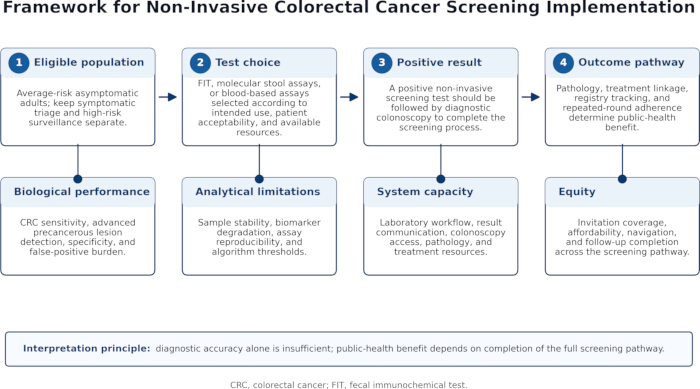
그림 1: 비침습적 대장암 선별 검사 시행을 위한 프레임워크. 이 그림은 인구 집단의 적격성, 검사 선택, 양성 결과 후의 추적 관찰, 결과 추적, 생물학적 성능, 분석적 한계, 시스템 수용 능력 및 형평성이 결합되어 비침습적 선별 검사가 공중 보건적 이점을 제공하는지 여부를 어떻게 결정하는지를 요약하여 보여준다. 여기에서 이 그림의 더 큰 버전을 확인하십시오.
| 테스트 카테고리 | 대표 분석 유형 | 대상 인구 / 용도 | 참조 표준 또는 근거 유형 | CRC 검출 증거 | 진행성 전암성 병변 증거 | 특이도 / 위양성 고려 사항 | 구현 해석 | 대표 참고문헌 |
| 분변 잠혈 검사 | 정량적 분변 헤모글로빈 면역측정법 | 평균 위험군 무증상 인구 집단 선별 검사; 매년 또는 2년마다 반복 사용 | 정확도 연구에서의 대장내시경; 인구 집단 연구에서의 체계적 검진 프로그램 결과 | 일반적으로 전암성 병변보다 확립된 대장암(CRC)에서 더 강하게 나타나며, 임계값, 병기, 위치, 성별, 연령 및 반복적인 순응도에 따라 차이가 있음 | 제한적이며 임계값에 의존함; 진행성 선종은 간헐적으로 출혈할 수 있음 | 임계값이 높을수록 대장내시경 수요가 감소하며, 임계값이 낮을수록 민감도는 증가하지만 양성 판정 건수가 증가합니다. | 등록부, 키트 배포, 실험실 처리 및 대장내시경 추적 관찰이 가능한 경우 가장 확장 가능성이 높은 1차 선택지 | (3,4,6,8,9,10,24,25,26) |
| 증상 기반 선별 검사에서의 FIT(분변 잠혈 검사) | 의뢰 임계값이 적용된 정량적 분변잠혈검사(FIT) | 대장암(CRC)을 시사하는 증상이나 징후가 있는 환자; 일반 인구 대상의 선별 검사와는 동일하지 않음 | 증상 기반 진단 경로 가이드라인 및 대장내시경 정밀 검사 | 사전 검사 확률이 선별 검사 집단과 다를 때, 조사의 우선순위를 정하는 데 유용함 | 단독 예방 검사용으로 설계되지 않음 | 임계값은 인구 집단 수준의 주기적 검진이 아니라, 분류 및 긴급 의뢰를 위해 설정되었습니다. | 평균 위험군 스크리닝과 별도로 해석하십시오. 무증상 스크리닝 정확도와 통합하지 마십시오. | 7 |
| 본래의 mt-sDNA-FIT | 분변 DNA 마커 및 분변 헤모글로빈 | 비침습적 대변 기반 검사를 선호하는 평균 위험군 성인 | 결장내시경 제어 평균 위험군 대상의 중추적 연구 | 중추적 근거에서 FIT보다 더 높은 단회 적용 대장암 민감도 | FIT보다 진행성 암 전단계 병변에 대한 민감도는 더 높으나, 여전히 불완전함 | FIT보다 낮은 특이도는 위양성률과 대장내시경 의뢰율을 증가시킨다 | 더 높은 민감도와 환자의 선호도로 인해 더 많은 비용과 대장 내시경 수요를 정당화할 수 있는 경우에 유용함 | (12,19) |
| 차세대 mt-sDNA-FIT | 업데이트된 대변 DNA/메틸화 마커 패널 및 분변잠혈검사(FIT) | 평균 위험군 선별 검사; 분석법별 해석 필요 | BLUE-C 대장내시경 대조 시험 | 평가 가능군에서 93.9%의 CRC 민감도를 보고함 | 진행성 전암성 병변에 대해 43.4%의 민감도가 보고됨 | 진행성 종양에 대한 특이도는 90.6%로 보고되었으며, 유병률이 낮은 선별 검사에서는 위양성 결과가 여전히 중요한 문제로 남습니다. | 단회 적용 검출에 있어 FIT보다 유망한 개선을 보이지만, 비용, 간격 및 대장내시경 수용 능력이 실행 가능성을 결정함 | (4,13,18,20,27) |
| mt-sRNA-FIT | 분변 RNA 전사체와 FIT 및 알고리즘 변수 | 평균 위험군 성인; 비침습적 대변 분자 스크리닝 목적으로 설계됨 | CRC-PREVENT 대장내시경 대조 연구 | 중추적 연구에서 I-III기 대장암(CRC)에 대한 높은 민감도 | 진행성 선종에 대해 중간 정도의 민감도를 보이며, 동일 연구 내 FIT보다 높은 수치를 나타냄 | FIT보다 특이도가 낮으며, 실험실 내 RNA 안정화 및 처리가 필요함 | 신규 분자 대변 검사 옵션으로서 유용하나, 장기적인 반복 주기 준수율 및 간격암(interval-cancer) 데이터가 여전히 필요한 상태임 | (4,14) |
| 혈액 기반 cfDNA 분석법 | 무세포 DNA, 메틸화 및 프래그먼토믹 신호 | 선호하는 대변 검사/내시경 옵션을 거부하거나 완료하지 않은 평균 위험군 성인 | ECLIPSE 임상시험 및 FDA/규제 요약 | ECLIPSE는 대장암(CRC)에 대해 83%의 민감도를 보고했다. | ECLIPSE는 진행성 전암성 병변에 대해 13%의 민감도를 보고했다. | 진행성 종양에 대한 특이도는 90%로 보고되었으며, 양성 결과 시 대장내시경 검사가 필요함 | 평소 검진을 받지 않는 사람들의 참여도를 높일 수는 있으나, 이를 예방 목적의 대변 검사와 동일한 것으로 구성해서는 안 된다. | (4,22,28) |
| 혈액 메틸화 분석법 | 메틸화된 SEPT9 및 기타 혈장 메틸화 패널 | 혈액 기반의 기회적 스크리닝 또는 보조적 검출 | 다양한 모집단을 대상으로 한 전향적 및 검증 연구 | 기존의 대장암(CRC) 사례의 일정 비율을 검출할 수 있음 | 일반적으로 진행성 선종/암전구 병변에 대해 약함 | 전구 병변의 위음성은 예방 효과를 제한함 | 더 강력한 예방 엔드포인트 증거가 확보될 때까지, 선호되는 검사를 거부하는 경우 보조 수단이나 대안으로 고려하는 것이 더 바람직함 | (29,30,31) |
| 위험 적응형 FIT 경로 | 설문지, 사전 스크리닝 또는 위험 점수와 결합된 분변 잠혈 검사(FIT) | 대장내시경 검사 역량의 우선순위 설정이 필요한 인구 집단 프로그램 | 인구 집단 코호트 및 모델링 증거 | 일부 환경에서 FIT 단독 검사보다 대장내시경 검사 대상자 선정 능력을 향상시킬 수 있음 | 국소적으로 보정 시 고급 신생물 검출률을 향상시킬 수 있는 잠재력 | 모델 보정 및 지역 유병률에 따라 달라짐 | 대장내시경 검사가 병목 현상을 일으키는 경우에 유용하며, 다양한 인구통계학적 집단에 걸친 검증이 필요함 | (11,38,39) |
| 최신 멀티오믹스 및 AI 모델 | 마이크로바이옴, 대사체학, 메틸화, 프래그먼토믹스(fragmentomics), 다유전자 위험 점수(PRS) 또는 AI 기반 위험 모델 | 향후의 스크리닝 및 트리아제 프레임워크; 검증된 검사법의 보편적 대체제는 아님 | 초기 검증 연구, 리뷰 및 위험 예측 코호트 | 위험 층화 또는 다중 모드 검출 능력을 향상시킬 가능성 | 고도 전암성 병변 검출 및 간격암과 비교하여 벤치마킹되어야 합니다. | 전향적 검증 없이는 과적합, 편향 및 낮은 전이 가능성의 위험이 높음 | 단순히 판별 성능 지표뿐만 아니라, 임상적 유용성, 형평성 영향 및 스크리닝 완료 여부를 통해 평가되어야 합니다. | (15,16,17,37,40,41,42) |
| 약어: APL, 진행성 전암성 병변; cfDNA, 세포 유리 DNA; CRC, 대장암; FIT, 분변 면역 화학 검사; mt-sDNA, 다중 표적 대변 DNA; mt-sRNA, 다중 표적 대변 RNA; PRS, 다유전자 위험 점수. 수치는 대표적인 분석 또는 연구별 결과이며 통합 추정치가 아닙니다. 인용 번호는 원고의 참고 문헌 목록에 해당합니다. | ||||||||
표 1: 비침습적 분변 및 혈액 기반 대장암 선별 검사를 위한 근거 체계. 이 표는 검사 방식, 바이오마커 표적, 대상 인구, 참조 표준, 주요 결과, 대표 성능 데이터 및 구현 해석을 요약합니다. 수치는 대표 연구 또는 규제 요약본에서 추출되었으며, 포함된 근거가 분석법, 임계값, 선별 검사 간격 및 연구 인구에 따라 다르므로 통합 분석하지 않았습니다. 이 표를 다운로드하려면 여기를 클릭하십시오.
| 스크리닝 경로 단계 | 일반적인 장벽 | 자원 또는 지역적 패턴 | 근거 / 데이터 유형 | 실질적 완화 방안 | 검사 선택을 위한 해석 | 대표 참고 문헌 |
| 적격성 확인 | 평균 위험군 성인을 대상으로 한 신뢰할 만한 등록부가 없으며, 연령 및 위험도에 따른 적격성 기준이 불분명함 | 기회주의적 또는 단편화된 시스템에서 흔히 나타남 | 프로그램 보고 및 CanScreen5 유형 지표 | 레지스트리, 일차 의료 명단 및 리콜 시스템 구축 | 어떠한 개별 분석법으로도 적격 대상자를 식별하지 못한 실패를 보완할 수 없습니다. | 23 |
| 초대 및 홍보 활동 | 낮은 인식, 언어 장벽, 두려움, 낙인, 낮은 위험 인지 | 농촌 지역, 의료 소외 계층, 청년층 및 소수 집단 | 이행 연구 및 지역사회 중재 | 문화적 적응 초대장, 리마인더, 내비게이션, 지역사회 보건 요원 | 수용 가능한 검사 선택지는 수동적으로 제공되기보다 적극적인 홍보 및 안내와 병행되어야 한다. | (32,33) |
| 액세스 테스트 | 비용, 보험 적용 범위, 약국/클리닉 접근성, 우편 물류 | 자원이 부족한 환경 및 무보험 인구 집단 | 가이드라인 및 구현 증거 | 보조금 지원 검사, 우편 발송 FIT 키트, 현장 진단 배포, 1차 의료 통합 | 검사 대상 범위 확장이 주요 병목 지점일 경우, 저비용의 분변잠혈검사(FIT)가 고비용의 분자 진단 검사보다 더 나은 성과를 낼 수 있다 | (3,4,6) |
| 시료 수집 또는 채혈 | 변혐오, 키트 복잡성, 지침 수행의 어려움, 운송 지연 | 연령, 문화, 문해력 및 거주 지역(도시/농촌)에 따라 다름 | 완결성 연구 및 분석법별 수집 요건 | 간소화된 키트, 그림 설명서, 다국어 자료, 클리닉 지원 워크플로 | 혈액 검사는 대변 수집을 거부하는 이들에게 도움이 될 수 있으나, 전구물질 검출 능력은 더 낮습니다. | (14,22,28,32) |
| 시료 회수 및 처리 | 반환 지연, 고온 노출, 우편 서비스의 불확실성, 실험실 제약 사항 | 고온 환경이나 원격지에서의 FIT 및 분변 분자 진단 검사에 더 중요한 사항 | 분석 전 및 실험실적 근거 | 안정화 완충액, 정의된 회수 기간, 지역 수집 지점, 실험실 품질 관리 | 분석법의 안정성과 인프라는 테스트 선택에 영향을 미쳐야 한다 | (9,14,21) |
| 결과 전달 | 양성 결과에 대한 이해 부족, 통보 지연, 취약한 전자 시스템 | 모든 자원 설정, 특히 분절된 의료 서비스 | 프로그램 실행 증거 | 중앙 집중식 보고, 환자 내비게이션, 전자 알림, 비정상 결과에 대한 명확한 설명 | 비침습적 검사 결과가 양성인 경우, 대장내시경 검사를 시행할 때까지는 선별 검사가 완료되지 않은 것입니다. | (10,23,36) |
| 추적 대장내시경 검사 | 제한된 내시경 검사 역량, 대기 시간, 비용, 운송, 시술에 대한 공포 | 많은 저소득 및 중소득 국가(LMIC)와 자원이 부족한 고소득 국가 환경에서의 주요 병목 지점 | 프로그램 연구 및 대장내시경 완료 증빙 | 내비게이션, 양성 검사 대상 대장내시경 예약 슬롯 확보, 임계값 보정, 수용 능력 계획 | 특이도가 낮은 검사는 용량이 제한적일 경우 대장내시경 서비스에 과부하를 줄 수 있습니다. | (10,13,22) |
| 병리와 치료의 연계 | 불충분한 병리, 외과, 종양학 또는 감시 서비스 | 암 치료 인프라가 제한적인 환경 | 공중보건 및 보건의료체계 근거 | 진단 및 치료 역량에 맞추어 스크리닝 확대 범위를 조정하십시오. | 선별 검사 확대 규모는 후속 진단 및 치료 역량을 초과해서는 안 된다. | (1,2,23) |
| 레지스트리 추적 | 참여도, 양성률, 추적 관찰, 간격암 및 결과 추적의 불가능함 | 성숙한 조직적 프로그램 외에서 흔히 발생하는 경우 | CanScreen5 및 프로그램 품질 지표 | 인구 등록부, 데이터 연결, 감사 대시보드 | 결과 추적이 없이는 프로그램의 효과를 입증할 수 없습니다. | 23 |
| 경제적 부담 가능성과 기회비용 | 높은 분자 진단 검사 비용은 전체 인구의 검사 범위(coverage)를 감소시킬 수 있습니다. | 예산이 제한된 모든 시스템 | 비용-효과 모델링 및 정책 분석 | 예산 영향 분석, 구간 모델링, 자원 계층화 경로 | 리소스당 가장 많은 완결된 형평성 스크리닝 에피소드를 생성하는 경로를 선택하십시오. | (18,19,20,27) |
| 보건 의료 체계 중단 | 팬데믹 또는 서비스 충격으로 인해 중단된 양성 판정 후 추적 조사 | COVID-19 및 기타 중단 상황 중에 관찰됨 | 실제 임상 환경의 복약 순응도 연구 | 비상 계획, 백로그 추적, 양성 검사 결과의 우선순위 지정 | 양성 검사 후 대장내시경 검사를 유지하는 것은 선별 검사의 이점을 보존하는 데 필수적입니다. | 36 |
| 약어: CRC, 대장암; FIT, 분변 면역화학 검사; LMICs, 저 및 중소득 국가. 이 표는 검진 경로에 따른 근거 기반의 시행 장벽을 나타내며, 행은 통합 섭취 추정치가 아닌 근거 유형과 실질적 함의를 요약합니다. 인용 번호는 원고의 참고문헌 목록과 일치합니다. | ||||||
표 2: 선별 검사 경로 전반에 걸친 실행 장벽 및 수용도 근거. 이 표는 검진 안내부터 추적 대장내시경 및 치료 연계까지의 장벽을 나타내며, 수용도 및 준수 데이터가 보고된 설정과 값이 일관되게 보고되지 않은 설정을 구분하고, 자원 계층화 실행에 따른 실질적인 시사점을 요약합니다. 이 표를 다운로드하시려면 여기를 클릭하십시오.
공개 사항
저자들은 이해 상충 관계가 없음을 밝힙니다.
감사의 글
연구비 지원 성명: 본 연구는 사천성 자연과학재단(지원 번호 2024NSFSC0718)의 지원을 받아 수행되었습니다.
참고문헌
- Bray F, et al. Global cancer statistics 2022: GLOBOCAN estimates of incidence and mortality worldwide for 36 cancers in 185 countries. CA Cancer J Clin. 2024;74(3):229–63.
- Morgan E, et al. Global burden of colorectal cancer in 2020 and 2040: incidence and mortality estimates from GLOBOCAN. Gut. 2023;72(2):338–44.
- Davidson KW, et al. Screening for colorectal cancer: US Preventive Services Task Force recommendation statement. JAMA. 2021;325(19):1965–77.
- Wolf AMD, et al. Colorectal cancer screening: an update to the American Cancer Society guideline, 2026. CA Cancer J Clin. 2026;76(3):e70083.
- Castells A, et al. Effect of invitation to colonoscopy versus faecal immunochemical test screening on colorectal cancer mortality (COLONPREV): a pragmatic, randomised, controlled, non-inferiority trial. Lancet. 2025;405(10486):1231–9.
- Shaukat A, et al. ACG clinical guidelines: colorectal cancer screening 2021. Am J Gastroenterol. 2021;116(3):458–79.
- Monahan KJ, et al. Faecal immunochemical testing (FIT) in patients with signs or symptoms of suspected colorectal cancer (CRC):): a joint guideline from the Association of Coloproctology of Great Britain and Ireland and the British Society of Gastroenterology. Gut. 2022;71(10):1939–62.
- Niedermaier T, et al. Sensitivity of fecal immunochemical test for colorectal cancer detection differs according to stage and location. Clin Gastroenterol Hepatol. 2020;18(13):2920–8.e6.
- Syrjänen K, et al. Colorectal cancer screening by fecal immunochemical tests (FIT): considerations on sampling and markers (Hb and Hb/Hp complex) of fecal occult blood (FOB). Anticancer Res. 2024;44(4):1513–23.
- Zorzi M, et al. Non-compliance with colonoscopy after a positive faecal immunochemical test doubles the risk of dying from colorectal cancer. Gut. 2022;71(3):561–7.
- Dong X, et al. Combining fecal immunochemical testing and questionnaire-based risk assessment in selecting participants for colonoscopy screening in the Chinese National Colorectal Cancer Screening Programs: a population-based cohort study. PLoS Med. 2024;21(2):e1004340.
- Imperiale TF, et al. Multitarget stool DNA testing for colorectal-cancer screening. N Engl J Med. 2014;370(14):1287–97.
- Imperiale TF, et al. Next-generation multitarget stool DNA test for colorectal cancer screening. N Engl J Med. 2024;390(11):984–93.
- Barnell EK, et al. Multitarget stool RNA test for colorectal cancer screening. JAMA. 2023;330(18):1760–8.
- Beniwal SS, et al. Current status and emerging trends in colorectal cancer screening and diagnostics. Biosensors (Basel). 2023;13(10):926.
- Hanna M, Dey N, Grady WM. Emerging tests for noninvasive colorectal cancer screening. Clin Gastroenterol Hepatol. 2023;21(3):604–16.
- Carethers JM, May FP. Next-generation noninvasive colorectal cancer screening. Annu Rev Med. 2026;77(1):161–75.
- Ladabaum U, et al. Projected impact and cost-effectiveness of novel molecular blood-based or stool-based screening tests for colorectal cancer. Ann Intern Med. 2024;177(12):1610–20.
- Ladabaum U, Mannalithara A. Comparative effectiveness and cost effectiveness of a multitarget stool DNA test to screen for colorectal neoplasia. Gastroenterology. 2016;151(3):427–39.e6.
- Lansdorp-Vogelaar I, et al. Cost-effectiveness of high-performance biomarker tests vs fecal immunochemical test for noninvasive colorectal cancer screening. Clin Gastroenterol Hepatol. 2018;16(4):504–12.e11.
- Wisse PHA, et al. The multitarget faecal immunochemical test for improving stool-based colorectal cancer screening programmes: a Dutch population-based, paired-design, intervention study. Lancet Oncol. 2024;25(3):326–37.
- Chung DC, et al. A cell-free DNA blood-based test for colorectal cancer screening. N Engl J Med. 2024;390(11):973–83.
- Zhang L, et al. CanScreen5, a global repository for breast, cervical and colorectal cancer screening programs. Nat Med. 2023;29(5):1135–45.
- Doubeni CA, et al. Fecal immunochemical test screening and risk of colorectal cancer death. JAMA Netw Open. 2024;7(7):e2423671.
- Levin TR, et al. Effects of organized colorectal cancer screening on cancer incidence and mortality in a large community-based population. Gastroenterology. 2018;155(5):1383–91.e5.
- Njor SH, Larsen MB, Søborg B, Andersen B. Colorectal cancer mortality after randomized implementation of FIT-based screening: a nationwide cohort study. J Med Screen. 2022;29(4):241–8.
- Ladabaum U, et al. Comparative effectiveness and cost-effectiveness of colorectal cancer screening with blood-based biomarkers (liquid biopsy) vs fecal tests or colonoscopy. Gastroenterology. 2024;167(2):378–91.
- U.S. Food and Drug Administration. Molecular and Clinical Genetics Panel executive SHORT ABSTRACT: Shield blood-based colorectal cancer screening test. Silver Spring, MD: U.S. Food and Drug Administration; 2024:https://www.fda.gov/media/178792/download.
- Shirley M. Epi proColon for colorectal cancer screening: a profile of its use in the USA. Mol Diagn Ther. 2020;24(4):497–503.
- Gallardo-Gómez M, et al. Serum methylation of GALNT9, UPF3A, WARS, and LDB2 as noninvasive biomarkers for the early detection of colorectal cancer and advanced adenomas. Clin Epigenetics. 2023;15(1):157.
- Mannucci A, Goel A. Stool and blood biomarkers for colorectal cancer management: an update on screening and disease monitoring. Mol Cancer. 2024;23(1):259.
- Beseler CL, et al. Investigating FIT kit completion for CRC screening in younger adults in rural areas. Discov Soc Sci Health. 2024;4(1):41.
- Sharif O, et al. Exploring the dietary, lifestyle, and demographic factors associated with risk for colorectal cancer and colorectal abnormalities in a fecal immunochemical test-positive population: a cross-sectional study in the Kingdom of Bahrain. Gastrointest Disord. 2024;6(3):622–33.
- Zeng F, et al. Application of fecal immunochemical test in colorectal cancer screening: a community-based, cross-sectional study in average-risk individuals in Hainan. World J Gastrointest Oncol. 2024;16(8):3445–56.
- Hsiao BY, et al. Insights into colorectal cancer screening: a multidatabase cohort study of over 1.5 million Taiwanese. Am J Prev Med. 2024;67(3):339–49.
- Richter B, et al. Impact of the COVID-19 pandemic on adherence to diagnostic colonoscopy after a positive non-invasive screening test for colorectal cancer in two Indiana healthcare systems. Prev Med Rep. 2025;49:102937.
- Duan C, Sheng J, Ma X. Innovative approaches in colorectal cancer screening: advances in detection methods and the role of artificial intelligence. Ther Adv Gastroenterol. 2025;18:17562848251314829.
- Tamlander M, et al. Genome-wide polygenic risk scores for colorectal cancer have implications for risk-based screening. Br J Cancer. 2024;130(4):651–9.
- Arnau-Collell C, et al. Evaluating the potential of polygenic risk score to improve colorectal cancer screening. Cancer Epidemiol Biomarkers Prev. 2022;31(7):1305–12.
- Torshizi Esfahani A, et al. Gut microbiome in colorectal cancer: metagenomics from bench to bedside. JNCI Cancer Spectr. 2025;9(3):pkaf026.
- Jayakrishnan TT, et al. Multi-omics machine learning to study host-microbiome interactions in early-onset colorectal cancer. NPJ Precis Oncol. 2024;8(1):146.
- Los B, et al. AI-driven pre-screening for colorectal cancer using complete blood counts: toward broader population impact. Int J Colorectal Dis. 2025;40(1):235.