가상 연예인 경험의 맥락에서 콘텐츠 품질이 가장 강력하게 만족도를 이끕니다; 만족도는 충성도를 통해 간접적으로 구매 의향을 증가시킵니다. 개인화는 만족도와 충성도 간의 연결을 강화하므로, 기업은 감정을 자극하고 내러티브에 일관성 있는 가상 연예인 콘텐츠와 개인화된 로열티 프로그램을 우선시해야 합니다.
이 콘텐츠를 보려면 JoVE 구독이 필요합니다. 로그인하거나 오늘 무료 평가판을 시작하세요.
연구 논문
가상 유명인 특성이 구매 의도를 어떻게 결정하는가: 구조 방정식 모델링을 이용한 자극-유기체-반응 프레임워크 검증
이 논문에서
요약
초록
최근 몇 년간 기업들은 다양한 미디어 채널에서 제품과 브랜드를 홍보하기 위해 가상 유명인사를 소개하기 시작했습니다. 이 연구는 자극-유기체-반응(SOR) 프레임워크를 활용하여 외모, 목소리, 콘텐츠 품질 등 가상 유명인의 매력 요소가 소비자 만족도, 충성도, 구매 의도에 어떻게 영향을 미치는지 실증적으로 조사합니다. 부분 최소제곱 구조 방정식 모델링(PLS-SEM)을 사용하여 가상 유명인 경험에 참여한 249명의 참가자를 대상으로 가설을 검증하였습니다. 연구 결과는 콘텐츠 품질이 사용자 만족도를 예측하는 가장 강력한 요인이며, 만족도가 충성도를 통해 구매 의도에 간접적으로 영향을 미친다는 것을 보여줍니다. 더 나아가, 개인화는 만족도와 충성도 관계를 완화하여, 개인화된 경험이 가상 유명인과 팬의 참여도를 높일 수 있음을 시사합니다. 이 연구 결과는 가상 셀러브리티 캠페인을 고려하는 기업들이 시각적 사실성보다는 감정을 자극하고 내러티브에 일관성 있는 콘텐츠에 더 집중해야 함을 시사합니다. 더 나아가, 충성도 구축 프로그램과 맞춤형 참여 솔루션에 대한 투자가 소비자 만족도를 지속 가능한 행동으로 전환하는 데 필수적입니다.
서론
유명인 홍보는 여전히 널리 사용되고 있으며, 기업들은 디지털 미디어 채널에서 가상 유명인을 점점 더 많이 채택하고있습니다. AI 및 관련 기술의 발전은 가상 유명인 형태를 다양화하고 확장성과 상호작용을 개선했습니다2.
가상 유명인사는 가상 캐릭터와 전통적인 유명인사의 하이브리드이며, 여기서 정의되는 것은 디지털로 만들어진 페르소나로, 반복적인 내러티브 기반 상호작용을 통해 대중의 인정과 지속적인 애착을 얻는 것입니다. 이 연구는 소비자 대상 디지털 마케팅에서 시청각 가상 유명인사에 초점을 맞춥니다. 기업들이 점점 더 이들을 소비자 행동에 영향을 미치기 위해 의존하지만, 연구는 가상 유명인 경험이 만족도, 충성도, 구매 의향으로 어떻게 연결되는지에 대해서는 제한적인 관심을 기울였습니다.
이전 연구에서는 행동, 인지, 정서적 관점4를 조사했으며, 신뢰성과 진정성 6,7, 인지된 진정성8, 정체성 공개9, 정보 질 10, 감정 반응11. 연구들은 외모, 목소리,콘텐츠 품질 같은 매력 단서도 강조했지만, 이러한 요인들이 소비자 결과를 어떻게 결정하는지 설명하는 데 종종 실패했습니다13,14. 그 결과, 긍정적인 평가가 항상 구매 의도로 이어지지 않으며, 만족과 구매 관계에 대한 증거는 엇갈립니다.
이 격차를 해소하기 위해 본 연구는 외모, 목소리, 콘텐츠 품질이 만족도, 충성도, 구매 의도에 어떻게 영향을 미치는지 살펴보고, SOR 프레임워크를 사용해 조정자로서 개인화를 테스트합니다.
이 연구는 가상 유명인의 매력을 외모, 목소리, 콘텐츠로 개념화하고, 충성도를 만족도와 구매 의도를 연결하는 핵심 메커니즘임을 명확히 하며, 개인화가 만족-충성관계의 증폭자임을 밝혀 기여합니다20.
자극-유기체-반응(SOR) 프레임워크
SOR 프레임워크는 환경 자극이 내부 상태와 행동 반응에 어떻게 영향을 미치는지21, 자극(S), 유기체 상태(O), 반응(R)의 연속을 통해 설명합니다. 메타버스, 게임, 소매, 광고, 전자상거래, 그리고 유명인 광고 등에서 널리 적용되어 왔습니다.22, 23, 24, 25, 26, 27, 28. 그러나 SOR은 가상 유명인 속성, 평가, 결과 간의 관계를 구조화하지만, 평가가 어떻게 행동 의도가 되는지에 대해서는 완전히 설명하지 못합니다. 따라서 본 연구는 관계 마케팅과 충성도 이론29를 통합하여 만족도–충성도–구매 의도 메커니즘을 명확히 합니다.
가상 유명인에 대한 소비자 반응은 점점 더 시청각 매력도와 콘텐츠 참여와 같은 경험적 단서에 의해 형성되고 있습니다 4,30. 외모와 목소리는 첫인상에 영향을 미치며, 콘텐츠의 질은 감정적·서사적 참여를 유지합니다14,31. 이러한 요소들이 긍정적인 평가를 촉진하지만, 이전 연구에서는 긍정적인 인식만으로는 구매 의향을 결정하지 못할 수 있습니다. 충성심과 헌신과 같은 관계 구성은 긍정적인 경험을 행동적 의도로 전환하는 것으로 보인다 32,33. 따라서 외모, 목소리, 내용 품질을 자극으로 모델링합니다; 유기체 상태로서의 만족과 충성; 구매 의도를 행동 반응으로 활용한다. 충성심은 심리적 헌신으로, 구매 의도는 성적 결과로 개념화됩니다.
유명인 광고
유명인 추천은 널리 사용되는마케팅 전략으로, 인정받는 인물들이 제품이나 서비스를 홍보하는 방식입니다. 특히 소셜 미디어 인플루언서의 증가로 전 세계적으로 사용이 확산되었습니다. 컴퓨터 생성 인플루언서는 주로 디지털 플랫폼을 통해 활동하는 인간 광고 대안으로 등장했습니다37.
광범위한 연구는 추천 효과39,40을 검토했으며, 출처 신뢰도41(의미 전이35), 확장 출처 매력도42, 유명인 브랜드 적합성43, 프로세스 이전 효과44와 같은 모델을 제안했습니다. 이 프레임워크들은 신뢰성, 매력, 상징적 의미 전달, 브랜드 일치45를 강조하여 가상 맥락에서 추천 메커니즘을 이해하는 데 기반을 제공합니다.
가상 유명인
최근 연구들은 AI 생성 인플루언서, VTuber, 가상 브랜드 홍보대사를 디지털 환경 전반에 걸쳐분석하며, 상호작용, 개인화, 진정성을 강조합니다. 미디어 풍부성 이론은 풍부한 미디어가 의사소통 효과를 높인다고 제안하며, 가상 캐릭터는 몰입형 다감각 상호작용을 통해 이러한 풍부함을 대표합니다48, 감정적·사회적 반응에 영향을 미칩니다.
"가상 유명인"은 다양한 디지털 페르소나를 포함하지만, 이 연구는 안정적인 정체성과 반복되는 콘텐츠를 가진 시각적으로 구현된 시청각 가상 유명인에 초점을 맞춥니다. 이전 연구들은 행동, 인지, 정서적 관점에서 그들의 영향을 정의합니다.4. 행동 연구는 참여 및 구매 행동을 조사합니다32,51; 인지 연구는 신뢰성, 진정성8점, 신원 공개9, 52점, 정보 품질10점을 강조합니다. 정서 연구는 감정적 태도를 강조합니다.11.
가상 유명인의 특징
출처 신뢰성 이론을 바탕으로, 연구는 가상 맥락에서 의인화, 매력, 신뢰성, 전문성, 그리고 기생사회적 상호작용을 조사해왔습니다. 1,32,53. 의인화는 소비자 반응54,55에 긍정적으로 영향을 미치며, Computers Are Social Actors 패러다임56과 일치합니다. 이 패러다임은 미디어 에이전트57, 챗봇58, 가상 인플루언서까지 확장됩니다. 하지만 가상 유명인들은현실성에 차이가 있으며, 언캐니 밸리 이론은 거의 인간 모습의 표현이 불편함을 불러일으킬 수 있음을 시사합니다59.
기술 발전으로 가상 유명인들은 역동적이고 콘텐츠 생성 에이전트로 전환되면서 콘텐츠 품질과 음성 표현력 같은 경험적 속성의 중요성이 커졌습니다. 연구에서는 합성 음성14, 얼굴 외모13, 외모-음성 일치60, 시청각 매력30, 컴퓨터 생성 얼굴에 대한 반응61을 조사했습니다.
이 연구는 외모, 목소리, 콘텐츠를 통해 가상 유명인의 매력을 개념화합니다. 신체적 매력은사회적 평가에 영향을 미치며, 이는 헤일로 효과와 일치하며,만족도를 높일 것으로 기대됩니다. 콘텐츠 품질은 가상 유명인 산출물의 내러티브적이고 경험적인 차원을 나타내며, 개념적으로 서비스 품질63, 64, 65와 구별됩니다.
만족
만족도는 경험이 기대에 부합하는지 소비자의 인지 및 정서적 평가를 반영하며, 기대에 비해 인지된 성과에 의해 형성됩니다.68,69. 온라인 맥락에서 널리 연구되었으며 성과 평가71의 핵심 주제입니다. 매력도는 서비스 환경에서 만족도에 영향을 미치며,목소리 매력도도 유사한 효과를 보였습니다74. 따라서 외모, 목소리, 콘텐츠 품질이 가상 연예인 맥락에서 만족도를 형성할 것으로 기대됩니다.
이에 따라 다음과 같은 가설들이 제안됩니다:
H1: 가상 유명인의 외모 매력은 소비자 만족도에 긍정적인 영향을 미칩니다.
H2: 가상 유명인의 목소리 매력은 소비자 만족도에 긍정적인 영향을 미칩니다.
H3: 가상 연예인들의 콘텐츠 품질은 소비자 만족도에 긍정적인 영향을 미칩니다.
충성심
본 연구에서는 충성도를 실제 반복 행동보다는 소비자의 심리적 헌신과 가상 유명인과의 유대감을 반영하는 태도적 충성도로 개념화한다19,33. 충성도는 장벽에도 불구하고 관계를 유지하려는 의지를나타내며, 온라인 환경(67,76), 관광77, VTuber 추천 맥락(33)에서 만족도의 결과로 널리 연구되었습니다. 따라서 다음과 같은 가설이 제안된다:
H4: 가상 유명인에 대한 소비자 만족도는 가상 유명인에 대한 충성도에 긍정적인 영향을 미칩니다.
가상 유명인들이 추천하는 상품과 서비스에 대한 구매 의도
구매 의도는 소비자가 제품이나 서비스를 구매할 가능성과 준비도를 반영하며, 만족도, 신뢰, 충성도, 즐거움과 같은 요인에 의해 영향을 받습니다. 충성도는 구매 의도를 강하게 예측하는 것으로 나타났습니다. 가상 유명인 맥락에서 연구는 구매 의도 효과 8,52와 매력과 구매 의도 사이의 만족도의 매개 역할을 조사했습니다81,82. 이에 따라 다음과 같은 가설들이 제안됩니다:
H5a: 소비자 만족도는 충성도를 통해 간접적으로 구매 의향에 긍정적인 영향을 미칩니다.
H5b: 충성도가 모델에 포함될 때 만족도와 구매 의도 간의 직접적인 관계는 유의미하지 않습니다.
H6: 가상 유명인에 대한 소비자 충성도는 구매 의향에 긍정적인 영향을 미칩니다.
개인화 (개인 맞춤형 서비스)
상호작용성은 사회학에서 유래했으며, 주로 기술을 통해 가능해진 관계 기반 커뮤니케이션83을 의미합니다. AI는 맞춤형 서비스를 통해 인터랙티브 마케팅을 강화했으며,46 개인화는 디지털 마케팅 효과의 중심이 되었습니다85. 개인화는 결과를 개선하고 참여와 가치 공동 창출을 지원하기 위해 개인에 맞춘 콘텐츠나 상호작용을 포함합니다86. 빅데이터와 디지털 추적의 발전으로 기업들은 행동 이력과 자기 공개 사용자 정보를 활용해 개인화된 커뮤니케이션을 할 수 있게 되었습니다 88,89,90.
이전 연구들은 개인화가 품질-만족도91, 신뢰-만족16, 기술 채택과 같은 주요 관계를 완화하는 것으로 나타났으며, 프라이버시 우려92와 기타 관계 경로24, 25, 26, 27도 마찬가지입니다. 본 연구에서는 개인화를 만족도와 충성도가 구매 관련 결과로 어떻게 연결되는지에 영향을 미치는 맥락적 조절자로 다뤄집니다. 다음과 같은 가설들이 제안된다:
H7a: 인지된 개인화는 만족도와 충성심 간의 관계를 강화합니다.
H7b: 인지된 개인화는 만족도와 구매 의도 간의 관계를 강화합니다.
H7c: 인지된 개인화는 충성도와 구매 의도 간의 관계를 강화합니다.
개념 연구 모델
그림 1 은 자극-유기체-반응 틀에 기반한 개념 모델을 제시합니다: 외모, 목소리, 내용(자극)이 만족도와 충성도(유기체)에 영향을 미치며, 구매 의도(반응)는 주로 충성심을 통해 발생합니다. 개인화는 만족도와 충성도 관계를 강화하며, 선택된 구조적 경로의 조절자로 모델링됩니다.
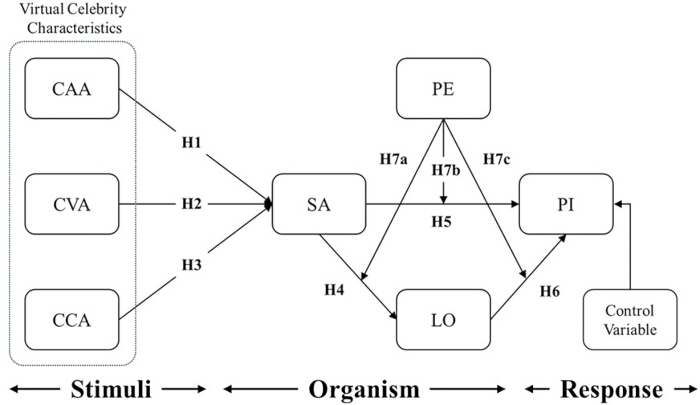
그림 1: 자극-유기체-반응 프레임워크를 기반으로 한 연구 모델. 가상 유명인 속성(외모, 목소리, 콘텐츠 품질)을 자극, 유기체 변수(만족도 및 충성도), 행동 결과(구매 의도) 간의 관계를 보여주는 개념 모델. 개인화는 만족과 충성심 관계의 조절자로 모델링됩니다. 충성심을 통한 간접적 효과도 묘사됩니다. 참고. CAA = 특징적인 외모 매력; CVA = 특징적인 목소리 매력; CCA = 특징적인 내용 매력도; LO = 충성심; PE = 개인화; PI = 구매 의도; SA = 만족. 이 그림의 더 큰 버전을 보시려면 여기를 클릭해 주세요.
액세스가 제한되었습니다. 이 콘텐츠를 보려면 로그인하거나 체험판을 시작하세요.
프로토콜
이 연구는 개인 식별 정보가 수집되지 않은 익명 온라인 설문조사를 포함했기 때문에 기관 최소 위험 지침에 따라 전면적인 윤리 심사 면제 자격을 얻었습니다. 설문 시작 시 연구 목적, 자발적 참여, 익명성, 데이터 사용에 대한 사전 동의서가 제시되었으며, 동의한 참가자만 진행했습니다.
1. 표본 크기 결정
최종 샘플(N = 249)은 PLS–SEM의 통계적 검정량 요구사항을 기준으로 결정되었습니다. 단일 내인성 구조에 대한 최대 예측 인자는 6개(가상 유명인 특성 3개와 만족도에 대한 3개 대조 변수; 만족도, 상호작용 용어, 충성도에 대한 대조군)였다. 검정력 분석 결과, α = 0.05와 0.80 검정력에서 중간 효과 크기(f2 = 0.15)를 감지하려면 약 97건의 관측이 필요했다. 달성된 표본 크기는 이 임계값을 초과하여 구조, 매개 및 조정 분석에 충분한 검정력을 확보했습니다.
2. 참가자 모집 및 선별
참가자들은 온라인 연구 패널 을 통해 목적적 비확률 표본추출을 통해 가상 유명인에 대한 사전 경험을 확인했습니다. 자격 요건은 18세 이상으로 제한되었습니다. 선별 및 주의력 검사 문항을 포함하였고, 무효 응답은 제외하였습니다. 목표 표본 크기에 도달하면 데이터 수집이 종료되었습니다.
3. 표준화된 정의 및 설문 지침
참가자들은 가상 유명인사를 안정적인 시각적 정체성, 목소리, 반복되는 내러티브 콘텐츠를 가진 디지털로 생성된 시청각 페르소나로 표준화된 정의를 제공받았습니다. 그들은 실제 경험에 따라 답변하라는 지시를 받았습니다.
4. 측량 기기 개발 및 관리
검증된 측정 척도는 가상 유명인 맥락에 맞게 조정되었으며(표 1), 모든 구성어가 7점 리커트 척도(1 = 강하게 반대; 7 = 매우 일치)를 사용해 측정되었다. 설문지는 외모, 목소리, 콘텐츠 품질, 만족도, 충성도, 개인화, 구매 의도, 인구통계 등 다양한 섹션으로 구성되어 있었습니다. 플랫폼 통제 덕분에 중복 제출이 방지되었습니다.
표 1: 측정 항목 및 출처. 각 구성체에 사용되는 측정 항목에는 외모 매력도, 목소리 매력도, 콘텐츠 품질, 만족도, 충성도, 개인화, 구매 의도가 포함됩니다. 축척 적응의 출처도 제공됩니다. 이 표를 다운로드하려면 여기를 클릭해 주세요.
5. 데이터 준비 및 정제
데이터는 CSV 형식으로 내보내졌습니다. 불완전, 불합격, 주의력 점검 실패 응답은 삭제되었습니다. 정화된 데이터셋은 분석을 위해 PLS–SEM 소프트웨어로 가져왔습니다.
6. 측정 및 구조 모델 평가
모든 구성물은 반사형으로 지정되었습니다. 신뢰성은 크론백의 알파 및 복합 신뢰도(≥ 0.70)를 사용하여 평가되었습니다. 수렴 타당도는 AVE를 사용해 평가되었고(≥ 0.50), 판별 타당도는 Fornell–Larcker 기준과 HTMT(< 0.90)를 사용해 평가되었습니다.
구조적 경로는 개념 모델에 따라 명시되었습니다. 다중공선성은 분산 인플레이션 팩터(VIF) 5.0< 사용하여 평가되었습니다. 5,000개의 하위 샘플로 부트스트래핑을 통해 경로 계수, t-값, p-값, 95% 신뢰구간, 효과 크기(f2)를 생성했습니다.
- 중재 분석
순차적 매개(가상 유명인 속성 → 만족도→ 충성도→ 구매 의도)는 부트스트랩 간접 효과(5,000개의 하위 표본)를 사용해 95% 신뢰구간으로 테스트되었습니다. - 감속 분석
상호작용 용어들은 개인화의 조절 효과를 테스트했습니다. 부트스트래핑은 조절 계수와 효과 크기를 추정하고, 상호작용 플롯은 조건부 효과를 보여주었습니다. - 예측 관련성
예측 성과는 눈가리개 및/또는 표본 외 절차를 통해 평가하였습니다. Q2_predict 값, RMSE, MAE를 선형 벤치마크 모델과 비교하였다. Q2_predict > 0과 PLS 오차가 벤치마크보다 낮을 때 예측 관련성이 지원되었습니다. - 보고 및 검증
모든 신뢰도, 타당도, 구조적, 매개 효과, 조절 및 예측 결과를 보고를 위해 종합하였습니다. 출력은 정확성과 일관성을 보장하기 위해 소프트웨어 결과와 교차 검증되었습니다.
7. 문제 해결 및 수정
선별 실패가 많을 경우, 자격 기준과 지침이 정교화되었습니다. 신뢰성(CR < 0.70) 또는 AVE(< 0.50)가 임계값 이하로 떨어지면, 이론적 일관성을 유지하면서 성능이 낮은 지표를 제거했습니다. 다중공선성 문제(VIF 초과 한계)는 구성 명세를 재평가하여 해결되었다. 매개 또는 조절 효과가 유의하지 않을 경우, 표본 크기 또는 운영화를 재평가하였습니다. 부트스트래핑은 안정적인 추정치를 보장하기 위해 5,000개의 하위 샘플을 사용했습니다.
액세스가 제한되었습니다. 이 콘텐츠를 보려면 로그인하거나 체험판을 시작하세요.
결과
표 2는 최종 표본(N = 249)의 인구통계학적 특성을 요약하는데, 여기에는 성별, 연령, 교육 수준, 가상 유명인과의 교류 빈도 등이 포함됩니다. 표본은 여성 52.6%로 성별 비율이 균형을 이루었으며, 주로 비교적 높은 교육 수준을 가진 젊은 성인에서 중년층으로 구성되었습니다. 참여 빈도는 주간에서 월간 범위에 집중되어 있으며, 일일 사용자 수는 적었습니다. 통제 변수로 포함했을 때, 사용 빈도는 종속 변수나 중심 관계에 유의미한 영향을 미치지 않아 주요 결과에 실질적인 영향이 없음을 나타냈다.
표 2: 표본 인구통계학과 참여 빈도. 응답자의 성별, 나이, 교육 수준, 가상 유명인 참여 빈도 등 특성에 대한 기술적 통계.
액세스가 제한되었습니다. 이 콘텐츠를 보려면 로그인하거나 체험판을 시작하세요.
토론
본 연구는 가상 유명인 특성이 SOR 프레임워크 내에서 만족도, 충성도, 구매 의도에 어떤 영향을 미치는지 조사하며, 개인화가 중재자 역할을 합니다. 세 가지 핵심 통찰이 드러납니다: 콘텐츠 품질이 외관과 목소리에 비해 만족도를 가장 크게 높여준다는 점; 만족도는 충성도를 통해서만 간접적으로 구매 의향에 영향을 미칩니다(간접 매개 방식); 개인화는 만족도와 충성도 관계를 강화하지만 구매 의도에 직접적인 영향을 미치지는 않습니다.
콘텐츠 품질의 두드러짐은 가상 유명인의 매력이 개념화되는 방식의 변화를 시사합니다. 이전 지지 연구들은 시각적 사실성과 표면적 단서를 강조했지만, 연구 결과는 내러티브의 일관성, 감정적 울림, 경험의 풍부함이 평가 반응 형성에 더 중심적인 역할을 한다는 것을 보여줍니다. 콘텐츠 품질은 반복되는 상호작용과 의미 축적을 구조화하여, 단순한 정보 입력이 아닌 관계적 결과의 기초로 자리매김합니다.
액세스가 제한되었습니다. 이 콘텐츠를 보려면 로그인하거나 체험판을 시작하세요.
공개 사항
저자들은 이해 상충이 없음을 선언합니다.
감사의 글
이 연구는 aSSIST 대학교의 연구 자금 지원을 받았습니다.
액세스가 제한되었습니다. 이 콘텐츠를 보려면 로그인하거나 체험판을 시작하세요.
재료
| 이름 | 회사 | 카탈로그 번호 | 댓글 |
|---|---|---|---|
| 퀄트릭스 버전: 해당 없음 | 퀄트릭스 LLC | 해당 없음 | 설문조사 코딩, https://www.qualtrics.com/ |
| 프로다작 버전: 해당 없음 | 다작 | 해당 없음 | 온라인 설문조사 패널 제공자, https://www.prolific.com/ |
| SmartPLS 버전: 4.0.1 | 스마트PLS GmbH | 해당 없음 | PLS-SEM 분석, https://www.smartpls.com/ |
| ChatGPT 버전: 5.2 | 오픈AI | 해당 없음 | 가독성 향상과 문법 검사 https://www.chatgpt.com/ |
참고문헌
- Erdogan, B. Z. Celebrity endorsement: A literature review. J Mark Manag. 15 (4), 291-314 (1999).
- Yu, J., Dickinger, A., So, K. K. F., Egger, R. Artificial intelligence–generated virtual influencer: Examining the effects of emotional display on user engagement. J Retail Consum Serv. 76, 103560(2024).
- Hoang, T. D., Su, Y. Virtual Celebrities and Consumers: A Blended Reality: How Virtual Celebrities are Consumed in the East and West. [Master’s Thesis]. , Copenhagen Business School. Copenhagen, Denmark. (2019).
- Yan, J., Xia, S., Jiang, A., Lin, Z. The effect of different types of virtual influencers on consumers’ emotional attachment. J Bus Res. 177, 114646(2024).
- Bowen, J. T., Chen, S. L. The relationship between customer loyalty and customer satisfaction. Int J Contem Hosp Manag. 13 (5), 213-217 (2001).
- De Brito Silva, M. J., De Oliveira Ramos Delfino, L., Alves Cerqueira, K., De Oliveira Campos, P. Avatar marketing: A study on the engagement and authenticity of virtual influencers on instagram. Soc Netw Anal Min. 12 (1), 130(2022).
- Chaihanchanchai, P., Anantachart, S., Ruangthanakorn, N. Unlocking the persuasive power of virtual influencer on brand trust and purchase intention: A parallel mediation of source credibility. J Mark Commun. 32 (3), 1-23 (2024).
- Lee, H., Shin, M., Yang, J., Chock, T. M. Virtual influencers vs. Human influencers in the context of influencer marketing: The moderating role of machine heuristic on perceived authenticity of influencers. Int J Hum Comput Interact. 41 (10), 1-18 (2024).
- Muniz, F., Stewart, K., Magalhães, L. Are they humans or are they robots? The effect of virtual influencer disclosure on brand trust. J Consum Behav. 23 (3), 1234-1250 (2024).
- Engström, J. Virtual influencers: Antecedents and typologizing. The SAGE Handbook of Social Media Marketing. , Sage. London. 276-292 (2022).
- Na, Y., Kim, Y., Lee, D. Investigating the effect of self–congruity on attitudes toward virtual influencers: Mediating the effect of emotional attachment. Int J Hum Comput Interact. 40 (18), 5534-5547 (2024).
- Stevenage, S. V., Neil, G. J., Hamlin, I. When the face fits: Recognition of celebrities from matching and mismatching faces and voices. Memory. 22 (3), 284-294 (2014).
- Suk, H., Laine, T. H. Influence of avatar facial appearance on users’ perceived embodiment and presence in immersive virtual reality. Electronics. 12 (3), 583(2023).
- Higgins, D., Zibrek, K., Cabral, J., Egan, D., Mcdonnell, R. Sympathy for the digital: Influence of synthetic voice on affinity, social presence and empathy for photorealistic virtual humans. Comput Graph. 104, 116-128 (2022).
- Anggraini, J. D., Adiwijaya, M., Herjanto, H. The moderating role of personalization on attitude–emotion–behavior (aeb) model. Indones Manag Account Res. 23 (2), 137-156 (2024).
- Hassan, N., Abdelraouf, M., El–Shihy, D. The moderating role of personalized recommendations in the trust–satisfaction–loyalty relationship: An empirical study of AI–driven e-commerce. Future Bus J. 11 (1), 66(2025).
- Gao, Y., et al. Trust in virtual agents: Exploring the role of stylization and voice. IEEE Trans Vis Comput Graph. 31 (5), 3623-3633 (2025).
- Vinoi, N., Shankar, A., Abdullah Alzeiby, E., Gupta, P., Agarwal, V. Unveiling customer intentions: Exploring factors driving engagement with hospitality virtual influencers. J Hosp Mark Manag. 34 (3), 325-354 (2025).
- Liu, C., Zhang, Y., Zhang, J. The impact of self–congruity and virtual interactivity on online celebrity brand equity and fans’ purchase intention. J Prod Brand Manag. 29 (6), 783-801 (2020).
- Honora, A., Wang, K. –Y., Chih, W. –H. Gaining customer engagement in social media recovery: The moderating roles of timeliness and personalization. Internet Res. 34 (6), 1963-1991 (2024).
- Mehrabian, A., Russell, J. A. The basic emotional impact of environments. Percept Mot Skills. 38 (1), 283-291 (1974).
- Abumalloh, R. A., Halabi, O., Nilashi, M. The relationship between technology trust and behavioral intention to use metaverse in baby monitoring systems’ design: Stimulus–organism–response (sor) theory. Entertain Comput. 52, 100833(2025).
- Ting, M. P., Min, C. D. What drives user churn in serious games? An empirical examination of the TAM, SOR theory, and game quality in Chinese cultural heritage games. Entertain Comput. 52, 100758(2025).
- Su, Y., Teo, P. C. A literature review on the impact of SOR theory on the retail industry and its applicability in studying blockchain technology's influence on consumer loyalty. Int J Acad Res Bus Soc Sci. 15 (3), 142-165 (2025).
- Li, X., Liu, Z., Chen, Y., Ren, A. Consumer avoidance toward message stream advertising on mobile social media: A stimulus–organism–response perspective. Information Technology & People. 38 (1), 23-47 (2025).
- Chang, H. H., Eckman, M., Yan, R. N. Application of the stimulus–organism–response model to the retail environment: The role of hedonic motivation in impulse buying behavior. Int Rev Retail Distrib Consum Res. 21 (3), 233-249 (2011).
- Kalam, A., Goi, C. L., Tiong, Y. Y. The effects of celebrity endorser on consumer advocacy behavior through the customization and entertainment intention–a multivariate analysis. Young Consum. 26 (1), 1-35 (2025).
- Zhou, T., Ma, X. Examining generative AI user continuance intention based on the SOR model. Aslib J Inf Manag. , (2025).
- Hussain, M., Javed, A., Khan, S. H., Yasir, M. Pillars of customer retention in the services sector: Understanding the role of relationship marketing, customer satisfaction, and customer loyalty. J Knowl Econ. 16 (1), 2047-2067 (2025).
- Akhtar, N., Siddiqi, U. I., Gugnani, R., Islam, T., Attri, R. The potency of audiovisual attractiveness and influencer marketing: The road to customer behavioral engagement. J Retail Consum Serv. 79, 103807(2024).
- Thielsch, M. T., Hirschfeld, G. Facets of website content. Hum Comput Interact. 34 (4), 279-327 (2019).
- Kim, H., Park, M. Virtual influencers’ attractiveness effect on purchase intention: A moderated mediation model of the product–endorser fit with the brand. Comput Hum Behav. 143, 107703(2023).
- The impact of VTuber endorsements on consumer satisfaction and brand loyalty in digital marketing. Hsu, K. K., Hung, W. –H. Proc Int Conf Electron Bus. (ICEB 2024), Zhuhai, China, , (2024).
- Shah, Z., Olya, H., Monkhouse, L. L. Developing strategies for international celebrity branding: A comparative analysis between Western and South Asian cultures. Int Mark Rev. 40 (1), 102-126 (2023).
- Mccracken, G. Who is the celebrity endorser? Cultural foundations of the endorsement process. J Consum Res. 16 (3), 310-321 (1989).
- Jun, M., Han, J., Zhou, Z., Eisingerich, A. B. When is celebrity endorsement effective? Exploring the role of celebrity endorsers in enhancing key brand associations. J Bus Res. 164, 113951(2023).
- Ozdemir, O., Kolfal, B., Messinger, P. R., Rizvi, S. Human or virtual: How influencer type shapes brand attitudes. Comput Hum Behav. 145, 107771(2023).
- Schouten, A. P., Janssen, L., Verspaget, M. Leveraged marketing communications. Ch. 12, 208-231 (2021).
- Khan, S., Sookhai, S. Reviewing the impact of country–of–origin on consumer purchase intention: The role of celebrity endorsement in existing literature. J Manag SMEs. 18 (2), 897-918 (2025).
- Schimmelpfennig, C., Hunt, J. B. Fifty years of celebrity endorser research: Support for a comprehensive celebrity endorsement strategy framework. Psychol Mark. 37 (3), 488-505 (2020).
- Hovland, C. I., Weiss, W. The influence of source credibility on communication effectiveness. Public Opin Q. 15 (4), 635-650 (1951).
- Frank, B., Mitsumoto, S. An extended source attractiveness model: The advertising effectiveness of distinct athlete endorser attractiveness types and its contextual variation. Eur Sport Manag Q. 23 (4), 1091-1114 (2023).
- Thomas, T., Johnson, J. The impact of celebrity expertise on advertising effectiveness: The mediating role of celebrity brand fit. Vision. 21 (4), 367-374 (2017).
- Chan, K., Fan, F. Perception of advertisements with celebrity endorsement among mature consumers. J Mark Commun. 28 (2), 115-131 (2022).
- Arora, N., Prashar, S., Tata, S. V., Parsad, C. Measuring personality congruency effects on consumer brand intentions in celebrity–endorsed brands. J Consum Mark. 38 (3), 251-261 (2021).
- Gao, Y., Liu, H. Artificial intelligence–enabled personalization in interactive marketing: A customer journey perspective. J Res Interact Mark. 17 (5), 663-680 (2023).
- Daft, R. L., Lengel, R. H. Organizational information requirements, media richness and structural design. Manage Sci. 32 (5), 554-571 (1986).
- Boyd, D. E., Koles, B. An introduction to the special issue “Virtual reality in marketing”: Definition, theory and practice. J Bus Res. 100, 441-444 (2019).
- Chen, H., Lou, C., Wang, Y., Lee, Y. Social virtual influencer effectiveness: Environmental factor and source trust. Soc Mark Q. , 15245004251342800(2025).
- Shen, Z. Shall brands create their own virtual influencers? A comprehensive study of 33 virtual influencers on instagram. Humanit Soc Sci Commun. 11 (1), 1-14 (2024).
- Lee, J., Kim, H. The moderating role of homophily and need for uniqueness in the relationship between anthropomorphism of virtual influencer and intention to imitate and word of mouth. Int J Hum Comput Interact. 41 (5), 1-12 (2025).
- Lim, R. E., Lee, S. Y. ”You are a virtual influencer!”: Understanding the impact of origin disclosure and emotional narratives on parasocial relationships and virtual influencer credibility. Comput Hum Behav. 148, 107897(2023).
- Kuo, Y. –H., Le, S. B. H. Authenticity meets aesthetics: Physical attractiveness as the equalizer for virtual and human influencers. Asia Pac Manag Rev. 30 (2), 100359(2025).
- Epley, N., Waytz, A., Cacioppo, J. T. On seeing human: A three–factor theory of anthropomorphism. Psychol Rev. 114 (4), 864(2007).
- Dabiran, E., Farivar, S., Wang, F., Grant, G. Virtually human: Anthropomorphism in virtual influencer marketing. J Retail Consum Serv. 79, 103797(2024).
- Nass, C., Steuer, J., Tauber, E. R. Proceedings of the SIGCHI Conference on Human Factors in Computing Systems. (CHI ’94). ACM. , 72-78 (1994).
- Gambino, A., Fox, J., Ratan, R. A. Building a stronger casa: Extending the computers are social actors paradigm. Hum Mach Commun. 1, 71-85 (2020).
- Gu, C., Zhang, Y., Zeng, L. Exploring the mechanism of sustained consumer trust in ai chatbots after service failures: A perspective based on attribution and casa theories. Humanit Soc Sci Commun. 11 (1), 1-12 (2024).
- Mori, M. The uncanny valley. Energy. 7 (4), 33-35 (1970).
- Alimardani, M., De Roode, R., Vaitonyte, J., Louwerse, M. M. Proceedings of the ACM International Conference on Intelligent Virtual Agents. (IVA ’24). , Glasgow, United Kingdom. 1-7 (2024).
- Miller, E. J., Foo, Y. Z., Mewton, P., Dawel, A. How do people respond to computer–generated versus human faces? A systematic review and meta–analyses. Comput Hum Behav Rep. 10, 100283(2023).
- Dion, K., Berscheid, E., Walster, E. What is beautiful is good. J Pers Soc Psychol. 24 (3), 285(1972).
- Bíziková, V., Psotová, E. Visitor profile of enological tourism in Slovakia: Implications of the regional analysis of the demand for wine–themed experience stay. J Infrastruct Policy Dev. 8 (11), 8072(2024).
- Lampropoulos, G. Combining artificial intelligence with augmented reality and virtual reality in education: Current trends and future perspectives. Multimodal Technol Interact. 9 (2), 11(2025).
- Sumi, R. S., Kabir, G. Satisfaction of e-learners with electronic learning service quality using the SERVQUAL model. J Open Innov Technol Mark Complex. 7 (4), 227(2021).
- Giese, J. L., Cote, J. A. Defining consumer satisfaction. Acad Mark Sci Rev. 1 (1), 1-22 (2000).
- Hellier, P. K., Geursen, G. M., Carr, R. A., Rickard, J. A. Customer repurchase intention: A general structural equation model. Eur J Mark. 37 (11/12), 1762-1800 (2003).
- Suchánek, P., Králová, M. Customer satisfaction and different evaluation of it by companies. Econ Res. 31 (1), 1330-1350 (2018).
- Gajewska, T., Zimon, D., Kaczor, G., Madzík, P. The impact of the level of customer satisfaction on the quality of e-commerce services. Int J Prod Perform Manag. 69 (4), 666-684 (2020).
- Hill, N., Brierley, J. How to Measure Customer Satisfaction. , Routledge. London. (2017).
- Grigoroudis, E., Siskos, Y. Customer Satisfaction Evaluation: Methods for Measuring and Implementing Service Quality. , Springer. New York. (2009).
- Söderlund, M., Julander, C. –R. Physical attractiveness of the service worker in the moment of truth and its effects on customer satisfaction. J Retail Consum Serv. 16 (3), 216-226 (2009).
- Koernig, S. K., Page, A. L. What if your dentist looked like Tom Cruise? Applying the match-up hypothesis to a service encounter. Psychol Mark. 19 (1), 91-110 (2002).
- Hey Alexa … Examining Factors Influencing the Educational Use of AI-Enabled Voice Assistants During the COVID-19 Pandemic. Rohan, R., Pal, D., Funilkul, S. in 15th International Conference on Knowledge and Smart Technology (KST), , 1-6 (2023).
- Oliver, R. L. Satisfaction: A Behavioral Perspective on the Consumer. , 2nd ed, Routledge. New York. (2014).
- Ariff, M. S. M., Yun, L. O., Zakuan, N., Ismail, K. The impacts of service quality and customer satisfaction on customer loyalty in internet banking. Procedia Soc Behav Sci. 81, 469-473 (2013).
- Nieves–Pavón, S., López–Mosquera, N., Jiménez–Naranjo, H. The factors influencing STD through SOR theory. J Retail Consum Serv. 75, 103533(2023).
- Dutta, B. Exploring the factors of consumer repurchase intention in online shopping. Int J Comput Sci Inf Secur. 14 (12), 520(2016).
- Seiders, K., Voss, G. B., Grewal, D., Godfrey, A. L. Do satisfied customers buy more? Examining moderating influences in a retailing context. J Mark. 69 (4), 26-43 (2005).
- Malik, M. E., et al. Importance of brand awareness and brand loyalty in assessing purchase intentions of consumer. Int J Bus Soc Sci. 4 (5), 167-171 (2013).
- Kim, H. –R., Yang, H. –M. The mediating effect of life satisfaction on relation between perceived physical attractiveness and health–promoting lifestyle in korean adults. Int J Environ Res Public Health. 18 (15), 7784(2021).
- Zhang, Y., He, J., Li, J. The role of flow experience in virtual influencer marketing: Insights into aesthetic, entertainment and parasocial influences on purchase intention. J Fash Mark Manag. 29 (6), 1109-1129 (2025).
- Blumer, H. Symbolic Interactionism: Perspective and Method. , University of California Press. Berkeley, CA. (1986).
- Quiring, O., Schweiger, W. Interactivity: A review of the concept and a framework for analysis. Communications - J Comm Res. 33 (2), 147-167 (2008).
- Casaca, J. A., Miguel, L. P. The influence of personalization on consumer satisfaction: Trends and challenges. Data-Driven Marketing for Strategic Success. , 256-292 (2024).
- Modersitzki, N., Phan, L. V., Mcdonald, S., Wright, A. G., Renner, K. –H. Personality psychology is getting personal: Advancing the field through personalization. Eur J Pers. 39 (1), 08902070251316915(2025).
- Manser Payne, E. H., Dahl, A. J., Peltier, J. Digital servitization value co–creation framework for ai services: A research agenda for digital transformation in financial service ecosystems. J Res Interact Mark. 15 (2), 200-222 (2021).
- Winter, S., Maslowska, E., Vos, A. L. The effects of trait–based personalization in social media advertising. Comput Hum Behav. 114, 106525(2021).
- Dijkstra, A. The psychology of tailoring-ingredients in computer-tailored persuasion. Soc Pers Psychol Compass. 2 (2), 765-784 (2008).
- Lee, J., Kim, C., Lee, K. C. Exploring the personalization–intrusiveness–intention framework to evaluate the effects of personalization in social media. Int J Inf Manag. 66, 102532(2022).
- Trivedi, J. P., Trivedi, H. Investigating the factors that make a fashion app successful: The moderating role of personalization. J Internet Commer. 17 (2), 170-187 (2018).
- Scortzaru, A. The moderating effect of personalization on the influence of consumer privacy concerns on mobile technology adoption. , Capella University. (2022).
- Henseler, J., Ringle, C. M., Sarstedt, M. A new criterion for assessing discriminant validity in variance–based structural equation modeling. J Acad Mark Sci. 43, 115-135 (2015).
- Hair, J. F., Ringle, C. M., Sarstedt, M. PLS–SEM: Indeed a silver bullet. J Mark Theory Pract. 19 (2), 139-152 (2011).
- Chin, W. W. Pls–graph user’s guide. 15, CT Bauer College of Business, University of Houston, USA. 1-16 (2001).
- Henseler, J., Hubona, G., Ray, P. A. Using PLS path modeling in new technology research: Updated guidelines. Ind Manag Data Syst. 116 (1), 2-20 (2016).
- Hair, J. F., Risher, J. J., Sarstedt, M., Ringle, C. M. When to use and how to report the results of PLS–SEM. Eur Bus Rev. 31 (1), 2-24 (2019).
- Shmueli, G., Ray, S., Estrada, J. M. V., Chatla, S. B. The elephant in the room: Predictive performance of PLS models. J Bus Res. 69 (10), 4552-4564 (2016).
- Cohen, J., Cohen, P., West, S. G., Aiken, L. S. Applied multiple regression/correlation analysis for the behavioral sciences. , Routledge. (2013).
- Sipos, D. The effects of AI–powered personalization on consumer trust, satisfaction, and purchase intent. Eur J Appl Sci Eng Technol. 3 (2), 14-24 (2025).
- Yao, Y., Meng, D., Wei, X. Empirical analysis of influencer attributes and social satisfaction effects on purchase intentions in Chinese social media. Sci Rep. 15 (1), 18860(2025).
- Rakovic, M. Comparative analysis of human and virtual influencers: The mediating role of perceived attractiveness and parasocial interaction in purchase intentions. , Tilburg University Tilburg. The Netherlands. (2023).
- Kong, H., Fang, H. Research on the effectiveness of virtual endorsers: A study based on the match-up hypothesis and source credibility model. Sustainability. 16 (5), 1761(2024).
- Huang, X., Chandra, A., Depaolo, C., Cribbs, J., Simmons, L. Measuring transactional distance in web-based learning environments: An initial instrument development. Open Learn. 30 (2), 106-126 (2015).
- Kim, C., Costello, F. J., Lee, J., Lee, K. C. Metaverse-based distance learning as a transactional distance mitigator and memory retrieval stimulant. Inf Process Manag. 62 (1), 103957(2025).
- Thielsch, M. T., Hirschfeld, G. Facets of website content. Hum Comput Interact. 34 (4), 279-327 (2019).
- Davlembayeva, D., Chari, S., Papagiannidis, S. Virtual influencers in consumer behaviour: A social influence theory perspective. Br J Manag. 36 (1), 202-222 (2025).
- Wang, Q., Long, S., Zeng, Y., Tang, L., Wang, Y. The creative behavior of virtual idol fans: A psychological perspective based on moa theory. Front Psychol. 14, 1290790(2023).
액세스가 제한되었습니다. 이 콘텐츠를 보려면 로그인하거나 체험판을 시작하세요.
재인쇄 및 허가
