천골미골 부위의 모소낭성 질환에 관한 1,014편의 출판물(2000–2025)을 대상으로 한 이 서지학적 분석은 전 세계적인 연구 동향, 협력 네트워크, 주제별 진화 및 신흥 연구 분야를 도출하며, 최소 침습 기술과 근거 중심의 예방 전략으로 진화하는 연구 중점을 밝히고 있습니다.
연구 논문
천미골 누공 질환 연구의 계량서지학적 및 지식 맵핑 분석 (2000–2025)
* These authors contributed equally
이 논문에서
요약
초록
Sacrococcygeal pilonidal disease (SPD) is an acquired inflammatory condition predominantly affecting young adults and adolescents, with a rising incidence and substantial clinical burden. Despite increasing research activity, the global scientific landscape of SPD, including research output, co-authorship patterns, knowledge diffusion pathways, thematic evolution, and emerging research frontiers, has not been systematically analyzed in the peer-reviewed literature. This study aimed to address this gap using a multitool bibliometric analysis. Bibliometric tools (VOSviewer, CiteSpace, and Pajek) were used to summarize the key features and generate visualizations. Articles and reviews on SPD published between 2000 and 2025 were retrieved from the Web of Science Core Collection. A total of 1,014 papers from 72 countries and 1,387 institutions were included. Research output steadily increased, with a marked acceleration after 2018. Turkey led in publication productivity and citation impact, whereas Germany, England, and the USA were key hubs for international collaboration. The University of Naples Federico II published the most articles, while the Technical University of Munich received the most citations. Dietrich Doll emerged as the most prominent and productive researcher in this field. Diseases of the Colon & Rectum was the most influential journal. Increasing research attention toward minimally invasive techniques, alongside continued interest in conventional surgical approaches, was identified. Current research interests emphasize less invasive strategies, etiological prevention, and evidence synthesis. This study provides valuable information for clinicians and researchers to better understand the current global status of SPD, recognize emerging research themes, and identify potential areas for future investigation and collaboration.
서론
천미골 모소낭 질환(Sacrococcygeal pilonidal disease, SPD)은 주로 청소년과 젊은 성인에게 영향을 미치는 후천성 염증성 질환으로, 무증상 중앙 함몰, 급성 농양 또는 통증을 동반한 누공이 특징입니다1,2,3. 이 질환의 발생률은 특히 유럽 국가들을 중심으로 임상 현장에서 증가하고 있습니다4,5,6. 독일의 경우 2005년에서 2017년 사이에 남성 100,000명당 평균 SPD 입원 건수가 43건에서 56건으로, 여성 100,000명당 14건에서 18건으로 증가했습니다5. 일반적으로 이 질환은 외과적 개입이 필요하며, 경제 활동 연령대 환자에게는 생산성 저하와 상당한 치료 비용을 초래하여 경제적 부담이 큰 질환이며, 전 세계 의료 시스템에 가해지는 부담을 가중시키고 있습니다7. 청소년의 경우, SPD는 상당한 신체적 및 심리적 부담을 주는데, 둔부 사이의 통증과 분비물로 인해 일상 활동, 스포츠 및 학교 출석에 지장을 받으며, 높은 재발률과 만성적인 경과로 인해 삶의 질이 저하되고 심리사회적 발달에 지장을 줍니다1,8.
페놀 주입술과 같은 보존적 비수술적 선택지가 관리법에서 중요한 비중을 차지하고 있음에도 불구하고1,9잠재적인 합병증과 재발 위험에도 불구하고, 수술은 증상이 있는 SPD의 표준 치료 방법으로 남아 있다.10모소낭성 농양에는 절개 및 배농이 권장됩니다.11, 또한 증상이 있는 만성 부비동 질환에 대해 수많은 외과적 치료법이 기술되어 왔습니다.1,10, 구체적인 선택은 주로 질환의 특성과 외과 의사의 숙련도에 따라 달라집니다.4역사적으로 만성 SPD에 대해서는 일차 봉합을 동반한 절제술 또는 이차 치유가 흔히 사용되는 외과적 접근법이었으며, 각 전략은 뚜렷한 장점과 한계를 가지고 있었습니다.3,12,13Karydakis 플랩, Limberg 플랩, Bascom cleft-lift를 포함한 정중선 외 폐쇄술은 양호한 치유 결과, 정중선 폐쇄술 대비 낮은 상처 이환율, 그리고 수용 가능한 재발률 덕분에 일차 폐쇄가 선택될 때 재건 옵션으로 점점 더 많이 채택되고 있습니다.4지난 10년 동안, 누공 절제술(예: Gips 술식)과 같은 제한적 절제술 및 내시경적 치료 접근법을 포함한 최소 침습적 수술 기법들이 기존의 절제술을 대체할 수 있는 덜 침습적인 대안으로서 임상 및 연구 분야에서 점점 더 많은 관심을 끌고 있습니다.1,2,14그럼에도 불구하고, SPD에 대한 최적의 수술 전략은 여전히 질환의 특성, 환자 요인 및 외과의의 선호도에 따라 달라지며, 사용 가능한 여러 접근법 간의 비교 효과에 대한 연구가 지속적으로 이루어지고 있다.
이러한 발전에도 불구하고, SPD에 관한 과학 문헌에는 체계적인 조사가 필요한 여러 거시적인 과제들이 존재합니다. 구체적으로, 이 분야의 연구 결과물은 빠르게 증가해 왔으나15, 연구 주제의 진화 궤적과 새로운 개척 분야는 정량적 관점에서 충분히 특성화되지 않았으며, 지식 확산 경로는 체계적으로 탐구되지 않았습니다. 또한, 연구 생산성은 지역별로 현저한 차이를 보이며16, 분야 내 협력이 과학적 교류와 지식 진전을 촉진하는 데 매우 중요함에도 불구하고17, 기여자 간의 협력 네트워크에 대한 종합적인 분석은 여전히 제한적입니다. 서지 분석(Bibliometric analysis)은 이러한 과제들을 해결할 수 있는 강력한 접근 방식으로 부상했으며, 치핵18,19, 항문 주위 누공20, 직장 탈출증21을 포함한 다양한 항문직장 질환을 조사하는 데 사용되어 왔습니다. SPD와 관련된 이전 연구들은 임상 증거 매핑15, 출판 생산성16, 인용 특성22, 방법론적 동향23 등 문헌의 특정 측면에 대해 귀중한 통찰력을 제공했습니다. 그러나 이러한 조사들은 주로 임상 증거 영역, 국가별 생산성, 고인용 논문 또는 연구 설계 특성과 같이 SPD 연구의 개별적 차원에 집중해 왔으며, 글로벌 협력 네트워크, 지적 구조 및 주제적 진화를 통합한 종합적인 평가는 여전히 부족한 실정입니다. 따라서 본 연구는 서지 분석 및 과학 매핑 접근 방식을 사용하여 SPD 연구에 대한 최신 글로벌 개요를 제공하고, 구체적으로 지식 구조를 특성화하며, 핵심 기여자를 식별하고, 국제 협력 패턴을 분석하며, 신흥 연구 핫스팟을 탐지하고, 향후 조사를 위한 잠재적 방향을 제시하는 것을 목표로 합니다. 본 논문의 보고는 BIBLIO 체크리스트24를 따릅니다.
프로토콜
데이터 소스
본 연구에서는 Clarivate Analytics에서 제공하는 Web of Science (WoS) Core Collection을 기본 데이터 소스로 활용하였다. 널리 사용되는 다학제적 과학 데이터베이스인 WoS Core Collection은 계량서지학적 분석을 위한 데이터 소스로 빈번하게 채택되어 왔다25. 이 데이터베이스에서 검색된 레코드는 VOSviewer와 같은 계량서지학 도구와 직접 호환되는 형식으로 내보낼 수 있다. SPD와 관련된 출판물을 식별하기 위해 포괄적인 검색 전략을 적용하였다. 문헌 포괄 범위를 최대화하고 잠재적으로 관련 있는 출판물을 누락할 위험을 최소화하기 위해, 특정 인덱스로 검색을 제한하지 않고 WoS Core Collection(재료 표 참조) 내에서 검색을 수행하였다.
검색 전략
잠재적으로 관련이 있는 모든 문헌을 식별하기 위해, 우선 WoS Core Collection의 주제(TS) 필드에서 다음과 같은 검색 쿼리를 사용하여 검색을 수행하였다: TS = (“pilonidal sinus” OR “pilonidal cyst” OR “pilonidal fistula” OR “pilonidal abscess” OR “pilonidal disease” OR “pilonidal tract” OR “sacrococcygeal cyst” OR “sacrococcygeal sinus” OR “sacrococcygeal fistula” OR “sacrococcygeal tract” OR “sacrococcygeal abscess” OR “sacrococcygeal pilonidal disease” OR “pilonidal cyst disease” OR “pilonidal sinus disease” OR “pilonidal fistula disease” OR “pilonidal tract disease” OR “pilonidal abscess disease” OR “jeep disease”). 두 명의 연구자(LC 및 WZ)가 2026년 2월 1일에 사전 정의된 검색 전략에 따라 독립적으로 문헌 검색을 수행하였으며, 의견 불일치 사항은 제3의 연구자(YL)와의 논의를 통해 해결하였다. 1차 검색 후, 출판 연도(2000–2025), 언어(영어), 문서 유형(Article 또는 Review)에 대해 사전 정의된 필터를 순차적으로 적용하였다. 1차 필터링 과정 이후, 남은 기록들을 대상으로 사전 정의된 선정 기준에 따라 제목 및 초록 검토를 통한 2단계 스크리닝을 진행하였다. 일부 증례 보고(case reports) 및 증례 시리즈(case series)가 WoS Core Collection에서 여전히 Article로 색인되어 있을 수 있으므로, 이러한 출판 유형은 해당 스크리닝 과정에서 추가로 식별하였다.
대상 선정 기준
천미골 모낭성 낭종(sacrococcygeal pilonidal disease)에 초점을 맞추고 하며 병인, 병태생리, 역학, 진단, 외과적 또는 보존적 관리, 치료 결과 또는 악성 변환을 포함하여 SPD와 관련된 유의미한 과학적 정보를 제공하는 문헌을 적격 대상으로 간주하였습니다. 본 서지학적 분석의 사전 정의된 범위 외의 문헌은 부적격으로 처리하였습니다. 본 연구의 목적은 개별 사례 기반의 출판물보다 연구 분야 전반의 출판 경향, 협력 패턴 및 지식 구조를 특성화하는 것이므로, 증례 보고 및 증례 시리즈는 제외하였습니다.
연구 선택
WoS Core Collection의 초기 검색 결과 SPD와 잠재적으로 관련된 2,600건의 레코드가 식별되었습니다. 사전 정의된 필터를 적용한 후, 이후의 제목 및 초록 검토를 위해 1,354건의 레코드가 유지되었습니다. 이 과정에서 비천미골 부위의 모소낭 질환 관련 연구, 카다버 연구 및 철회된 출판물을 포함하여 적격성 기준과 일치하지 않는 레코드는 제외되었습니다. 최종적으로 1,014건의 적격 출판물이 후속 서지 분석 대상으로 포함되었습니다. 포함된 출판물의 전체 레코드와 인용 정보는 후속 데이터 처리 및 시각화를 위해 일반 텍스트(.txt) 형식으로 내보냈습니다. 문헌 검색 및 스크리닝 과정의 상세 순서도는 그림 1A에 나타나 있습니다.
분석 방법
제목, 출판 연도, 인용 횟수, 핵심어, 저자, 국가/지역, 소속 기관, 학술지 및 참고문헌 목록을 포함한 서지학적 정보는 포함된 출판물과 내보내기 된 레코드로부터 수집되었습니다. 연간 출판 건수 및 출판 동향을 포함한 서지학적 정보의 데이터 정리, 표 작성 및 기본 요약에는 Microsoft Excel 2024가 사용되었습니다. 평균 연간 성장률은 다음과 같이 계산되었습니다: 평균 연간 성장률 = (최종 논문 수 / 시작 논문 수)^(1/n) − 1. 서지학적 분석 및 시각화를 위해 VOSviewer (version 1.6.20)26, CiteSpace (version 6.3.R3)27, Pajek (version 6.02)28의 세 가지 분석 도구가 사용되었습니다. 네트워크 구축에 앞서, 내보내기 된 WoS 레코드와 원본 출판 정보를 바탕으로 국가명, 기관명, 저자명, 학술지명 및 핵심어 간의 변이와 중복 항목을 수동으로 검토하고 표준화하였습니다. 핵심어 조화를 위해 철자 변형, 하이픈 사용 차이, 단수/복수 변형, 약어 및 밀접하게 연관된 표현을 포함하여 의미가 동일하거나 형식이 미세하게 다른 용어들을 통합된 용어로 병합하였습니다. 세부적인 핵심어 조화 절차와 그에 따른 변경 사항은 부록 표 1에 제공되어 있습니다.
VOSviewer를 사용하여 국가, 기관 및 저자 간의 협력 네트워크를 구축하고, 기여 학술지의 인용 네트워크와 인용 문헌의 공동 인용 네트워크를 시각화하였다. 모든 VOSviewer 분석에는 전체 계산법(Full counting)과 연관 강도 정규화(association strength normalization)를 적용하였다. 공동 저자 네트워크에서 링크 강도는 연결된 두 항목 간의 공동 저술 논문 수로 정의되었으며, 이는 직접적인 협력 강도를 반영한다. 총 링크 강도(TLS)는 네트워크 내의 다른 모든 연결 항목과 해당 항목 간의 누적 링크 강도를 나타내며, 국가, 기관 및 저자의 전반적인 협력 강도를 평가하는 데 사용되었다. 네트워크 클러스터링은 해상도 매개변수 1.0의 VOSviewer 클러스터링 알고리즘을 사용하여 수행되었다. 사전 정의된 최소 출판 임계값을 충족하는 항목을 시각화에 포함하였으며, 임계값은 국가의 경우 논문 10편 이상, 기관 및 학술지의 경우 5편 이상, 저자의 경우 2편 이상으로 설정하였다. 인용 문헌 시각화의 경우, 인용 횟수가 50회 이상인 문헌을 포함하였다. CiteSpace를 사용하여 키워드 클러스터링, 타임라인 시각화, 그리고 키워드 및 인용 문헌의 인용 버스트(citation burst) 탐지를 수행하였다. 분석 기간은 2000년 1월부터 2025년 12월까지로 설정하였으며, 간격은 1년 단위로 하였다. 키워드 및 인용 문헌 분석은 상위 N개 선택 기준을 20으로 하여 수행하였다. 네트워크 구조를 최적화하기 위해 패스파인더 가지치기(Pathfinder pruning), 슬라이스 네트워크 가지치기 및 병합 네트워크 가지치기를 적용하였다. 키워드 클러스터는 로그 가능도비(LLR) 알고리즘을 사용하여 식별하였다. 인용 버스트 탐지는 최소 버스트 지속 기간을 2년으로 설정한 CiteSpace의 기본 Kleinberg 버스트 탐지 모델을 사용하여 수행하였다. 마지막으로, 시각화 품질과 해석력을 높이기 위해 Pajek 소프트웨어를 사용하여 VOSviewer로 생성된 네트워크의 그래픽 레이아웃을 정교화하였다.
결과
Bibliometric analysis of global publication output
Based on a predefined search strategy and inclusion criteria, 1,014 relevant publications were retrieved from the WoS Core Collection database, originating from 255 peer-reviewed journals. These comprised 916 articles and 98 reviews, with a total of 18,036 citations and an average of 17.79 citations per publication. In total, 3,942 authors from 72 countries and 1,387 institutions contributed to publications on SPD. Figure 1B illustrates the annual and cumulative publication output in this field from 2000–2025, with publication counts rising from nine in 2000 to a peak of 87 in 2025, a nearly tenfold increase, indicating a growing research interest in this topic. A compound annual growth rate of 9.52% was calculated using the geometric mean approach. From 2018 onwards, annual publication output has increased noticeably, while cumulative output has followed a stable upward trajectory, reaching 1,014 publications by 2025, indicating a robust and persistent expansion of research output in this area.
Contributions and collaboration of countries/regions
A total of 72 countries (and regions) contributed to the field of SPD from 2000 to 2025. Table 1 shows the top 10 most productive countries ranked by publications. Among these, Turkey leads with 294 publications (28.99%), followed by the United States (114, 11.24%), England (80, 7.89%), Germany (76, 7.50%), and Italy (76, 7.50%). In terms of total citations, Turkey ranked first with 5,282 citations, with an average of 17.97 citations per publication, followed by the United States (1,996, 17.51), Germany (1,783, 23.46), England (1,548, 19.35), and Italy (1,488, 19.58). Notably, Scotland achieved an outstanding average of 66.80 citations per publication despite having only 10 publications, indicating relatively high-impact research from this country. A network visualization of 21 countries (each with at least 10 publications) was generated using VOSviewer (Figure 2A). In this network, node size reflects publication volume, line thickness indicates link strength between connected countries, and colors denote clusters of similar collaboration patterns. Despite Turkey’s leading productivity, cooperation occurred more frequently between the United States and several European countries (e.g., Germany, England, Italy, Switzerland, and the Netherlands). Regarding TLS, a measure of collaborative intensity in co-authorship networks, Germany ranked first (TLS = 46), followed by the United States (TLS = 38), England (TLS = 33), Italy (TLS = 29), and Switzerland (TLS = 29), reflecting their central position in international collaboration.
Contributions and collaboration of institutions
In this analysis, a total of 1,387 institutions were involved in research pertaining to SPD, with 68 institutions contributing five or more articles. Table 2 presents the top 10 most prolific and most collaborative institutions. Regarding publication volume, the University of Naples Federico II is the leading contributor to SPD research with 28 publications and 615 citations, followed by Technical University of Munich (17, 674) and University of Bern (15, 608). As for collaborative intensity, the University of Sheffield has the strongest inter‑institutional collaboration (TLS = 70), followed by the University of Bern (TLS = 66) and St Mark’s Hospital (TLS = 61). Notably, six of the top 10 institutions by TLS are located in England, highlighting its central role in collaborative networks. A network of key institutions and their collaborative relationships is illustrated using VOSviewer (Figure 2B).
Contributions and collaboration of authors
Overall, 3,942 authors contributed to studies on SPD in this analysis. Table 3 offers an overview of the top 10 authors ranked by publication count, total citations, and TLS. Notably, Dietrich Doll from Germany ranks highest in publication volume, total citations, and collaborative intensity during the study period (2000–2025). With respect to publication output, following Doll (48 papers), other highly prolific authors are Marco Milone (18 papers) from Italy and Markus M. Luedi (16 papers) from Switzerland. Regarding total citations, Sven Petersen (660 citations), Markus M. Luedi (620 citations), and Iain J. D. McCallum (574 citations) also demonstrate strong scholarly impact. Figure 3A depicts collaborative relationships among authors with more than one publication, where node size represents publication volume, node color denotes cluster affiliation, and line thickness reflects link strength between connected authors. Most collaborative ties are concentrated among European researchers, particularly from Germany, Italy, and England. However, among the 544 authors who published at least two articles, only 132 formed large‑scale collaborations, represented as nodes scattered across 11 clusters of different colors in the network. The network shows several core collaborative groups, whereas many authors remained isolated or belonged to smaller collaborative teams.
Analysis of contributing journals
From 2000–2025, 255 academic journals have published articles in the realm of SPD. Table 4 lists the top 10 contributing journals with the most publications. The most prolific journal is Diseases of the Colon & Rectum from the United States, ranking first with 55 papers and 2,667 citations. This journal, with an impact factor (IF) of 3.7 and a Q1 Journal Citation Reports (JCR) ranking, has consistently served as the leading journal and is ranked among the major journals in colorectal surgery. Other productive journals include Techniques in Coloproctology (42 papers, 945 citations, IF 2.9, Q1), Colorectal Disease (41 papers, 829 citations, IF 2.7, Q1), and International Journal of Colorectal Disease (34 papers, 942 citations, IF 2.3, Q2), all of which have a strong reputation in this domain. In addition, the Journal of Pediatric Surgery has a considerable number of publications (33 papers, 781 citations, IF 2.5, Q1), highlighting current attention to the pediatric population affected by this disease.
A citation network of journals (Figure 3B) was constructed using VOSviewer software, with each node representing a journal, and the link strength between two journals reflecting the number of times that one journal has cited articles from the other. Nodes with higher link strength indicate journals that are heavily cited by others and play a central role in knowledge dissemination. A total of 50 journals with at least five papers were included in this network, and the above productive journals occupied central positions and were highly interconnected with other sources. Figure 3C presents an overlay visualization of the journal citation network, where node colors indicate the average publication year of relevant articles in each journal. In this overlay map, a color gradient ranging from white to red is used, with white nodes representing journals with earlier average years. For instance, Diseases of the Colon & Rectum and American Journal of Surgery have earlier average years than 2010, highlighting their foundational significance in this research period.
Analysis of keywords
Supplementary Table 2 lists the top 30 most frequently occurring keywords in SPD research from 2000–2025. Apart from the core terms “pilonidal sinus” and “disease”, keywords such as “primary closure”, “excision”, and “surgery” also appeared prominently in the literature, highlighting the importance of surgical treatment in this condition. The CiteSpace software to generate a keyword clustering network and timeline map to identify research topics and their evolution in SPD research. The parameter settings were as follows: the time slicing was from January 2000 to December 2025 with one-year intervals per slice, and the node type was “keyword”. To simplify the network structure and concentrate on core hotspots, the selection criterion was set to the top 20 items per slice. Network pruning and clustering were performed according to the predefined CiteSpace settings. The resulting network comprised 231 nodes and 1,011 links, forming 15 clusters labeled by the log likelihood ratio (LLR) method. The modularity Q value was 0.8134, indicating a significant clustering structure ( > 0.3), and the weighted mean silhouette S value was 0.9203, suggesting reliable clustering results ( > 0.7). Figure 4A presents the keyword clustering network generated by CiteSpace, while Figure 4B shows the timeline visualization of keyword clustering results, illustrating the temporal progression of focal topics in this research area. A total of 10 major clusters were retained in the clustering network, each labeled by a cluster number (0–9) and its top LLR term, representing distinct research themes in the SPD literature. As shown in Supplementary Table 3, the largest clusters are Cluster 0 “pilonidal disease” (size = 31, S = 0.984), followed by Cluster 1 “recurrence rate” (26, 0.861), Cluster 2 “Limberg flap” (20, 0.814), and Cluster 3 “Karydakis flap” (19, 0.777). Notably, seven clusters have S values above 0.9 (Cluster 0, 4–9), indicating high internal homogeneity and strong alignment with their assigned thematic labels. Supplementary Table 4 displays all keywords and their frequency of occurrence in each cluster. In the timeline map, each horizontal line corresponds to a keyword cluster, with its color indicating the cluster identity. The nodes on each line represent individual keywords, and their positions along the line indicate the year when the keyword first appeared in the literature.
Figure 5 shows the top 25 keywords with the strongest citation bursts, which reflect the thematic evolution and research hotspots in this field. The leftmost side of the dark blue bars in the map corresponds to the year when the keyword first appeared, while the red bars represent the duration of keyword bursts. The keyword with the highest burst strength was “minimally invasive treatment” (strength 14.35, 2019–2025), followed by “risk factors” (12.60, 2019–2025) and “video-assisted ablation” (10.63, 2017–2023). Research on this topic has experienced a two-phase trajectory. In the early period (2000–2013), bursts were mainly associated with surgical techniques such as “rhomboid flap”, “y‑advancement flap”, “z‑plasty”, “transposition”, and “follicle removal”, along with the keyword “randomized trial”, suggesting that the initial focus likely centered on evaluating a variety of asymmetric closure and full‑thickness flap techniques (also referred to collectively as “flattening procedures”) through clinical trials. In the latter period (2014–2025), keywords such as “video-assisted ablation”, “crystallized phenol”, and “minimally invasive treatment” experienced strong and relatively recent bursts, indicating an evolving research focus with increasing attention toward less invasive techniques. Furthermore, the most recent and ongoing hotspots include “risk factors”, “hair”, “guidelines”, and “society”, reflecting growing interest in etiological and preventive aspects, as well as increasing attention toward evidence synthesis and guideline-related research.
Analysis of cited references
Table 5 lists the top 10 most cited publications in this analysis. The most frequently cited article is “Easy and successful treatment of pilonidal sinus after explanation of its causative process” published in ANZ Journal of Surgery by Karydakis GE in 1992. Karydakis also authored the paper “New approach to the problem of pilonidal sinus,” published in The Lancet in 1973, which is the earliest publication in this list. The second most cited article is “Patient characteristics and symptoms in chronic pilonidal sinus disease,” published in the International Journal of Colorectal Disease by Sondenaa K in 1995. Of note, although all other highly cited references were published before 2010, the article “Common surgical procedures in pilonidal sinus disease: A meta-analysis, merged data analysis, and comprehensive study on recurrence” (Scientific Reports, Stauffer VK et al, 2018) ranks seventh with 165 citations.
Figure 6A displays the top 25 references with the strongest citation bursts, where the red bars correspond to the duration of reference bursts. Among these publications, the article by Stauffer VK et al published in Scientific Reports in 2018 exhibits the highest burst strength (40.61), reflecting its influence within the field. Figure 6B presents the co-citation network visualization of cited references, comprising 83 articles that met the 50-citation threshold. In the network, nodes represent cited references, and their sizes reflect citation frequency. Connections between nodes indicate that the two references have been co‑cited by the same later publication, with thicker lines representing stronger co‑citation relationships. Node colors indicate cluster membership, with nodes sharing the same color belonging to the same thematic cluster.
DATA AVAILABILITY:
The datasets generated and analyzed during the current study are included in this article as supplementary materials. The bibliographic records used for this analysis were retrieved from the Web of Science Core Collection, and the relevant search strategy and screening process are described in the manuscript. All data necessary to reproduce the analyses and interpret the findings are provided within this article and its Supplementary Tables 1–4 and Supplementary File 1.
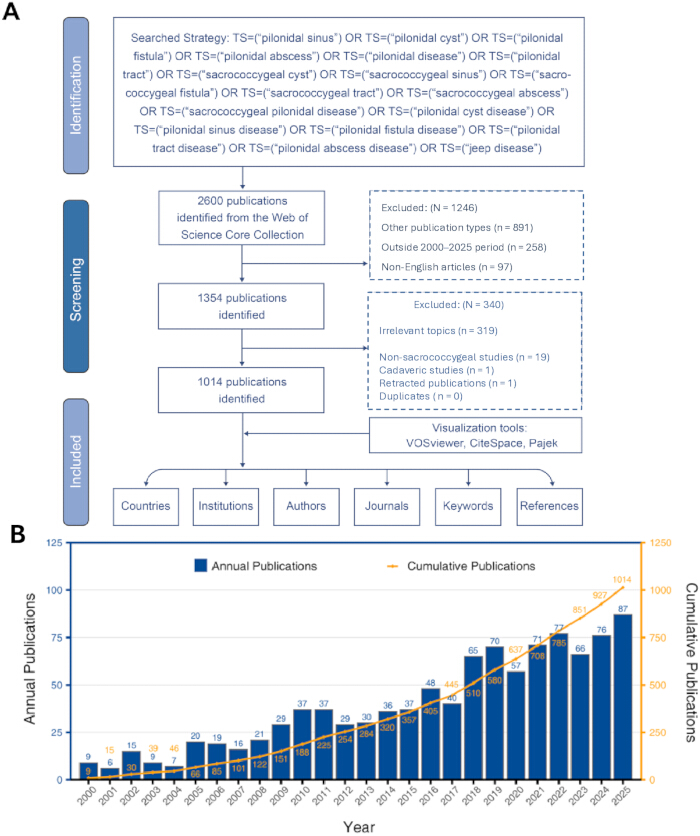
Figure 1: Study selection and publication trends. (A) Flow diagram illustrating the stepwise screening and inclusion process based on the WoS Core Collection, resulting in a final curated dataset of 1,014 original English-language publications on SPD. (B) Annual and cumulative numbers of publications on sacrococcygeal pilonidal disease between 2000 and 2025. Please click here to view a larger version of this figure.
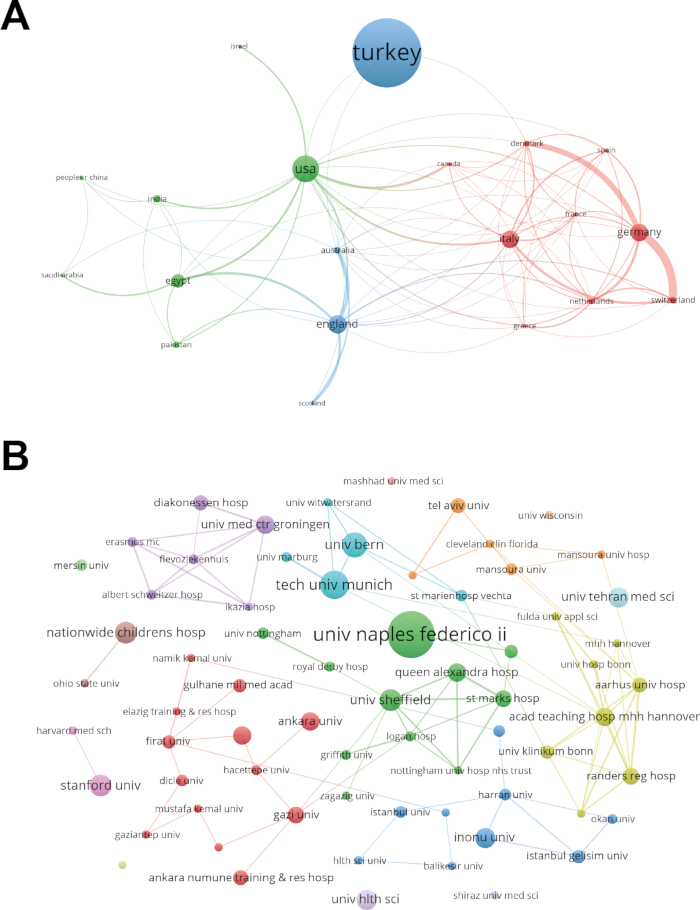
Figure 2: Network maps of the productive countries and institutions. (A) Collaborative network of countries. (B) Collaborative network of institutions. In both networks, larger nodes represent higher publication volume, node colors indicate different clusters, and thicker lines indicate stronger links between connected nodes. Please click here to view a larger version of this figure.
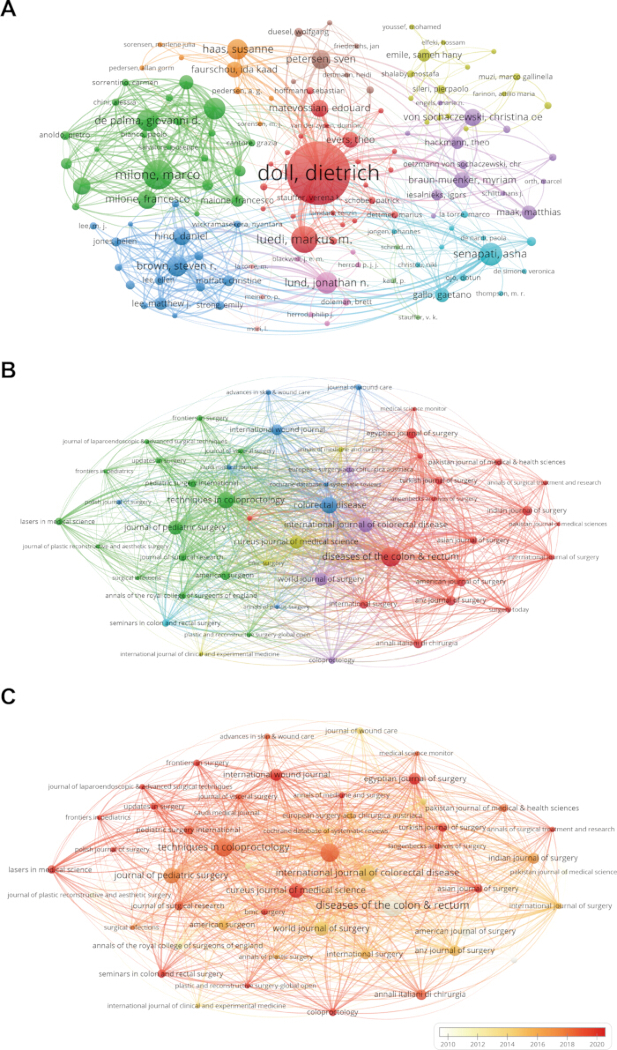
Figure 3: Network maps of prolific authors and journals. (A) Collaborative network visualization of authors. (B) Citation network visualization of contributing journals. (C) Overlay visualization of contributing journals. In (A) and (B), larger nodes represent higher publication volume, node colors indicate different clusters, and thicker lines indicate higher link strength between connected items. In (C), node colors indicate the average publication year of articles in each journal, using a gradient from white (earlier years) to red (later years). Please click here to view a larger version of this figure.
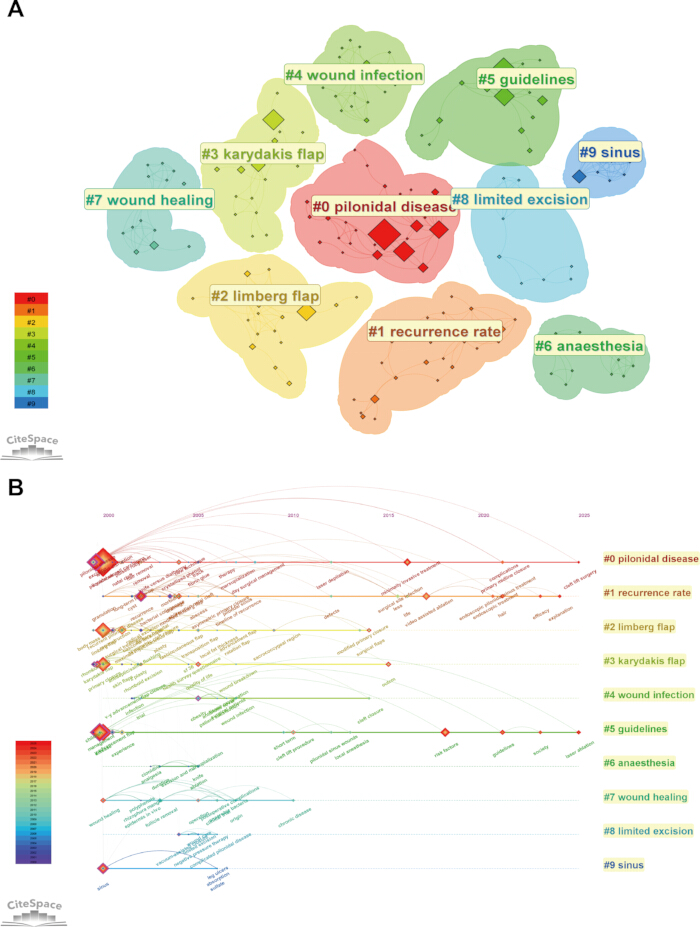
Figure 4: Keyword clustering and temporal evolution. (A) Keyword clustering network generated by CiteSpace, with clusters labeled by the log likelihood ratio (LLR) method. (B) Timeline visualization of keyword clustering analysis, showing the temporal progression of research topics from 2000–2025. Please click here to view a larger version of this figure.
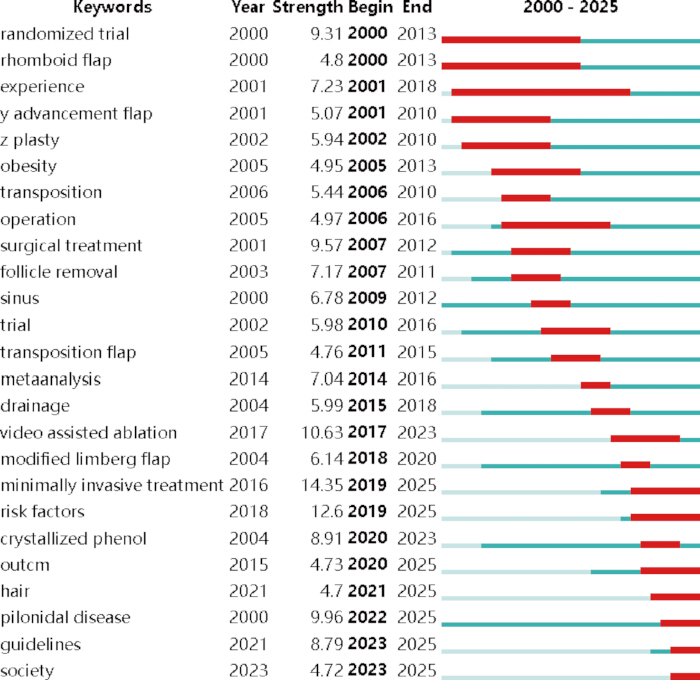
Figure 5: Top 25 keywords with the strongest citation bursts. The dark blue bars indicate the temporal distribution of each keyword, and the red bars denote burst duration. Please click here to view a larger version of this figure.
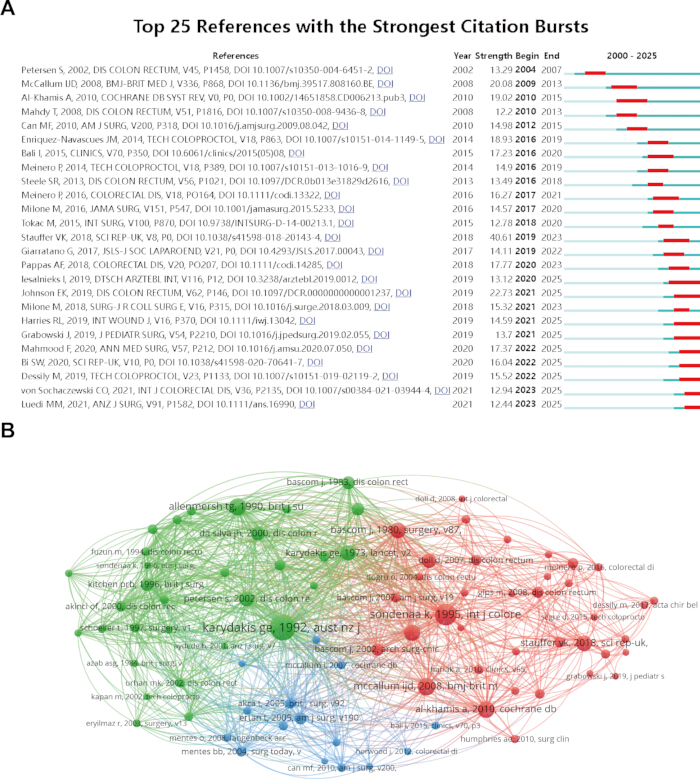
Figure 6: Visualization of references. (A) Top 25 references with the strongest citation bursts. (B) Co-citation network visualization of cited references. In this network, each node represents a cited reference; node size reflects citation frequency; line thickness denotes co‑citation strength; and colors represent thematic clusters. Please click here to view a larger version of this figure.
Table 1: Top 10 most productive countries in SPD research. This table presents country rankings by publication count, total citations, and total link strength. Abbreviations: ACPP = average citations per publication; TC = total citations; TLS = total link strength. Please click here to download this file.
Table 2: Top 10 most prolific institutions in SPD research. This table presents the top 10 institutions ranked according to total citations and total link strength, respectively. Abbreviations: TC = total citations; TLS = total link strength. Please click here to download this file.
Table 3: Top 10 highest-impact authors in SPD research. This table presents the top 10 authors ranked by publication count, total citations, and total link strength. Abbreviations: TC = total citations; TLS = total link strength. Please click here to download this file.
Table 4: Top 10 most productive journals. This table presents the top 10 journals ranked by publication count, with corresponding total citations, average citations per publication, Journal Citation Reports quartile, and impact factor. Abbreviations: ACPP = average citations per publication; IF = impact factor; JCR = Journal Citation Reports; TC = total citations. Please click here to download this file.
Table 5: Top 10 most cited references. This table presents the top 10 references ranked by citation count, including title, first author, journal, and publication year. Please click here to download this file.
Supplementary Table 1: Keywords harmonization. Keyword harmonization and standardization are applied during bibliometric data preprocessing.Please click here to download this file.
Supplementary Table 2: Keywords. The top 30 most frequently occurring keywords in SPD research from 2000 to 2025. Keywords with a greater log-likelihood ratio are more representative of the clusters. Abbreviations: LLR, log-likelihood ratio. Please click here to download this file.
Supplementary Table 3: Keyword clusters. The 10 largest keyword clusters and the top 5 label terms (by log-likelihood ratio) for each cluster.Please click here to download this file.
Supplementary Table 4: Frequency of keywords. All keywords and their frequency of occurrence in each cluster.Please click here to download this file.
Supplementary File 1: Completed BIBLIO checklist for reporting bibliometric reviews.
The checklist details the manuscript page, line, and section corresponding to each BIBLIO reporting item.Please click here to download this file.
토론
1,014편의 출판물을 대상으로 한 이 종합적인 계량서지학적 합성은 21세기 1분기 동안의 SPD 연구 궤적을 기술하며, 출판 활동의 증가, 주제적 다양성의 확장 및 진화하는 연구 관심 분야를 가진 영역임을 보여줍니다. 본 연구는 과학적 성과물의 확장을 도표화할 뿐만 아니라, 더욱 결정적으로 현대 SPD 연구의 특징인 기저의 지적 구조, 협력 역학 및 진화하는 연구 주제를 해체하기 위한 거시적 정량적 프레임워크를 제안합니다16,22. 기술 통계를 넘어 성능 분석, 과학 매핑 및 버스트 탐지를 통합한 이 다중 도구 계량서지학적 접근 방식은 방대하고 파편화된 문헌에 대한 독특하고 체계적인 합성을 제공합니다. 지식 네트워크를 시각화함으로써, 우리는 핵심 기여자, 특정 학술지의 중심성29 및 글로벌 협력 네트워크의 이질적 구조30를 특성화하였으며, 이를 통해 연구 동향을 이해하고 향후 협력을 위한 잠재적 방향에 대한 유용한 참고 자료를 제공하였습니다. 이미 다른 항문직장 분야18,19,20,21에서 효과적임이 입증된 이 방법론은 연구 동향에 대한 객관적인 평가를 가능하게 하며, 주로 외과적 술식에 집중된 연구에서 예방, 증거 합성 및 환자 중심 결과물을 포함하는 광범위한 조사로의 진화에 대한 통찰력을 제공합니다1,31.
연구 결과, 기존의 외과적 접근법에 대한 지속적인 연구와 더불어 최소 침습 기술 및 병인론적 예방으로 연구 관심이 점차 이동하며 상당한 주제적 진화가 이루어지고 있음이 드러났습니다. 키워드 클러스터링 및 버스트 탐지 분석 결과는 이 분야의 연구 우선순위가 변화하고 있음을 보여주며1,2,14, 최근 몇 년 동안 “minimally invasive treatment” 및 “video-assisted ablation”과 같은 용어들이 지속적으로 높은 강도의 버스트를 나타냈습니다. 이러한 저침습적 접근 방식의 등장은 치료 부담을 줄이고 환자 중심의 결과물을 개선하려는 관심이 증가하고 있음을 반영하는 것일 수 있습니다14,30,31. 하지만, 이러한 계량서지학적 결과는 주로 연구 우선순위의 변화를 나타내는 것이며, 가용한 외과적 기술들 간의 임상적 우월성에 대한 확정적인 증거는 아닙니다. 동시에 “risk factors”, “hair”, “guidelines”와 같은 키워드의 급증은 질환 발생에서 털 삽입의 역할과 같은 병인론적 요인을 점점 더 탐구하며 연구 환경이 성숙해가고 있음을 나타내며32,33, 증거 합성 및 향후 가이드라인 개발에 대한 관심이 높아지고 있음을 반영합니다4,34. 이러한 주제적 다양화는 SPD 연구가 수술 기법을 넘어 병인론적, 예방적 관점 및 증거 합성의 관점으로 점차 확대되고 있음을 시사합니다.
분석 결과, SPD 연구 분야 내에서 국제 협력 패턴의 변동성이 나타났으며, 이는 SPD 연구 커뮤니티 내의 국제적 연결성을 강화할 수 있는 기회를 시사합니다. 출판물 수는 터키가 압도적이었으나16, 국제 협력 패턴은 국가별로 상당한 차이를 보였으며, 특히 여러 서유럽 국가들이 더 강력한 국가 간 협력 연결망을 보여주었습니다. 이러한 차이는 SPD 연구의 글로벌 협력 네트워크가 이질적인 구조를 가지고 있음을 강조합니다. 이러한 협력 네트워크의 불균등한 분포는 향후 근거 창출을 위해 광범위한 다국적 협력이 가져올 수 있는 잠재적 이점을 뒷받침합니다30. 이전의 방법론적 분석에 따르면, 이 분야는 여전히 단일 센터의 후향적 코호트 및 이질적 데이터의 메타 분석에 의존하고 있으며, 무작위 대조 시험(RCT)의 비율이 우려할 정도로 감소하고 있다고 보고되었습니다23. 향후 연구는 더 활발한 국제 협력과 다양한 인구 집단 및 의료 환경에서 서로 다른 수술 접근법을 비교할 수 있도록 잘 설계된 전향적 연구를 통해 이점을 얻을 수 있을 것입니다34.
이러한 발견의 잠재적 영향은 두 가지 측면이 있습니다. 우선, 연구자와 임상의에게 현재 SPD 연구 현황에 대한 구조적인 개요를 제공하며, 지식의 공백, 새롭게 떠오르는 주제 및 향후 조사가 필요한 잠재적 영역을 식별하는 데 도움을 줄 수 있습니다. 핵심 학술지29와 영향력 있는 저자를 식별함으로써 연구자들이 해당 분야의 기성 지식 기여자 및 잠재적인 협력 네트워크를 인식하는 데에도 도움이 될 수 있습니다. 연구자와 과학 단체에게는 “guidelines” 및 “society”와 같은 버스트 키워드의 등장이 연구 관심도가 높아지는 영역을 강조하며, 증거 합성 및 다기관 연구11,34를 포함한 향후 조사의 잠재적 방향을 제시합니다. 향후 연구 방향은 단순한 기술적 수술 사례 보고를 넘어 가설 기반의 협동 연구로 나아감으로써 이득을 얻을 수 있을 것입니다. 현재의 문헌 현황에서 제안된 잠재적 우선순위는 다음과 같습니다. (1) 5~10년 후의 재발을 일차 평가 변수로 설정하여, 가장 유망한 최소 침습 기술과 기존의 정중선 외 플랩 절차를 비교하는 충분한 통계적 검정력을 갖춘 RCT를 수행하는 것34; (2) 특히 청소년 인구에서 치료가 삶의 질과 심리 사회적 웰빙에 미치는 전체적인 영향을 포착할 수 있는 표준화된 환자 보고 결과 측정 도구를 개발하고 검증하는 것1,8; (3) 고위험군에서 레이저 제모와 같은 예방적 중재의 역할을 견고한 장기 코호트 연구를 통해 탐색하여, 일차성 및 재발성 질환 예방에 대한 비용 효율성을 평가하는 것입니다.
이러한 결과의 맥락을 파악하기 위해 본 합성 연구의 방법론적 한계점을 인정해야 합니다. 첫째, 단일 데이터베이스(WoS Core Collection)에 의존하고 영어 출판물로 제한함으로써, 다른 주요 과학 데이터베이스나 영어가 아닌 언어로 발표된 중요한 연구들이 의도치 않게 제외되었을 수 있습니다. 둘째, 모든 서지학적 분석과 마찬가지로, 인용 지표는 시간에 따른 자연스러운 인용 축적의 영향을 받으므로 본질적으로 오래된 출판물에 유리하며 최근 혁신 기술의 현대적 영향력을 완전히 포착하지 못할 수 있습니다. 마지막으로, 인용 횟수와 출판 빈도는 과학적 관심과 활동의 대리 지표일 뿐, 방법론적 엄격함이나 임상적 유용성을 직접적으로 측정하는 척도는 아닙니다. 향후 연구에서는 여러 데이터베이스를 통합하고 알트메트릭스(altmetrics)를 활용하여 더 광범위한 사회적 및 임상적 영향을 파악함으로써, 전통적인 인용 기반 분석을 보완하고 해당 분야의 진화에 대한 보다 종합적인 관점을 제공하여 이러한 한계점을 완화할 수 있을 것입니다.
1,014편의 문헌을 대상으로 한 이번 계량서지학적 분석은 2000년부터 2025년까지의 미골낭종(sacrococcygeal pilonidal disease) 연구에 대한 종합적이고 체계적인 개요를 제공하며, 글로벌 지형, 협력 네트워크, 주제별 진화 및 신흥 분야를 매핑합니다. 해당 분야는 연구 성과가 뚜렷하고 지속적으로 증가해 왔으며, 터키가 가장 생산적인 국가로 부상한 반면 독일, 영국 및 미국은 국제 협력 네트워크에서 상대적으로 두드러진 역할을 보였습니다. Dietrich Doll 교수는 이 분야에서 가장 많은 연구 성과를 내고 높은 인용 횟수를 기록한 연구자로 돋보입니다. 주제별 진화 분석 결과, 기존의 외과적 접근법에 대한 지속적인 조사와 더불어 최소 침습 기술에 대한 연구 강조점이 증가하고 있으며, 재발은 문헌에서 여전히 핵심적인 결과 측정 지표로 남아 있습니다. "minimally invasive treatment", "risk factors", "hair", "guidelines"를 포함한 버스트 키워드로 강조된 신흥 연구 주제들은 덜 침습적인 전략, 원인론적 예방 및 근거 합성에 대한 관심이 증가하고 있음을 시사합니다. 본 연구는 글로벌 생산성 패턴, 협력 구조 및 주제별 진화를 통합함으로써 SPD 연구의 지식 공백, 신흥 연구 우선순위 및 잠재적 협력 기회를 식별하기 위한 정량적 참조 프레임워크를 제공합니다.
공개 사항
저자들은 이해상충이 없음을 밝힙니다. 데이터 수집, 데이터 분석, 결과 해석 또는 도표 작성에 인공지능 도구가 사용되지 않았습니다. ChatGPT (OpenAI)는 언어 교정 및 원고 다듬기 용도로만 사용되었습니다.
감사의 글
저자들은 선언할 감사 사항이 없습니다.
재료
| 이름 | 회사 | 카탈로그 번호 | 댓글 |
|---|---|---|---|
| CiteSpace | Drexel University | 버전 6.3.R3 | https://citespace.podia.com/ |
| Microsoft Excel | Microsoft Corporation | 버전 2024 | https://www.microsoft.com/microsoft-365/excel |
| Pajek | 류블랴나 대학교 | 버전 6.02 | https://mrvar.fdv.uni-lj.si/pajek/ |
| VOSviewer | 라이덴 대학교 | 버전 1.6.20 | https://www.vosviewer.com/ |
| Web of Science 핵심 컬렉션 | Clarivate | 해당 사항 없음 | https://www.webofscience.com/ |
참고문헌
- Gil LA, Deans KJ, Minneci PC. Management of Pilonidal Disease: A Review. JAMA Surg. 2023;158(8):875-883.
- Di Castro A, Guerra F, Levi Sandri GB, Ettorre GM. Minimally invasive surgery for the treatment of pilonidal disease. The Gips procedure on 2347 patients. Int J Surg. 2016;36(Pt A):201-205.
- McCallum IJ, King PM, Bruce J. Healing by primary closure versus open healing after surgery for pilonidal sinus: systematic review and meta-analysis. BMJ. 2008;336(7649):868-871.
- Wiinblad IM, Ulrichsen J, Brandstrup B. Outcome After Surgical Treatment for Chronic Pilonidal Sinus Disease: A Systematic Review of Common Surgical Techniques. Dis Colon Rectum. 2025;68(5):515-529.
- Oetzmann von Sochaczewski C, Gödeke J. Pilonidal sinus disease on the rise: a one-third incidence increase in inpatients in 13 years with substantial regional variation in Germany. Int J Colorectal Dis. 2021;36(10):2135-2145.
- Faurschou IK, Erichsen R, Doll D, Haas S. Time trends in incidence of pilonidal sinus disease from 1996 to 2021: A Danish population-based cohort study. Colorectal Dis. 2024;27(1):e17227.
- Brown SR et al. Real-world practice and outcomes in pilonidal surgery: Pilonidal Sinus Treatment Studying The Options (PITSTOP) cohort. Br J Surg. 2024;111(3):znae009.
- Salimi-Jazi F et al. Burden of pilonidal disease and improvement in quality of life after treatment in adolescents. Pediatr Surg Int. 2022;38(10):1453-1459.
- Calikoglu I et al. Phenol Injection Versus Excision With Open Healing in Pilonidal Disease: A Prospective Randomized Trial. Dis Colon Rectum. 2017;60(2):161-169.
- Walker H, Hamid O, Ramirez J, Glancy D. Diagnosis and management of sacrococcygeal pilonidal disease in primary care. BMJ. 2023;382:e071511.
- Johnson EK, Vogel JD, Cowan ML, Feingold DL, Steele SR. Clinical Practice Guidelines Committee of the American Society of Colon and Rectal Surgeons. The American Society of Colon and Rectal Surgeons’ Clinical Practice Guidelines for the Management of Pilonidal Disease. Dis Colon Rectum. 2019;62(2):146-157.
- Vartanian E, Gould DJ, Lee SW, Patel KM. Pilonidal Disease: Classic and Contemporary Concepts for Surgical Management. Ann Plast Surg. 2018;81(6):e12-e19.
- Al-Khamis A, McCallum I, King PM, Bruce J. Healing by primary versus secondary intention after surgical treatment for pilonidal sinus. Cochrane Database Syst Rev. 2010;2010(1):CD006213.
- Tien T, Athem R, Arulampalam T. Outcomes of endoscopic pilonidal sinus treatment (EPSiT): a systematic review. Tech Coloproctol. 2018;22(5):325-331.
- Kumar M, Clay WH, Lee MJ, Brown SR, Hind D. A mapping review of sacrococcygeal pilonidal sinus disease. Tech Coloproctol. 2021;25(6):675-682.
- Doll D, Stauffer V, Diekann M, Van Wyk P, Luedi MM. Turkey is leading in the 21st century pilonidal sinus disease research. Turk J Surg. 2020;36(3):284-290.
- Dhole S, Mahakalkar C. Advancements and Innovations in the Surgical Management of Sacrococcygeal Pilonidal Sinus: A Comprehensive Review. Cureus. 2024;16(5):e61141.
- Chen X. Global knowledge mapping and technological evolution in hemorrhoid therapy: a multi-tool bibliometric analysis. Updates Surg. 2025. doi:10.1007/s13304-025-02460-2.
- Wang Z et al. Top 100 most-cited articles on hemorrhoids: A bibliometric analysis and visualized study. Front Surg. 2022;9:1021534.
- Chen Q, Li Y, Wang X, Li H. Hot topics in global perianal fistula research: A SCOPUS-based bibliometric analysis. Medicine (Baltimore). 2020;99(17):e19659.
- Feng L, Wang M, Li X, Yang Q. A bibliometric analysis of surgical treatment for rectal prolapse. Medicine (Baltimore). 2025;104(32):e43763.
- Şahin A, Şimşek G. The One Hundred Most Cited Articles from Turkey about Pilonidal Disease: A Bibliometric Study. Turk J Colorectal Dis. 2022;32:123-133.
- Doll D et al. One century of pilonidal sinus research: trends in study size and the declining share of randomized controlled trials. Coloproctology. 2025;47:353-359.
- Montazeri A et al. Preliminary guideline for reporting bibliometric reviews of the biomedical literature (BIBLIO): a minimum requirements. Systematic Reviews. 2023;12(1):239.
- Thelwall M. Bibliometrics to webometrics. J Inf Sci. 2008;34(4):605-621.
- van Eck NJ, Waltman L. Software survey: VOSviewer, a computer program for bibliometric mapping. Scientometrics. 2010;84(2):523-538.
- Chen C. Searching for intellectual turning points: progressive knowledge domain visualization. Proc Natl Acad Sci U S A. 2004;101 Suppl 1(Suppl 1):5303-5310.
- Mrvar A, Batagelj V. Analysis and visualization of large networks with program package Pajek. Complex Adapt Syst Model. 2016;4:6.
- Becerra AZ et al. A New Bibliometric Index: The Top 100 Most Disruptive and Developmental Publications in Colorectal Surgery Journals. Dis Colon Rectum. 2022;65(3):429-443.
- Wagner CS, Leydesdorff L. Network structure, self-organization, and the growth of international collaboration in science. Res Policy. 2005;34(10):1608-1618.
- Esposito C et al. Quality of life of pediatric patients operated for pilonidal sinus disease. Eur J Pediatr. 2023;182(1):25-30.
- Halleran DR et al. Recurrence of Pilonidal Disease: Our Best is Not Good Enough. J Surg Res. 2018;232:430-436.
- Karydakis GE. Easy and successful treatment of pilonidal sinus after explanation of its causative process. Aust N Z J Surg. 1992;62(5):385-389.
- Stauffer VK et al. Common surgical procedures in pilonidal sinus disease: A meta-analysis, merged data analysis, and comprehensive study on recurrence. Sci Rep. 2018;8(1):3058.