본 연구는 네트워크 기반 표적 매핑, GEO 발현 데이터 및 도킹을 통합하여 만성 심부전에서 진무-오령(Zhenwu-Wuling) 조합과 관련된 후보 물질의 순위를 결정합니다.
연구 논문
만성 심부전을 위한 진무탕과 오령산의 네트워크 약리학, GEO 전사체학 및 분자 도킹 분석
69 조회수
⸱
2026년 9월 11일
이 논문에서
요약
초록
진무탕(Zhenwu Decoction)과 오령산(Wuling Powder)의 병용 투여는 만성 심부전(CHF) 치료에 사용되지만, 그 분자적 기전은 아직 완전히 규명되지 않았습니다. 본 연구에서는 네트워크 기반 타겟 매핑, Gene Expression Omnibus (GEO) 전사체 데이터 및 분자 도킹을 통합하여 후보 타겟과 경로의 우선순위를 선정하였습니다. 8가지 약재의 화합물 기록을 약리학 및 화학 데이터베이스에서 수집하여 화합물 및 타겟 스크리닝을 수행하였습니다. CHF 관련 유전자를 6가지 질환 리소스에서 수집하였으며, PPI 네트워크 및 기능적 풍부도 분석을 통해 처방 관련 타겟과의 중첩 여부를 검토하였습니다. GSE5406을 통해 심부전 및 정상 샘플의 심근 발현 데이터를 확보하였습니다. 이러한 워크플로우를 통해 89개의 스크리닝된 화합물, 314개의 비중복 화합물 타겟, 2,515개의 CHF 관련 타겟이 도출되었으며, 143개의 공통 유전자가 확인되었습니다. 질환-타겟 네트워크에서는 AKT1, IL6, TNF, SRC, ESR1이 가장 높은 순위로 나타났습니다. 발현 분석 결과 1,348개의 차등 발현 유전자(DEGs)가 도출되었으며, HSP90AA1과 STAT1을 전사체 허브 후보로 선정하였습니다. 풍부도 분석 결과 저산소증, 혈액 순환, TNF 관련 신호 전달, PI3K-Akt 및 MAPK 경로를 중심으로 클러스터가 형성되었습니다. 도킹 분석 결과, 대표적인 성분-타겟 쌍에서 음수의 예측 점수가 나타났으며, STAT1과 alisol C 조합에서 가장 낮은 점수(-9.2 kcal/mol)가 관찰되었습니다. 이러한 결과는 검증 가능한 계산적 가설을 제시하며, 실험적 검증을 위한 후보군을 우선순위화하는 근거가 됩니다.
서론
CHF는 구조적 또는 기능적 심근 이상으로 인해 발생하는 이질적인 증후군으로 구성됩니다. 이러한 변화는 심실 충만 또는 수축기 박출을 저해할 수 있으며, 종종 폐성 또는 전신성 울혈을 동반합니다. 전형적인 증상으로는 호흡 곤란, 피로, 체액 정체 등이 있습니다1. 1990년부터 2023년까지의 중국 글로벌 질병 부담 데이터를 회고적으로 분석한 결과, 새로 진단된 CHF의 국가적 유병률이 30년 동안 208.4% 증가한 것으로 나타났습니다2.
전통 중의학(TCM)에서 울혈성 심부전(CHF)은 심성 부종, 호흡곤란 증후군 및 전신 부종에 해당합니다. 그 병인론은 일반적으로 본허표실(root deficiency and branch excess)로 설명됩니다. 음, 양 및 기의 부족이 근본적인 병리적 기초를 구성하며, 내부의 수액 저류와 혈액 정체가 표면적인 실증으로 나타납니다. 이에 따라 중의학적 관리는 양기를 보하고, 정체된 수분을 제거하며, 순환을 촉진하고, 어혈을 제거하는 것을 강조합니다.
진무탕(Zhenwu Decoction)과 오령산(Wuling Powder)의 병용 투여는 임상적 CHF 관리를 위한 고전적인 한약 전략입니다. 진무탕은 양기를 돋우고 이뇨를 촉진하며, 오령산은 양기를 보하고 체액 대사를 조절합니다. 이 두 처방을 함께 사용하면 양기를 강화하고 내부의 습을 제거할 수 있습니다. 임상적 근거에 따르면, 이러한 조합은 증상을 완화하고 심장 기능 지표를 개선하며 CHF의 악화를 늦출 수 있습니다3. 본 연구에서는 먼저 네트워크 약리학을 사용하여 처방 성분과 CHF 후보 타겟을 매핑한 후, 도킹 시뮬레이션을 통해 선택된 성분-타겟 쌍의 순위를 매겼습니다. 이후 GEO 유래 발현 프로파일을 사용하여 네트워크 후보군을 심근 질환 맥락에 배치하고 하위 경로를 분석하였습니다. 본 연구는 후속 실험적 검증을 위한 후보군 우선순위 결정을 위한 가설 생성용 계산 프레임워크를 제공하며, 임상적 효능이나 검증된 기전을 확립하는 것은 아닙니다.
프로토콜
This study analyzed public database resources and did not involve new human participants, human specimens, or animal experiments. All databases, web-based resources, software, analysis packages, visualization tools, molecular docking tools, and other computational resources used in this study, together with their details, are listed in the Table of Materials.
Formula composition and botanical provenance
The eight distinct crude drugs were aligned to current botanical and pharmacopoeial naming as follows: Aconiti Lateralis Radix Praeparata, the processed lateral root of Aconitum carmichaelii Debeaux; Poria, the sclerotium of Wolfiporia cocos (F.A.Wolf) Ryvarden & Gilb.; Atractylodis Macrocephalae Rhizoma, the rhizome of Atractylodes macrocephala Koidz.; Paeoniae Radix Alba, the root of Paeonia lactiflora Pall.; Zingiberis Rhizoma Recens, the fresh rhizome of Zingiber officinale Roscoe; Alismatis Rhizoma, the rhizome of Alisma orientale (Sam.) Juzep.; Polyporus, the sclerotium of Polyporus umbellatus (Pers.) Fr.; and Cinnamomi Ramulus, the young twig of Cinnamomum cassia (L.) J.Presl. The prescription comprised 9 g Aconiti Lateralis Radix Praeparata, 12 g Poria, 9 g Paeoniae Radix Alba, 12 g Atractylodis Macrocephalae Rhizoma (stir-fried Atractylodes), 9 g Zingiberis Rhizoma Recens, 9 g Polyporus, 15 g Alismatis Rhizoma, and 6 g Cinnamomi Ramulus; the corresponding ratio was 3:4:3:4:3:3:5:2. Aconiti Lateralis Radix Praeparata was treated as processed material. This was an entirely in silico study: no decoction batch was prepared, purchased, chemically assayed, or administered. Manufacturer, lot number, batch-specific processing records, and voucher specimens are therefore not applicable; the gram amounts define the formula composition and relative ratio, not experimental exposure. Poria and Atractylodis Macrocephalae Rhizoma are shared by the two formulae. Botanical names and medicinal-part terminology were checked against the 2025 Pharmacopoeia of the People’s Republic of China4.
Screening and target prediction of active ingredients in Zhenwu Decoction and Wuling Powder
TCMSP was queried separately for compounds recorded for Zhenwu Decoction and Wuling Powder, including Aconiti Lateralis Radix Praeparata, Poria, Atractylodis Macrocephalae Rhizoma, Paeoniae Radix Alba, Zingiberis Rhizoma Recens, Alismatis Rhizoma, Polyporus, and Cinnamomi Ramulus. Initial filtering required oral bioavailability (OB) of at least 30% and drug-likeness (DL) of at least 0.18. When a simplified molecular-input line-entry system (SMILES) record was unavailable, the corresponding structure was retrieved from a public chemical database. SMILES records were evaluated for physicochemical and drug-likeness properties. A compound passed the secondary filter when its molecular weight was ≤500, lipophilicity ≤5, hydrogen-bond donors ≤5, hydrogen-bond acceptors ≤10, at least three of the Lipinski, Ghose, Veber, Egan, and Muegge rule sets were positive, and predicted gastrointestinal absorption was high5. Eligible structures were subjected to target prediction, and only predictions with probability >0.02 were included in the target list. TCMSP and target-prediction records were combined at the herb-compound-target level, duplicate identifiers were collapsed, and gene names were standardized to official gene symbols.
Deduplication produced 646 candidate associations; 71 rows without a mapped official gene symbol were excluded, leaving 575 standardized associations. The independent herb-level integration yielded 314 nonredundant target genes. The compound and target screening criteria are supported by the TCMSP and SwissTargetPrediction source papers6,7.
Screening of disease targets for CHF
CHF-related gene entries were downloaded from GeneCards, OMIM, TTD, DisGeNET, DrugBank, and PharmGKB. The disease search used four phrases: heart failure, congestive heart failure, diastolic heart failure, and systolic heart failure. For GeneCards, entries with relevance scores below 0.20 were excluded. The six database-derived target sets were integrated after duplicate identifiers were removed, while preserving the source database for each record. All screened gene names were standardized to official gene symbols. The overlap between the formula and CHF target lists was visualized using a Venn diagram. The shared identifiers were treated as candidate formula-related targets for CHF.
TCMSP was searched on 7 February 2026; SwissTargetPrediction, GeneCards, OMIM, and DisGeNET on 10 February 2026; and PharmGKB, TTD, and DrugBank on 12 February 2026. Disease queries were entered as heart failure, congestive heart failure, heart failure, diastolic, and heart failure, systolic; the search was restricted to Homo sapiens where supported. Retrieved entries were standardized to official gene symbols before deduplication.
Construction of the protein-protein interaction (PPI) network and screening of core targets
The shared target identifiers were queried in STRING for PPI analysis. The query used Homo sapiens interactions and a confidence cutoff above 0.9. Isolated nodes were omitted, and the resulting STRING interaction data were used for network visualization and topological analysis. Candidate hubs were ranked by network topology. Betweenness, closeness, degree, and eigenvector centralities were calculated as network descriptors. Degree was the primary ranking variable, and the five highest-degree targets were retained as candidate hubs.
Official gene symbols were used for gene-level analyses, including AKT1, IL6, TNF, SRC, ESR1, BCL2, CASP3, PPARG, PTGS2, and MMP9; protein names are written in full only when needed for clarity. The initial PPI network contained 143 nodes and 584 interaction records before visualization-specific filtering; after network processing, the graph contained 143 nodes and 292 edges.
Construction of the drug-disease-component-target network
Once names were standardized, the network data were assembled and used to construct the drug-disease-component-target graph.
GO and KEGG enrichment analyses
The candidate CHF target list was submitted to Metascape for functional annotation and pathway enrichment analysis. The analysis was run for Homo sapiens. The raw p-value cutoff was set at 0.01, a minimum overlap of 3, and a minimum enrichment score of 1.5. GO bar charts and KEGG bubble plots were generated for visualization. The 143-gene input set was used for Gene Ontology biological-process (GO-BP), molecular-function (GO-MF), and KEGG enrichment analyses. The analysis thresholds were raw p < 0.01, minimum overlap 3, and minimum enrichment 1.58. The GO-CC analysis was based on a 60-gene hit list against a 30,230-gene library. Because this input differed from the 143-gene input used for the BP, MF, and KEGG analyses, the GO-CC results were reported separately and were not quantitatively pooled with the other categories.
Screening of heart failure-related targets based on the GEO database
The GSE5406 dataset9 was used for differential-expression analysis. The series included 210 myocardial samples: 108 with ischemic cardiomyopathy, 86 with idiopathic dilated cardiomyopathy, and 16 nonfailing donor controls. The GEO record identifies the platform as GPL96, the Affymetrix Human Genome U133A Array. The series matrix was already robust multi-array average (RMA)-normalized. Probes without matched SYMBOL annotations were removed after matching to the platform annotation, and rowSums(expression > 0.5) ≥ 3 was applied before limma fitting. Group levels were defined as Control, DCM, and ICM, with a no-intercept design matrix (~0 + group) and the contrasts (DCM+ICM)/2-Control, DCM-Control, and ICM-Control. Differential expression was defined as adjusted p value < 0.05 and |log2(Fold Change)| > 0.3. Because all samples were processed within one GEO series and no separate batch variable was available, no batch-correction term was introduced. Differential-expression results were visualized using heatmaps and volcano plots. DEGs were subjected to PPI analysis followed by network-based hub ranking. Docking and pose visualization were conducted for the selected targets and prescription compounds.
The GEO record identifies the platform as GPL96, the Affymetrix Human Genome U133A Array. Group levels were defined as Control, DCM, and ICM, with a no-intercept design matrix (~0 + group) and the contrasts (DCM+ICM)/2-Control, DCM-Control, and ICM-Control. The series matrix was already robust multi-array average (RMA)-normalized; probes with missing SYMBOL annotations were removed after matching to the platform annotation, and the code applies rowSums(expression > 0.5) ≥ 3 before limma fitting. Because all samples were processed within one GEO series and no separate batch variable was available, no batch-correction term was introduced.
Molecular docking verification
A three-dimensional PDB structure for each receptor was obtained from the RCSB Protein Data Bank. Protein structures were prepared by removing crystallographic waters and non-receptor ligands. Structure-data file (SDF) structures for the five highest-degree compounds were obtained from a public chemical database.
The receptor structures used for docking were AKT1/1H10 (chain A, 1.40 Å, 4IP), IL6/1ALU (chain A, 1.90 Å, TLA), TNF/1A8M (chain A, 2.30 Å, no co-crystallized ligand), SRC/1A09 (chain A, 2.00 Å, no ligand), ESR1/1A52 (chain A, 2.80 Å, EST), STAT1/1BF5 (chain A, 2.90 Å, no ligand), and HSP90AA1/3OWB (chain A, 2.05 Å, BSM). The center, box dimensions, and random seed were specified for each tested pair. The search boxes were defined to encompass the receptor for exploratory global docking.
Receptor and ligand files were prepared with the docking-preparation tools. Waters were deleted and polar hydrogens were added to receptor structures. SDF ligands were converted to PDB, then dehydrated and hydrogenated before PDBQT export. The prepared receptor-ligand files were assigned to the docking models. PDBQT files were loaded into AutoDock Vina. Vina runs were executed and scores were recorded. Scores below -5 kcal/mol were treated as comparatively more favorable and scores below -7 kcal/mol as more strongly predicted interactions10; these are not experimental thresholds. The three complexes with the best predicted scores were selected for visualization.
No search-depth or output-mode override was specified; therefore, the documented command-line defaults were used: exhaustiveness 8 and at most 9 modes. Pair-specific random seeds were used, and mode 1 (the best-scoring returned pose) was selected for representative visualization. The HSP90AA1 output-file assignment was confirmed because each mode-1 score matched the corresponding HSP90AA1 value in the docking-score matrix. Molecular dynamics simulations were not performed, so the scores are exploratory computational predictions only.
결과
진무탕과 오령산 병용 투여의 활성 성분 및 타겟
각 약재에 대한 성분-타겟 기록을 수집하였다. 각 약재별 타겟 수는 부자 178개, 복령 21개, 백출 18개, 백작약 86개, 생강 127개, 택사 96개, 복분자 4개, 계지 45개였다. 심볼 표준화 및 중복 제거 후, 통합된 처방 관련 세트에는 314개의 비중복 타겟 유전자가 포함되었다. dihydrocapsaicin의 약재 할당은 식물학적 기원의 확인이 아닌 데이터베이스 할당으로 보고되었다.
CHF 관련 질환 타겟 획득
6개의 질환 리소스를 통해 총 3,563개의 CHF 원시 타겟 레코드를 수집하였습니다. 분포는 다음과 같습니다: GeneCards에서 2,000개, OMIM에서 973개, PharmGKB에서 17개, TTD에서 83개, DisGeNET에서 459개, 그리고 DrugBank에서 31개의 타겟을 수집하였습니다. 중복 제거 후 2,515개의 고유한 CHF 관련 타겟 리스트로 압축되었습니다. 두 타겟 리스트를 비교한 결과, 그림 1에 표시된 바와 같이 CHF 관련 유전자와 진무탕 및 오령산 복합 처방의 타겟 사이에서 143개의 교차 타겟이 확인되었습니다.
PPI 네트워크 구축
그 결과 생성된 PPI 그래프는 143개의 노드와 292개의 엣지로 구성되었습니다(평균 차수, 4.08). 차수가 가장 높은 5개의 노드는 AKT1, TNF, IL6, SRC, ESR1이었습니다. 이 노드들은 formula-CHF 분석을 위한 후보 허브로 유지되었습니다(그림 2). 이 분석에서 허브 후보들은 지정된 네트워크 내의 차수에 따라 우선순위가 지정되었습니다. 높은 연결성은 후보 선정 기준으로 사용되었으며, 이를 인과적 중요성이나 치료 효능의 증거로 해석하지는 않았습니다.
약물-질환-성분-타겟 네트워크 분석
최종 그래프는 384개의 노드와 615개의 엣지로 구성되었습니다. 여기서 노드 차수(degree)는 직접 연결된 엣지의 수로 정의되었습니다. 표 1은 384개 노드와 615개 엣지로 이루어진 약물-질환-성분-타겟 네트워크에서 차수 값으로 순위를 매긴 상위 10개 타겟을 나타내며, 143개 노드와 292개 엣지로 구성된 PPI 네트워크는 그림 2에 별도로 제시되어 있습니다. 그림 3은 이에 해당하는 약물-질환-성분-타겟 그래프를 보여줍니다. 네트워크 그래프에서 정육각형은 개별 한약재의 활성 성분을 나타내며, 마름모는 약물 치료 타겟을 나타냅니다.
GO 농축 분석
143개의 공유 타겟에 대해 Gene Ontology 분석을 수행하였다. 분석 결과 1,647개의 생물학적 과정(BP) 용어와 188개의 분자 기능(MF) 용어가 확인되었으며, 세포 구성 성분(CC) 패널은 아래 설명과 같이 기술적으로 유지되었다. 모든 농축 용어는 -log10(p) 값의 내림차순으로 정렬하였으며, 각 GO 범주의 상위 10개 용어를 시각화를 위해 선택하였다. BP 용어는 주로 저산소증에 대한 세포 반응, 산소 수치 감소에 대한 반응, 혈액 순환, 변화된 산소 수치에 대한 반응 및 순환계 과정에서 농축되었다. 기술적인 CC 패널에서는 caveolae, ficolin-1-rich granule lumens, 세포막 지질 뗏목(lipid rafts), 막 마이크로도메인 및 내분비 루멘이 나타났으며, 행 단위의 CC 통계는 주장되지 않았다. MF 용어는 주로 스캐폴드 단백질 결합, 단백질 티로신 키나아제 활성 조절, 헴 결합 및 단백질 키나아제 활성 조절과 관련되었다. 각 GO 범주의 상위 10개 농축 용어는 그림 4에 시각화하였다. GO-CC 분석은 143개 유전자의 BP/MF/KEGG 분석과 다른 입력 크기를 사용했기 때문에, 해당 범주들은 별도로 보고되었으며 정량적으로 통합되지 않았다.
KEGG 농축 분석
143개의 공통 표적 유전자를 대상으로 KEGG 분석을 수행하였다. 주요 농축 경로로는 MAPK, PI3K-Akt, 암 관련 경로, 바이러스 감염 경로, 결핵, 인플루엔자 A, AGE-RAGE, 지질/동맥경화 및 홍역이 확인되었다(그림 5).
GEO 데이터베이스 기반의 심부전 DEG 스크리닝
GEO에서 "heart failure"로 검색을 수행하였으며, R의 limma 패키지를 사용하여 심부전 그룹과 비심부전 그룹을 비교하였습니다. 스크리닝 임계값은 보정된 p value < 0.05 및 |log2(Fold Change)| > 0.3으로 설정하였습니다. 분석 결과 1,348개의 DEG가 도출되었으며, 그 중 568개는 발현이 증가하였고 780개는 발현이 감소하였습니다. 화산 플롯(volcano plot)을 통해 차등 발현 결과를 나타내었으며, 히트맵(heatmap)으로 두 그룹 간의 발현 패턴을 시각화하였습니다 (그림 6, 그림 7).
먼저 DEG를 질병 데이터베이스에서 검색한 질병 관련 유전자와 교차 분석하여 407개의 중복 질병 유전자를 도출하였습니다. 이후 이 유전자들을 약물 표적 유전자와 교차 분석하여 18개의 교차 유전자를 결과로 얻었습니다. 18개 유전자에 대한 PPI 분석을 통해 18개의 노드와 10개의 상호작용 엣지로 구성된 네트워크를 생성하였습니다. 모든 노드 중 HSP90AA1과 STAT1이 가장 높은 degree 값을 나타냈습니다. 이 두 전사체 허브 후보를 우선순위가 높은 5가지 화합물인 β-sitosterol, alisol C, benzoylnapelline, dihydrocapsaicin 및 kaempferol과 도킹 분석하였습니다. 분석 결과, 테스트된 모든 쌍에서 Vina 스코어는 음수로 나타났으며, STAT1과 alisol C의 조합에서 가장 낮은 값(-9.2 kcal/mol)이 도출되었고, GEO 유래 모든 쌍의 스코어는 -5 kcal/mol 미만이었습니다. 이 값들은 비교 도킹 예측치이며 친화도, 활성 또는 생물학적 효과를 확정하는 것은 아닙니다.
분자 도킹 결과
도킹을 통해 우선순위가 지정된 성분들을 네트워크 및 GEO 분석에서 도출된 CHF 관련 허브와 비교하였습니다. 여기에는 질병 데이터베이스 마이닝을 통해 확인된 AKT1, IL6, TNF, SRC, ESR1뿐만 아니라, GEO 유래 허브 유전자인 HSP90AA1 및 STAT1이 포함되었습니다. 도킹 절차는 프로토콜 섹션에 설명되어 있습니다. 표 2는 두 분석 소스에서 도출된 우선순위 화합물과 CHF 관련 표적에 대한 예측 점수 행렬을 요약한 것입니다. Alisol C는 AKT1 및 SRC와 -7 kcal/mol보다 더 낮은(더 음수 값의) 점수를 기록했으며, benzoylnapelline은 TNF, AKT1, SRC에 대해 동일한 기준치 이하의 점수를 나타냈습니다. 모든 GEO 유래 허브-화합물 쌍은 -5 kcal/mol 미만의 점수를 기록했습니다. 모든 리간드-표적 쌍 중에서, STAT1은 alisol C(-9.2 kcal/mol) 및 benzoylnapelline(-8.7 kcal/mol)과 함께 가장 낮은 점수를 나타냈으며, 이는 실험적 친화도가 아니라 테스트된 복합체 중 예측 점수가 가장 낮음을 나타냅니다.
데이터 가용성:
본 연구에서는 공개적으로 이용 가능한 데이터를 분석하였습니다. 전사체 시리즈 GSE5406은 NCBI Gene Expression Omnibus (GEO)에서 등록 번호 GSE5406으로 이용 가능합니다. 연구를 통해 생성 및 유지된 모든 데이터와 분석 기록은 보충 원시 데이터 폴더(보충 파일 1)에 제공됩니다. 이 폴더에는 화합물 및 표적 감사, 표적 소스 데이터, PPI 네트워크 파일, 검증된 농축 데이터, GSE5406 분석 코드, 도킹 입력값, 출력값, 설정 및 로그, 도킹 시각화 자료, 그리고 파일 목록 및 범례가 포함되어 있습니다.
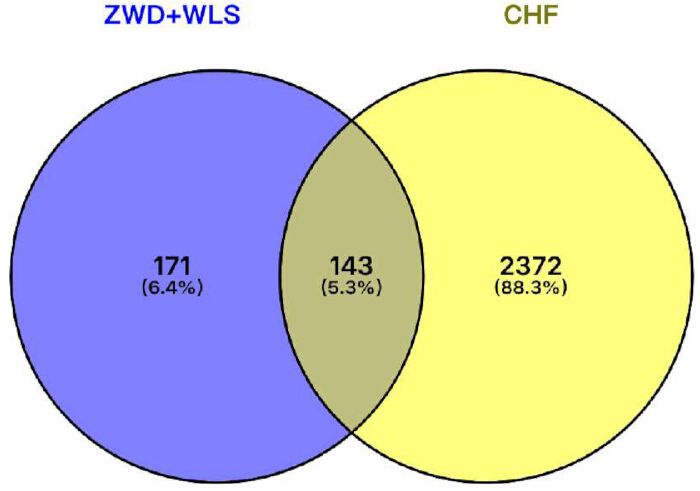
그림 1: 약물 및 질병 표적의 벤 다이어그램. 파란색 영역은 진무탕과 오령산의 복합 표적을 나타내며, 노란색 영역은 CHF 관련 표적을 나타내고, 겹치는 영역은 143개의 공통 표적을 나타낸다. 숫자는 표적 수와 백분율을 나타낸다. 이 그림의 더 큰 버전을 보려면 여기를 클릭하십시오.
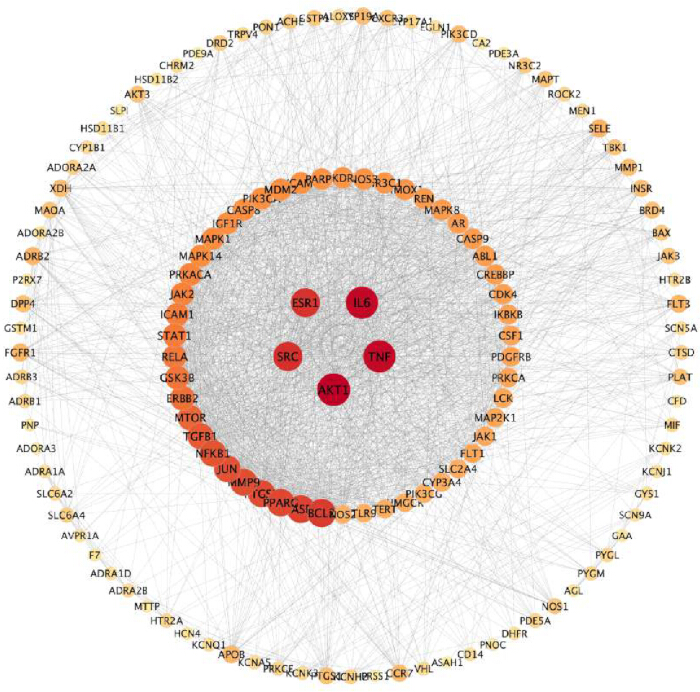
그림 2: PPI 네트워크. 노드의 색상과 크기는 연결 정도(degree)를 나타내며, 더 크고 진한 빨간색 노드일수록 연결 정도가 높은 타겟임을 의미한다. 회색 선은 신뢰도가 높은 PPI 링크를 나타낸다. 고립된 노드는 표시되지 않았다. 이 그림의 더 큰 버전을 보시려면 여기를 클릭하십시오.
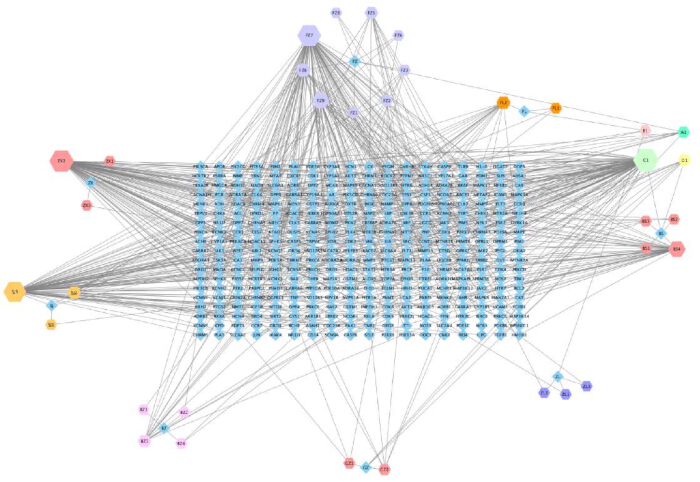
그림 3: 약물-질환-성분-타겟 네트워크. 노드 색상은 8가지 약초 그룹을 나타내며, 노드 모양은 약초, 성분 및 타겟을 구분합니다. 노드 크기는 연결 정도(degree)를 나타내며, 회색 선은 약초-성분 및 성분-타겟 간의 연관성을 나타냅니다. 여기를 클릭하여 이 그림의 더 큰 버전을 확인하십시오.
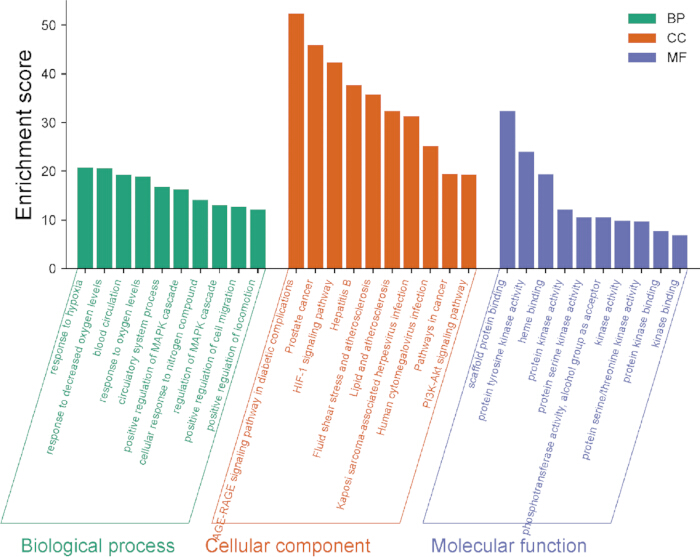
그림 4: GO 농축 분석. 녹색, 주황색, 보라색 막대는 각각 생물학적 과정(BP), 세포 구성 성분(CC), 분자 기능(MF)을 나타냅니다. 막대의 높이는 농축 점수를 나타내며, 각 카테고리의 상위 10개 항목이 표시되었습니다. CC 분석에는 60개 유전자의 히트 리스트가 사용된 반면, BP 및 MF 분석에는 143개 유전자의 공유 표적 입력값이 사용되었습니다. 따라서 각 카테고리는 기술적으로 표시되었으며 정량적으로 통합되지 않았습니다. 이 그림의 더 큰 버전을 보시려면 여기를 클릭하십시오.
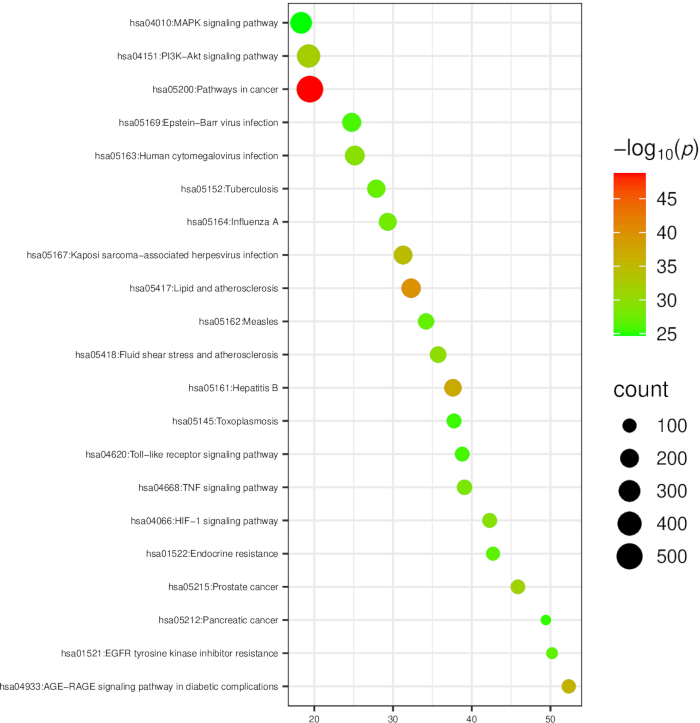
그림 5: KEGG 농축 분석. 점의 위치는 농축 비율을, 점의 크기는 유전자 수를 나타내며, 색상은 -log10(p) 값을 나타내어 따뜻한 색일수록 더 작은 p 값을 의미합니다. 여기를 클릭하여 이 그림의 더 큰 버전을 확인하십시오.
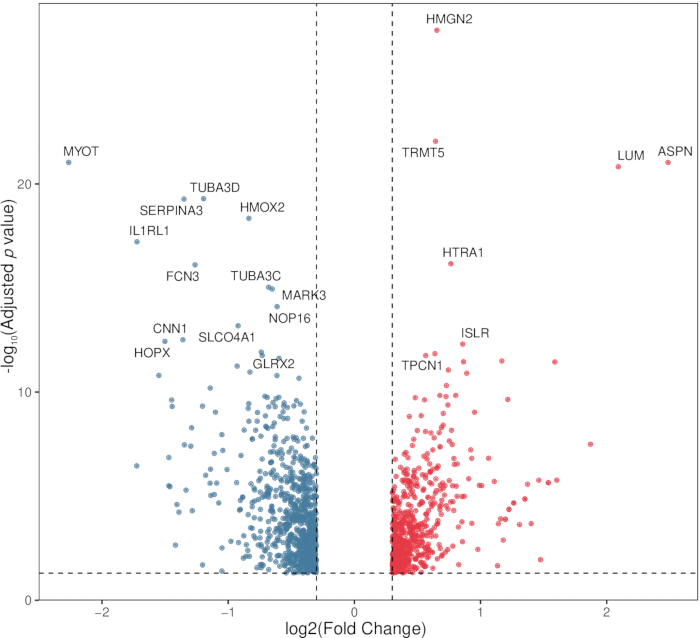
그림 6: 차등 발현 유전자의 볼케이노 플롯. 빨간색 점은 설정된 임계값에서 상향 조절된 유전자를 나타내고, 파란색 점은 하향 조절된 유전자를 나타냅니다. 세로축은 -log10(보정된 p 값), 가로축은 log2(Fold Change)이며, 점선은 보정된 p 값 < 0.05 및 |log2(Fold Change)| > 0.3을 나타냅니다. 이 그림의 더 큰 버전을 보려면 여기를 클릭하십시오.
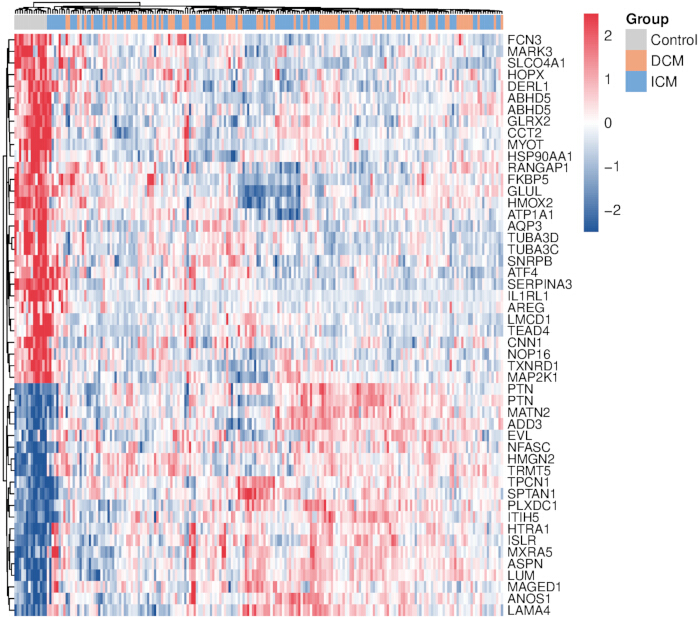
그림 7: DEG 히트맵. 히트맵은 상위 50개의 DEG를 보여주며, 행별 스케일링 후 빨간색과 파란색은 각각 상대적으로 높은 발현량과 낮은 발현량을 나타냅니다. 상단 주석은 대조군, 특발성 심근병증 및 허혈성 심근병증 그룹을 식별합니다. 이 그림의 더 큰 버전을 보려면 여기를 클릭하십시오.
| 단백질 이름 | 유전자 기호 | 정도 |
| AKT serine/threonine kinase 1 | AKT1 | 94 |
| Interleukin-6 | IL6 | 91 |
| Tumor necrosis factor | TNF | 91 |
| SRC proto-oncogene, non-receptor tyrosine kinase | SRC | 78 |
| Estrogen receptor 1 | ESR1 | 77 |
| B-cell lymphoma/leukemia 2 | BCL2 | 74 |
| Caspase 3 | CASP3 | 72 |
| Peroxisome proliferator-activated receptor gamma | PPARG | 70 |
| Prostaglandin-endoperoxide synthase 2 | PTGS2 | 69 |
| Matrix metalloproteinase 9 | MMP9 | 68 |
표 1: 핵심 유전자 및 연결 정도(degree) 값. 연결 정도 값은 143개 노드와 292개 엣지로 구성된 별도의 PPI 네트워크가 아니라, 384개 노드와 615개 엣지로 구성된 약물-질환-성분-타겟 네트워크에서 산출되었습니다. 공식 유전자 심볼이 사용되었습니다.
| 표적 유전자 | β-sitosterol | Alisol C | Benzoylnapelline | Dihydrocapsaicin | Kaempferol |
| AKT1 | -6.2 | -7.0 | -7.2 | -4.8 | -5.9 |
| IL6 | -5.7 | -6.6 | -6.1 | -4.0 | -4.6 |
| TNF | -5.5 | -6.8 | -7.6 | -5.0 | -6.3 |
| SRC | -5.2 | -8.0 | -8.0 | -5.6 | -6.9 |
| ESR1 | -3.2 | -6.7 | -7.9 | -4.3 | -3.2 |
| STAT1 | -6.1 | -9.2 | -8.7 | -5.3 | -8.6 |
| HSP90AA1 | -6.4 | -6.9 | -7.1 | -5.4 | -7.3 |
표 2: 분자 도킹 점수. 값은 kcal/mol 단위의 예측 도킹 점수이며, 값이 더 음수일수록 해당 실행 내에서 더 유리한 예측 포즈임을 나타내며, 이는 생물학적 친화력이나 활성을 입증하는 것은 아닙니다.
보충 파일 1: 보충 원시 데이터 폴더. 이 파일을 다운로드하려면 여기를 클릭하십시오.
토론
CHF는 장기적인 임상 관리가 필요하며 종종 복잡한 약물 요법을 수반합니다. Wang JX와 Zhang S11 등의 연구 및 기타 연구들에 따르면, 장기적인 기존의 병용 약물 치료는 복약 순응도를 감소시킬 수 있습니다. 낮은 순응도는 재입원 위험과 부정적인 정서적 결과를 증가시킬 수 있습니다. 현재 사용 가능한 약물들은 주로 증상 조절과 심실 리모델링 완화에 집중되어 있습니다. 2023년 중국 심부전 관리 국가 가이드라인12에서는 최근 심부전이 악화된 환자의 GDMT에 수용성 구아닐릴 사이클라제 자극제인 vericiguat를 추가할 것을 권고합니다. 그럼에도 불구하고, 심부전 관리에는 여전히 몇 가지 과제가 남아 있습니다. 심근세포는 최종 분화된 상태이며 재생 능력이 제한적이어서, 심근 손상은 종종 가역적이지 않게 진행됩니다. 기존의 약물들은 확립된 구조적 손상을 완전히 되돌리기보다는 주로 심근 섬유화와 심실 리모델링을 늦추는 역할을 합니다.
중의학 이론에서, 울혈성 심부전의 병태생리는 기혈 조절 장애와 밀접한 관련이 있습니다. 심부전의 중의학 명명법에 관한 전문가 합의13 정의합니다 "신수이" (심장 부종) 및 "페이 인" (폐 수액 정체)는 CHF에 대한 표준화된 TCM 질병 용어입니다. 두 처방 모두 양기를 북돋우고 수액 배출을 촉진하지만, 전통적인 적응증은 서로 다른 질환 부위와 패턴을 강조합니다. 전통적으로 진무탕은 비신양허(spleen-kidney yang deficiency)에서 양기를 보하고 정체된 습기를 제거하는 데 사용됩니다. 상한론 82행과 316행에 처음 기록되었습니다.14이 처방은 본래 과도한 발한으로 인한 양기 손상이 동반된 양성 단계의 질환과 양허 및 수범을 특징으로 하는 소음증에 사용되었습니다. 진무탕으로 치료하는 근본적인 병리는 신양부족으로 인한 수습 정체입니다. 전통적인 효능은 온신, 보양, 조기 및 이수(fluid removal)로 설명됩니다. 금궤요략14 또한 사지 무거움과 통증이 해당 처방의 치료 범위와 일치하기 때문에, 범람성 수종에 진무탕을 사용한 기록이 있다. 오령산은 상한론의 71, 72, 73, 74, 141행에 기록되어 있다. 이는 주로 태양방광 수종 증후군에 사용된다. 그 병생기전은 태양병 단계에서 외감 병인이 해소되지 않아 하초에 수분이 축적되고, 삼초의 기화 작용이 손상되어 체액 분포가 무질서해지는 것을 포함한다. 임상적으로 이러한 변화는 갈증으로 인한 음용 욕구와 배뇨 곤란으로 나타난다. 심한 경우, 과도한 수분 축적이 삼초를 막고 범람하여, 물이 역류하고 음용 후 구토가 발생하는 수역 현상이 나타난다. 이에 따라 오령산은 기화 작용을 회복하고 수분 배출을 촉진하기 위해 사용된다.
Zheng Minghao 등이 CHF에 대한 진무탕(Zhenwu Decoction)을 대상으로 수행한 약리학적 연구15에서는 aconitine/mesaconitine 노출 후 LVSP는 증가하고 LVEDP는 감소했으며, 이는 수축 및 이완 기능의 개선으로 해석되었습니다. CHF 쥐 모델에서 paeoniflorin은 TGF-β1/Smad 신호 전달의 조절, 리모델링 감소 및 심기능 개선과 관련이 있었습니다. Atractylenolide III와 kaempferol은 심근세포 사멸 감소와 연관되었으며, poricoic acid와 gingerol은 항염증 및 항산화 작용을 보이는 것으로 보고되었습니다. Higenamine과 paeoniflorin은 세포 내 칼슘 농도를 낮춤으로써 비정상적인 칼슘 순환을 개선할 수 있습니다. Chen Jiye 등16은 오령산(Wuling Powder)의 주요 생성물인 hederagenin과 β-sitosterol이 콜레스테롤 수치를 낮추고, 내피 기능을 조절하며, 항산화 능력을 강화하고, 염증을 감소시킴으로써 심혈관 보호 효과를 제공한다고 보고했습니다. 말기 CHF 환자들은 흔히 허증과 실증이 혼재된 양상을 보입니다. 심신양허(Heart-kidney yang deficiency)가 근본적인 병리 기전(본, root)이며, 심한 수분 정체는 분지 증상(표, branch)에 해당합니다. 정체된 수분이 삼초(triple jiao)를 통해 퍼져 상초, 심장, 폐로 침범하면 심계항진, 기침 및 호흡 곤란이 발생합니다. 심한 경우 수분이 심장과 폐를 압도하여 기좌호흡으로 이어집니다. 중초의 수분 축적은 비위의 운화 기능을 방해하여 식욕 부진과 위 팽만을 유발합니다. 하초의 수분 정체는 발목 부종과 배뇨 곤란을 일으킵니다. 이러한 패턴은 본 처방의 조합이 근본적인 허증과 분지 증상인 수분 정체를 동시에 해결한다는 TCM(전통 중의학)적 근거를 제공합니다. 축적된 증거들에 따르면, 중약 처방은 미토콘드리아 기능 및 심근 에너지 대사16뿐만 아니라 TGF-β17 및 NF-κB18 신호 전달 경로를 포함한 다중 경로와 표적을 조절함으로써 CHF를 치료할 수 있음을 시사합니다.
처방 적합성의 근거는 약리학적 및 중의학(TCM) 이론적 관점에 기반합니다. 본 계산 워크플로우는 시너지 효과를 테스트하거나, 조합의 새로운 약리학적 효과를 입증하거나, 해당 처방을 가이드라인 기반의 표준 의료 치료법과 비교하지 않았습니다. 또한 약초-약물 상호작용, 노출-반응 관계 또는 오프타겟 독성을 평가하지 않았습니다. 이러한 제한 사항으로 인해 본 결과는 치료법의 대체 또는 병용 투여 권고를 지원할 수 없습니다.
본 연구는 Zhenwu Decoction과 Wuling Powder의 병용 투여가 β-sitosterol (BS), alisol C, benzoylnapelline, dihydrocapsaicin (DHC), kaempferol (KAE)을 포함한 여러 생성 활성 성분들의 예측된 협동 작용을 통해 CHF 관련 과정에 영향을 줄 수 있음을 시사합니다. BS는 약용 식물에 널리 분포하는 피토스테롤로, 본 처방에서는 Paeoniae Radix Alba, Zingiberis Rhizoma Recens, Cinnamomi Ramulus로부터 유래합니다19. BS는 구조가 콜레스테롤과 유사하여 콜레스테롤의 결합 부위를 두고 경쟁하며, 혈청 유리 콜레스테롤을 감소시키고 지방 분해를 촉진합니다20. 또한 항동맥경화, 항산화, 항염증 및 항균 활성을 가지고 있습니다21. 데이터베이스 기록에 따르면 dihydrocapsaicin은 Zingiberis Rhizoma Recens에 할당되어 있으며, 이전 연구들22,23은 이 성분의 항염증, 항세포사멸 및 허혈-재관류 손상 완화 특성을 뒷받침합니다. Chen YM 등24은 Raf-1을 dihydrocapsaicin의 직접적인 표적으로 확인했으며, 급성 심근경색 후 Raf-1/ASK1 복합체 형성이 산화 스트레스와 심근세포 세포사멸을 낮추는 것과 연관되어 있음을 밝혔습니다. Kaempferol은 Paeoniae Radix Alba의 주요 생성 활성 성분입니다. 기존 연구들에 따르면 KAE는 PI3K/Akt/mTOR 카스케이드의 상향 조절25, 세포 내 칼슘 채널 단백질 발현 억제26, 그리고 MAPK/ERK 신호 전달 경로 억제27를 통해 심근세포를 과도한 자가포식으로부터 보호합니다. MOL002410은 benzoylnapelline으로 확인되었습니다. 인용된 benzoylaconine 연구28는 독킹된 별도의 benzoylnapelline 기록을 실험적으로 뒷받침하지 않습니다. 종합적으로, 이러한 성분들은 항염증, 항산화 및 지질 저하 메커니즘을 통해 CHF 치료에 기여할 수 있습니다. 이는 Zhenwu Decoction과 Wuling Powder 병용 투여의 다경로 및 다표적 조절 특성을 뒷받침합니다.
가공된 부자 뿌리에는 aconitine 계열 알칼로이드가 포함되어 있을 수 있으나, 본 연구에서는 성분 노출량, 용량-반응 관계 또는 독성을 정량화하지 않았습니다. 결과적으로, 예측된 치료 네트워크를 안전성 평가로 해석할 수 없으며, 잠재적인 오프타겟 효과(off-target effects)는 해결되지 않은 상태로 남아 있습니다.
PPI 네트워크의 차수 랭킹(degree ranking) 결과, AKT1, IL6, TNF, SRC, ESR1의 다섯 가지 후보가 최상위에 올랐습니다. PI3K/Akt/mTOR 캐스케이드의 중심 노드인 AKT1은 차수가 가장 높은 후보 중 하나였습니다. 이 캐스케이드는 증식, 혈관 신생 및 당지질 대사에 관여합니다29. Wang X 등30은 건강한 대조군 생쥐보다 심부전 쥐에서 AKT1 발현이 더 높음을 확인했습니다. Lou WZ 등31은 캠페롤(kaempferol) 및 관련 성분들이 핵심 노드인 AKT1을 통해 PI3K/Akt 경로를 억제함으로써 심장 섬유아세포의 증식을 저해하고 CHF 진행과 심실 리모델링을 지연시킨다고 보고했습니다. IL-6와 TNF는 전형적인 염증성 사이토카인입니다. 이전 연구32에서는 염증성 사이토카인 및 케모카인이 다양한 심부전 표현형 전반에서 심실 리모델링 및 심근 기능 장애와 연관되어 있음을 밝혔습니다. 1,086명의 환자 코호트 연구에서 Berger 등33은 IL-6 농도가 높을수록 불량한 심혈관 결과 및 NT-proBNP 증가와 연관이 있음을 확인했습니다. TNF는 혈관 신생 및 혈전 형성과 밀접한 관련이 있으며, 이 두 과정 모두 심장 및 심실 리모델링의 원인이 됩니다. TNF는 CHF 발생의 생물학적 마커로 작용할 수 있으며34, TNF의 과발현은 불량한 심혈관 사건, 심근 손상 위험 층화 및 예후와 관련이 있습니다. SRC는 세포 접착, 증식 및 활성 산소 생성에 관여합니다35. 증거에 따르면 SRC 과발현은 베타-아드레날린 수용체(β-AR) 신호를 증폭시키고 β-AR/Src/ERK 캐스케이드를 활성화하며 심실 리모델링을 매개합니다36. 다른 연구들은 SRC를 심혈관 질환 중재를 위한 후보 표적으로 제안했습니다37. 에스트로겐은 항염증, 항산화 및 항동맥경화 특성을 가진 심장 보호 인자로 널리 알려져 있습니다38. 따라서 에스트로겐 수용체 알파를 인코딩하는 ESR1은 심장 보호를 위한 잠재적 치료 표적이 됩니다. Fukuma N 등39은 생쥐에서 비유전적 에스트로겐 수용체 알파 신호를 선택적으로 차단함으로써 에스트로겐 수용체의 심장 보호 효과를 규명했습니다. 단일 화합물이나 경로에 집중한 연구들과 달리, 본 워크플로우는 처방 기반의 표적 커버리지를 질환 PPI 네트워크 및 심근 전사체 맥락과 상호 참조했습니다. 이러한 통합은 후보의 우선순위를 좁혀주지만, 이는 여전히 상관관계에 기반한 것입니다. 허브 유전자 기준은 인과적 중요성을 증명하기보다는 후속 연구를 위해 연결성이 높은 후보를 식별하는 것입니다.
공유 타겟 KEGG 프로파일은 MAPK, PI3K-Akt, 지질/동맥경화, TNF, Toll-like receptor 및 AGE-RAGE 신호 전달 용어들이 지배적이었습니다. 이러한 경로들은 종합적으로 비대, 섬유화, 염증, 산화 스트레스 및 심실 리모델링을 포함하여 CHF의 중심 과정들과 일치합니다. MAPK 신호 전달은 증식, 세포 사멸, 염증 및 섬유화 반응을 조정합니다40. 과도한 MAPK 활성은 심근 섬유화를 촉진하고 심실 리모델링을 가속화하여41 심부전을 악화시킬 수 있습니다. PI3K-Akt 신호 전달은 세포 성장, 세포 사멸, 이동 및 혈관 신생에 관여합니다. 세포 골격 리모델링에서의 역할로 인해 이 경로는 암 생물학의 후보 타겟이 되기도 했습니다42. 생리적 조건에서 PI3K-Akt 경로는 미토콘드리아 기능을 개선하고 산화 스트레스를 줄이며 심근세포 사멸을 억제함으로써 심장을 보호합니다. 기발표된 연구들43에서는 심부전 동안 심근세포에서 PI3K-Akt 활성이 억제되며, 이것이 미토콘드리아 기능 장애와 에너지 대사 손상을 유발할 수 있다고 보고했습니다. 이 경로의 억제는 TGF-β 신호 전달 및 세포 사멸 관련 caspase 경로와 같은 전섬유화 캐스케이드를 활성화하여 심실 리모델링과 심근세포 소실을 촉진할 수 있습니다. 이상지질혈증은 임상적 심부전의 빈번한 기저 원인인 관상동맥 심장질환과 연결되어 있습니다. 2024년 중국 심부전 가이드라인은 이상지질혈증과 관상동맥 심장질환 모두를 CHF의 공유 위험 요인으로 나열하고 있습니다44. 또한 예방을 위해 조기 지질 강하 요법에 Class IA 권고 등급을 부여했습니다. 각각 70명과 150명의 심부전 환자를 대상으로 한 Li Tingting 및 Zhou Li 등의 후속 연구45,46에서는 심장 기능이 악화됨에 따라 혈청 HDL-C가 점진적으로 감소한다고 보고했습니다. 그러나 혈청 지질 변동은 예후와 유의미한 상관관계가 없었습니다. 이는 이상지질혈증이 심근세포를 직접적으로 손상시키거나 심장 기능을 저하시키지 않을 수 있음을 시사합니다. 따라서 지질 및 동맥경화 경로는 직접적인 심근 손상보다는 CHF 예방 및 병인학적 해석과 더 밀접한 관련이 있을 수 있습니다. TNF-α는 중추적인 염증성 사이토카인이자 CHF 개시 및 진행의 핵심 동력입니다34. 상승된 TNF-α 농도는 심근 수축력을 억제하며 모든 원인으로 인한 사망률과 양의 상관관계를 보입니다47. 교감신경계는 심실 리모델링의 중요한 신경체액 매개체입니다. 과도한 TNF-α 상향 조절은 교감신경 기능을 손상시키고, β-수용체 기능 장애를 유발하며, 카테콜아민 방출을 자극하여48 심실 리모델링을 악화시킬 수 있습니다. Toll-like receptor 경로는 PAMPs와 DAMPs를 감지하여 선천 면역 신호 전달을 개시합니다49. 지속적인 활성화는 염증과 심근 손상을 촉진할 수 있습니다. Ye S 등50은 심근세포의 TLR2 결핍이 Ang II로 유도된 염증, 비대 및 간질성 섬유화를 완화시킨다고 보고했습니다. 이러한 개선은 더 약한 하위 NF-κB/MAPK 활성화 및 감소된 심근 손상과 일치했습니다. AGE-RAGE 생물학은 당뇨병 외의 상황에서도 유효합니다. 노화, 허혈, 압력 과부하 또는 염증성 심장 스트레스 상황에서 AGEs가 축적되어 RAGE와 결합함으로써 산화 스트레스, 염증 및 섬유화를 증폭시키고, 이는 심실 리모델링과 CHF에 기여합니다51. 네트워크 약리학은 처방 유래 성분-타겟 커버리지의 광범위함을 포착하는 반면, GEO는 질환-조직 맥락을 제공합니다. 따라서 이들의 교집합은 복잡한 TCM 처방 연구에서 가설의 우선순위를 정하는 데 유용하지만, 이를 전사체적 또는 약리학적 검증으로 기술해서는 안 됩니다.
한계점: 본 연구는 in vitro 및 in vivo 검증이 수행되지 않았으며, 단일 발견 마이크로어레이 데이터셋을 사용하고 데이터베이스 주석 및 스크리닝 임계값에 의존하였습니다. 광범위한 수용체 포함 도킹 그리드는 결합 부위의 확정보다는 탐색적 순위 결정에 유용하며, 정확한 패키지 패치 버전은 보존되지 않았습니다. 또한, 포즈 출력 PDBQT 파일은 5개의 HSP90AA1-화합물 쌍에 대해서만 보존되었으며, 나머지 30개의 표적-화합물 쌍에 대한 포즈 출력 파일은 보존되지 않았습니다. GO-CC 분석에는 BP/MF/KEGG에 사용된 143개 유전자 입력 세트 대신 60개 유전자 히트 리스트가 사용되었으며, 따라서 이러한 범주들은 정량적으로 통합되지 않았습니다. 독립적인 전사체 검증 세트나 분자 동역학 시뮬레이션은 이용 가능하지 않았습니다.
향후 연구 방향: 향후 연구에서는 심근세포 저산소/재산소화 모델 및 적절한 동물 모델을 통해 HSP90AA1, STAT1 및 우선순위 화합물을 검증하고, 해당 처방을 가이드라인 기반 치료법과 비교하며, 약초-약물 상호작용 및 부자 관련 독성을 평가하고, 도킹 예측 결과를 독립적인 생화학적 또는 세포 분석법으로 테스트해야 한다.
요약하자면, 네트워크 약리학, 심근 전사체 데이터, 농축 분석 및 분자 도킹의 통합을 통해 CHF에서 진무탕과 오령산 병용 투여와 잠재적으로 연관된 후보 성분, 표적 및 경로의 우선순위를 정하였습니다. 처방 관련 표적 예측과 질환 관련 발현 변화의 수렴을 통해 HSP90AA1 및 STAT1을 추가 연구 대상 후보로 식별하였으며, 도킹 분석을 통해 실험적 검증을 위한 특정 성분-표적 쌍의 우선순위를 정하였습니다. 이러한 결과는 임상적 효능이나 검증된 분자 기전의 증거라기보다는 가설 생성 프레임워크를 제공하는 것이며, 독립적인 실험 체계에서의 확인이 필요합니다.
공개 사항
저자들은 본 연구와 관련하여 이해관계의 충돌이 없음을 밝힙니다.
재료
| 이름 | 회사 | 카탈로그 번호 | 댓글 |
|---|---|---|---|
| AutoDock Vina | CCSB-Scripps | v1.2.6 | 사용된 커맨드 라인 버전; 현재 공식 릴리스 v1.2.7; 사용된 설정은 CLI 기본값인 exhaustiveness 8 및 num_modes 9입니다. https://github.com/ccsb-scripps/AutoDock-Vina/releases |
| AutoDockTools | 스크립스 연구소(The Scripps Research Institute) | v1.5.7 | 수용체/리간드 준비; 분석에 사용된 버전. https://autodock.scripps.edu/ |
| Bioconductor | Bioconductor 프로젝트 | 3.16 호환성 릴리스 | R 4.2 호환 환경; 현재 릴리스 3.23. https://bioconductor.org/about/release-announcements/ |
| Cytoscape 데스크톱 | Cytoscape 컨소시엄 | v3.7.1 | 사용된 네트워크 시각화/분석 버전; 현재 릴리스 v3.10.4. https://cytoscape.org/download.html |
| DisGeNET | MedBioinformatics Solutions | v25.4 | CHF 관련 유전자 검색; 2026-02-10 검색. https://disgenet.com/ |
| DrugBank | OMx 개인 건강 분석 | v6.0 | CHF 관련 유전자 검색; 2026-02-12 검색. https://go.drugbank.com/ |
| GeneCards | 와이즈만 과학 연구소 | 웹 데이터베이스 | CHF 관련 유전자 검색; 2026-02-10 검색. https://www.genecards.org/ |
| GEO / GSE5406 | NCBI | GSE5406; GPL96 | RMA 정규화된 인간 좌심실 마이크로어레이 시리즈. https://www.ncbi.nlm.nih.gov/geo/query/acc.cgi?acc=GSE5406 |
| hgu133a.db | Bioconductor | Bioconductor 3.16 환경 | Affymetrix Human Genome U133A 프로브 어노테이션; 정확한 패치 버전은 유지되지 않음. https://bioconductor.org/packages/hgu133a.db/ |
| limma | Bioconductor | Bioconductor 3.16 환경 | 차등 발현 분석; 정확한 패치 버전은 유지되지 않음. https://bioconductor.org/packages/limma/ |
| MacBook | 사과 | M4 프로세서 | 로컬 컴퓨팅 워크스테이션; 메모리 사양 미기재. https://www.apple.com/mac/ |
| Metascape | Metascape | v3.5 | GO/KEGG 농축 분석; 정확한 접속 시간 기록 없음. https://metascape.org/ |
| Microsoft Excel | 마이크로소프트 | 데스크톱 애플리케이션 | 데이터 큐레이션/내보내기; 애플리케이션 빌드는 유지되지 않음. https://www.microsoft.com/microsoft-365/excel |
| 온라인 멘델 유전학 정보(OMIM) | 존스 홉킨스 대학교 | 웹 데이터베이스 | CHF 관련 유전자 검색; 2026-02-10 검색. https://www.omim.org/ |
| Open Babel | Open Babel 프로젝트 | 버전이 유지되지 않음 | 도킹 워크플로우에서의 구조 변환. https://openbabel.org/ |
| PharmGKB | PharmGKB | 웹 데이터베이스 | CHF 관련 유전자 검색; 2026-02-12 검색. https://www.pharmgkb.org/ |
| PubChem | NCBI | 웹 데이터베이스 | SMILES 및 구조 완성. https://pubchem.ncbi.nlm.nih.gov/ |
| PyMOL | Schrö딩거 | 버전이 유지되지 않음 | 단백질 전처리 및 포즈 시각화. https://www.pymol.org/ |
| R | R 재단 | 4.2.0+ | 분석을 위해 기록된 버전 제품군; 현재 릴리스 4.6. https://www.r-project.org/ |
| RCSB Protein Data Bank | RCSB PDB | 웹 아카이브 | 단백질 결정 구조. https://www.rcsb.org/ |
| RStudio | 가정하다 | 2026.04.0+526 | 분석 IDE가 수정 노트에 기록되었습니다. https://posit.co/download/rstudio-desktop/ |
| 제공된 텍스트가 없습니다. 번역할 소스 텍스트를 입력해 주십시오. | STRING 컨소시엄 | 웹 서비스 | 호모 사피엔스; 신뢰도 >0.9; 릴리스/세션 메타데이터가 유지되지 않음. https://string-db.org/ |
| SwissADME | SIB 스위스 생물정보학 연구소 | 웹 서비스 | ADME 및 Lipinski 법칙 스크리닝; 로컬 버전 해당 없음. https://www.swissadme.ch/ |
| SwissTargetPrediction | SIB 스위스 생물정보학 연구소 | 2019 주요 업데이트 | 호모 사피엔스; 확률 >0.02; 2026-02-10 검색. https://www.swisstargetprediction.ch/ |
| TCMSP | 노스웨스트 A&F 대학교 | v2.3 | 화합물 검색; 2026-02-07 검색. https://tcmsp-e.com/ |
| TTD | 치료 표적 데이터베이스 | 2026년 출시 | CHF 관련 유전자 검색; 2026-02-12 검색. https://ttd.idrblab.cn/ |
| UniProtKB | UniProt 컨소시엄 | 릴리스 2026_01 | 검토된 Homo sapiens 유전자 기호 표준화. https://www.uniprot.org/ |
| Venny | CNB-CSIC | v2.1.0 | 타겟 세트 교집합 시각화. https://bioinfogp.cnb.csic.es/tools/venny/ |
참고문헌
- McDonagh TA, et al. 2021 ESC Guidelines for the diagnosis and treatment of acute and chronic heart failure. Eur Heart J. 2021;42(36):3599-3726.
- Yang X, et al. The evolving burden of heart failure in China: a 34-year subnational analysis of trends and causes from the Global Burden of Disease Study 2023. Mil Med Res. 2025;12(1):65.
- Tang KH. Study on Zhenwu Decoction combined with Wuling Powder in the treatment of heart failure with yang deficiency and water flooding syndrome. Chin Med Guide. 2024;22(14):153-155.
- National Pharmacopoeia Commission. Pharmacopoeia of the People's Republic of China. 2025 ed. China Medical Science Press; Beijing; 2025.
- Daina A, Michielin O, Zoete V. SwissADME: a free web tool to evaluate pharmacokinetics, drug-likeness and medicinal chemistry friendliness of small molecules. Sci Rep. 2017;7:42717.
- Ru J, et al. TCMSP: a database of systems pharmacology for drug discovery from herbal medicines. J Cheminform. 2014;6:13.
- Daina A, Michielin O, Zoete V. SwissTargetPrediction: updated data and new features for efficient prediction of protein targets of small molecules. Nucleic Acids Res. 2019;47(W1):W357-W364.
- Zhou Y, et al. Metascape provides a biologist-oriented resource for the analysis of systems-level datasets. Nat Commun. 2019;10:1523.
- Hannenhalli S, et al. Transcriptional genomics associates FOX transcription factors with human heart failure. Circulation. 2006;114(12):1269-1276.
- Shahzadi Z, et al. Network pharmacology and molecular docking: combined computational approaches to explore the antihypertensive potential of Fabaceae species. Bioresour Bioprocess. 2024;11:53.
- Wang JX, Zhang S. Correlation between medication adherence, coping styles and depression in patients with chronic heart failure. J Int Psychiatry. 2026;53(1):225-228.
- National Center for Cardiovascular Diseases, Heart Failure Professional Committee of National Cardiovascular Experts Committee, Heart Failure Committee of Chinese Medical Doctor Association, et al. 2023 National guidelines for heart failure. Chin J Heart Fail Cardiomyopathies. 2023;7(4):215-311.
- Dong GJ, Wei Y. Expert consensus on TCM disease nomenclature of heart failure. Chin Arch Tradit Chin Med. 2025;43(7):253-258.
- Zhang ZJ. Treatise on Febrile Diseases. Qian CC, collator. People's Medical Publishing House; Beijing; 2005. p. 22-23.
- Zheng MH, Guo D. Research progress on active ingredients and mechanism of Zhenwu Decoction in the treatment of chronic heart failure. China J Tradit Chin Med Pharm. 2024;39(11):6007-6011.
- Chen L, Yu D, Ling S, Xu JW. Mechanism of tonifying-kidney Chinese herbal medicine in the treatment of chronic heart failure. Front Cardiovasc Med. 2022;9:988360.
- Wang Y, et al. A review of Chinese herbal medicine for the treatment of chronic heart failure. Curr Pharm Des. 2017;23(34):5115-5124.
- He Y, et al. Clinical evidence and potential mechanisms of traditional Chinese medicine for the treatment of chronic gastritis: an updated systematic review and meta-analysis. J Herb Med. 2023;42:100761.
- Wang H, et al. β-Sitosterol as a promising anticancer agent for chemoprevention and chemotherapy: mechanisms of action and future prospects. Adv Nutr. 2023;14(5):1085-1110.
- Dwivedi J, et al. Aspects of β-sitosterol's pharmacology, nutrition and analysis. Curr Pharm Biotechnol. 2025;26(14):2234-2256.
- Khan Z, et al. Multifunctional roles and pharmacological potential of β-sitosterol: emerging evidence toward clinical applications. Chem Biol Interact. 2022;365:110117.
- Jittiwat J, Suksamrarn A, Tocharus C, Tocharus J. Dihydrocapsaicin effectively mitigates cerebral ischemia-induced pathological changes in vivo, partly via antioxidant and anti-apoptotic pathways. Life Sci. 2021;283:119842.
- Lai Y, et al. Dihydrocapsaicin suppresses the STING-mediated accumulation of ROS and NLRP3 inflammasome and alleviates apoptosis after ischemia-reperfusion injury of perforator skin flap. Phytother Res. 2024;38(5):2539-2559.
- Chen Y, et al. Dihydrocapsaicin attenuates oxidative stress and apoptosis in acute myocardial infarction via promoting Raf-1/ASK1 complex formation. Phytomedicine. 2025;146:157126.
- Li YX, Liu SY. Kaempferol alleviates myocardial injury in rats with coronary heart disease via regulating the PI3K/AKT/mTOR pathway. Chin J Histochem Cytochem. 2025;34(5):439-445.
- Wu JP, Chen JJ, Yuan Q, et al. Effects and mechanisms of kaempferol on cardiomyocyte apoptosis induced by hypoxia/reoxygenation injury. Shaanxi Med J. 2024;53(1):3-7,18.
- Chen MJ, Li XD, Wang NN. Effects and mechanisms of kaempferol on cardiac function in rat models of chronic heart failure. Prog Anat Sci. 2023;29(1):18-20,24.
- Zhou WM, Lang SK, Ge X, et al. Benzoylaconine alleviates oxygen-glucose deprivation/reoxygenation-induced cardiomyocyte injury via the phosphatidylinositol 3-kinase/protein kinase B pathway. Chin J Geriatr Heart Brain Vessel Dis. 2025;27(2):211-216.
- Brand CS, Lighthouse JK, Trembley MA. Protective transcriptional mechanisms in cardiomyocytes and cardiac fibroblasts. J Mol Cell Cardiol. 2019;132:1-12.
- Wang X, Chen ZQ, Li L, et al. Effects of Zhenwu Decoction on cardiomyocyte apoptosis and PI3K-AKT pathway in heart failure rats. Chin J Comp Med. 2022;32(7):27-33,57.
- Lou WZ, Huang SS, Chen BS. Mechanism analysis of Ginkgo biloba leaves against chronic heart failure. Zhejiang Clin Med J. 2026;28(1):32-37.
- Hanna A, Frangogiannis NG. Inflammatory cytokines and chemokines as therapeutic targets in heart failure. Cardiovasc Drugs Ther. 2020;34(6):849-863.
- Berger M, et al. IL-6 and hsCRP predict cardiovascular mortality in patients with heart failure with preserved ejection fraction. ESC Heart Fail. 2024;11(6):3607-3615.
- Zhang H, Dhalla NS. The role of pro-inflammatory cytokines in the pathogenesis of cardiovascular disease. Int J Mol Sci. 2024;25(2):1082.
- Wu PL, Wei M, Zhu W. Src signaling pathway and its role in the pathophysiology of heart failure. Int J Cardiovasc Dis. 2013;40(1):6-8,15.
- Li W, et al. Src tyrosine kinase promotes cardiac remodeling induced by chronic sympathetic activation. Biosci Rep. 2023;43(10):BSR20231097.
- Zhai Y, et al. Src-family protein tyrosine kinases: a promising target for treating cardiovascular diseases. Int J Med Sci. 2021;18(5):1216-1224.
- Qian C, Liu J, Liu H. Targeting estrogen receptor signaling for treating heart failure. Heart Fail Rev. 2024;29(1):125-131.
- Fukuma N, et al. Estrogen receptor-α non-nuclear signaling confers cardioprotection and is essential to cGMP-PDE5 inhibition efficacy. JACC Basic Transl Sci. 2020;5(3):282-295.
- Sun Y, et al. Signaling pathway of MAPK/ERK in cell proliferation, differentiation, migration, senescence and apoptosis. J Recept Signal Transduct Res. 2015;35(6):600-604.
- Zhang Z, et al. Targeting MAPK-ERK/JNK pathway: a potential intervention mechanism of myocardial fibrosis in heart failure. Biomed Pharmacother. 2024;173:116413.
- Deng S, et al. PI3K/AKT signaling tips the balance of cytoskeletal forces for cancer progression. Cancers (Basel). 2022;14(7):1652.
- Ghafouri-Fard S, et al. Interplay between PI3K/AKT pathway and heart disorders. Mol Biol Rep. 2022;49(10):9767-9781.
- Cardiovascular Branch of Chinese Medical Association, Cardiovascular Physicians Branch of Chinese Medical Doctor Association, Heart Failure Professional Committee of Chinese Medical Doctor Association, et al. 2024 Chinese guidelines for the diagnosis and treatment of heart failure. Chin J Cardiovasc Dis. 2024;52(3):235-275.
- Li TT, et al. Correlations of BNP, Hcy and blood lipid levels with cardiac function and prognosis in elderly patients with chronic heart failure. Chin J Evid Based Cardiovasc Med. 2021;13(9):1050-1053.
- Zhou L. Clinical study on TCM syndrome types, blood lipid levels and cardiac function in 150 patients with chronic heart failure. Guide China Med. 2024;22(12):77-79.
- Müller-Ehmsen J, Schwinger RH. TNF and congestive heart failure: therapeutic possibilities. Expert Opin Ther Targets. 2004;8(3):203-209.
- Arvunescu AM, et al. Inflammation in heart failure—future perspectives. J Clin Med. 2023;12(24):7738.
- Yu L, Feng Z. The role of Toll-like receptor signaling in the progression of heart failure. Mediators Inflamm. 2018;2018:9874109.
- Ye S, et al. Toll-like receptor 2 signaling deficiency in cardiac cells ameliorates Ang II-induced cardiac inflammation and remodeling. Transl Res. 2021;233:62-76.
- Vianello E, et al. The advanced glycation end-products (AGE)-receptor for AGE system (RAGE): an inflammatory pathway linking obesity and cardiovascular diseases. Int J Mol Sci. 2025;26(8):3707.