This video demonstrates the effect of ethylene generated by 2-chloroethylphosphonic acid (CEPA) on bacterial growth and cellulose production. Ethylene activates signaling pathways that stimulate cellulose synthesis, resulting in enhanced pellicle formation. These results highlight the bacterial response to ethylene.
Een abonnement op JoVE is vereist om deze inhoud te bekijken. Log in of start vandaag met uw gratis proefperiode.
Methodenartikel
Investigating the Bacterial Response to Ethylene Using an Ethylene-Releasing Compound
398 weergaven
⸱
26 september 2025
In dit artikel
Samenvatting
Protocol
- Pellicle Assays
- Grow and Quantify Komagataeibacter xylinus Starter Cultures in Triplicate:
- In triplicate, inoculate a single colony of Komagataeibacter xylinus into 5 ml of Schramm and Hestrin (SH) medium (pH 5) supplemented with 0.2% (v/v) filter-sterilized cellulase. Incubate cultures at 30 °C with agitation at 150 rpm until an optical density at 600 nm (OD600) of 0.3 to 0.4 is reached (about 72 hr).
- Harvest starter cultures by centrifugation (2,000 x g; 4 °C; 10 min). Wash the cells twice with 5 ml of sterile saline and resuspend the cell pell....
- Grow and Quantify Komagataeibacter xylinus Starter Cultures in Triplicate:
Toegang beperkt. Log in of start een proefperiode om deze inhoud te bekijken.
Resultaten
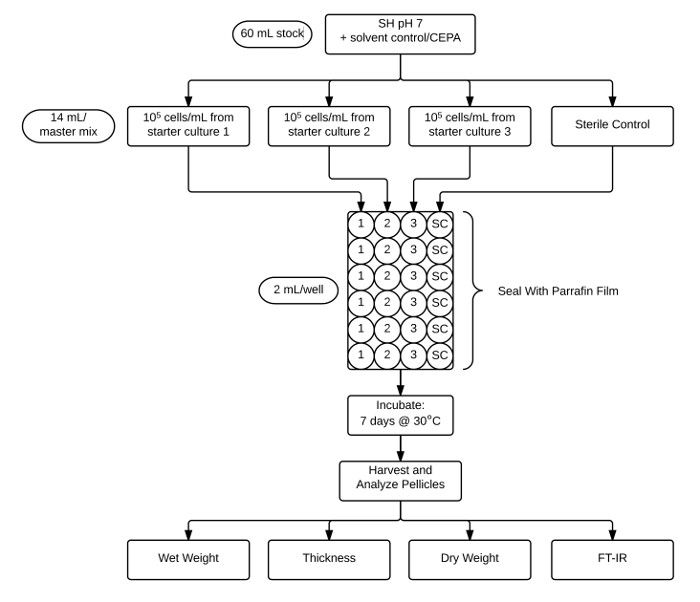
Figure 1: Flow chart illustrating the protocol used for pellicle assay and analysis. Stock CEPA-supplemented pH 7 SH medium .......
Toegang beperkt. Log in of start een proefperiode om deze inhoud te bekijken.
Materialen
| Naam | Bedrijf | Catalogusnummer | Opmerkingen |
|---|---|---|---|
| Cellulase from Trichoderma reesei ATCC 26921 | Sigma | C2730 | Aqueous solution |
| Citric acid | BioShop | CIT002.500 | For SH medium |
| Ethephon (≥ 96%; 2-chloroethylphosphonic acid) | Sigma | C0143 | Ethylene-releasing compound |
| Glucose | BioBasic | GB0219 | For SH medium |
| Komagataeibacter xylinus ATCC 53582 | ATCC | 53582 | Bacterial cellulose-producing alphaproteobacterium |
| Sodium phosphate, dibasic heptahydrate | BioShop | SPD579.500 | Sodium phosphate, dibasic heptahydrate for SH medium |
| NaCl | BioBasic | SOD001.1 | Sodium chloride for saline and control solution |
| Sodium phosphate, monobasic monohydrate | BioShop | SPM306.500 | Sodium phosphate, monobasic monohydrate for control solution |
| NaOH | BioShop | SHY700.500 | Sodium hydroxide for pH adjustment |
| Paraffin film | Parafilm | PM996 | For sealing plates and flasks |
| Peptone (bacteriological) | BioShop | PEP403.1 | For SH medium |
| Petroff-Hausser counting chamber | Hausser scientific | 3900 | Bacterial cell counting chamber |
| Polyethersulfone sterilization filter 0.2 µm | VWR | 28145-501 | For sterilizing cellulase |
| Yeast extract | BioBasic | G0961 | For SH medium |
