This video demonstrates the use of a double-layer gradient swarm plate to study bacterial swarming behavior under varying inhibitor concentrations. A plate with a gradient-forming inhibitor in the bottom layer is inoculated with bacteria and incubated. Images are captured at regular intervals to analyze the effect of inhibitor concentration on bacterial swarming.
Een abonnement op JoVE is vereist om deze inhoud te bekijken. Log in of start vandaag met uw gratis proefperiode.
Methodenartikel
Assessing Bacterial Swarming Using a Gradient Inhibitor Plate
513 weergaven
⸱
26 september 2025
In dit artikel
Samenvatting
Protocol
1. Preparation of gradient swarm plates
- Preparation of swarm medium
NOTE: 0.7% (w/v) agar concentration of swarm medium was used in this protocol.- Prepare Lysogeny broth (LB) powder with agar in two conical flasks; each flask contains 2 g of tryptone, 2 g of sodium chloride (NaCl), 1 g of yeast extract, and 1.4 g of agar. Add double-distilled water (ddH2O) and stir the suspension using a magnetic stir bar. Adjust the final volume to 200 mL by adding additional ddH2O.
- Autoclave the solution at 121 °C for 20 min. Use an air-permeable cap or bottle sealing film with an air vent.
NOTE: Agar will dissolve when heated in the autoclave. - When the temperature drops to 65 °C, mix the solution to ensure homogeneity, and transfer the medium to a 65 °C incubator or water bath for short-term usage.
- Preparation of bottom-layer swarm medium
NOTE: The bottom-layer medium is the mixture of swarm medium and inducer stock solutions. The formulation of inducer gradient swarm plates is shown in Table 1.- Prepare a 100 mM resveratrol stock solution by dissolving 114.12 mg of lyophilized resveratrol powder into 5 mL of dimethyl sulfoxide (DMSO), and store the solution at -20 °C.
- Prepare a 20% (w/v) arabinose stock solution by dissolving 6 g of arabinose powder in 30 mL of ddH2O; wait for 10-15 min to allow the arabinose to dissolve; and store the solution at room temperature.
- Take out the medium from the 65 °C incubator and place it at room temperature; allow the swarm medium to cool until the Erlenmeyer flask is cool enough to hold (~50 °C). Do not place the swarm medium at room temperature for long periods, as this will cause the solidification of agar.
- Add the required volume of the inducer stock solution to the swarm medium at 50 °C (Table 1). Use a pipette to dispense the inducer solution instead of pouring it. Gently swirl to mix the inducer with the swarm medium.
NOTE: This step is for inducers that cannot be autoclaved. Be careful not to introduce bubbles into the medium.
- Preparation of double-layer gradient swarm plates
NOTE: The upper-layer medium is LB medium containing 0.7% (w/v) agar.- Label 13 x 13 cm square Petri dishes with inducer name and strains, and prop the dishes up over the edge of the lids (Figure 1B).
- Add 40 mL warm bottom-layer medium (50 °C) using a 50 mL pipette or a 50 mL centrifuge tube.
NOTE: Alternatively, for 13 x 13 cm square Petri dishes, 40 mL bottom-layer and upper-layer medium is suitable; for 10 x 10 cm square Petri dishes, 25 mL bottom layer and upper-layer medium is suitable. - Allow the bottom-layer medium to cure uncovered for 1 h inside a laminar flow hood. Do not disturb the square Petri dishes while the medium solidifies.
NOTE: While curing the bottom layer, the swarm medium not containing inducers should be maintained in a 65 °C incubator or water bath. - Once the bottom layer is completely solidified, remove the lids and place the square Petri dishes inside a laminar flow hood.
- Add 40 mL of warm upper-layer medium (50 °C) using a 50 mL pipette or 50 mL centrifuge tube.
NOTE: The upper-layer medium does not contain inducers. - Cure the double-layer plates on the benchtop, covered and undisturbed for 1 h. Store the prepared plates at 4 °C for up to 24 h.NOTE: Longer curing times would reduce the moisture content and restrict swarming motility.
2. Growth of E. coli K12 and P. aeruginosa PAO1
- Prepare 500 mL of LB medium by adding 5 g of tryptone, 5 g of NaCl, and 2.5 g of yeast extract into ddH2O, and top up the solution to 500 mL. Autoclave the solution on the liquid cycle for 20 min at 121 °C, and store it at 4 °C.
- Prepare 100 mL of 1.5% (w/v) LB-agar medium by adding 1 g of tryptone, 1 g of NaCl, 0.5 g of yeast extract, and 1.5 g of agar into ddH2O and top up the solution to 100 mL. Autoclave the solution on liquid cycle for 20 min at 121 °C. Transfer the medium to a 50 °C water bath to prevent the agar from solidifying.
- When the LB-agar medium flask is comfortable to hold, add 20 mL of LB-agar medium into a Petri dish (10 cm in diameter) using a 25 mL pipette. Leave the plate at room temperature overnight, and store the LB-agar plate at 4 °C.
- Take stock cultures stored at -80 °C, streak E. coli K12, E. coli K12-YdeH, P. aeruginosa PAO1, and P. aeruginosa PAO1-YdeH strains on LB-agar Petri dishes using disposable inoculation loops. Incubate the Petri dishes inverted overnight at 37 °C.
- Pick single colonies for different strains from the Petri dishes, inoculate each colony into 5 mL of LB medium, and incubate the culture at 37 °C in a laboratory orbital shaker set at 220 rpm.
- When the culture density reaches OD600nm ~1.0, remove the culture from the shaker and place it at room temperature. Adjust the culture density to OD600nm = 1.0, as described in step 3.2.1.
3. Inoculation and incubation of gradient swarm plates
- Preparation of inoculation wells
NOTE: 3D printing cover models capable of generating wells separated by a standard distance can be used instead of the method described below.- Mark the well positions on A4 paper, as shown in Figure 1C. Set three test concentrations in one square Petri dish with two or three replicates.
- Place the marked A4 paper under a solidified gradient plate. Push the broader side of a 100 µL pipette tip into the semisolid medium surface at the marked position. Press the pipette tip until it reaches the bottom of the upper-layer medium.
- When the tip touches the bottom, apply no vertical force to the tip; gently rotate the tip to isolate the content of the cylindrical well.
- Horizontally move the pipette tips along a very small distance to allow airflow into the narrow space set aside. Press the tip with the index finger to block the gas flow inside the tip while holding the pipette using the thumb and middle finger.
- Pull the tip out vertically, keeping the well content in the tip while pulling it out.
NOTE: If the well content slips, apply slightly more pressure with the index finger to seal the tip completely. - Repeat steps 3.1.2 to 3.1.5 in every marked position. Cover the swarm plate before inoculation.
- Gradient plate inoculation and incubation
- Adjust the overnight growth culture density to OD600nm = 1.0.
- Pipette 80 µL of the overnight growth culture into every well. Do not spill the bacterial culture outside the wells.
- Wrap the plates with sealing film. For long-term observation (3-5 days), wrap the plates with sterile laboratory rubber tape.
NOTE: Rubber tape is less likely to break. - Place a beaker filled with ddH2O in the incubator to maintain humidity inside the incubator. Incubate the gradient swarm plates at 37 °C.
NOTE: Do not incubate the swarm plates upside-down; this will cause the bacterial culture to leak from the wells. - Image the swarm plate immediately after inoculation, recording this as the 0 h time point.
4. Imaging bacterial surface swarming
- Take the swarm plates out, one at a time, from the incubator every 12 h, holding the plate horizontally, and place them in the gel imaging system (see the Table of Materials).
NOTE: Do not leave fingerprints on the surface of plates; hold the side of the swarm plate with clean gloves. - Select gel imaging mode; expose the swarm plate to white light; and adjust the focal length to give the clearest view of swarms.
NOTE: Use the same focal length for all plates in a given batch. - Enhance the brightness of the swarms for clear observation by adjusting the exposure time to 300 ms. Adjust the threshold to minimize interference from the background light.
NOTE: Threshold is adjusted on the operating interface of the gel imaging system. Increase values on the left to minimize interference from background light; decrease values on the right to enhance the brightness of the swarms. In this protocol, the region is usually between 6,000 and 50,000. - Save the image file for further analysis. Record the imaging time, inducer type, gradient orientation, and strains in a .txt file.
Table 1: Double-layer swarm medium specifications.
| Upper layer medium/lysogeny broth medium (per 100 mL) | ||
| Tryptone: 1 g | ||
| Sodium chloride: 1 g | ||
| Yeast extract: 0.5 g | ||
| Agar: 0.7 g | ||
| Bottom layer medium/Inducer-containing medium (per 100 mL) | ||
| Tryptone: 1 g | Working concentration: | Stock solution concentration: |
| Sodium chloride: 1 g | ||
| Yeast extract: 0.5 g | - Resveratrol: 400 μM | - Resveratrol: 100 mM |
| Agar: 0.7 g | ||
| Inducer: | - Arabinose: 0.5% (w/v) | - Arabinose: 20% (w/v) |
| - Resveratrol stock solution: 400 μL | or 1% (w/v) | |
| - Arabinose stock solution: 2.5 mL or 5 mL | ||
Toegang beperkt. Log in of start een proefperiode om deze inhoud te bekijken.
Resultaten
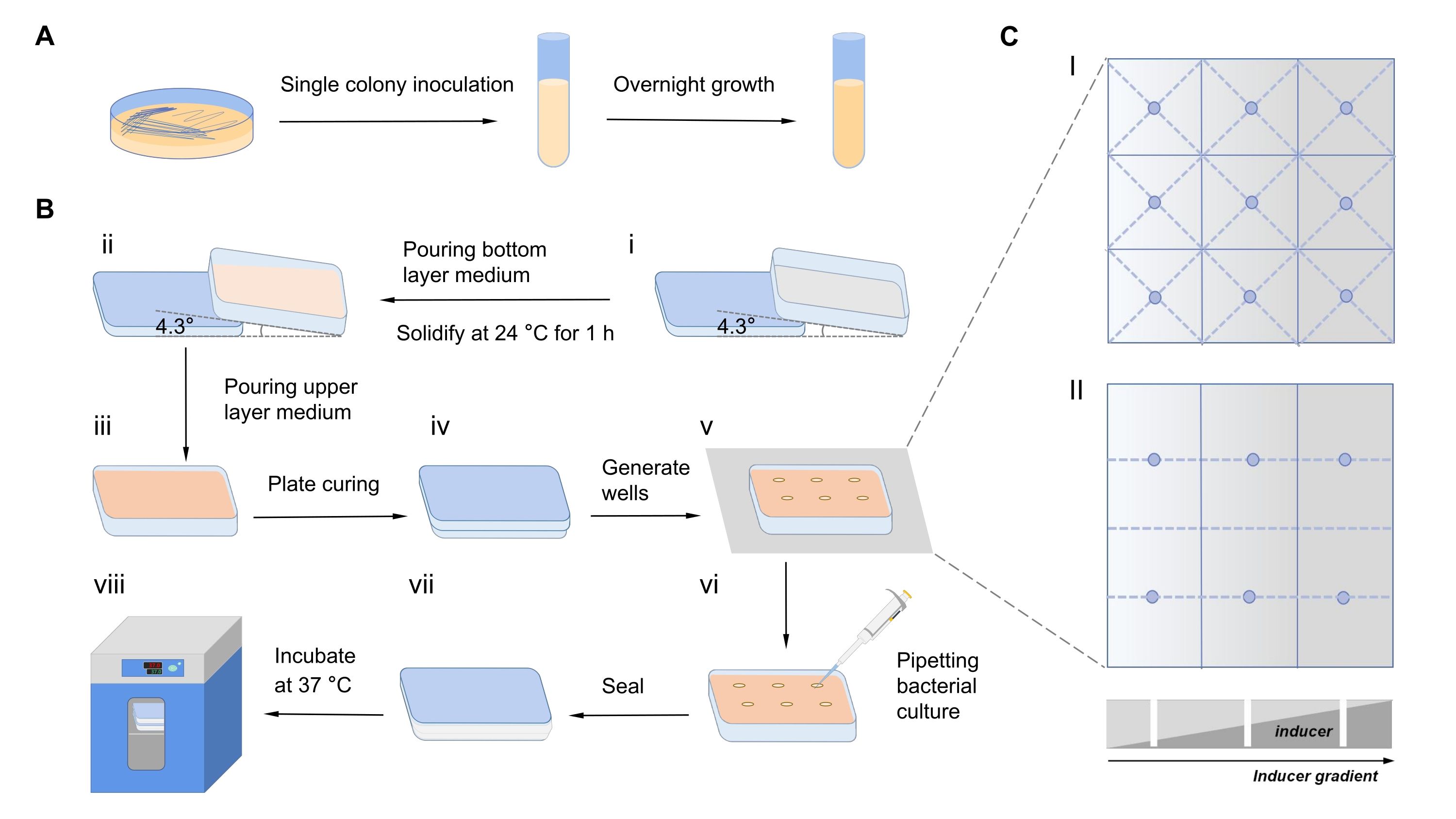
Figure 1: Schematic of inducer gradient swarm plate preparation, inoculation, and incubation.
Toegang beperkt. Log in of start een proefperiode om deze inhoud te bekijken.
Materialen
| Naam | Bedrijf | Catalogusnummer | Opmerkingen |
|---|---|---|---|
| Agar | Sigma-Aldrich | V900500 | 500 g |
| Ampicillin | Solarbio | A8180 | 25 g, ≥ 85% (GC) |
| Centrifuge tube | Corning | 430790 | 15 mL |
| Cryogenic vial | Corning | 430488 | 2 mL |
| Dimethyl sulfoxide (DMSO) | Aladdin | D103272 | AR, > 99% (GC) |
| L(+)-Arabinose | Aladdin | A106195 | 98% (GC), 500 g |
| Petri dishes | Bkman | B-SLPYM90-15 | Plastic Petri dishes,circular,90 mm x 15 mm |
| Resveratrol | Aladdin | R107315 | 99% (GC), 25 g |
| Sodium chloride | Macklin | S805275 | AR, 99.5% (GC), 500 g |
| Square Petri dishes | Bkman | B-SLPYM130F | Plastic Petri dishes, square, 13 mm x 13 mm |
| Tryptone | Thermo Scientific Oxoid | LP0042 | 500 g |
| Yeast extract | Thermo Scientific Oxoid | LP0021 | 500 g |
| Equipments | |||
| Biochemical incubator | Blue pard | LRH-70 | |
| Tanon 5200multi imaging system | Tanon | 5200CE | |
| Thermostatic water bath | Jinghong | DK-S28 |
