This video demonstrates site-specific replication fork blockage in Escherichia coli using arabinose-induced expression of yellow fluorescent protein-tagged TetR that binds chromosomal tetO arrays.
Een abonnement op JoVE is vereist om deze inhoud te bekijken. Log in of start vandaag met uw gratis proefperiode.
Methodenartikel
Fluorescently Tagged Repressor Protein-Mediated Replication Blockage in Escherichia coli
401 weergaven
⸱
28 november 2025
In dit artikel
Samenvatting
Protocol
1. Blocking Replication with Fluorescence Repressor Operator System (FROS)
- Inducing the Replication Blockage
- Dilute a fresh overnight culture of an E. coli strain carrying a tetO array and pKM118 to OD600nm = 0.01 in a dilute complex medium (0.1% tryptone, 0.05% yeast extract, 0.1% NaCl, 0.17 M KH2PO4, 0.72 M K2HPO4) with antibiotics as required for selection.
NOTE: Do not add tetracycline for selection as it is not compatible with this system. Make the volume of the culture equivalent to 10 ml per sample required. For example, the culture volume for the experimental design in Figure 1 is 60 ml. - Grow at 30 °C with shaking until OD600 nm = 0.05-0.1. Remove a 10 ml sample to serve as the uninduced control and add 0.1% arabinose to the remaining culture to induce the production of TetR-YFP from pKM1. Continue to grow both the uninduced and induced cultures. After 1 hr, check for the presence of a single focal point within each cell of the induced culture using fluorescence microscopy.
- If the induced cells are confirmed blocked (more than 70% of cells have a single focus), record the OD600nm and take a 7.5 ml sample for analysis by 2-D gels. Take an equivalent sample from the uninduced control culture.
- Dilute a fresh overnight culture of an E. coli strain carrying a tetO array and pKM118 to OD600nm = 0.01 in a dilute complex medium (0.1% tryptone, 0.05% yeast extract, 0.1% NaCl, 0.17 M KH2PO4, 0.72 M K2HPO4) with antibiotics as required for selection.
Toegang beperkt. Log in of start een proefperiode om deze inhoud te bekijken.
Resultaten
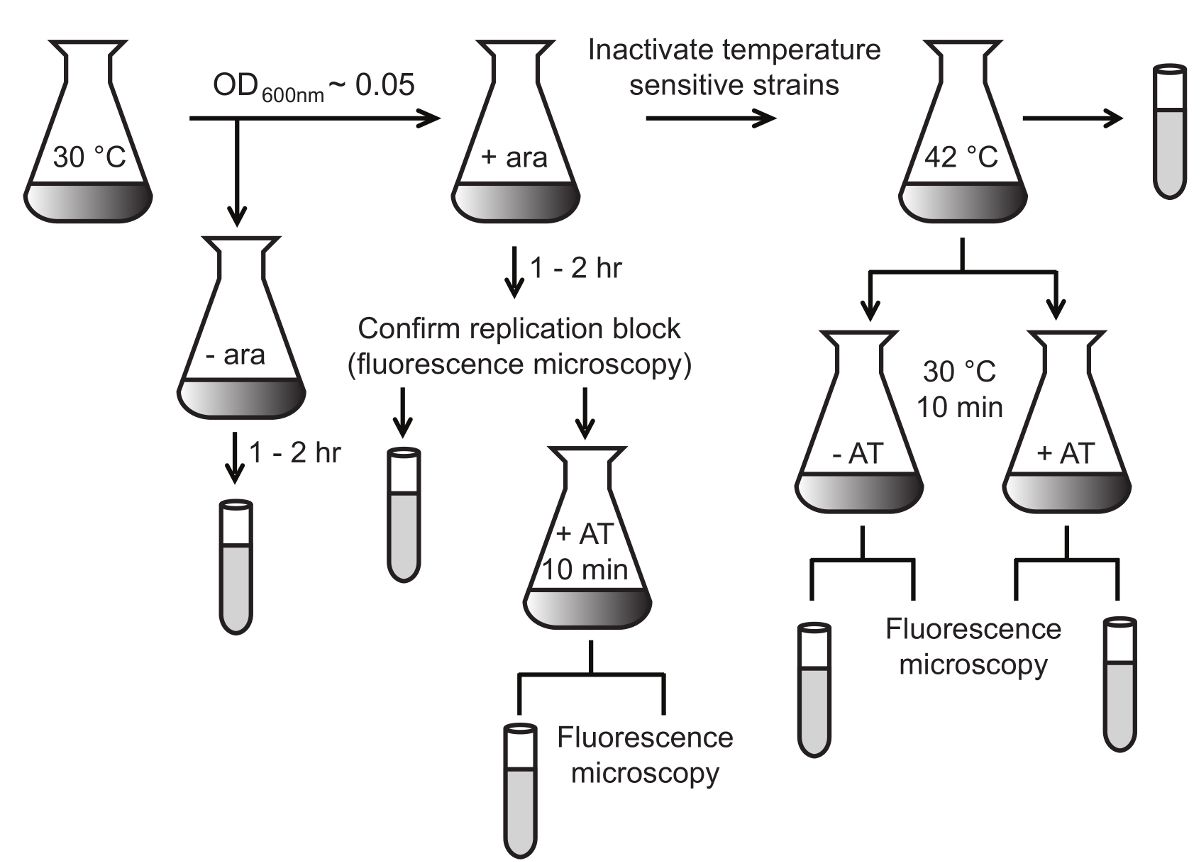
Figure 1: Overview of the FROS Replication Block and Release Experimental Procedure. E. coli stra...
Toegang beperkt. Log in of start een proefperiode om deze inhoud te bekijken.
Materialen
| Naam | Bedrijf | Catalogusnummer | Opmerkingen |
|---|---|---|---|
| Tryptone | Sigma-Aldrich | 16922 | Growth media component |
| Sodium Chloride | VWR | 27810.364 | Growth media component |
| Yeast extract | Sigma-Aldrich | 92144 | Growth media component |
| Potassium phosphate monobasic | Sigma-Aldrich | P9791 | Growth media component; Potassium buffer component |
| Potassium phosphate dibasic | Sigma-Aldrich | P3786 | Growth media component; Potassium buffer component |
| L-Arabinose | Sigma-Aldrich | A3256 | For induction of TetR-YFP production |
| Axioskop 2 Fluorescence microscope | Zeiss | 452310 | Visualization of cells |
| eYFP filter set | Chroma Technology | 41028 | Visualization of YFP |
| CCD camera | Hamamatsu | Orca-AG | Visualization of cells |
| MetaMorph Software (Molecular Devices) | SDR Scientific | 31282 | Version 7.8.0.0 used in the preparation of this manuscript |
