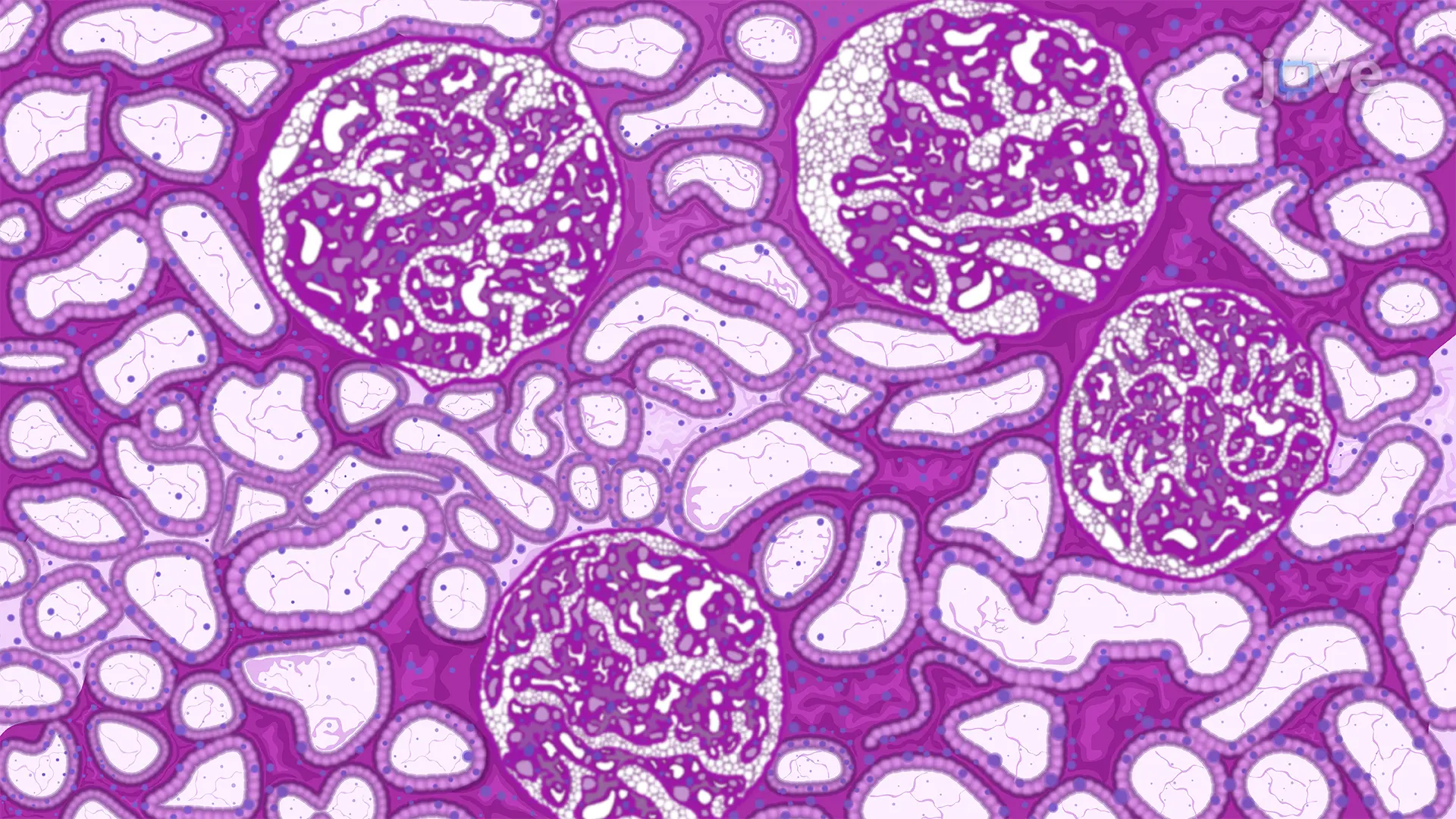
1. Periodic Acid Schiff (PAS) Stain
NOTE: The PAS stain will highlight the basement membranes of glomerular capillary loops and the tubular epithelium. It enables detailed visualization of the glomerular cells, mesangial matrix and potential expansion, and potential changes of the GBM (i.e., thickening and irregularities).
- Section the paraffin-embedded, PFA-fixed kidney cortex using a microtome at 5 µm thickness onto poly-L-lysine coated slides. Dry at 37 °C for 1 h. Ensure the section does not contain any folds or holes, which can distort the morphology under the microscope.
- Deparaffinize slides by incubating twice in xylene (CAUTION, irritant; use in fume cabinet) for 3 min each, twice in 100% EtOH for 3 min each, and then once in 95%, 70%, and 50% EtOH for 3 min each, all at room temperature. Rehydrate the slides in dH2O.
- Incubate the slides in periodic acid solution (CAUTION, irritant; use in fume cabinet) (1 g/dL) for 5 min, and then rinse the slides in several changes of dH2O. Use a container with 100 mL dH2O at room temperature.
- Incubate slides in Schiff's reagent (Parasoaniline HCl 6 g/L and sodium metabisulfite 4% in HCl 0.25 mol/L) for 15 min at room temperature. Wash slides in running tap water for 5 min.
- Counterstain with Hematoxylin for 3 s before thoroughly rinsing slides in running tap water for 15 min.
NOTE: Some optimization may be required to determine the optimal time for Hematoxylin staining.
- Dehydrate slides using the reverse of the deparaffinization protocol. Finish with xylene.
- Air dry slides and mount with xylene-based mounting media.
- Image on a light microscope at 400X magnification to assess glomerular structures. Evaluate the following: thickening and irregularities of the GBM, collapsing of capillary loops, fibrotic tissue, sclerosis, cellular proliferation (endothelial, podocyte, and mesangial, or inflammatory cells infiltrating the tuft).
NOTE: For a comprehensive evaluation of glomerular pathophysiology, lesions elsewhere in the kidney should be evaluated, such as in the tubules.