Een abonnement op JoVE is vereist om deze inhoud te bekijken. Log in of start vandaag met uw gratis proefperiode.

Methodenartikel

An Air Pouch Mouse Model for Lipopolysaccharide-Induced Inflammatory Exudate Collection

2.2K weergaven

8 juli 2025

In dit artikel

Samenvatting

Source: Lu, Q., et al. Detecting Migration and Infiltration of Neutrophils in Mice. J. Vis. Exp.  (2020).

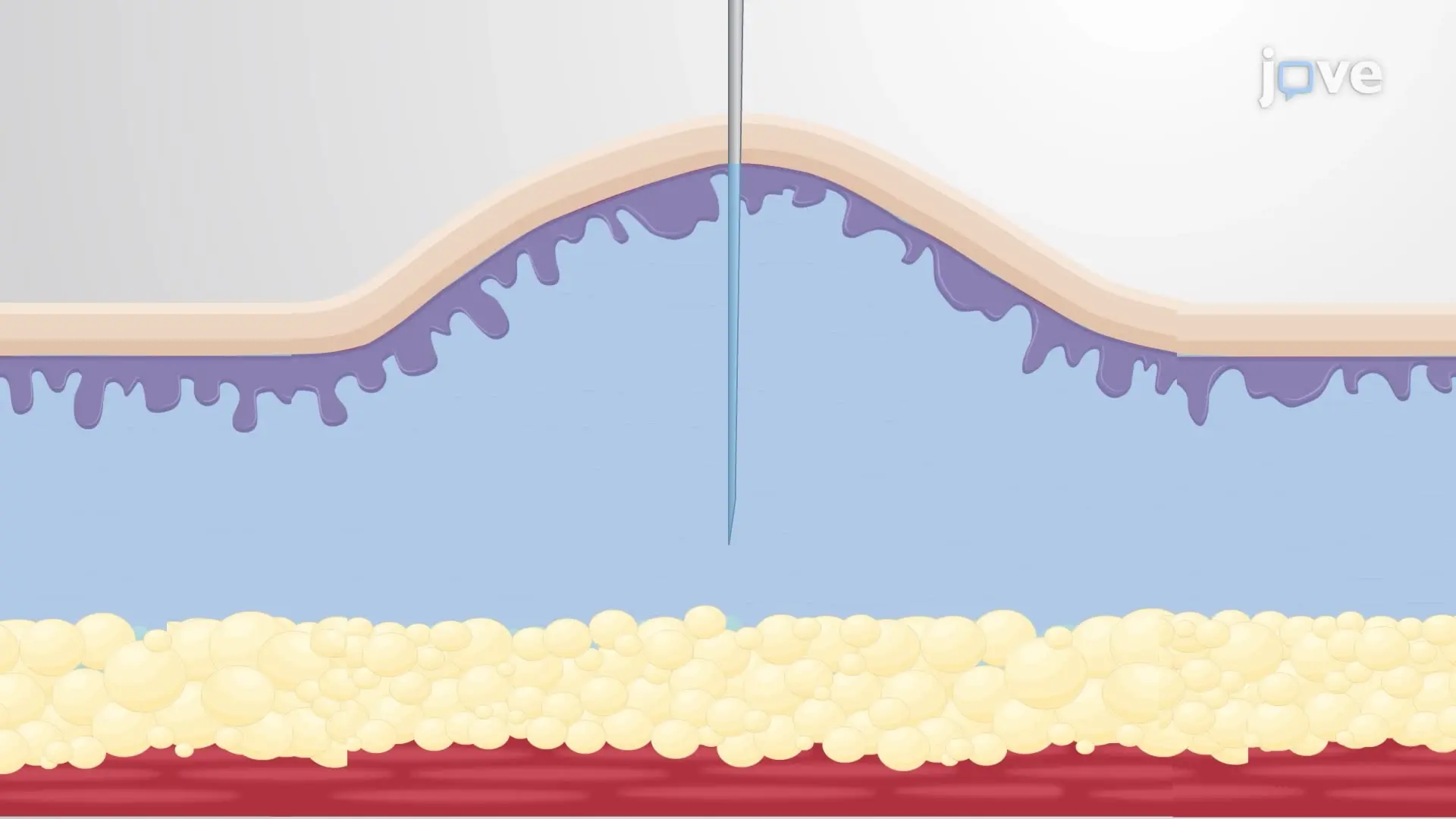
This video describes the procedure for generating an air pouch in the subcutaneous tissue of mice and collecting inflammatory exudates in response to lipopolysaccharide administration in vivo. This video also covers the analysis of the neutrophil infiltration in the air pouch.

Protocol

All procedures involving animal models have been reviewed by the local institutional animal care committee and the JoVE veterinary review board.

1. Air pouch assay

  1. First air injection
    1. On day 0, fully anesthetize mice with 5% isoflurane for 3 min in a gas anesthesia chamber at a speed of 2 L/min, and maintain the anesthesia of each mouse in a single breathing unit with 2% isoflurane at a speed of 0.5 L/min.
      NOTE: Sufficient depth of anesthesia is ensured by pinching the toes before moving mice from the chamber to the single breathing unit. The legs should not move when the toes are pinched.
    2. Use a 0.22 µm filter attached to a 5 mL syringe to obtain a 3 mL volume of sterilized air.
    3. Lift the back skin of the anesthetized mouse with tweezers and subcutaneously inject 3 mL of sterilized air using a 26 G x 3/8" needle.
    4. After treatment, remove the mice from the breathing unit. Monitor the mice to ensure they are alive until they start to move around.
  2. Second air injection
    1. On day 3, inject an additional 3 mL of sterilized air into the previously established air pocket to sustain the air pouch as described in section 1.1.
  3. Treatment
    1. On day 6, 6 h before sacrifice, inject different treatments into the air pouch. Inject 1 mL of phosphate-buffered saline (PBS) as a negative control. Inject 1 mL of 1 µg/mL LPS as the positive control to induce local inflammation.
    2. Fully anesthetize mice with 5% isoflurane for 3 min in a gas anesthesia chamber at a speed of 2 L/min, and maintain the anesthesia of each mouse in a single breathing unit with 2% isoflurane at a speed of 0.5 L/min. Prepare wash buffer according to Table of Materials.
      NOTE: Sufficient depth of anesthesia is ensured by pinching the toes before moving mice from the chamber to the single breathing unit. The legs should not move when the toes are pinched.
    3. For each air pouch, wash the air pouch with 1 mL of wash buffer and collect the inflammatory exudate in a 15 mL centrifuge tube. Wash the air pouch with 2 mL of wash buffer 2x and collect the inflammatory exudate in the same centrifuge tube.
    4. Centrifuge at 100 x g for 10 min at RT. Discard the supernatant and resuspend cells in 1 mL of wash buffer. Count the cells to quantify the neutrophil ratio using the automatic hematology analyzer.
      NOTE: See representative results in Figure 1.

Toegang beperkt. Log in of start een proefperiode om deze inhoud te bekijken.

Resultaten

Mouse model study; leukocyte count comparison (PBS vs. LPS); bar chart; immunology research.
Figure 1: Representative results of the air pouch assay. (A) Illustration of the air pouch assay. (B) Representative results of leukocyte subset infiltration in the air pouch assay. PBS: control; LPS: 1 µg/mL LPS. Data are presente...

Toegang beperkt. Log in of start een proefperiode om deze inhoud te bekijken.

Openbaarmakingen

No conflicts of interest declared.

Materialen

Lijst van materialen gebruikt in dit artikel
NaamBedrijfCatalogusnummerOpmerkingen
100% EthanolBeijing Chemical Works
100% MethanolBeijing Chemical Works
15 mL Conical Polypropylene Centrifuge TubeFalconFalcon
23 G x 1 1/4" NeedleBD305120
26 G x 3/8" NeedleBD305110
30 G x 1/2" NeedleBD305106
5 mL SyringeBDZ683574
50 mL Conical Polypropylene Centrifuge TubeFalcon14-432-22
Gas Anesthesia SystemZS DichuangZS-MV-IV
Phosphate-Buffered Saline (PBS), 1×Mix 90% ddH2O with 10% (v/v) 10×PBS, autoclaved
Phosphate-Buffered Saline (PBS), 10×Dissolve 16 g NaCl, 0.4 g KCl, 2.88 g Na2HPO4·2H2O, 0.48 g KH2PO4 (anhydrous) in 200 mL ddH2O, adjust pH 7.4, autoclaved 
Lipopolysaccharide (LPS)SigmaL3012
Wash Buffer in Air Pouch AssayDilute 0.5M EDTA to 10mM with HBSS

Trefwoorden

Door lipopolysacharide ge nduceerde ontstekinganalyse van neutrofieleninfiltratiesubcutane luchtinjectieprotocol voor LPS toedieningactivering van Toll like receptor 4afgifte van cytokinen en chemokinentoename van vasculaire permeabiliteitcentrifugeren en cellen wassen