Een abonnement op JoVE is vereist om deze inhoud te bekijken. Log in of start vandaag met uw gratis proefperiode.

Methodenartikel

Extracellular Recording of Electrical Activity in the Drosophila Central Nervous System

914 weergaven

⸱

8 juli 2025

In dit artikel

Samenvatting

Source: Swale, D. R., et al. Electrophysiological Recording of The Central Nervous System Activity of Third-Instar Drosophila Melanogaster. J. Vis. Exp. (2018)

The video demonstrates the extracellular recording of neuronal activity from the central nervous system (CNS) of Drosophila larvae. The transected CNS is positioned in a recording chamber, and the electrical activity from a descending nerve is recorded to establish the baseline firing frequency. A test agent is then introduced, and the change in firing frequency is recorded to determine the agent's excitatory or inhibitory effect.
Protocol

All procedures involving sample collection have been performed in accordance with the institute's IRB guidelines.

1. Dissect and Prepare the Larval Drosophila CNS

NOTE: Methods for larval CNS dissection are clearly illustrated in Hafer and Schedl, but these previously published methods reduce the length of the descending neurons that are important for measuring spike frequency. Here, an additional method is outlined to excise the larval CNS that maintains long, intact descending neurons.

  1. Saline preparation.
    1. Prepare the dissection and recording sal....

Toegang beperkt. Log in of start een proefperiode om deze inhoud te bekijken.

Resultaten

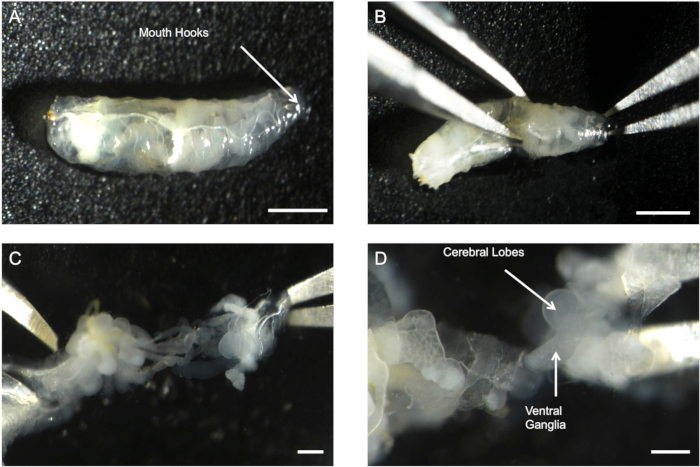
Larval dissection, highlighting mouth hooks, ventral ganglia, cerebral lobes; dissecting scope.
Figure 1: Method for excising the CNS from third-instar maggots. (A) Intact maggot submerged in 200 µL of saline. The arrow indicates the mouth hooks that are used for separation of the body wall. (B) Two pairs of forceps are placed in .......

Toegang beperkt. Log in of start een proefperiode om deze inhoud te bekijken.

Openbaarmakingen

No conflicts of interest declared.

Materialen

Lijst van materialen gebruikt in dit artikel
NaamBedrijfCatalogusnummerOpmerkingen
Drosophila melanogaster (strain OR)Bloomington Drosophila Stock Center2376
Vibration isolation tableKinetic Systems9200 series
Faraday CageKinetic SystemsN/A
Dissecting Microscope on a BoomNikonSMZ800NMultiple scopes can be used; boom stand is critical
AC/DC differential amplifierADInstrumentsAM3000HThe model 1700 can be used instead of the model 3000
audio monitorADInstrumentsAM3300
Hum Bug Noise EliminatorA-M Systems726300
Data Acquisition System (PowerLab)ADInstrumentsPL3504Multiple PowerLab models can be used.
Lab Chart Pro SoftwareADInstrumentsN/A - Online Download
Fiber Optic LightsEdmund Optics89-740Different light sources can be used, but fiber optics are the most adaptable
MicromanipulatorWorld Precision InstrumentsM325
Microelectrode HolderWorld Precision InstrumentsMEH715Different models are acceptable
BNC cablesWorld Precision Instrumentsmultiple based on size
Glass CapillariesWorld Precision InstrumentsPG52151-4
Microelectrode PullerSutter InstrumentsP-1000Also can use Narashige PC-100
Black WaxCarolina Biological Supply974228
Non-coated insect pins, size #2Bioquip1208S2
Fince ForcepsFine Science Tools11254-20
Vannas Spring ScissorsFine Science Tools15000-03

Meer artikelen verkennen

Drosophila CNSvuringfrequentiezuigelektrodebasisactiviteittestmiddelexciterend effectinhiberend effectgegevensverwervingperifere zenuw