Een abonnement op JoVE is vereist om deze inhoud te bekijken. Log in of start vandaag met uw gratis proefperiode.

Methodenartikel

Recording Brain Signals from Freely Moving Piglets

833 weergaven

8 juli 2025

In dit artikel

Samenvatting

Source: de Camp, et al. Noninvasive EEG Recordings from Freely Moving Piglets. J. Vis. Exp. (2018).

This video demonstrates the recording of brain signals from a freely moving piglet. The piglet's head is cleaned, and the electrodes are attached. These electrodes are then connected to a telemetry unit. The setup is secured with silicone rubber. The piglet is allowed to acclimate before data recording.
Protocol

All procedures involving animal models have been reviewed by the local institutional animal care committee and the JoVE veterinary review board.

1. Piglet

  1. Catch a piglet by grabbing it at the leg or the thorax. Hold it and be aware of any defecation or urination.
  2. If necessary, mark the piglet with a number.
  3. Wrap the piglet in a towel. The piglet will calm down. Be aware of overheating the piglet.
  4. Hold the piglet with one hand at the body or forearm. Use the other hand to hold the snout. Be aware of overheating the piglet, and make sure it is free to breathe properly.

2. Electrodes

  1. Have a second person attach the electrodes.
  2. Clean the skin from dirt with water or ethanol. If necessary, shave the head.
  3. Remove any dead skin cells with an abrasive electroencephalogram (EEG) gel and a quality (Q)-tip. Remove the abrasive gel afterward. Alternatively, use sandpaper.
  4. Fix the self-adhesive electrodes at the desired location. Place the ground electrode above the cerebellum (between the ears) and the reference electrode on the nose. Place the recording electrode at the desired location.
    NOTE: In this case, a unipolar recording was performed because the reference was placed at a neutral position (nose). There is no standardized system available for piglets until now. Here, a parietal recording position was used (between the eye and the ear) on the right brain hemisphere.
  5. Connect the cables to the telemetry unit. Turn the unit on. Depending on the telemetry system used, this might be a magnetic switch or a radio frequency wake-up signal.
  6. Cover the telemetry unit and all cables as well as all electrodes with two-component skin adhesive silicone rubber (see Table of Materials). By mixing equal amounts of both components, the curing time will be in the range of 1 min. Eyes and eyelashes should not be covered with the rubber.
  7. Wait until the silicone rubber is completely cured.
  8. Place the piglet back in the pigpen.
  9. Observe the piglet to see if it is showing signs of discomfort over a longer period of time (several minutes).

3. Measurement

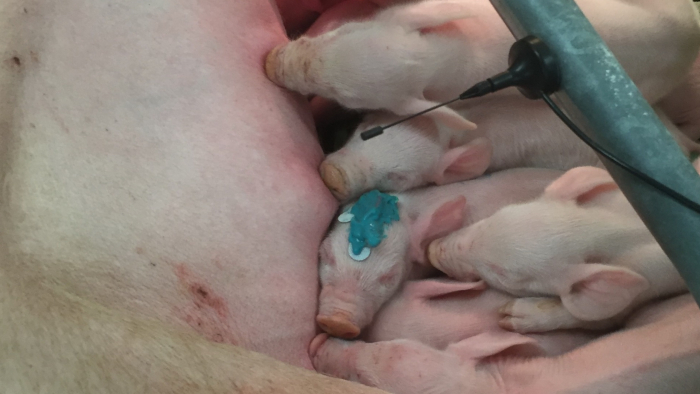
  1. Wait until the piglet has recovered and starts to synchronize its behavior with that of its siblings (feeding, playing, sleeping), usually after 30 s (Figure 1).
  2. Wait for sleep phases, if desired. The recording time depends on the specific scientific question. Here, 10 min recording sessions were used.
  3. If the telemetry unit is covered by more than 2 other piglets, the signal might be too low for the receiver. Gently push the piglets away if they are sleeping on top. Be aware of the sow; it might react aggressively.
  4. Start the recording with the data acquisition software (see Table of Materials).

4. Finish

  1. After the recording (usually several hours), catch the piglet again, as has been described in step 1. Be aware of the sow; it might react aggressively.
  2. Gently lift the silicone rubber at one edge. Then, remove the whole patch of silicone rubber containing the electrodes and the telemetry unit. Be careful with the piglet's eyes.
  3. Place the piglet back in the pigpen.

Toegang beperkt. Log in of start een proefperiode om deze inhoud te bekijken.

Resultaten

Piglets nursing from sow; animal husbandry; swine farming; lactation; agriculture practices.
Figure 1: A sleeping piglet with the telemetric EEG system.

Toegang beperkt. Log in of start een proefperiode om deze inhoud te bekijken.

Openbaarmakingen

No conflicts of interest declared.

Materialen

Lijst van materialen gebruikt in dit artikel
NaamBedrijfCatalogusnummerOpmerkingen
Disposable adhesive surface silver/silver chloride electrodesSpes Medica S.r.l., Genova, ItalySelf adhesive hydrogel electrode
Abralyt HiClEasycap GmbHAbrasive cream
Body Double fastSmooth On Inc.Skin adhesive silicone
Telemetry systemInternal development
Picolog 1216Pico TechnologyAD converter
LaptopPanasonicRugged laptop
ReceiverInternal development

Trefwoorden

Registratie van hersensignalenEEG registratiesplaatsing van elektrodentelemetrie eenheidsiliconenrubbergrounding elektrodereferentie elektrodereiniging van de kopdata acquisitie