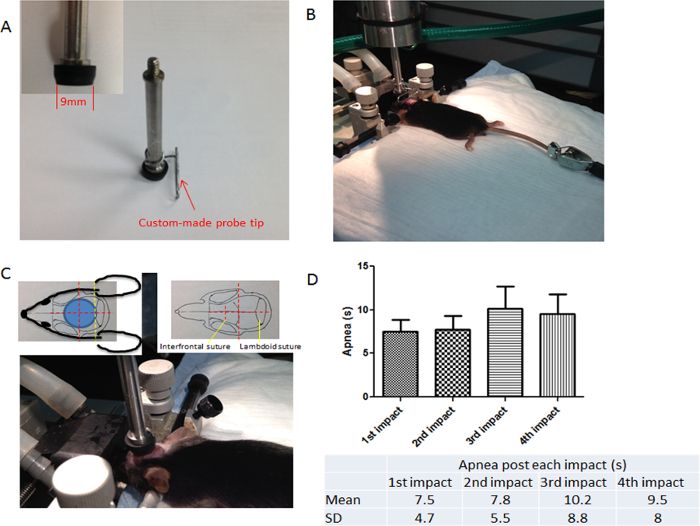
All procedures involving animal models have been reviewed by the local institutional animal care committee and the JoVE veterinary review board.
1. Animal Care
- Use 3–4-month-old male C57BL/6J mice. Provide bedding, nesting material, food, and water ad libitum. Keep the mice in ambient temperatures controlled at 20 - 22 °C with constant 12-hr light/12-hr dark cycles.
2. Pre-impaction Preparation
- Attach a custom-made silicone rubber-coated metal tip to an electromagnetic stereotaxic impact device. Make sure the flat bottom of the tip is parallel to the surface of the probe tip (Figure 1A).
- Anesthetize the mouse with 4% isoflurane followed by maintenance anesthesia of 2.5% isoflurane. Check the anesthesia via the flow meter. Monitor the anesthesia level until the animal reaches a surgical level of anesthesia by showing loss of pedal withdrawal reflex.
- Put the mouse in a prone position on a heating pad. Use a funnel-shaped nose cone to keep the mouse under anesthesia. Completely shave the head using a trimmer. Use petrolatum ophthalmic ointment on the mouse's eyes to prevent dryness while under anesthesia.
3. Impact Parameters Setting
NOTE: The impact system includes a control box to set impact parameters, an actuator to perform the impaction, and a digital stereotactic frame with 3-movement axes.
- Pre-set the velocity of the impact device to 4 m/sec and dwell time to 240 msec on the control box.
4. Positioning the Impact Center
- Put a soft heating pad under the animal's body to keep the body temperature near 39 °C. Mount the mouse in a stereotactic frame in a prone position with the blunt-end ear bars.
- Lower the impact tip close to the mouse's head by moving the Z-driver. Adjust the flat impact tip (9 mm diameter) by moving the X- and Y-drivers midway to the target coordinates above the sagittal suture.
- Make sure one edge of the impact tip is vertically parallel to an imaginary horizontal line drawn between the two ears (Figure 1C). The center of impact corresponds to the central sagittal suture midway between interfrontal and lambdoid sutures (interaural 9 mm to interaural 0 mm, lateral 4.5 mm).
5. Impact Depth Setting
- To correctly set the impact depth, use an additional probe tip to replace the insulated silicone rubber-coated impact tip.
- To make sure there is no shift of the impact center after switching tips, set the X and Y channel on the digital stereotaxic control panel to zero before switching the tips.
- Move the probe tip to the center of the impact area by manually moving the X-and Y-drives.
- Clip contact sensor to the mouse's tail.
- Move the impactor (Z drive) down until the probe tip touches the surface of the impact site.
- Set the Z channel on the stereotaxic control panel to zero.
- Move the impact tip back to the impact area by manually adjusting X- and Y-drivers (NOT the zero buttons on the digital stereotaxic control panel) until X- and Y-drivers are zero (where the impact tip was previously positioned).
- Retract the actuator by moving the retract switch on the control box. Manually move the impactor down (Z driver) by 4 mm.
6. Impact
- Trigger the impact by clicking the impact switch on the control box and achieve a deformation depth of 4 mm.
7. Post-impaction
- Measure the time from the impact until the mouse's first breath using a timer.
- Remove the animal from the instrument and place them on a warm pad to maintain their body temperature. Do not leave the animal unattended until it has regained sufficient consciousness to maintain sternal recumbency.
- Allow for recovery before returning the animal back into a clean cage. Do not return an animal to the company of other animals until fully recovered.
- Observe and weigh the mice daily. If the mice show signs of pain, intraperitoneally inject them with Meloxicam at 1 - 2 mg/kg every 12 - 24 hr.
8. Repetitive Impaction
- Give the mice additional injuries on days 4, 7, and 10 after the initial injury (72 hr interval between impacts).