This video demonstrates diffusion tensor imaging in assessing chronic spinal cord compression. By analyzing water diffusion patterns, fractional anisotropy, and apparent diffusion coefficient values, the findings reveal axonal damage in compressed regions. The findings provide critical insights into spinal cord pathology and structural integrity.
Een abonnement op JoVE is vereist om deze inhoud te bekijken. Log in of start vandaag met uw gratis proefperiode.
Methodenartikel
Assessing Spinal Cord Compression Using Diffusion Tensor Imaging
829 weergaven
⸱
17 juni 2025
In dit artikel
Samenvatting
Protocol
All procedures involving human participants have been performed in compliance with the institutional, national, and international guidelines for human welfare and have been reviewed by the local institutional review board.
1. Subject Preparation
- Ensure that each participant meets the following criteria for chronic spinal cord compression: a) a history of loss of significant neurological function, b) a positive myelopathy physical examination, and c) magnetic resonance imaging (MRI) evidence of cervical cord compression.
NOTE: The exclusion criteria are a) incapability of providing written consent and b) inability to obtain diffusion tensor imaging (DTI) parameters of artifacts. For controls, inclusion criteria are a) no history of significant back or neck injuries, neurological disorders, or spine surgeries; b) no MRI evidence of cervical cord compression. - Ask each participant to complete and sign a consent form that lists MRI safety guidelines and the imaging protocol. Specifically, patients with chronic spinal cord compression are examined by MRI preoperatively and 1 year postoperatively.
- Provide earplugs for each participant. Place them in a supine position with a head/neck coil enclosing the cervical region, and a landmark at the thyroid cartilage level. Ensure that each participant is in a comfortable position that effectively reduces movement.
2. Structural MRI Parameters
NOTE: Anatomical T1-weighted (T1 W) images, T2-weighted (T2 W) images, and DTI were acquired on a 3 Tesla MRI scanner with a 16-channel head coil.
- Use fast perturbation gradient echo (FPGR) for localization scanning to obtain axial, sagittal, and coronal position maps.
- Position the sagittal positioning line with the coronal position maps to ensure that the positioning baseline is parallel to the spinal canal (spinal cord); first locate the sagittal plane T2 W, then copy and paste the sagittal T1 W positioning line to the T2 W positioning line.
- Use the following imaging parameters for T1 W and T2 W sagittal imaging: field of view (FOV) = 240 mm x 240 mm, voxel size = 1.0 mm x 0.8 mm x 3.0 mm, slice gap = 0.3 mm, slice thickness = 3 mm, number of excitation (NEX) = 2, fold-over direction = feet/head (FH), and time of echo (TE)/time of repetition (TR) = 10/700 ms (T1 W) and 101/2,500 ms (T2 W). Obtain nine sagittal images covering the entire cervical spinal cord.
- Position the axial positioning line on the sagittal T2 W image and cover the intervertebral disc from C2/3 to C6/7, centering on the anteroposterior diameter of the intervertebral space. Use the following imaging parameters: FOV = 180 mm x 180 mm, voxel size = 0.7 mm x 0.6 mm x 3.0 mm, slice thickness = 3 mm, fold-over direction = anterior/posterior (AP), NEX = 2, and TE/TR = 120/3,000 ms.
- Position the axial positioning line on the sagittal T2 W image, centering on the anteroposterior diameter of the intervertebral space, with 45 slices covering the cervical spinal cord from C1 to C7.
- Obtain DTI via the following sequence: single-shot spin-echo echo-planar imaging (SE-EPI) with 20 orthogonal directions. Non-coplanar diffusion directions with b-value = 800 s/mm2.
- Use the following imaging parameters: FOV = 230 mm x 230 mm, acquisition matrix = 98 x 98, reconstructed resolution = 1.17 x 1.17, slice thickness = 3 mm, fold-over direction = AP, NEX = 2, EPI factor = 98, and TE/TR = 74/8,300 ms. Provide a time course summarizing the steps in the MRI protocol, as shown in Figure 1.
NOTE: The time course summarizing the MRI and DTI protocol is shown in Figure 1.
Toegang beperkt. Log in of start een proefperiode om deze inhoud te bekijken.
Resultaten
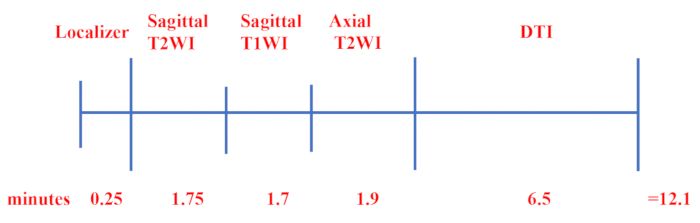
Figure 1: Time course of the clinical MRI protocol. First, the FSPGR sequence was selected for localiza...
Toegang beperkt. Log in of start een proefperiode om deze inhoud te bekijken.
Materialen
| Naam | Bedrijf | Catalogusnummer | Opmerkingen |
|---|---|---|---|
| 3-Tesla MRI scanner | Siemens | 40708 | Software: NUMARIS/4 |
| Syngo MR B17 | Siemens | 40708 | Software: NUMARIS/4 |
