Hier presenteren we een protocol laboratorium adaptieve evolutie van micro-organismen onder omstandigheden met behulp chemostaat cultuur te verkrijgen. Ook is genomische analyse van het vrijkomende stam besproken.
Een abonnement op JoVE is vereist om deze inhoud te bekijken. Log in of start vandaag met uw gratis proefperiode.
Methodenartikel
Procedure voor Adaptive Laboratorium Evolutie van micro-organismen met behulp van een Chemostat
* These authors contributed equally
In dit artikel
Samenvatting
Samenvatting
Natuurlijke evolutie omvat genetische diversiteit zoals veranderingen in de omgeving en een selectie tussen kleine populaties. Adaptieve laboratoriumevolutie (ALE) verwijst naar de experimentele situatie waarin evolutie wordt waargenomen met behulp van levende organismen onder gecontroleerde omstandigheden en stressfactoren; organismen worden daarbij kunstmatig gedwongen om evolutionaire veranderingen door te voeren. Micro-organismen worden in de omgeving blootgesteld aan verschillende stressfactoren en zijn in staat om bepaalde stress-induceerbare eiwitten te reguleren om hun overlevingskansen te vergroten. Natuurlijk voorkomende spontane mutaties brengen veranderingen teweeg in het genoom van een micro-organisme die zijn overlevingskansen beïnvloeden. Langdurige blootstelling aan chemostaatcultuur veroorzaakt een accumulatie van spontane mutaties en maakt de meest aanpasbare stam dominant. Vergeleken met de kolonie-overdracht- en seriële overdrachtmethoden brengt chemostaatcultuur het hoogste aantal celdelingen en dus het hoogste aantal diverse populaties met zich mee. Hoewel chemostaatcultuur voor ALE complexere kweekapparaten vereist, is het minder arbeidsintensief zodra de operatie begint. Vergelijkende genomische en transcriptoomanalyses van de aangepaste stam geven evolutionaire aanwijzingen over hoe de stressfactoren bijdragen aan mutaties die de stress overwinnen. Het doel van het huidige artikel is om versnelde evolutie van micro-organismen onder gecontroleerde laboratoriumomstandigheden tot stand te brengen.
Inleiding
Micro-organismen kunnen overleven en zich aan te passen aan verschillende omgevingen. Onder zware stress, kan de aanpassing gebeuren via de overname van heilzame fenotypes door willekeurige genomische mutaties en de daaropvolgende positieve selectie 1-3. Daarom kan microbiële cellen aangepast door het veranderen van metabole of regulerende netwerken voor een optimale groei, die wordt aangeduid als "adaptieve evolutie". Recente belangrijke microbiële tendensen, zoals het uitbreken van superbugs en het optreden van sterke microbiële stammen, zijn nauw verwant aan adaptieve evolutie onder stressvolle omstandigheden. Onder laboratoriumomstandigheden gedefinieerd, kunnen wij de mechanismen van moleculaire evolutie bestuderen en zelfs de richting van microbiële evolutie verschillende toepassingen te beheersen. In tegenstelling tot meercellige organismen, eencellige organismen zijn zeer geschikt voor adaptieve laboratorium evolutie (ALE) om de volgende redenen: ze snel herstellen, onderhouden ze grote populaties, en het is eenvoudig te maken en te onderhouden homogeneous omgevingen. Gecombineerd met recente ontwikkelingen in DNA sequencing technieken en high-throughput technologieën ALE maakt de directe waarneming van genomische veranderingen die leiden tot structurele veranderingen in regelgeving. Mutatie dynamiek en diversiteit van de bevolking zijn ook waarneembaar. Genetische manipulatie strategieën kunnen worden bepaald uit de analyse van ALE stammen 4,5.
Chemostaat cultuur is een methode die wordt gebruikt om steady-state cellen te verkrijgen en de productiviteit in fermentatieprocessen 6 te verhogen. Vers medium wordt toegevoegd en kweekbouillon wordt tijdens het proces (de laatste omvat medium en biomassa) geoogst. Langdurige kweek chemostaat echter verandert de steady-state productiviteit van de kweek en brengt de accumulatie van spontane mutaties en selectie in kweek (Figuur 1a). Onder verschillende selectiedruk (stressoren), zal de accumulatie van mutaties verbeterd. Een geleidelijke toename van stress op lange termijn chemostaat voorziet in een continue selectie van mutaties die werken tegen de gegeven stressoren, zoals temperatuur, pH, osmotische druk, voedingsmiddel verhongering, oxidatie, toxische eindproducten, enz Colony transfer van een vast medium en seriële overdracht van een vloeibaar medium (herhaalde batch cultuur) ook kunnen onderzoekers ontwikkelde micro-organismen (figuur 1b en 1c) te verkrijgen. Hoewel chemostaat cultuur ingewikkelde methodes vereist, het zwembad van de diversiteit (het aantal herhalingen en de grootte van de populatie) is hoger dan die verkregen door kolonie overdracht en serial transfer technieken. De stabiele spanning blootstelling aan individuele cellen en verminderde variatie in de cellulaire toestand tijdens chemostaat cultuur (steady state) zijn andere voordelen van ALE in vergelijking met batch-cultuur gebaseerde technieken. Stress geïnduceerde ALE van Escherichia coli onderworpen aan hoge succinate omstandigheden die in dit artikel.
iles / ftp_upload / 54446 / 54446fig1.jpg "/>
Figuur 1: Methoden van adaptieve laboratorium evolutie (A) Chemostat;. (B) seriële overdracht; (C) kolonie overdracht. De bovenste cijfers illustreren het concept van de methoden voor het ALE en de onderste cijfers illustreren het aantal cellen die groeide tijdens ALE. Klik hier om een grotere versie van deze figuur te bekijken.
Toegang beperkt. Log in of start een proefperiode om deze inhoud te bekijken.
Protocol
1. apparatuur Voorbereiding
- Verkrijgen van een chemostat pot (150-250 ml) of een erlenmeyer (250 ml) die een inlaatpoort en een uitlaatpoort. Sluit de poorten met siliconenslang waardoor stroomsnelheden van 10-100 ml / uur. Optioneel gebruik van een ontluchter, een luchtuitlaat poort, en temperatuurgecontroleerde water inlaat en uitlaat poorten.
- Verkrijgen van een apparaat om de chemostaat pot die voorziet roeren en temperatuurregeling (of een roterende schudincubator).
- Verkrijgen twee peristaltische pompen om vers medium te leveren en het verzamelen van de cultuur.
- Zorg voor een reservoir jar (10-20 L) met een medium uitlaatpoort en een luchtinlaat poort.
- Verkrijgen van silicium slangen die geschikt zijn voor de verdunning (dat wil zeggen, ID 0,8 mm, stroom range 0,06-36 ml / min; L / S 13 buizen).
2. Medium Voorbereiding en Sterilisatie
- Initial Medium
- Los op 0,3 g glucose, 0,08 g NH4Cl, 0,05 g NaCl, 0,75 g Na 2 HPO 4 · 2H 2 O, en 0,3 g KH 2 PO 4 in 90 ml gedestilleerd water (DW) in een chemostaat pot.
- Sluit de chemostat pot samen met de slang met behulp van klemmen. Niet sluit de ontluchter.
- Steriliseer het chemostaat pot in een autoclaaf bij 121 ° C gedurende 15 minuten. Na sterilisatie, slaan de chemostaat pot bij kamertemperatuur.
- Ontbinden 0,02 g MgSO4 · 7H 2 O, 0,01 g CaCl 2 en 0,1 mg thiamine in 10 ml DW (oplossing A).
- Filteroplossing Een behulp van een injectiespuit en een voorgevulde injectiespuit filter gesteriliseerd (0,45 urn poriën een filter).
- Voeg de oplossing A filtraten de chemostaat pot.
- Stress Medium
- Los op 30 g glucose, 8 g NH 4 Cl, 5 g NaCl, 75 g Na 2 HPO 4 · 2H 2 O, 30 g KH 2 PO 4, en 300 g dinatriumsuccinaat hexahydraat (Na 2 · succinaat · 6H 2 O; de stressor gebruikt in dit experiment) in 9,9 L DW in een reservoir pot.
- Sluit de reservoir pot samen met de slang met behulp van klemmen. Niet sluit de ontluchter.
- Steriliseer het reservoir pot in een autoclaaf bij 121 ° C gedurende 15 minuten. Na sterilisatie Bewaar de kruik bij kamertemperatuur.
- Los 2 g MgSO4 · 7H 2 O, 1 g CaCl 2 en 10 mg thiamine in 100 ml DW (oplossing A).
- Filteroplossing A met een injectiespuit en een voorgevulde injectiespuit filter gesteriliseerd (0,45 urn poriën een filter).
- Voeg de oplossing A filtraten het reservoir pot.
- Aseptisch sluit de gesteriliseerde silicium slang aan het reservoir pot en bevestig de peristaltische pompen.
- High-stress-Medium
- Bereid het medium volgens punt 2.2, maar met een grotere concentratie van stressor (dwz 3-5 g / l hoger succinaat adaptatie).
Let op: Dit protocol is voor de aanpassing aan een stress-thop kan worden geleverd via het medium. Bij fysische stressfactoren zoals temperatuur, roeren of verlichting moet de teelt dienovereenkomstig worden ontworpen.
- Bereid het medium volgens punt 2.2, maar met een grotere concentratie van stressor (dwz 3-5 g / l hoger succinaat adaptatie).
3. Eerste Teelt
- Inoculeer een enkele kolonie van wild-type E. coli in een 15 ml reageerbuis met 4 ml oorspronkelijke medium.
- Incubeer de reageerbuis in een schudincubator gedurende 12 uur bij 37 ° C en 220 rpm.
- Aseptisch overdracht 1 ml voorkweek de chemostaat pot.
- Incubeer de chemostaat pot, voorziet beluchting (lucht 50 ml / min) en roeren (200 rpm) bij 37 ° C gedurende 6 uur.
4. Stress Adaptation
- Aseptisch sluit het einde van het silicium slang van de pompen naar de chemostaat pot.
- Start de pomp uitlaat (10 ml / u of hoger) en verzamel cultuur.
Opmerking: De cultuur moet in de exponentiële fase typisch 4-8 uur na initiële kweek. - check de optische dichtheid (600 nm) van de kweek van de uitlaat slang.
- Start de inlaatpomp (10 ml / uur, overeenkomend met een snelheid van verdunning van 0,1 h-1).
- Controleer de optische dichtheid van de kweek bij 600 nm van de uitvoerslang elke 24 uur.
- Bedien de chemostaat voor 96 uur (omzet 9,6-voudig) of meer. Als de optische dichtheid stabiel, wisselen het reservoir met de zwaar belaste medium. Als de optische dichtheid lager dan 0,2, stopt de toevoertransporteur inlaatpomp voor 6 uur. Herstart de inlaat pomp en controleer of de optische dichtheid is voorbij 0.2.
- Geleidelijk verhogen van de concentratie van de stressor door het veranderen van een reservoir met een hogere concentratie stressor.
- Monsters van de kweek aangepast wanneer het een mijlpaal bereikt (bijvoorbeeld een stam aangepast om 100 g / l succinaat stress), en opslag voor verdere genomische analyse.
- Voor monster opslag, meng de cultuur monster (0,5 ml) met een gesteriliseerde 80% glycerol solution (0,5 ml) en het op -80 ° C.
Opmerking: Als het micro-organisme verwerft het vermogen om de stressor afgebroken tijdens de ALE proces de stressor concentratie in de fermentatie pot is niet dezelfde als die in de verse reservoir.
5. Single-kolonie Isolatie van de stress-aangepaste stam
- Bereid agarplaat-medium (1,6% agar) die dezelfde stressor en bij dezelfde concentratie drager.
- Plaat de uitlaat kweek (0,1 ml) van de chemostaat en incubeer bij 37 ° C gedurende 16 uur.
- Pick enkele kolonies van de plaat met een steriele tandenstoker en beënt ze in 15 ml reageerbuizen die dezelfde stressor en in hetzelfde medium concentratie in de chemostaat en incubeer gedurende 6 uur.
- Breng 1 ml van de cultuur bouillon in een 250 ml Erlenmeyer die 50 ml medium. Oogst 0,5 ml van de kweekbouillon elke 1 uur, en meet de OD bij 600 nm. Vergelijk de groei van de aangepaste Strain met die van de wildtype gezien de stressor.
Toegang beperkt. Log in of start een proefperiode om deze inhoud te bekijken.
Resultaten
Voor high-succinaat stress-adaptatie, de wild-type E. coli W3110 stam werd gekweekt in een chemostat bij D = 0,1 h-1 gedurende 270 dagen (figuur 2).
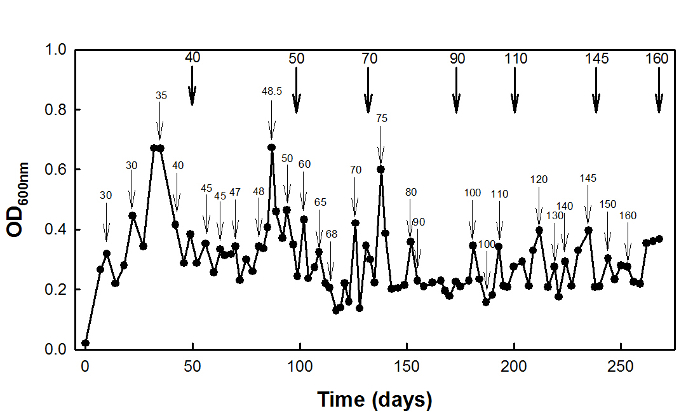
Figuur 2: High-succinaat spanning aanpassing van E. coli W3110 gebruik chemostaat cultuur. Dunne pijlen geven de tijdstippen waarop de concentratie stressor werd verhoogd en vetge...
Toegang beperkt. Log in of start een proefperiode om deze inhoud te bekijken.
Discussie
Micro-organismen zijn in staat aan te passen aan bijna alle omgevingen vanwege hun snelle groei en de genetische diversiteit. Adaptive laboratorium evolutie stelt micro-organismen om te evolueren onder omstandigheden ontworpen, die een manier van het selecteren van de individuele organismen harboring spontane mutaties die gunstig onder de gegeven omstandigheden biedt.
De chemostaat techniek robuuster te bereiken kunstmatig aangedreven evolutie dan transfertechniek om de volgende redenen: (a)...
Toegang beperkt. Log in of start een proefperiode om deze inhoud te bekijken.
Openbaarmakingen
De auteurs hebben niets te onthullen.
Dankbetuigingen
Deze studie werd financieel ondersteund door het Koreaanse ministerie van Wetenschap, ICT en Toekomstplanning (Intelligent Synthetic Biology Center-programma 2012M3A6A8054887). P. Kim werd ondersteund door een beurs van de Katholieke Universiteit van Korea (2015).
Toegang beperkt. Log in of start een proefperiode om deze inhoud te bekijken.
Materialen
| Naam | Bedrijf | Catalogusnummer | Opmerkingen |
|---|---|---|---|
| Mini-chemostat fermentor | Biotron Inc. | - | vervaardigd op speciale bestelling |
| siliconen slang | Cole-Parmer | Masterflex L/S 13 | slangmaat kan worden gevarieerd afhankelijk van de verdunningssnelheid en de grootte van de fermentorpot. |
| reservoirpot | Bellco | Media opslag fles | 20 L |
| chemicaliën | Sigma-Aldrich | - | reagenskwaliteit |
| glucose | Sigma-Aldrich | G5767 | ACS reagens |
| NH4Cl | Sigma-Aldrich | A9434 | voor moleculaire biologie, geschikt voor celcultuur, ≥99,5% |
| NaCl | Sigma-Aldrich | 746398 | ACS reagens, ≥99% |
| Na2HPO4·2H2O | Sigma-Aldrich | 4272 | 98,5-101% |
| KH2PO4 | Sigma-Aldrich | 795488 | ACS reagens, ≥99% |
| MgSO4·7H2O | Sigma-Aldrich | 230391 | ACS reagens, ≥98% |
| CaCl2 | Sigma-Aldrich | 793639 | ACS reagens, ≥96% |
| thiamine·HCl | Sigma-Aldrich | T4625 | reagenskwaliteit, ≥99% |
| Na2·succinate·6H2O | Sigma-Aldrich | S2378 | ReagentPlus, ≥99% |
Referenties
- Rando, O. J., Verstrepen, K. J. Timescales of genetic and epigenetic inheritance. Cell. 128, 655-668 (2007).
- Kim, H. J., et al. Short-term differential adaptation to anaerobic stress via genomic mutations by Escherichia coli strains K-12 and B lacking alcohol dehydrogenase. Front Microbiol. 5, 476(2014).
- Mendizabal, I., Keller, T. E., Zeng, J., Yi, S. V. Epigenetics and evolution. Integr Comp Biol. 54, 31-42 (2014).
- Lee, J. Y., Seo, J., Kim, E. S., Lee, H. S., Kim, P. Adaptive evolution of Corynebacterium glutamicum resistant to oxidative stress and its global gene expression profiling. Biotechnol Lett. 35, 709-717 (2013).
- Lee, J. Y., et al. Artificial oxidative stress-tolerant Corynebacterium glutamicum. AMB Express. 4, 15(2014).
- Narang, A. The steady states of microbial growth on mixtures of substitutable substrates in a chemostat. J Theor Biol. 190, 241-261 (1998).
- Kwon, Y. D., Kim, S., Lee, S. Y., Kim, P. Long-term continuous adaptation of Escherichia coli to high succinate stress and transcriptome analysis of the tolerant strain. J Biosci Bioeng. 111, 26-30 (2011).
- Barrick, J. E., Lenski, R. E. Genome dynamics during experimental evolution. Nat Rev Genet. 14, 827-839 (2013).
- Li, H., et al. The Sequence Alignment/Map format and SAMtools. Bioinformatics. 25, 2078-2079 (2009).
- McKenna, A., et al. The Genome Analysis Toolkit: a MapReduce framework for analyzing next-generation DNA sequencing data. Genome Res. 20, 1297-1303 (2010).
- Deatherage, D. E., Barrick, J. E. Identification of mutations in laboratory-evolved microbes from next-generation sequencing data using breseq. Methods Mol Biol. 1151, 165-188 (2014).
Toegang beperkt. Log in of start een proefperiode om deze inhoud te bekijken.
Herprints en machtigingen
