Deze bibliometrische analyse brengt met behulp van CiteSpace de onderzoekstrends en opkomende hotspots op het gebied van antimicrobiële resistentie in China in kaart voor de periode 2016–2025. De bevindingen benadrukken de toenemende aandacht voor nieuwe therapeutica en technologie-gestuurde benaderingen, naast contrasterende resistentietrends voor MRSA en CRKP, wat de noodzaak onderstreept voor voortdurende surveillance en gericht antimicrobieel stewardship.
Onderzoeksartikel
Visuele bibliometrische analyse van onderzoekshotspots en trends in antimicrobiële resistentie in China
In dit artikel
Samenvatting
Samenvatting
Om het onderzoekslandschap van antimicrobiële resistentie (AMR) in China van 2016–2025 systematisch te analyseren, hotspots te identificeren en opkomende trends te detecteren met behulp van bibliometrische visualisatietechnieken, hebben we 3.096 publicaties verzameld uit de Web of Science Core Collection (inclusief Science Citation Index Expanded, SCI-E) en de China National Knowledge Infrastructure (CNKI). Met behulp van CiteSpace hebben we co-auteurschapnetwerkanalyse, keyword-co-occurrence mapping en clusteranalyse uitgevoerd met het Log-Likelihood Ratio (LLR) algoritme. Burst-detectie via het algoritme van Kleinberg identificeerde de onderzoeksfronten, terwijl modulariteit Q (>0,3) en silhouette-metrieken de structurele kwaliteit van het netwerk valideerden. Het aantal publicaties steeg van 357 in 2016 naar 365 in 2022, met een versnelde groei na de periode 2019–2022. Er ontstonden zes belangrijke onderzoekclusters met een significante structurele validiteit (modulariteit Q = 0,8108). Burst-analyse identificeerde gemobiliseerde colistine-resistentie-1 (mcr-1, burst-sterkte 9,12) en carbapenemase (8,52) als de sterkste opkomende signalen. Resistentie-surveillance onthulde uiteenlopende trends: carbapenem-resistente Klebsiella pneumoniae nam alarmerend toe van 5,6% naar 20,0%, terwijl methicilline-resistente Staphylococcus aureus afnam van 48,8% naar 25,8%. Analyse van het auteursnetwerk onthulde een sterk gecentraliseerde structuur met beperkte cross-regionale samenwerking. Nieuwe therapieën, waaronder antimicrobiële peptiden, faagtherapie en machine learning-toepassingen, vertoonden een significante opkomst. Over het algemeen suggereren de bibliometrische patronen dat AMR-onderzoek in China is geëvolueerd van beschrijvende surveillance naar mechanistisch onderzoek en toenemende aandacht voor innovatieve interventies. De contrasterende daling van methicilline-resistente Staphylococcus aureus en de stijging van carbapenem-resistente pathogenen benadrukken de noodzaak van voortdurende nationale surveillance, sterkere interregionale samenwerking, gerichte antimicrobial stewardship en een voorzichtige vertaling van opkomende technologieën naar de klinische praktijk.
Inleiding
Antimicrobiële resistentie (AMR) vormt een kritieke bedreiging voor de wereldwijde volksgezondheid, waarbij de Wereldgezondheidsorganisatie het heeft geïdentificeerd als een van de tien grootste gezondheidsbedreigingen waar de mensheid voor staat1. De economische last van AMR is aanzienlijk; prognoses suggereren dat resistente infecties tegen 2050 jaarlijks 10 miljoen doden wereldwijd kunnen veroorzaken als de huidige trends aanhouden2. De fundamentele mechanismen van antimicrobiële resistentie bij bacteriën omvatten complexe genetische en fenotypische adaptaties, waaronder enzymatische drugmodificatie, veranderingen van de targetsite, overexpressie van effluxpompen en biofilmvorming, die gezamenlijk de effectiviteit van het bestaande therapeutische arsenaal bedreigen3. Recente wereldwijde evaluaties hebben de uitgebreide omvang van deze uitdaging verder benadrukt, waarbij antimicrobiële resistentie nu wordt erkend als een complex ecologisch fenomeen dat gecoördineerde actie vereist over de sectoren menselijke gezondheid, dierlijke landbouw en milieu4. AMR heeft ook bredere implicaties voor duurzame ontwikkeling, inclusief milieu- en sociaaleconomische doelstellingen5. De uitdaging is bijzonder acuut bij de bestrijding van resistentie bij malaria, HIV en tuberculose, waarbij multidrug-resistente stammen decennia aan vooruitgang in de beheersing van infectieziekten bedreigen6. Historische analyses van de AMR-epidemiologie in China hebben kenmerken gedocumenteerd die verschillen van die in westerse populaties, waaronder unieke resistentiegenprofielen en transmissiedynamieken die zijn gevormd door gezondheidszorgpraktijken en antibioticagebruikspatronen7.
China wordt, vanwege de grote bevolking en het aanzienlijke antibioticagebruik, geconfronteerd met bijzonder ernstige uitdagingen op het gebied van AMR. Het antibioticagebruik per hoofd van de bevolking in China blijft aanzienlijk hoger dan in veel Europese landen, wat een selectieve druk creëert die de ontwikkeling van resistentie stimuleert8. Gezien de ernst van deze crisis heeft de Chinese overheid het Nationaal Actieplan ter Beheersing van Antimicrobiële Resistentie (2016–2020, 2022–2025) geïmplementeerd en het China Antimicrobial Resistance Surveillance System (CARSS) opgericht om resistentiepatronen landelijk te monitoren9. Vanuit regionaal perspectief is Zuidoost-Azië een kritiek brandpunt geworden voor AMR-onderzoek en -verspreiding, waarbij bibliometrische analyses een snel groeiende onderzoeksproductie laten zien die parallel loopt aan de koers van China10. Mondiale trends en projecties suggereren dat zonder beslissend ingrijpen de mortaliteitslast van AMR disproportioneel groot zal zijn voor landen met een middeninkomen, waarbij sommige projecties aangeven dat de Aziatisch-Pacifische regio tegen het midden van de eeuw verantwoordelijk kan zijn voor bijna de helft van alle resistentie-gerelateerde sterfgevallen11. Deze ontnuchterende voorspellingen hebben geleid tot internationale verbintenissen tot antimicrobial stewardship, hoewel er wereldwijd implementatiekloven blijven bestaan tussen beleidsformulering en klinische praktijk12. Deze initiatieven hebben uitgebreide gegevens opgeleverd over resistentie-epidemiologie, moleculaire mechanismen en klinische uitkomsten, wat een rijke bron vormt voor bibliometrische analyse. Recente One Health-kaders benadrukken daarom gecoördineerde interventies in de menselijke gezondheidszorg, diergezondheid, landbouw en milieusectors, ondersteund door antimicrobial stewardship en snelle diagnostische technologieën13.
Bibliometrische analyse, waarbij wiskundige en statistische methoden worden gebruikt om gepubliceerde literatuur kwantitatief te analyseren, stelt onderzoekers in staat om onderzoekshotspots te ontdekken, evolutionaire trajecten te volgen en toekomstige richtingen te voorspellen14. Visualisatietools zoals CiteSpace transformeren complexe citatiedata in intuïtieve kenniskaarten, waardoor verborgen patronen in de wetenschappelijke literatuur zichtbaar worden15. Eerdere bibliometrische studies hebben onderzoekstrends in specifieke AMR-domeinen in kaart gebracht, waaronder mondiaal onderzoek naar antischimmelresistentie16. Echter, uitgebreide bibliometrische analyses die zowel Chinees- als Engelstalig onderzoek naar AMR in China integreren, blijven beperkt. In tegenstelling tot eerdere bibliometrische analyses die zich richtten op specifieke AMR-domeinen, integreert de huidige studie records uit het Chinees-talige CNKI en het Engelstalige Web of Science en contextualiseert deze de bibliometrische bevindingen afzonderlijk aan de hand van nationale CARSS-surveillancetrends. Deze studie beoogt een systematische bibliometrische analyse te bieden van AMR-onderzoek in China van 2016–2025, waarbij CiteSpace-software wordt gebruikt om kenniskaarten te genereren en evidence-based aanbevelingen te formuleren voor toekomstige onderzoeksprioriteiten en beleidsontwikkeling. Dit gecombineerde ontwerp biedt een tweetalig overzicht van het onderzoekslandschap, terwijl bibliometrische trends kunnen worden geïnterpreteerd naast, maar onafhankelijk van, nationale data over resistentiesurveillance.
Protocol
Gegevensbronnen
Er is een uitgebreide literatuurstudie uitgevoerd in zowel internationale als nationale databanken om een wereldsekkend overzicht te krijgen van AMR-onderzoek met betrekking tot China. Voor de internationale literatuur hebben we systematisch gezocht in de Web of Science Core Collection (inclusief Science Citation Index Expanded, SCI-E) en de China National Knowledge Infrastructure (CNKI) van 1 januari 2016 tot 31 december 2025. Exacte Boolean Query voor SCI-E: TS = ((“antimicrobial resistance” OR “antibiotic resistance” OR “drug resistance”) AND (“China” OR “Chinese” OR “Mainland China”)). Voor CNKI is in het vakgebied 'Subject' gezocht met de Chinees-talige equivalenten van “antibiotic resistance”, “antimicrobial resistance” en “drug resistance”, in combinatie met “China”. Voorafgaand aan de CiteSpace-analyse is er geen formele samenvoeging van trefwoord-synoniemen of thesaurus-gebaseerde voorbewerking uitgevoerd. De definitieve zoekopdracht is uitgevoerd op 28 april 2026, om voldoende tijd te geven aan de indexering van publicaties verschenen tot en met 31 december 2025 in de databanken. Het filter voor het publicatiejaar in de databank is beperkt tot 2016–2025. Records die als Early Access waren gelabeld, zijn tijdens de screening aanvullend gecontroleerd, en artikelen met een eerste online publicatiedatum in 2026 zijn uitgesloten van de analyse. Trefwoordlabels zijn gecontroleerd aan de hand van de oorspronkelijke CiteSpace-output om een consistente terminologie in de tekst, tabellen en figuren te waarborgen.
Voor de CNKI-zoekopdracht werden 983 records opgehaald uit de Peking University Core Journals (PKU Core), 802 uit de Chinese Science Citation Database (CSCD) en 462 uit de World Journal Clout Index (WJCI). Omdat één artikel in meer dan één van deze categorieën kan zijn geïndexeerd, vertegenwoordigen deze getallen categorie-specifieke zoekresultaten en zijn dit geen wederzijds uitsluitende publicatieaantallen. De drie recordsets werden daarom samengevoegd vóór de screening op geschiktheid. Dubbele vermeldingen werden eerst geïdentificeerd via exacte DOI-matching. Voor records zonder DOI werden genormaliseerde artikeltitels vergeleken samen met de naam van de eerste auteur en het publicatiejaar. Records met onvolledige of inconsistente metadata werden handmatig beoordeeld. Wanneer hetzelfde artikel in twee of meer CNKI-indexcategorieën voorkwam, werd het slechts één keer behouden in de gecombineerde CNKI-dataset, ongeacht het aantal categorieën waarin het was geïndexeerd. Na deduplicatie binnen CNKI en screening op geschiktheid werden 1.096 unieke Chinees-talige artikelen behouden. Er is geen drempelwaarde voor de impactfactor van tijdschriften toegepast, omdat het doel van deze studie was om het algemene AMR-onderzoekslandschap te karakteriseren in plaats van het corpus te beperken op basis van het prestige van het tijdschrift. Er is geen formele beoordeling van de methodologische kwaliteit of het risico op bias van individuele publicaties uitgevoerd, omdat het doel van deze studie was om het algemene bibliometrische landschap te karakteriseren in plaats van de methodologische kwaliteit op studieniveau te evalueren.
In totaal werden aanvankelijk 5.286 records geïdentificeerd in SCI-E en CNKI. Vervolgens werden dezelfde criteria op basis van DOI, titel, auteur en jaartal toegepast om potentiële overlap tussen de CNKI- en Web of Science-datasets vast te stellen. In totaal werden 2.190 records verwijderd tijdens de gecombineerde deduplicatie en screening op geschiktheid, waardoor er 3.096 publicaties overbleven voor analyse. Het volledige proces van literatuuridentificatie, screening en inclusie wordt weergegeven in Aanvullende figuur 1.
De inclusiecriteria waren: studies die gericht waren op bacteriële AMR in China; artikelen die resistentiecijfers, moleculaire epidemiologie, klinische resultaten of interventiestrategieën rapporteerden; en publicaties tussen 1 januari 2016 en 31 december 2025. Dubbele records, publicaties uit 2026, reviews of meta-analyses zonder originele datasets, en studies die beperkt waren tot veterinair of milieu-AMR zonder een component voor de menselijke gezondheid werden uitgesloten. Reviews en meta-analyses zonder nieuwe primaire datasets werden uitgesloten omdat de analyse was ontworpen om de output van origineel onderzoek te karakteriseren. Door het corpus te beperken tot origineel onderzoek wordt de vergelijkbaarheid van bibliometrische indicatoren verbeterd, waaronder het aantal publicaties, co-auteurschapspatronen, trefwoordfrequenties en citatiegerelateerde maten, aangezien artikelen over bewijssynthese eerdere studies aggregeren en wezenlijk andere citatie- en trefwoordprofielen kunnen hebben. Na het verwijderen van duplicaten uit de databases en het screenen van titels/abstracts werden in totaal 3.096 publicaties opgenomen voor bibliometrische analyse, bestaande uit 1.096 artikelen in het Chinees (35,4%) en 2.000 publicaties in het Engels (64,6%).
Analytische methoden
CiteSpace (Drexel University, Philadelphia, PA, USA)17 werd gebruikt voor de bibliometrische analyse. De tijdsperiode was 2016–2025 met een tijdinterval van 1 jaar. Knooppunt-typen werden afzonderlijk geselecteerd voor analyses van auteurs, instellingen en trefwoorden. Voor de selectie van knooppunten werd de g-index met k = 10 gebruikt; de weergegeven configuratie maakte daarnaast gebruik van LRF = 2.5, L/N = 10, LBY = 5 en e = 1.0. Pathfinder pruning werd toegepast op de netwerken van auteurs, trefwoorden en clusters om redundante verbindingen te verminderen met behoud van de belangrijkste netwerkstructuur. Het tijdinterval van 1 jaar werd gekozen om jaarlijkse wijzigingen binnen het studievenster van 10 jaar te behouden.
Er werden vier hoofdanalysemodules gebruikt: co-auteurschapsanalyse om samenwerkingsnetwerken tussen auteurs en instellingen in kaart te brengen; trefwoord-co-occurrentieanalyse om onderzoeksthema's en hun relaties te identificeren; clusteranalyse met behulp van het Log-Likelihood Ratio (LLR)-algoritme om thematische clusters met automatische etikettering te extraheren; en burst-detectie met behulp van het algoritme van Kleinberg om opkomende trends en onderzoeksfronten te identificeren. Netwerkmetrieken, waaronder modulariteit Q en het gemiddelde silhouet S, werden gebruikt om de clusterkwaliteit te evalueren. Een modulariteitswaarde Q van meer dan 0,3 duidt op een betekenisvolle gemeenschapsstructuur, terwijl een gemiddelde silhouetwaarde van meer dan 0,7 duidt op een hoge consistentie binnen het cluster en een betrouwbare clustertoewijzing18.
Statistische analyse van resistentietrends
Trends in de resistentiegraad voor belangrijke pathogenen werden afgeleid uit de jaarverslagen (2016–2025) van het China Antimicrobial Resistance Surveillance System (CARSS), waarin gegevens van deelnemende sentinel-ziekenhuizen in het hele land worden samengevoegd. Deze surveillancedata werden onafhankelijk van het bibliometrische corpus geanalyseerd en werden niet geëxtraheerd uit, samengevoegd met of opgenomen in de 3.096 Web of Science- en CNKI-publicaties die werden gebruikt voor de CiteSpace-analyses.
Voor elke combinatie van pathogeen en antimicrobiële stof hebben we de jaarlijkse resistentiegraad (percentage niet-duplicaten van isolaten die resistent waren tegen het gespecificeerde middel), het totale aantal geteste isolaten (noemer) en het aantal sentinel-ziekenhuizen dat gegevens heeft aangeleverd, geëxtraheerd. De gevoeligheidstests werden uitgevoerd met gestandaardiseerde broth microdilution- of disk diffusion-methoden, waarbij de interpretaties waren gebaseerd op de richtlijnen van het Clinical and Laboratory Standards Institute (CLSI) (M100-documenten, edities 2016–2025).
Om temporele trends te beoordelen, hebben we een lineaire regressieanalyse uitgevoerd met de resistentiegraad als afhankelijke variabele en het jaar als onafhankelijke variabele, over de volledige periode van 10 jaar (2016–2025). De regressiehelling (β) en de determinatiecoëfficiënt (R2) werden berekend voor elk pathogeen-antimicrobieel paar. Om rekening te houden met mogelijke veranderingen in de surveillancedekking (bijv. de uitbreiding van 1.398 ziekenhuizen in 2016 naar 2.349 ziekenhuizen in 2025), hebben we ook sensitiviteitsanalyses uitgevoerd waarbij de resistentiegraad van elk jaar werd gewogen naar de inverse van het aantal deelnemende ziekenhuizen en naar de geografische distributie van de rapportagecentra. Deze gewogen modellen gaven trendrichtingen en significantieniveaus die consistent waren met de ongewogen analyses; daarom worden de ongewogen resultaten gepresenteerd voor de eenvoud en interpreteerbaarheid. Alle statistische analyses werden uitgevoerd met R versie 4.3.2 (R Foundation for Statistical Computing, Wenen, Oostenrijk). Een tweezijdige p-waarde <0,05 werd beschouwd als statistisch significant.
Resultaten
Publication trends
A total of 3,096 publications were included in the analysis. Total annual output increased from 357 publications in 2016 to a peak of 365 in 2022 and subsequently declined continuously to 146 in 2025 (Figure 1). English-language output increased from 130 publications in 2016 to 295 in 2022 before decreasing to 69 in 2025. Chinese-language output decreased from 227 publications in 2016 to 93 in 2019, increased during 2020–2021, and ended at 77 in 2025 (Figure 1).
The linguistic distribution revealed interesting patterns: while Chinese-language publications dominated overall (63.6%) in 2016, English publications showed faster relative growth, increasing from merely 130 papers (36.4%) in 2016 to 295 papers (80.8%) in 2022. This shift reflects enhanced international collaboration and the growing global impact of Chinese AMR research.
Author and institutional collaboration networks
Network analysis identified the principal authors and collaboration patterns in the co-authorship network (Figure 2). Table 1 presents the 10 most prolific authors. Wang Juan from South China Agricultural University and Yue Min from Zhejiang University were tied for the highest publication output, with 44 publications each. Xu Xuebin from the Shanghai Municipal Center for Disease Control and Prevention and Wu Qingping from the Guangdong Academy of Sciences each published 42 papers, followed by Zhang Jumei from the Guangdong Academy of Sciences with 41 papers. Two authors from the same institution (Wu Qingping and Zhang Jumei at the Institute of Microbiology, Guangdong Academy of Sciences) are among the top five, indicating strong institutional research activity at this center. Publication count was interpreted as an indicator of research productivity, whereas betweenness centrality was interpreted separately as an indicator of an author’s bridging role within the collaboration network. Their betweenness centrality values were 0.01 and 0.04, respectively.
The author collaboration network comprised 248 nodes and 420 links, with a density of 0.0137. This low density indicates that only a small proportion of all possible author pairs were connected, suggesting that collaborations were concentrated within a limited number of research groups rather than broadly distributed across the network. Notably, cross-institutional collaborations were less frequent than intra-institutional partnerships, suggesting potential for enhanced inter-hospital cooperation. The leading institutions were concentrated primarily in major eastern metropolitan and research centers, particularly Beijing, Shanghai, Hangzhou, Guangzhou, and Yangzhou.
Institutional analysis showed that Zhejiang University ranked first, with 195 publications and 10,660 citations, followed by South China Agricultural University with 112 publications and China Agricultural University with 99 publications (Table 2). Among the top 10 institutions, five were located in Beijing, two in Shanghai, and one each in Yangzhou, Hangzhou, and Guangzhou. No formal East/Central/West China publication-output analysis was performed.
Research hotspots and keyword analysis
Keyword co-occurrence analysis identified 257 keyword nodes with 932 co-occurrence connections (Figure 3). The network density was 0.0283, with an average of approximately 7.3 connections per keyword, indicating moderate thematic coherence. Table 3 lists the top 10 high-frequency keywords. “Antimicrobial Resistance” appeared as the central node with 285 occurrences in the co-occurrence matrix and a centrality of 0.92, followed by “Carbapenem” (192 occurrences, centrality 0.78) and “ESBL” (extended-spectrum β-lactamase; 168; 0.72). The discrepancy between co-occurrence counts and total occurrence counts in Table 3 arises because Table 3 reports raw term frequencies from the full corpus, whereas the network co-occurrence matrix counts only co-occurrences within the same document; both metrics are reported for completeness.
The keyword network revealed distinct thematic clusters. Pathogen-specific keywords (K. pneumoniae, A. baumannii, P. aeruginosa) clustered tightly with resistance mechanisms (carbapenemases, biofilm), while clinical management terms (stewardship, combination therapy) formed a separate but connected cluster. This structure suggests that research has evolved from descriptive pathogen studies toward mechanistic understanding and intervention strategies.
Cluster analysis using the LLR algorithm identified 15 keyword clusters with a modularity Q of 0.8108 and a mean silhouette S of 0.9388 (Figure 4). The six principal clusters highlighted in the timeline were #0 “virulence gene,” #2 “Klebsiella pneumoniae,” #4 “antimicrobial resistance genes,” #5 “antibiotic resistance,” #6 “molecular epidemiology,” and #7 “Escherichia coli.” The timeline shows that broad antibiotic-resistance, pathogen-surveillance, and molecular-epidemiology themes were prominent during the earlier years, while virulence genes, antimicrobial-resistance genes, and Klebsiella pneumoniae remained active into the later period. The temporal overlap among the clusters indicates cumulative diversification of research themes rather than a strictly sequential replacement of one theme by another.
The high betweenness centrality of “Carbapenem” and “ESBL” indicates that β-lactam resistance served as an important connecting theme across the bibliometric network. This thematic prominence was consistent with, but analytically independent from, the external CARSS surveillance data presented below, which showed increasing carbapenem resistance in Klebsiella pneumoniae and persistently high carbapenem resistance in Acinetobacter baumannii.
Resistance trends and epidemiological patterns
In a separate analysis, the external CARSS surveillance data provided epidemiological context for the bibliometric prominence of carbapenem- and β-lactam-resistance topics and revealed divergent pathogen-specific resistance trends (Table 4). MRSA demonstrated a consistent and significant decline from 48.8% in 2016 to 25.8% in 2025 (β = –2.43% per year, R2 = 0.94, p < 0.001), representing a 47.1% relative reduction. The decline in MRSA was temporally consistent with the implementation of active surveillance, contact precautions, decolonization protocols, and antimicrobial-stewardship measures in Chinese hospitals19, although the present ecological analysis cannot attribute the trend to any single intervention. Previous nationwide studies have reported associations between the use of carbapenems and third-generation cephalosporins and resistance among Gram-negative pathogens20, providing a possible explanatory context for the observed trends. However, antimicrobial-consumption data were not directly analyzed in the present study.
Conversely, carbapenem resistance in Gram-negative pathogens showed alarming increases. CRKP rose dramatically from 5.6% (2016) to 20.0% (2025) (β = +1.61% per year, R2 = 0.97, p < 0.001), representing a 3.6-fold increase. carbapenem-resistant Acinetobacter baumannii (CRAB) maintained high-level epidemic status throughout the period, increasing from 56.0% to 76.5% (β = +2.35% per year, R2 = 0.92, p < 0.001), with some regions reporting rates exceeding 80%. vancomycin-resistant enterococci (VRE), though starting from a low baseline (1.5%), showed a consistent upward trend reaching 6.5% in 2025 (β = +0.56% per year, R2 = 0.89, p < 0.001). In contrast to the marked decline in MRSA, carbapenem-resistant Pseudomonas aeruginosa (CRPA) showed only a modest decrease from 25.0% to 19.9%. Overall, the resistance trajectories were pathogen-specific rather than uniform: MRSA and CRPA declined, whereas CRKP, CRAB, and VRE increased during the study period.
Emerging research frontiers
Burst detection identified the 10 keywords with the strongest burst signals (Table 5 and Figure 5). Mobilized colistin resistance-1 (mcr-1) showed the strongest burst (9.12; 2016–2022), whereas carbapenemase showed a slightly lower but longer-lasting burst (8.52; 2016–2024). The mcr-1 hotspot primarily represented a gene-centered research trajectory, progressing from the identification and molecular characterization of plasmid-mediated colistin resistance toward surveillance of its dissemination. In contrast, the longer carbapenemase burst reflected sustained attention extending from enzyme and resistance-gene mechanisms to molecular epidemiology, clinical transmission, and infection-control concerns. Because burst detection identifies the temporal concentration of research attention rather than discrete internal stages, separate subperiod boundaries were not assigned within each burst interval.
Antimicrobial peptides (burst strength 7.92; 2019–2024), phage therapy (6.54; 2020–2024), machine learning (5.83; 2021–2024), and clustered regularly interspaced short palindromic repeats (CRISPR; 4.92; 2022–2024) all showed sustained burst intervals ending in 2024. Their progressively later onset years indicate the sequential emergence of alternative therapeutic and technology-enabled research topics. Because separate annual keyword-frequency growth rates were not calculated, these terms are described as burst-detected research frontiers rather than as topics with demonstrated year-on-year growth.
DATA AVAILABILITY:
The bibliographic records analyzed in this study were retrieved from the Web of Science Core Collection and the China National Knowledge Infrastructure (CNKI) under their respective database access and licensing conditions. These source records are subject to database licensing restrictions and cannot be redistributed by the authors. The search strategy and screening procedures are reported in the manuscript and Supplementary Figure 1, while annual publication counts are provided in Supplementary Table 1. The bibliographic records of the 3,096 publications included in the final analysis are provided in Supplementary Table 2, comprising 2,000 Web of Science Core Collection records and 1,096 CNKI records. The antimicrobial-resistance surveillance data were derived from publicly available China Antimicrobial Resistance Surveillance System (CARSS) annual reports.
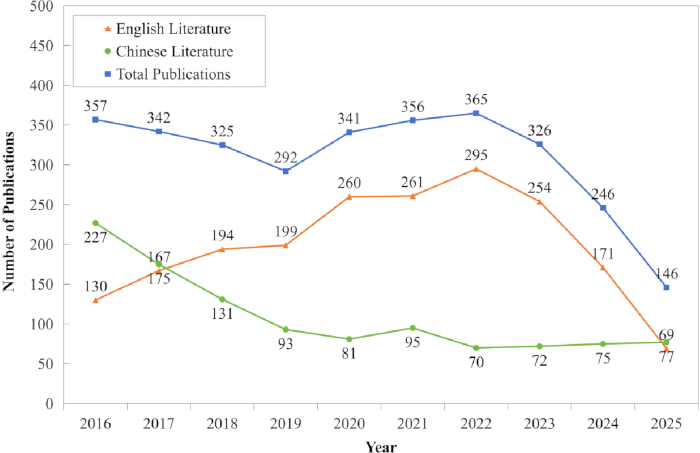
Figure 1: Annual publication output of antimicrobial resistance research in China from 2016 to 2025 (n = 3,096 publications). The figure presents annual English-language, Chinese-language, and total publication counts. English-language output increased from 130 publications in 2016 to 295 in 2022 and declined to 69 in 2025. Please click here to view a larger version of this figure.
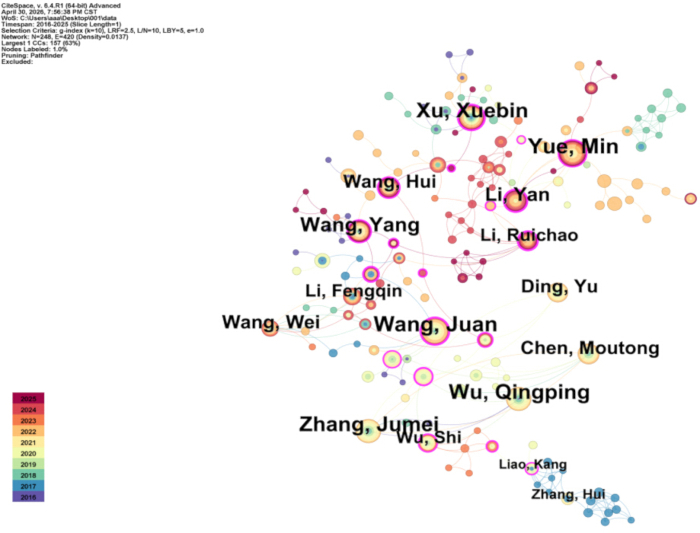
Figure 2: Author collaboration network generated from the 2,000 SCI-E publications on antimicrobial resistance in China included in the analysis (2016–2025). The network visualizes co-authorship relationships among authors publishing on AMR in China. Node size represents publication count; line thickness indicates collaboration frequency. Node colors follow the CiteSpace default time-zone gradient: purple nodes represent the earliest publications (2016–2017); blue nodes represent the middle period (2018–2021); and red/orange nodes represent the recent publications (2022–2025). Centrality is not explicitly encoded in node color; instead, nodes with high betweenness centrality (>0.1) are highlighted with an outer ring in the visualization. The network comprises 248 author nodes and 420 collaboration links (density = 0.0137). Prominent authors include Wang Juan, Yue Min, Xu Xuebin, Wu Qingping, and Zhang Jumei. The largest connected component contains 157 authors (63% of the network). Pruning was performed using the Pathfinder algorithm to enhance structural clarity. The relatively low network density indicates limited cross-institutional collaboration, with research activities concentrated within a few major research groups. Data source: Web of Science Core Collection; analyzed using CiteSpace. Please click here to view a larger version of this figure.
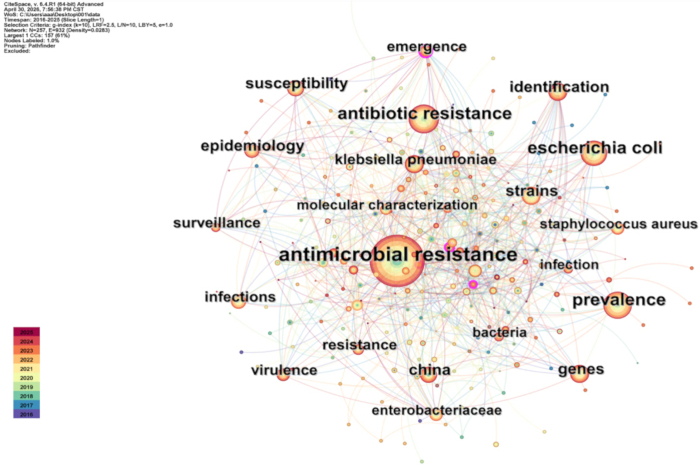
Figure 3: Keyword co-occurrence network generated from the 2,000 SCI-E publications included in the keyword analysis (2016–2025). Node size represents keyword frequency; line thickness indicates co-occurrence strength. Colors follow the CiteSpace time-zone gradient from purple (2016) through blue (2018–2021) to red/orange (2022–2025). Centrality values are not displayed as colors; instead, node labels are sized proportionally to betweenness centrality, with larger labels indicating greater bridging importance. The network comprises 257 keyword nodes and 932 co-occurrence links (density = 0.0283). The largest connected component contains 157 keywords (61% of the network). High-frequency keywords include “antimicrobial resistance,” “Klebsiella pneumoniae,” “Escherichia coli,” “Staphylococcus aureus,” “prevalence,” and “molecular characterization,” reflecting the dominant research themes of resistance surveillance and molecular epidemiology. The network demonstrates stronger interconnectivity compared to the author collaboration network, indicating thematic coherence across different research topics. Data source: Web of Science Core Collection; analyzed using CiteSpace. Please click here to view a larger version of this figure.
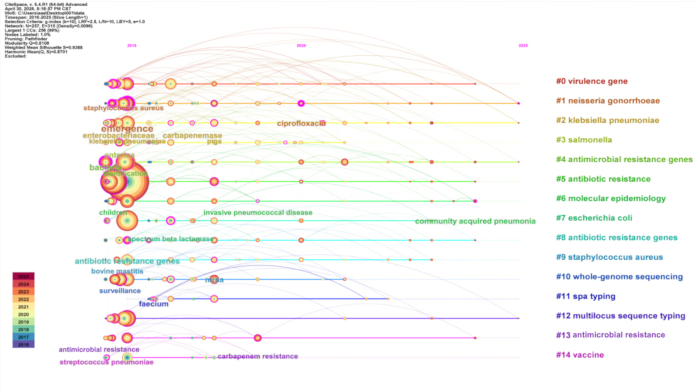
Figure 4: Keyword cluster timeline generated from the 2,000 SCI-E publications included in the keyword analysis (2016–2025). Each horizontal line represents a research cluster (#0–#14), with nodes indicating individual keywords appearing in that year. Node size represents keyword frequency. The clustering analysis was performed using the Log-Likelihood Ratio (LLR) algorithm, yielding 15 distinct clusters with excellent structural validity (modularity Q = 0.8108, mean silhouette S = 0.9388). The six major clusters discussed in the text represent the most prominent clusters (#0, #2, #4, #5, #6, #7). The timeline view reveals temporal shifts in research focus: early clusters (2016–2018) concentrated on surveillance and molecular epidemiology, while later-emerging clusters incorporated advanced genomic tools. The network comprises 257 keyword nodes and 315 co-occurrence links (density = 0.0096), with the largest connected component containing 256 nodes (99% of the network). Data source: Web of Science Core Collection; analyzed using CiteSpace. Please click here to view a larger version of this figure.
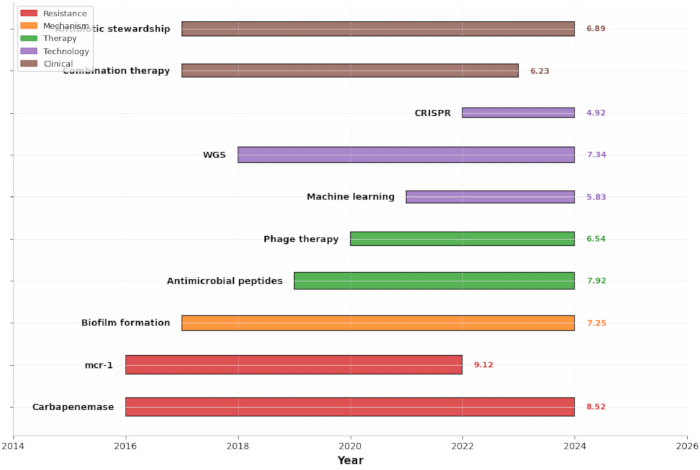
Figure 5: Top 10 burst keywords detected from the SCI-E publication dataset on antimicrobial resistance in China (2016–2025). Each bar represents a keyword with its burst strength (numerical value). Red segments indicate the detected burst intervals, and blue segments indicate years without a detected burst. The horizontal time axis covers the complete study period from 2016 to 2025. The beginning and ending years of each red segment correspond exactly to the “Begin” and “End” values reported in Table 5. The strongest bursts were observed for mcr-1 (9.12, 2016–2022) and carbapenemase (8.52, 2016–2024), reflecting their sustained dominance as research drivers. Burst keywords are categorized into five thematic groups: Resistance genes (mcr-1); Resistance mechanisms (carbapenemase, biofilm formation); Novel therapies (antimicrobial peptides, phage therapy); Clinical management (antimicrobial stewardship, combination therapy); and Technologies (WGS, machine learning, CRISPR). Keywords with burst strength >3.0 are considered significant. Data source: Web of Science Core Collection; analyzed using CiteSpace. Please click here to view a larger version of this figure.
| Rank | Author | Institution | Papers | Centrality |
| 1 | Wang Juan | South China Agricultural University | 44 | 0.2 |
| 2 | Yue Min | Zhejiang University | 44 | 0.15 |
| 3 | Xu Xuebin | Shanghai Municipal Center for Disease Control and Prevention | 42 | 0.2 |
| 4 | Wu Qingping | Institute of Microbiology, Guangdong Academy of Sciences | 42 | 0.01 |
| 5 | Zhang Jumei | Institute of Microbiology, Guangdong Academy of Sciences | 41 | 0.04 |
| 6 | Wang Yang | China Agricultural University | 35 | 0.11 |
| 7 | Li Yan | Zhejiang University | 30 | 0.23 |
| 8 | Wang Wei | China National Center for Food Safety Risk Assessment | 26 | 0.03 |
| 9 | Chen Moutong | Institute of Microbiology, Guangdong Academy of Sciences | 25 | 0.07 |
| 10 | Wang Hui | Peking University People's Hospital | 24 | 0.12 |
Table 1: Top 10 Most Prolific Authors in AMR Research (2016-2025). Publication count represents author productivity. Betweenness centrality measures the extent to which an author connects otherwise separate parts of the collaboration network; higher values indicate a stronger bridging role. Publication count and centrality were interpreted as separate bibliometric indicators.
| Rank | Institution | City | Publications | Total citations |
| 1 | Zhejiang University | Hangzhou | 195 | 10,660 |
| 2 | South China Agricultural University | Guangzhou | 112 | 7,496 |
| 3 | China Agricultural University | Beijing | 99 | 7,275 |
| 4 | Yangzhou University | Yangzhou | 97 | 2,227 |
| 5 | Shanghai Jiao Tong University | Shanghai | 94 | 3,437 |
| 6 | Chinese Academy of Medical Sciences - Peking Union Medical College | Beijing | 91 | 3,138 |
| 7 | Chinese Center for Disease Control & Prevention | Beijing | 84 | 2,657 |
| 8 | Chinese Academy of Sciences | Beijing | 84 | 4,903 |
| 9 | Chinese Academy of Agricultural Sciences | Beijing | 79 | 1,988 |
| 10 | Fudan University | Shanghai | 78 | 3,392 |
Table 2: Top 10 Research Institutions by Publication Output (2016-2025). Publication count and total citations are as of April 28, 2026. Geographic distribution shows Beijing (5 institutions in top 10: China Agricultural University, Chinese Academy of Medical Sciences – Peking Union Medical College, Chinese Center for Disease Control and Prevention, Chinese Academy of Sciences, and Chinese Academy of Agricultural Sciences), Shanghai (2: Shanghai Jiao Tong University and Fudan University), and one each in Hangzhou (Zhejiang University), Guangzhou (South China Agricultural University), and Yangzhou (Yangzhou University). The institutional network demonstrated clear geographic clustering, with Beijing and Shanghai accounting for 7 of the top 10 institutions, indicating a concentration of research capacity in eastern metropolitan regions.
| Rank | Keyword | Frequency | Centrality | Category |
| 1 | Antimicrobial Resistance | 1167 | 0.92 | General AMR concept |
| 2 | Carbapenem | 467 | 0.78 | Antimicrobial class |
| 3 | ESBL | 168 | 0.72 | Resistance mechanism/phenotype |
| 4 | MRSA | 156 | 0.68 | Resistant clinical pathogen |
| 5 | Biofilm | 134 | 0.65 | Resistance mechanism |
| 6 | CRE | 128 | 0.62 | Resistance phenotype/pathogen group |
| 7 | P. aeruginosa | 108 | 0.58 | Clinical pathogen |
| 8 | A. baumannii | 102 | 0.55 | Clinical pathogen |
| 9 | K. pneumoniae | 98 | 0.52 | Clinical pathogen |
| 10 | E. coli | 95 | 0.5 | Clinical pathogen |
Table 3: Top 10 High-Frequency Keywords in AMR Research (2016–2025). The category indicates the primary semantic role of each keyword in the antimicrobial-resistance literature. Keywords were classified as general AMR concepts, antimicrobial classes, resistance genes or mechanisms, resistance phenotypes, clinical pathogens, treatment or management terms, or surveillance and epidemiology terms, where applicable. In the present top-10 list, the represented categories were general AMR concepts, antimicrobial classes, resistance mechanisms or phenotypes, and clinical pathogens.
| Organism | 2016 | 2018 | 2022 | 2025 | Trend | p-value |
| MRSA | 48.80% | 35.80% | 27.20% | 25.80% | Declining | <0.001 |
| CRKP | 5.60% | 15.20% | 22.80% | 20.00% | Increasing | <0.001 |
| CRPA | 25.00% | 27.20% | 21.50% | 19.90% | Declining | 0.003 |
| CRAB | 56.00% | 64.50% | 76.80% | 76.50% | High-level | <0.001 |
| VRE | 1.50% | 2.90% | 5.20% | 6.50% | Increasing | <0.001 |
Table 4: Trends of Antimicrobial Resistance in Major Pathogens (2016–2025). Each horizontal line represents one of the 15 LLR-generated clusters (#0–#14), and each node represents a keyword appearing in the corresponding year. Node size represents keyword frequency. The six principal clusters discussed in the text are #0 “virulence gene,” #2 “Klebsiella pneumoniae,” #4 “antimicrobial resistance genes,” #5 “antibiotic resistance,” #6 “molecular epidemiology,” and #7 “Escherichia coli.” The clustering solution had a modularity Q of 0.8108 and a mean silhouette S of 0.9388.
| Rank | Keyword | Burst | Begin | End | Category |
| 1 | mcr-1 | 9.12 | 2016 | 2022 | Resistance gene |
| 2 | Carbapenemase | 8.52 | 2016 | 2024 | Resistance mechanism |
| 3 | Antimicrobial peptides | 7.92 | 2019 | 2024 | Novel therapy |
| 4 | Biofilm formation | 7.25 | 2017 | 2024 | Resistance mechanism |
| 5 | WGS | 7.34 | 2018 | 2024 | Molecular typing |
| 6 | Antibiotic stewardship | 6.89 | 2017 | 2024 | Clinical management |
| 7 | Phage therapy | 6.54 | 2020 | 2024 | Novel therapy |
| 8 | Combination therapy | 6.23 | 2017 | 2023 | Treatment strategy |
| 9 | Machine learning | 5.83 | 2021 | 2024 | Technology |
| 10 | CRISPR | 4.92 | 2022 | 2024 | Technology |
Table 5: Top 10 Burst Keywords Indicating Research Frontiers (2016–2025). Burst strength and burst duration were used as the quantitative indicators of frontier activity. Separate annual keyword-frequency growth rates were not calculated. Burst strength was calculated using CiteSpace burst detection algorithm (Kleinberg's algorithm) with default parameters (γ = 1.0, minimum duration = 2 years). Keywords with burst strength >3.0 are considered significant. “Begin” and “End” indicate the first and last year of the burst period, as visualized in Figure 5. The category column reflects the thematic classification of each burst keyword. The strongest bursts were observed for mcr-1 (9.12, 2016–2022) and carbapenemase (8.52, 2016–2024), indicating their central roles as research drivers. Notably, novel therapeutic approaches (antimicrobial peptides, phage therapy) and emerging technologies (machine learning, CRISPR) showed sustained burst activity through 2024, signaling a paradigm shift toward innovation-driven AMR research. The analytical time window was 2016–2025. A burst ending in 2024 indicates that no significant burst was detected for that keyword in 2025; it does not indicate that the overall analytical time window ended in 2024.
Supplementary Figure 1: PRISMA-style flow diagram of literature identification, screening, and inclusion. A total of 5,286 database records were initially identified, including 3,043 records from the Web of Science Core Collection Science Citation Index Expanded (SCI-E), 983 records from the Peking University Core Journals category of the China National Knowledge Infrastructure (CNKI), 802 records from the Chinese Science Citation Database category, and 462 records from the World Journal Clout Index category. Because the three CNKI categories were overlapping, category-specific records were consolidated before screening. Duplicate records were identified using DOI matching where available, followed by comparison of article titles, first-author names, and publication years, with manual review of uncertain matches. After combined deduplication and eligibility screening, 2,190 records were removed, and 3,096 publications were included, comprising 2,000 English-language SCI-E publications and 1,096 Chinese-language CNKI publications.Please click here to download this file.
Supplementary Table 1: Annual publication output of antimicrobial resistance research in China from 2016 to 2025. Annual numbers of English-language and Chinese-language publications included in the bibliometric analysis are presented together with the total publication count for each year. The final dataset comprised 3,096 publications.Please click here to download this file.
Supplementary Table 2: Bibliographic records of publications included in the final bibliometric analysis. The table lists the 3,096 publications included in the final analytical dataset, comprising 2,000 English-language records from the Web of Science Core Collection and 1,096 Chinese-language records from the China National Knowledge Infrastructure (CNKI). Please click here to download this file.
Discussie
De bibliometrische patronen suggereren dat het AMR-onderzoek in China geleidelijk is verbreed van beschrijvende surveillance en pathogeenkarakterisering naar resistentiemechanismen, genomische benaderingen en interventiegericht onderzoek. De overlappende trefwoordclusters en burst-perioden duiden op een cumulatieve thematische diversificatie in plaats van drie afzonderlijke en wederzijds exclusieve fasen. De timing van deze veranderingen viel samen met de Nationale Actieplannen voor de Beheersing van Antimicrobiële Resistentie voor 2016–2020 en 2022–2025, die een relevante beleidscontext bieden; de huidige bibliometrische analyse kan echter niet vaststellen dat de publicatie van dit beleid de waargenomen veranderingen in publicatiethema's heeft veroorzaakt. De toename in publicaties weerspiegelt zowel de groeiende ernst (2019–2021) van de AMR-crisis als de toegenomen overheids- en institutionele inzet om deze uitdaging aan te pakken. Bijgevolg moet de voorgestelde evolutie van onderzoeksthema's beschrijvend worden geïnterpreteerd en is deze niet onafhankelijk gevalideerd met behulp van mijlpaal-paper- of fase-specifieke analyses van veel geciteerde papers. In een mondiale context komt het traject van de Chinese onderzoeksuitvoer overeen met bredere patronen die zijn waargenomen in opkomende economieën, waar het volume aan AMR-publicaties exponentieel is gegroeid als reactie op de toenemende resistentielast21.
De afname in het aantal publicaties na de piek in 2022 viel samen met de implementatieperiode van het tweede Nationaal Actieplan ter Beheersing van Antimicrobiële Resistentie (2022–2025), terwijl de eerdere toename volgde op het eerste actieplan (2016–2020). Deze temporele correspondentie kan duiden op veranderingen in onderzoeksprioriteiten, budgettoewijzing en publicatiepatronen over opeenvolgende beleidsfasen, in plaats van een eenvoudige afname in de AMR-onderzoeksactiviteit. Echter kunnen vertragingen in publicatie en indexering, de dekking van databases en de criteria voor deelname aan de studie eveneens hebben bijgedragen aan de schijnbare daling, in het bijzonder in de latere jaren. De huidige bibliometrische analyse kan daarom geen causaal verband vaststellen tussen het nationale actieplan en de publicatieopbrengst.
De analyse van het collaboratieve netwerk onthult een sterk gecentraliseerde structuur waarbij Wang Juan, Yue, Min en de Zhejiang University fungeren als kritische knooppunten die regionale onderzoekscentra met elkaar verbinden. De beperkte cross-regionale samenwerking (netwerkdichtheid = 0,0137) suggereert echter dat de lage dichtheid van het collaboratieve netwerk wijst op een beperkte connectiviteit tussen onderzoeksgroepen; er is echter geen formele publicatieanalyse voor de regio's Oost/Centraal/West uitgevoerd. Een haalbaar kader voor cross-regionale samenwerking zou CARSS kunnen gebruiken als de nationale ruggengraat voor surveillance en datacoördinatie, regionale medische consortia als eenheden voor de harmonisatie van monsterafname, gevoeligheidstesten en multicentrische klinische validatie, en universitaire onderzoeksplatforms als centra voor genomische sequencing, bio-informatica en methodologische ontwikkeling. Gedeelde datadictionary's, gedeïdentificeerde interoperabele datasets, regelmatige cross-regionale benchmarking en gezamenlijke projecten voor vroegtijdige waarschuwing zouden kunnen helpen om surveillancesignalen te vertalen naar onderzoeksprioriteiten en lokaal aangepaste stewardship-acties. Dit voorgestelde kader vormt een implementatiepad dat is afgeleid van de netwerkbevindingen en is geen interventie die direct in de huidige studie is geëvalueerd.
De divergerende resistentietrends die in deze studie zijn geïdentificeerd, hebben verstrekkende klinische implicaties. De dramatische afname van MRSA (48,8%→25,8%; β = –2,43% per jaar, p < 0,001) toont aan dat gecoördineerde nationale interventies—waaronder verplichte surveillance, handhygiënecampagnes en antimicrobial stewardship—effectief resistente pathogenen kunnen bestrijden22.
De uiteenlopende trajecten weerspiegelen waarschijnlijk verschillen tussen pathogenen in de antimicrobiële selectiedruk, resistentiemechanismen, ecologische persistentie, transmissiedynamiek en de respons op infectiebeheersingsmaatregelen. De afname van MRSA kan verband houden met de bredere implementatie van surveillance- en infectiebeheersingsprogramma's, terwijl de toenemende of aanhoudend hoge resistentie bij CRKP en CRAB de voortdurende verspreiding van carbapenem-resistentie-determinanten en de moeilijkheid om multidrug-resistente Gram-negatieve organismen te beheersen kan weerspiegelen. De bescheiden afname van CRPA geeft aan dat resistentietrends niet kunnen worden gegeneraliseerd voor alle carbapenem-resistente pathogenen. Evenzo vereist de toename van VRE vanuit een relatief lage basislijn voortdurende monitoring. Omdat deze factoren niet direct zijn gemeten, moeten ze worden beschouwd als plausibele interpretaties in plaats van aangetoonde causale mechanismen.
In overeenstemming met de burst-analyse bleven mcr-1 en carbapenemase prominente onderzoeksthema's, wat wijst op aanhoudende aandacht voor mobiele colistineresistentie en carbapenem-resistente organismen. De opkomst van antimicrobiële peptiden en fagentherapie duidt op een groeiende belangstelling voor alternatieven voor conventionele antibiotica, terwijl whole-genome sequencing, machine learning en CRISPR wijzen op een toenemende aandacht voor genomische surveillance, resistentievoorspelling en gen-gerichte benaderingen. Recente studies hebben bovendien de potentiële toepassingen van kunstmatige intelligentie bij AMR-surveillance, identificatie van resistentiemarkers, biofilmanalyse, diagnostiek en de ontdekking van antimicrobiële middelen benadrukt12,23,24,25.
De detectie van deze termen als onderzoeksfrontiers duidt echter niet op klinische gereedheid. Machine-learningmodellen vereisen gestandaardiseerde multicenter-datasets, externe en prospectieve validatie, modelinterpreteerbaarheid en integratie met laboratorium- en klinische workflows. Faagtherapie staat voor uitdagingen met betrekking tot stam-specificiteit, consistentie in de productie, kwaliteitscontrole, de evolutie van resistentie en regulatoire standaardisatie, terwijl CRISPR-gebaseerde antibacteriële strategieën beperkt blijven door de efficiëntie van de aflevering, off-target effecten, biosafety en inperkingsvereisten. Internationaal onderzoek legt steeds meer de nadruk op multicenter-validatie, gestandaardiseerde productie en regulatoire trajecten; deze dimensies moeten ook worden meegewogen bij het evalueren van de translationele rijpheid van onderzoek dat in China wordt uitgevoerd. Omdat de huidige studie de binnenlandse en internationale stadia van klinische ontwikkeling niet kwantitatief heeft vergeleken, blijft deze interpretatie kwalitatief.
Studies uitgevoerd bij diverse klinische populaties en infectiesettings tonen aanzienlijke variatie aan in de distributie van pathogenen en antimicrobiële resistentieprofielen26,27,28,29,30,31,32,33,34,35,36,37,38. Gezamenlijk wijzen deze rapporten erop dat resistentiepatronen worden beïnvloed door patiëntkenmerken, infectieplaatsen, blootstelling aan antimicrobiële middelen en de lokale epidemiologie. Carbapenem-resistente Gram-negatieve pathogenen blijven een terugkerend probleem in meerdere settings, terwijl de empirische behandeling geleid dient te worden door lokale surveillance en gestandaardiseerde gevoeligheidstesten. Bewijs met betrekking tot combinatietherapie, β-lactam/β-lactamase-remmercombinaties, tetracycline-derivaten en andere alternatieve behandelingen biedt tevens een klinische context voor de therapeutische thema's die zijn geïdentificeerd door de trefwoord- en burst-analyses30,39.
In overeenstemming met de bevindingen uit de trefwoorden en clusters blijft biofilmvorming een belangrijk fenotypisch mechanisme dat bijdraagt aan antimicrobiële tolerantie en therapeutisch falen. Studies naar Cutibacterium acnes illustreren hoe gestructureerde microbiële gemeenschappen de tolerantie kunnen verhogen via fysieke barrières en gewijzigde micro-omgevingen40. Niet-coderende RNA's zijn tevens naar voren gekomen als potentiële regulatoren van de expressie van resistentiegenen in Acinetobacter baumannii41. Parallel hieraan hebben next-generation β-lactamaseremmers, tetracycline-derivaten en combinatieregimes het onderzoek naar therapeutische opties voor carbapenem-resistente organismen uitgebreid42. Deze ontwikkelingen blijven klinisch relevant gezien de aanhoudende hooggradige resistentie van Klebsiella pneumoniae en Acinetobacter baumannii die in nationale surveillancedata wordt gerapporteerd43.
Perspectieven van zorgverleners op antimicrobiële resistentie, met name in gespecialiseerde contexten zoals chronische luchtwegaandoeningen, benadrukken het kritieke belang van menselijke gedragsfactoren voor het succes van stewardship44. Bovendien hebben landelijke analyses van factoren die geassocieerd zijn met klinische antimicrobiële resistentie de antibioticaconsumptiedichtheid geïdentificeerd als een primaire drijfveer, wat bevestigt dat een verhoogd gebruik van carbapenems en cefalosporines van de derde generatie direct correleert met toenemende resistentie bij Pseudomonas aeruginosa en andere Gram-negatieve pathogenen45.
Er moeten enkele beperkingen worden erkend. Ten eerste kunnen verschillen in databasecoverage, indexeringspraktijken, veldstructuren en Chinees- en Engelstalige terminologie hebben geleid tot retrievalbias en kunnen ze een volledige matching van semantisch equivalente records hebben belemmerd. In de huidige studie is geen aparte thematische analyse van de Chinees- en Engelstalige corpora uitgevoerd; daarom konden taal-specifieke verschillen in de onderzoekseenheid niet kwantitatief worden geëvalueerd. Ten tweede kunnen bibliometrische indicatoren de methodologische kwaliteit of het risico op bias van individuele studies niet direct evalueren, en kunnen citatiegebaseerde maten een voorkeur hebben voor oudere, zeer zichtbare of internationaal geïndexeerde publicaties. Ten derde kan de uitsluiting van veterinaire en milieuonderzoeken zonder expliciete component voor de menselijke gezondheid, samen met de beperkte dekking van conferentieverslagen, institutionele rapporten, proefschriften en andere grijze literatuur, het bredere One Health AMR-landschap ondervertegenwoordigen, in het bijzonder bewijsmateriaal uit gemeenschaps- en landelijke omgevingen. De uitsluiting van systematische reviews en meta-analyses zonder nieuwe primaire datasets kan ook de bijdrage van bewijssynthese aan de vorming van hotspots ondervertegenwoordigen. Ten vierde kunnen vertragingen in publicatie en indexering de representatie van studies die aan het einde van de studieperiode zijn gepubliceerd, hebben verminderd. Ten vijfde kan het Kleinberg burst-detectiealgoritme fout-positieve signalen genereren wanneer trefwoorden kortstondige of sporadische temporele fluctuaties vertonen. Daarnaast is er geen formele sensitiviteitsanalyse van de CiteSpace-parameterinstellingen uitgevoerd; daarom is de robuustheid van het netwerk, de clustering en de burst-resultaten bij alternatieve CiteSpace-parameterkeuzes niet beoordeeld. De afwezigheid van formele synoniemconsolidatie kan semantisch equivalente trefwoorden hebben gefragmenteerd en kan de schattingen van trefwoordenfrequentie en het netwerk hebben beïnvloed. Omdat er geen formele publicatieanalyse van Oost-/Centraal-/West-China is uitgevoerd, konden regionale verschillen in de publicatieopbrengst niet kwantitatief worden beoordeeld.
Toekomstige studies zouden alternatieve parameters voor burst-gevoeligheid en drempelwaarden voor minimale duur moeten testen, transparante synoniemenwoordenboeken moeten toepassen, resultaten over onafhankelijke databases moeten vergelijken en burst-signalen moeten trianguleren met jaarlijkse trefwoordenfrequenties en expertbeoordelingen. Er is geen specifieke analyse van de meest geciteerde artikelen uitgevoerd; toekomstige studies zouden een analyse van mijlpaalartikelen kunnen opnemen om temporele veranderingen in AMR-onderzoeksthema's verder te karakteriseren en onafhankelijk te valideren. Een dual-map overlay-analyse viel evenzo buiten de reikwijdte van de huidige studie en kan in toekomstig werk worden overwogen om citatiepaden op tijdschriftniveau te karakteriseren.
De bibliometrische patronen suggereren dat AMR-onderzoek in China in toenemende mate is verschoven van beschrijvende surveillance naar mechanistisch onderzoek en de ontwikkeling van innovatieve interventies. Hoewel er aanzienlijke vooruitgang is geboekt bij de beheersing van MRSA via uitgebreid stewardship, blijven carbapenem-resistente Gram-negatieve pathogenen een kritieke bedreiging die dringende aandacht vereist. De opkomst van AI-gestuurde voorspellingsmodellen, fagentherapie en CRISPR-gebaseerde interventies kan toekomstige mogelijkheden bieden voor de aanpak van AMR, hoewel de vertaling van laboratoriumonderzoek naar de klinische praktijk uitdagend blijft. De bevindingen ondersteunen voortgezette surveillance, sterkere interregionale samenwerking en aanhoudend onderzoek naar zowel conventionele antibiotica als opkomende therapeutische strategieën.
Openbaarmakingen
De auteurs verklaren dat generatieve kunstmatige intelligentie (AI)-tools als volgt zijn gebruikt bij de voorbereiding van dit manuscript: Grammarly (versie 1.2.3) werd gebruikt voor het taalpolijsten en de grammaticaal correctie van de definitieve conceptversie van het manuscript; OpenAI's ChatGPT (GPT-4, geraadpleegd via API op 15 maart 2026) werd gebruikt ter ondersteuning bij het opschonen van bibliometrische gegevens en voor het genereren van initiële Python-scripts voor datapreprocessing; Er is geen AI-tool gebruikt om de wetenschappelijke bevindingen te genereren, resultaten te interpreteren of conclusies te formuleren; Alle figuren en tabellen zijn direct gegenereerd vanuit CiteSpace- en R 4.3.2-outputs zonder AI-ondersteunde generatie. De auteurs hebben alle met AI-ondersteuning gegenereerde inhoud beoordeeld en geverifieerd en dragen de volledige verantwoordelijkheid voor de nauwkeurigheid en integriteit van het manuscript.
Dankbetuigingen
De auteurs danken de Afdeling Infectieziekten van The Affiliated People’s Hospital of Ningbo University (Yinzhou People’s Hospital) hartelijk voor het bieden van de administratieve en technische ondersteuning die nodig was om dit manuscript te voltooien.
Dit onderzoek werd gefinancierd door het Ningbo Medical and Health Leading Academic Discipline Project (beurs nr. 2026-A42).
Materialen
| Naam | Bedrijf | Catalogusnummer | Opmerkingen |
|---|---|---|---|
| CiteSpace | Drexel University, Philadelphia, PA, USA | versie 6.4.R1 | Voor het uitvoeren van uitgebreide bibliometrische analyses, waaronder co-auteurschapanalyse, keyword-co-occurrentieanalyse, clusteranalyse en burst-detectie. |
| China National Knowledge Infrastructure (CNKI) | China National Knowledge Infrastructure | Niet van toepassing | Voor het samenstellen van onderzoeksartikelen verstrekt door Chinese binnenlandse bronnen. |
| R | R software | versie 4.3.2 | |
| Web of Science Core Collection (SCI-E) | Web of Science | Niet van toepassing | Voor het systematisch zoeken naar en ophalen van internationale literatuur. |
Referenties
- World Health Organization. Global action plan on antimicrobial resistance. World Health Organization; Geneva; 2015.
- O’Neill J. Tackling drug-resistant infections globally: Final report and recommendations. 2016.
- Bockstael K, Van Aerschot A. Antimicrobial resistance in bacteria. Open Med. 2009;4(2):141–155.
- Okeke IN, de Kraker MEA, Van Boeckel TP. The scope of the antimicrobial resistance challenge. Lancet. 2024;403(10442):13.
- Bhattacharya R, et al. Impact of antimicrobial resistance on sustainable development goals and the integrated strategies for meeting environmental and socio-economic targets. Environ Prog Sustain Energy. 2024;43(1):e14320.
- Duffey M, Shafer RW, Timm J. Combating antimicrobial resistance in malaria, HIV and tuberculosis. Nat Rev Drug Discov. 2024;23(6):19.
- Xiao YH, et al. Epidemiology and characteristics of antimicrobial resistance in China. Drug Resist Updat. 2011;14(4):236–241.
- Yin X, et al. A systematic review of antibiotic utilization in China. J Antimicrob Chemother. 2013;68(11):2445–2452.
- National Health Commission of the People’s Republic of China. National action plan to contain antimicrobial resistance (2022–2025). 2022.
- Borromeo AS, Manaloto AM, Antonio RP. Southeast Asian landscape of antimicrobial resistance research (2014–2024): A bibliometric analysis. J Glob Antimicrob Resist. 2025;45(c):125–132.
- Fekadu A, Woldeamanuel Y, Hailu A. Global trends and projections in antimicrobial resistance. Lancet. 2025;(10493):405.
- Selvaraj V, Sudhakar S, Sekaran S. Global trends and projections in antimicrobial resistance. Lancet. 405(10493):413–414.
- Bhattacharya R, et al. A One health plan to combat antimicrobial resistance for improving global health through sustainable development. Discov Public Health. 2025;22(1):521.
- Chen C, Leydesdorff L. Patterns of connections and movements in dual-map overlays: A new method of publication portfolio analysis. J Assoc Inf Sci Technol. 2014;65(2):334–351.
- Persson O, Danell R, Schneider JW. Using the BIBLIOMETRIX package for bibliometric analysis. Scientometrics. 2009;80(2):253–275.
- Bhattacharya R, et al. Bibliometric assessment of the global research trends in antimicrobial resistance for fungal species. Ind Biotechnol. 2024;20(5):212–224.
- Zhu J, Zhou Y, Ding YQ. Visualization analysis of hotspots and trends of drug control institutions in China based on bibliometrics. Chin J Mod Appl Pharm. 2023;40(18):2591–2599.
- Chen C. Science mapping: A systematic review of the literature. J Data Inf Sci. 2017;2(2):1–40.
- Wang S, Shen J, Yang Y. MRSA in China: Epidemiology, resistance mechanisms, and control strategies. Chin J Antibiot. 2021;46(9):837–844.
- Zhou W, Wen Z, Zhu W. Factors associated with clinical antimicrobial resistance in China: A nationwide analysis. Infect Dis Poverty. 2025;14:27.
- Sweileh WM, Al-Jabi SW, Zyoud SH. Global research output in antimicrobial resistance among uropathogens: A bibliometric analysis (2002–2016). J Glob Antimicrob Resist. 2017;11:230–238.
- Cui L, Li Y, Cheng L. Effectiveness of an antimicrobial stewardship program in reducing antimicrobial use and microbial resistance in a tertiary hospital in China. J Glob Antimicrob Resist. 2019;17:168–174.
- Yang Y, Li Y, Wang Z. Machine learning-enabled prediction of antimicrobial resistance from whole-genome sequencing data. J Clin Microbiol. 2021;59(10):e00821-21.
- Bhattacharya R, et al. Artificial intelligence for sustainable solutions in combating antimicrobial resistance through data driven health innovations. Discov Public Health. 2026;23(1):10.
- Yosef I, Manor M, Kiro R. Temperate and lytic bacteriophages programmed to sensitize and kill antibiotic-resistant bacteria. Proc Natl Acad Sci U S A. 2015;112(23):7267–7272.
- Shou TJ, Cheng XQ, Gong S. Analysis of antimicrobial use strategy in childhood perforated appendicitis based on bacterial resistance changes. Chin Gen Pract. 2020;23(24):3070–3074.
- China Antimicrobial Resistance Surveillance System. Surveillance of antimicrobial resistance in bacteria isolated from cerebrospinal fluid specimens from 2020 to 2024. Chin J Infect Chemother. 2026;26(2):196–205.
- Gao YH, Ma XY, Wang DB. Distribution and drug resistance of pathogens causing acute bacterial conjunctivitis in children. J Pathog Biol. 2024;19(10):1194–1197.
- Zhang Y, Fan YY, Yao LH. Drug resistance and risk factors of multidrug-resistant bacteria in neonatal pneumonia. J Pathog Biol. 2020;15(11):1340–1343.
- Duan MB, He XZ, Qi JY. Research progress on anti-multidrug resistant bacteria drugs. J Shenyang Pharm Univ. 2023;40(12):1680–1690.
- Zhou LC, Li GQ, Xu BY. Distribution and drug resistance of pathogens in acute, delayed and chronic periprosthetic joint infections. Chin J Surg. 2021;59(6):484–490.
- Zhang XX, Ge W, Yang M. Analysis of resistance of 137 Neisseria gonorrhoeae strains to 5 antimicrobial agents. Chin J Dermatovenereol. 2022;36(2):199–203.
- Zhang XY, Han Y, Wang YM. Correlation analysis between antimicrobial resistance of Pseudomonas aeruginosa and antimicrobial use density. J Hebei Univ Nat Sci Ed. 2021;41(2):188–194.
- China Antimicrobial Resistance Surveillance System. Antimicrobial resistance surveillance report of common clinical isolates from elderly patients from 2014 to 2019. Chin J Infect Control. 2021;20(2):112–123.
- Ruan ZH, Huang AX, Wang XJ. Overview of CLSI, EUCAST and Chinese drug resistance judgment standards. Biotechnol Bull. 2022;38(9):47–58.
- Liu L, Feng CX, Wang Y. Analysis of bacterial resistance in the First Hospital of Qiqihar in 2016. Chin J Antibiot. 2021;46(12):1143–1147.
- Zhang XH, Chen JY, Yang H. Distribution and antimicrobial resistance of pathogens in early infection after lung transplantation in respiratory intensive care unit. Chin J Infect Control. 2020;19(9):785–790.
- Wang SS, Wu ZW, Zhao JP. Research progress on hospital infection, drug resistance and treatment of carbapenem-resistant Klebsiella pneumoniae. Chin J Antibiot. 2020;45(5):428–432.
- Lv YF, Xue M, Huang XY. Research progress on antimicrobial peptides combined with traditional antibiotics against bacterial resistance. Chin J Infect Control. 2023;22(10):1266–1273.
- Ma Y, Liu Y, Jiang M. Correlation analysis between biofilm formation and antimicrobial resistance of Cutibacterium acnes. Chin J Infect Chemother. 2021;21(6):703–707.
- Peng Q, Ling BD. Regulatory non-coding RNAs and antimicrobial resistance in Acinetobacter baumannii. Chin J Infect Control. 2021;20(12):1174–1178.
- Qin XH, Hao M, Wang MG. Research progress on new antimicrobial agents. Chin J Infect Chemother. 2024;24(4):489–496.
- Guo Y, Ding L, Hu FP. CHINET surveillance of bacterial resistance in China in 2024. Chin J Infect Chemother. 2025;25(6):597–607.
- Ananth S, Adeoti A, Ray A. Healthcare worker views on antimicrobial resistance in chronic respiratory disease. Eur Respir J. 2024;64(68):2.
- Holt KE. Microbial genomics for antimicrobial resistance ecology and action. Nat Rev Genet. 2026;27(1):7–8.