Deze bibliometrische analyse van 1.014 publicaties over sacrococcygeale pilonidale ziekte (2000–2025) brengt wereldwijde onderzoekstrends, collaboratieve netwerken, thematische evolutie en nieuwe frontieren in kaart, waarbij een verschuiving in de onderzoeksfocus naar minimaal invasieve technieken en evidence-based preventiestrategieën aan het licht komt.
Onderzoeksartikel
Bibliometrische en kenniskaartanalyse van onderzoek naar sacrococcygeale pilonidale ziekte (2000–2025)
* These authors contributed equally
In dit artikel
Samenvatting
Samenvatting
Sacrococcygeal pilonidal disease (SPD) is an acquired inflammatory condition predominantly affecting young adults and adolescents, with a rising incidence and substantial clinical burden. Despite increasing research activity, the global scientific landscape of SPD, including research output, co-authorship patterns, knowledge diffusion pathways, thematic evolution, and emerging research frontiers, has not been systematically analyzed in the peer-reviewed literature. This study aimed to address this gap using a multitool bibliometric analysis. Bibliometric tools (VOSviewer, CiteSpace, and Pajek) were used to summarize the key features and generate visualizations. Articles and reviews on SPD published between 2000 and 2025 were retrieved from the Web of Science Core Collection. A total of 1,014 papers from 72 countries and 1,387 institutions were included. Research output steadily increased, with a marked acceleration after 2018. Turkey led in publication productivity and citation impact, whereas Germany, England, and the USA were key hubs for international collaboration. The University of Naples Federico II published the most articles, while the Technical University of Munich received the most citations. Dietrich Doll emerged as the most prominent and productive researcher in this field. Diseases of the Colon & Rectum was the most influential journal. Increasing research attention toward minimally invasive techniques, alongside continued interest in conventional surgical approaches, was identified. Current research interests emphasize less invasive strategies, etiological prevention, and evidence synthesis. This study provides valuable information for clinicians and researchers to better understand the current global status of SPD, recognize emerging research themes, and identify potential areas for future investigation and collaboration.
Inleiding
Sacrococcygeale pilonidale ziekte (SPD) is een verworven inflammatoire aandoening die wordt gekenmerkt door asymptomatische midline pits (putjes), acute abcessen of pijnlijke fistelgangen, die voornamelijk tieners en jongvolwassenen treffen1,2,3. De incidentie hiervan is in de klinische praktijk toegenomen, in het bijzonder in Europese landen4,5,6. In Duitsland steeg tussen 2005 en 2017 het gemiddelde aantal opname-episodes van SPD per 100.000 mannen van 43 naar 56, en per 100.000 vrouwen van 14 naar 185. Over het algemeen is chirurgische interventie vereist en is het een economisch belastende ziekte die bij patiënten in werkende leeftijd bijdraagt aan productiviteitsverlies en aanzienlijke behandelingskosten, wat een toenemende druk legt op de gezondheidszorgsystemen wereldwijd7. Bij adolescenten brengt SPD aanzienlijke fysieke en psychologische belastingen met zich mee, waarbij intergluteale pijn en afscheiding dagelijkse activiteiten, sport en schoolbezoek verstoren, terwijl hoge recidieven en een chronisch beloop de kwaliteit van leven verminderen en de psychosociale ontwikkeling belemmeren1,8.
Hoewel conservatieve niet-operatieve opties, zoals fenolinjectie, een belangrijke plaats innemen in de behandeling1,9chirurgie blijft een standaardbehandelingsmethode voor symptomatische SPD, ondanks de potentiële complicaties en het risico op recidief10Incisie en drainage wordt aanbevolen bij een pilonidale absces.11, en voor symptomatische chronische sinusziekte zijn talloze chirurgische modaliteiten beschreven1,10, waarbij de specifieke keuze grotendeels afhangt van de ziektekenmerken en de expertise van de chirurg4Historisch gezien waren excisie met primaire sluiting of secundaire genezing veelgebruikte chirurgische benaderingen voor chronische SPD, waarbij elke strategie werd geassocieerd met specifieke voordelen en beperkingen.3,12,13Procedure voor sluiting buiten de middellijn, waaronder Karydakis-flappen, Limberg-flappen en de Bascom cleft-lift, worden steeds vaker toegepast als reconstructieve opties wanneer voor primaire sluiting wordt gekozen, vanwege hun gunstige genezingsresultaten, verminderde wondmorbiditeit in vergelijking met sluiting in de middellijn en aanvaardbare recidiefpercentages.4In het afgelopen decennium hebben minimaal invasieve chirurgische technieken, waaronder beperkte excisiesprocedures zoals sinusectomie (bijv. de Gips-procedure) en endoscopische behandelmethoden, een toenemende klinische en wetenschappelijke belangstelling gewekt als minder invasieve alternatieven voor conventionele excisiesprocedures.1,2,14Niettemin blijft de optimale chirurgische strategie voor SPD beïnvloed door ziektekenmerken, patiëntfactoren en de voorkeur van de chirurg, waarbij het vergelijkend effect van de beschikbare benaderingen nog steeds onderwerp van onderzoek is.
Ondanks deze ontwikkelingen vertoont de wetenschappelijke literatuur over SPD verschillende macroscopische uitdagingen die een systematisch onderzoek rechtvaardigen. Specifiek, hoewel de onderzoeksproductie in dit domein snel is gegroeid15, blijven de evolutionaire trajecten van onderzoeksonderwerpen en opkomende grensvlakken onvoldoende gekarakteriseerd vanuit een kwantitatief perspectief, en zijn de verspreidingspaden van kennis nog niet systematisch onderzocht. Bovendien varieert de onderzoeksproductiviteit sterk per regio16, en hoewel samenwerking binnen het vakgebied cruciaal is voor het bevorderen van wetenschappelijke uitwisseling en kennisvooruitgang17, blijft een uitgebreide analyse van coöperatieve netwerken tussen bijdragers beperkt. Bibliometrische analyse is ontstaan als een robuuste benadering die in staat is deze uitdagingen aan te pakken en is gebruikt om diverse anorectale aandoeningen te onderzoeken, waaronder aambeizigers18,19, perianale fistels20 en rectumprolaps21. Eerdere studies met betrekking tot SPD hebben waardevolle inzichten geboden in specifieke aspecten van de literatuur, waaronder klinische evidence mapping15, publicatieproductiviteit16, citatiekenmerken22 en methodologische trends23. Deze onderzoeken hebben zich echter primair gericht op individuele dimensies van SPD-onderzoek, zoals klinische bewijsdomeinen, productiviteit op landniveau, veel geciteerde publicaties of kenmerken van het studiedesign, terwijl een uitgebreide evaluatie waarin wereldwijde samenwerkingsnetwerken, intellectuele structuren en thematische evolutie zijn geïntegreerd, nog ontbreekt. Daarom beoogt deze studie een actueel wereldwijd overzicht van SPD-onderzoek te verschaffen met behulp van bibliometrische en science-mapping benaderingen, waarbij specifiek de kennisstructuur wordt gekarakteriseerd, kernbijdragers worden geïdentificeerd, internationale samenwerkingspatronen worden ontcijferd, opkomende onderzoekshotspots worden gedetecteerd en potentiële richtingen voor toekomstig onderzoek worden benadrukt. De rapportage van dit artikel volgt de BIBLIO-checklist24.
Protocol
Gegevensbron
De Web of Science (WoS) Core Collection (geleverd door Clarivate Analytics) werd gebruikt als de primaire gegevensbron voor deze studie. Als een veelgebruikte multidisciplinaire wetenschappelijke database is de WoS Core Collection vaak ingezet als gegevensbron voor bibliometrische analyses25. Records die uit deze database zijn opgehaald, kunnen worden geëxporteerd in formaten die direct compatibel zijn met bibliometrische tools zoals VOSviewer. Er werd een uitgebreide zoekstrategie toegepast om publicaties te identificeren die gerelateerd zijn aan SPD. De zoekopdracht werd uitgevoerd binnen de WoS Core Collection (zie Tabel van materialen>) zonder de resultaten te beperken tot een specifieke index, om de literatuurdekking te maximaliseren en het risico op het missen van potentieel relevante publicaties te minimaliseren.
Zoekstrategie
Om alle potentieel relevante literatuur te identificeren, is de WoS Core Collection aanvankelijk doorzocht via het Topic-veld (TS) met de volgende zoekopdracht: TS = (“pilonidal sinus” OR “pilonidal cyst” OR “pilonidal fistula” OR “pilonidal abscess” OR “pilonidal disease” OR “pilonidal tract” OR “sacrococcygeal cyst” OR “sacrococcygeal sinus” OR “sacrococcygeal fistula” OR “sacrococcygeal tract” OR “sacrococcygeal abscess” OR “sacrococcygeal pilonidal disease” OR “pilonidal cyst disease” OR “pilonidal sinus disease” OR “pilonidal fistula disease” OR “pilonidal tract disease” OR “pilonidal abscess disease” OR “jeep disease”). Twee onderzoekers (LC en WZ) hebben op 1 februari 2026 onafhankelijk de literatuurzoekopdracht uitgevoerd volgens de vooraf gedefinieerde zoekstrategie, waarbij discrepanties werden opgelost door overleg met een derde onderzoeker (YL). Na de initiële retrieval werden sequentieel vooraf gedefinieerde filters toegepast voor publicatiejaren (2000–2025), taal (Engels) en documenttype (Article of Review). Na dit initiële filterproces ondergingen de resterende records een screening in een tweede fase op basis van de titel en het abstract, overeenkomstig de vooraf gedefinieerde geschiktheidscriteria. Aangezien sommige casusrapporten en casuseries in de WoS Core Collection nog steeds als Article kunnen zijn geïndexeerd, werden deze publicatietypes tijdens dit screeningsproces verder geïdentificeerd.
geschiktheidscriteria
Publicaties werden als in aanmerking komend beschouwd wanneer ze gericht waren op sacrococcygeale pilonidale ziekte en relevante wetenschappelijke informatie verschaften met betrekking tot SPD, waaronder etiologie, pathofysiologie, epidemiologie, diagnose, chirurgisch of conservatief beheer, behandelingsresultaten of maligne transformatie. Publicaties buiten het vooraf gedefinieerde bereik van deze bibliometrische analyse werden als niet in aanmerking komend beschouwd. Casusrapporten en casusreeksen werden uitgesloten omdat deze studie tot doel had publicatietrends, samenwerkingspatronen en kennisstructuren op veldniveau te karakteriseren, terwijl individuele casusgebaseerde publicaties mogelijk minder representatief zijn voor de algemene onderzoeksontwikkeling.
Studie-selectie
De initiële zoekopdracht in de WoS Core Collection identificeerde 2.600 records die mogelijk gerelateerd waren aan SPD. Na toepassing van de vooraf gedefinieerde filters bleven 1.354 records over voor de daaropvolgende beoordeling van titels en abstracts. Tijdens dit proces werden records die niet voldeden aan de geschiktheidscriteria uitgesloten, waaronder studies naar pilonidale ziekte op niet-sacrococcygeale locaties, kadaverstudies en ingetrokken publicaties. Een definitief corpus van 1.014 geschikte publicaties werd opgenomen voor de daaropvolgende bibliometrische analyse. Volledige records en citaties van de opgenomen publicaties werden geëxporteerd in plattekstformaat (.txt) voor verdere gegevensverwerking en visualisatie. Het gedetailleerde stroomschema van het proces voor literatuurwerving en screening wordt weergegeven in Figuur 1A.
Analytische methode
Bibliometrische informatie, waaronder titels, publicatiejaren, citatieaantallen, trefwoorden, auteurs, landen/regio's, affiliaties, tijdschriften en referentielijsten, werd verkregen uit de geïncludeerde publicaties en geëxporteerde records. Microsoft Excel 2024 werd gebruikt voor de organisatie, tabulatie en basis samenvatting van de bibliometrische informatie, inclusief jaarlijkse publicatieaantallen en publicatietrends. De gemiddelde jaarlijkse groeiနှုန်း werd berekend als: gemiddelde jaarlijkse groeiနှုန်း = (final number of articles / starting number of articles)^(1/n) − 1. Drie analytische tools werden ingezet voor de bibliometrische analyse en visualisatie: VOSviewer (versie 1.6.20)26, CiteSpace (versie 6.3.R3)27 en Pajek (versie 6.02)28. Voorafgaand aan de netwerkconstructie werden variaties en duplicaten in landnamen, instellingsnamen, auteursnamen, tijdschriftnamen en trefwoorden handmatig beoordeeld en gestandaardiseerd op basis van de geëxporteerde WoS-records en de oorspronkelijke publicatiegegevens. Voor de harmonisatie van trefwoorden werden termen met een equivalente betekenis of kleine formateringsverschillen, waaronder spellingsvarianten, verschillen in koppeltekengebruik, enkelvoud/meervoud-variaties, afkortingen en nauw verwante uitdrukkingen, samengevoegd tot uniforme termen. De gedetailleerde procedures voor trefwoordharmonisatie en de bijbehorende wijzigingen zijn opgenomen in Aanvullende Tabel 1.
VOSviewer werd gebruikt om collaboratienetwerken tussen landen, instellingen en auteurs te construeren, en om citatienetwerken van bijdragende tijdschriften en co-citatienetwerken van geciteerde referenties te visualiseren. Voor alle VOSviewer-analyses werden full counting en normalisatie van de associatiesterkte toegepast. In co-auteurschapnetwerken werd de linksterkte gedefinieerd als het aantal gezamenlijk geschreven publicaties tussen twee verbonden items, wat de intensiteit van de directe collaboratie weerspiegelt. De totale linksterkte (TLS) vertegenwoordigt de cumulatieve linksterkte van een item met alle andere verbonden items in het netwerk en werd gebruikt om de algemene collaboratieve intensiteit van landen, instellingen en auteurs te evalueren. Netwerkclustering werd uitgevoerd met het clusteringalgoritme van VOSviewer met een resolutieparameter van 1,0. Items die voldeden aan vooraf gedefinieerde minimale publicatiedrempels werden opgenomen voor visualisatie, waarbij de drempels waren vastgesteld op ≥ 10 publicaties voor landen, ≥ 5 publicaties voor instellingen en tijdschriften, en ≥ 2 publicaties voor auteurs. Voor de visualisatie van geciteerde referenties werden referenties met ≥ 50 citaties opgenomen. CiteSpace werd gebruikt voor keyword-clustering, tijdlijnvisualisatie en het detecteren van citatie-bursts van keywords en geciteerde referenties. De analyseperiode werd vastgesteld van januari 2000 tot december 2025, met intervallen van één jaar. Keyword- en geciteerde referentie-analyses werden uitgevoerd met een top N-selectiecriterium van 20. Pathfinder-pruning, het prunen van gesliceerde netwerken en het prunen van het samengevoegde netwerk werden toegepast om de netwerkstructuren te optimaliseren. Keyword-clusters werden geïdentificeerd met behulp van het log-likelihood ratio (LLR) algoritme. De detectie van citatie-bursts werd uitgevoerd met het standaard Kleinberg burst detection model van CiteSpace met een minimale burstduur van 2 jaar. Tot slot werd Pajek-software gebruikt om de grafische lay-out van de door VOSviewer gegenereerde netwerken te verfijnen om de visualisatiekwaliteit en interpreteerbaarheid te verbeteren.
Resultaten
Bibliometric analysis of global publication output
Based on a predefined search strategy and inclusion criteria, 1,014 relevant publications were retrieved from the WoS Core Collection database, originating from 255 peer-reviewed journals. These comprised 916 articles and 98 reviews, with a total of 18,036 citations and an average of 17.79 citations per publication. In total, 3,942 authors from 72 countries and 1,387 institutions contributed to publications on SPD. Figure 1B illustrates the annual and cumulative publication output in this field from 2000–2025, with publication counts rising from nine in 2000 to a peak of 87 in 2025, a nearly tenfold increase, indicating a growing research interest in this topic. A compound annual growth rate of 9.52% was calculated using the geometric mean approach. From 2018 onwards, annual publication output has increased noticeably, while cumulative output has followed a stable upward trajectory, reaching 1,014 publications by 2025, indicating a robust and persistent expansion of research output in this area.
Contributions and collaboration of countries/regions
A total of 72 countries (and regions) contributed to the field of SPD from 2000 to 2025. Table 1 shows the top 10 most productive countries ranked by publications. Among these, Turkey leads with 294 publications (28.99%), followed by the United States (114, 11.24%), England (80, 7.89%), Germany (76, 7.50%), and Italy (76, 7.50%). In terms of total citations, Turkey ranked first with 5,282 citations, with an average of 17.97 citations per publication, followed by the United States (1,996, 17.51), Germany (1,783, 23.46), England (1,548, 19.35), and Italy (1,488, 19.58). Notably, Scotland achieved an outstanding average of 66.80 citations per publication despite having only 10 publications, indicating relatively high-impact research from this country. A network visualization of 21 countries (each with at least 10 publications) was generated using VOSviewer (Figure 2A). In this network, node size reflects publication volume, line thickness indicates link strength between connected countries, and colors denote clusters of similar collaboration patterns. Despite Turkey’s leading productivity, cooperation occurred more frequently between the United States and several European countries (e.g., Germany, England, Italy, Switzerland, and the Netherlands). Regarding TLS, a measure of collaborative intensity in co-authorship networks, Germany ranked first (TLS = 46), followed by the United States (TLS = 38), England (TLS = 33), Italy (TLS = 29), and Switzerland (TLS = 29), reflecting their central position in international collaboration.
Contributions and collaboration of institutions
In this analysis, a total of 1,387 institutions were involved in research pertaining to SPD, with 68 institutions contributing five or more articles. Table 2 presents the top 10 most prolific and most collaborative institutions. Regarding publication volume, the University of Naples Federico II is the leading contributor to SPD research with 28 publications and 615 citations, followed by Technical University of Munich (17, 674) and University of Bern (15, 608). As for collaborative intensity, the University of Sheffield has the strongest inter‑institutional collaboration (TLS = 70), followed by the University of Bern (TLS = 66) and St Mark’s Hospital (TLS = 61). Notably, six of the top 10 institutions by TLS are located in England, highlighting its central role in collaborative networks. A network of key institutions and their collaborative relationships is illustrated using VOSviewer (Figure 2B).
Contributions and collaboration of authors
Overall, 3,942 authors contributed to studies on SPD in this analysis. Table 3 offers an overview of the top 10 authors ranked by publication count, total citations, and TLS. Notably, Dietrich Doll from Germany ranks highest in publication volume, total citations, and collaborative intensity during the study period (2000–2025). With respect to publication output, following Doll (48 papers), other highly prolific authors are Marco Milone (18 papers) from Italy and Markus M. Luedi (16 papers) from Switzerland. Regarding total citations, Sven Petersen (660 citations), Markus M. Luedi (620 citations), and Iain J. D. McCallum (574 citations) also demonstrate strong scholarly impact. Figure 3A depicts collaborative relationships among authors with more than one publication, where node size represents publication volume, node color denotes cluster affiliation, and line thickness reflects link strength between connected authors. Most collaborative ties are concentrated among European researchers, particularly from Germany, Italy, and England. However, among the 544 authors who published at least two articles, only 132 formed large‑scale collaborations, represented as nodes scattered across 11 clusters of different colors in the network. The network shows several core collaborative groups, whereas many authors remained isolated or belonged to smaller collaborative teams.
Analysis of contributing journals
From 2000–2025, 255 academic journals have published articles in the realm of SPD. Table 4 lists the top 10 contributing journals with the most publications. The most prolific journal is Diseases of the Colon & Rectum from the United States, ranking first with 55 papers and 2,667 citations. This journal, with an impact factor (IF) of 3.7 and a Q1 Journal Citation Reports (JCR) ranking, has consistently served as the leading journal and is ranked among the major journals in colorectal surgery. Other productive journals include Techniques in Coloproctology (42 papers, 945 citations, IF 2.9, Q1), Colorectal Disease (41 papers, 829 citations, IF 2.7, Q1), and International Journal of Colorectal Disease (34 papers, 942 citations, IF 2.3, Q2), all of which have a strong reputation in this domain. In addition, the Journal of Pediatric Surgery has a considerable number of publications (33 papers, 781 citations, IF 2.5, Q1), highlighting current attention to the pediatric population affected by this disease.
A citation network of journals (Figure 3B) was constructed using VOSviewer software, with each node representing a journal, and the link strength between two journals reflecting the number of times that one journal has cited articles from the other. Nodes with higher link strength indicate journals that are heavily cited by others and play a central role in knowledge dissemination. A total of 50 journals with at least five papers were included in this network, and the above productive journals occupied central positions and were highly interconnected with other sources. Figure 3C presents an overlay visualization of the journal citation network, where node colors indicate the average publication year of relevant articles in each journal. In this overlay map, a color gradient ranging from white to red is used, with white nodes representing journals with earlier average years. For instance, Diseases of the Colon & Rectum and American Journal of Surgery have earlier average years than 2010, highlighting their foundational significance in this research period.
Analysis of keywords
Supplementary Table 2 lists the top 30 most frequently occurring keywords in SPD research from 2000–2025. Apart from the core terms “pilonidal sinus” and “disease”, keywords such as “primary closure”, “excision”, and “surgery” also appeared prominently in the literature, highlighting the importance of surgical treatment in this condition. The CiteSpace software to generate a keyword clustering network and timeline map to identify research topics and their evolution in SPD research. The parameter settings were as follows: the time slicing was from January 2000 to December 2025 with one-year intervals per slice, and the node type was “keyword”. To simplify the network structure and concentrate on core hotspots, the selection criterion was set to the top 20 items per slice. Network pruning and clustering were performed according to the predefined CiteSpace settings. The resulting network comprised 231 nodes and 1,011 links, forming 15 clusters labeled by the log likelihood ratio (LLR) method. The modularity Q value was 0.8134, indicating a significant clustering structure ( > 0.3), and the weighted mean silhouette S value was 0.9203, suggesting reliable clustering results ( > 0.7). Figure 4A presents the keyword clustering network generated by CiteSpace, while Figure 4B shows the timeline visualization of keyword clustering results, illustrating the temporal progression of focal topics in this research area. A total of 10 major clusters were retained in the clustering network, each labeled by a cluster number (0–9) and its top LLR term, representing distinct research themes in the SPD literature. As shown in Supplementary Table 3, the largest clusters are Cluster 0 “pilonidal disease” (size = 31, S = 0.984), followed by Cluster 1 “recurrence rate” (26, 0.861), Cluster 2 “Limberg flap” (20, 0.814), and Cluster 3 “Karydakis flap” (19, 0.777). Notably, seven clusters have S values above 0.9 (Cluster 0, 4–9), indicating high internal homogeneity and strong alignment with their assigned thematic labels. Supplementary Table 4 displays all keywords and their frequency of occurrence in each cluster. In the timeline map, each horizontal line corresponds to a keyword cluster, with its color indicating the cluster identity. The nodes on each line represent individual keywords, and their positions along the line indicate the year when the keyword first appeared in the literature.
Figure 5 shows the top 25 keywords with the strongest citation bursts, which reflect the thematic evolution and research hotspots in this field. The leftmost side of the dark blue bars in the map corresponds to the year when the keyword first appeared, while the red bars represent the duration of keyword bursts. The keyword with the highest burst strength was “minimally invasive treatment” (strength 14.35, 2019–2025), followed by “risk factors” (12.60, 2019–2025) and “video-assisted ablation” (10.63, 2017–2023). Research on this topic has experienced a two-phase trajectory. In the early period (2000–2013), bursts were mainly associated with surgical techniques such as “rhomboid flap”, “y‑advancement flap”, “z‑plasty”, “transposition”, and “follicle removal”, along with the keyword “randomized trial”, suggesting that the initial focus likely centered on evaluating a variety of asymmetric closure and full‑thickness flap techniques (also referred to collectively as “flattening procedures”) through clinical trials. In the latter period (2014–2025), keywords such as “video-assisted ablation”, “crystallized phenol”, and “minimally invasive treatment” experienced strong and relatively recent bursts, indicating an evolving research focus with increasing attention toward less invasive techniques. Furthermore, the most recent and ongoing hotspots include “risk factors”, “hair”, “guidelines”, and “society”, reflecting growing interest in etiological and preventive aspects, as well as increasing attention toward evidence synthesis and guideline-related research.
Analysis of cited references
Table 5 lists the top 10 most cited publications in this analysis. The most frequently cited article is “Easy and successful treatment of pilonidal sinus after explanation of its causative process” published in ANZ Journal of Surgery by Karydakis GE in 1992. Karydakis also authored the paper “New approach to the problem of pilonidal sinus,” published in The Lancet in 1973, which is the earliest publication in this list. The second most cited article is “Patient characteristics and symptoms in chronic pilonidal sinus disease,” published in the International Journal of Colorectal Disease by Sondenaa K in 1995. Of note, although all other highly cited references were published before 2010, the article “Common surgical procedures in pilonidal sinus disease: A meta-analysis, merged data analysis, and comprehensive study on recurrence” (Scientific Reports, Stauffer VK et al, 2018) ranks seventh with 165 citations.
Figure 6A displays the top 25 references with the strongest citation bursts, where the red bars correspond to the duration of reference bursts. Among these publications, the article by Stauffer VK et al published in Scientific Reports in 2018 exhibits the highest burst strength (40.61), reflecting its influence within the field. Figure 6B presents the co-citation network visualization of cited references, comprising 83 articles that met the 50-citation threshold. In the network, nodes represent cited references, and their sizes reflect citation frequency. Connections between nodes indicate that the two references have been co‑cited by the same later publication, with thicker lines representing stronger co‑citation relationships. Node colors indicate cluster membership, with nodes sharing the same color belonging to the same thematic cluster.
DATA AVAILABILITY:
The datasets generated and analyzed during the current study are included in this article as supplementary materials. The bibliographic records used for this analysis were retrieved from the Web of Science Core Collection, and the relevant search strategy and screening process are described in the manuscript. All data necessary to reproduce the analyses and interpret the findings are provided within this article and its Supplementary Tables 1–4 and Supplementary File 1.
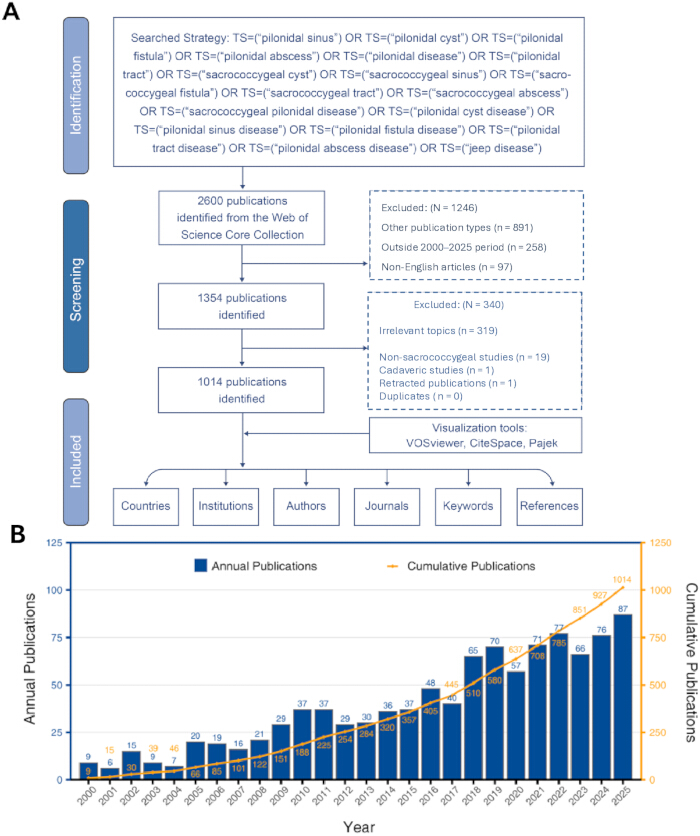
Figure 1: Study selection and publication trends. (A) Flow diagram illustrating the stepwise screening and inclusion process based on the WoS Core Collection, resulting in a final curated dataset of 1,014 original English-language publications on SPD. (B) Annual and cumulative numbers of publications on sacrococcygeal pilonidal disease between 2000 and 2025. Please click here to view a larger version of this figure.
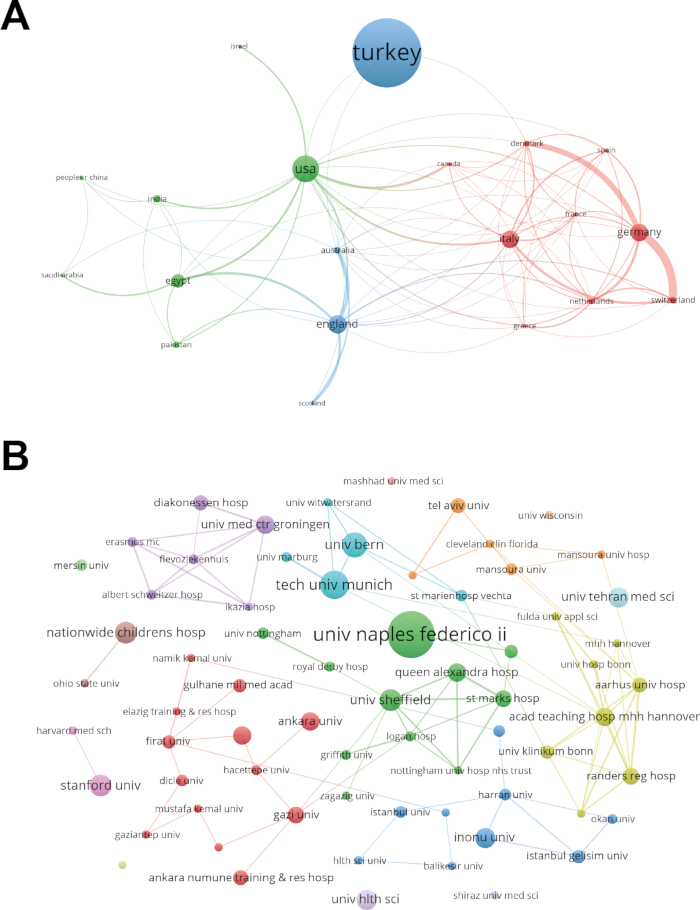
Figure 2: Network maps of the productive countries and institutions. (A) Collaborative network of countries. (B) Collaborative network of institutions. In both networks, larger nodes represent higher publication volume, node colors indicate different clusters, and thicker lines indicate stronger links between connected nodes. Please click here to view a larger version of this figure.
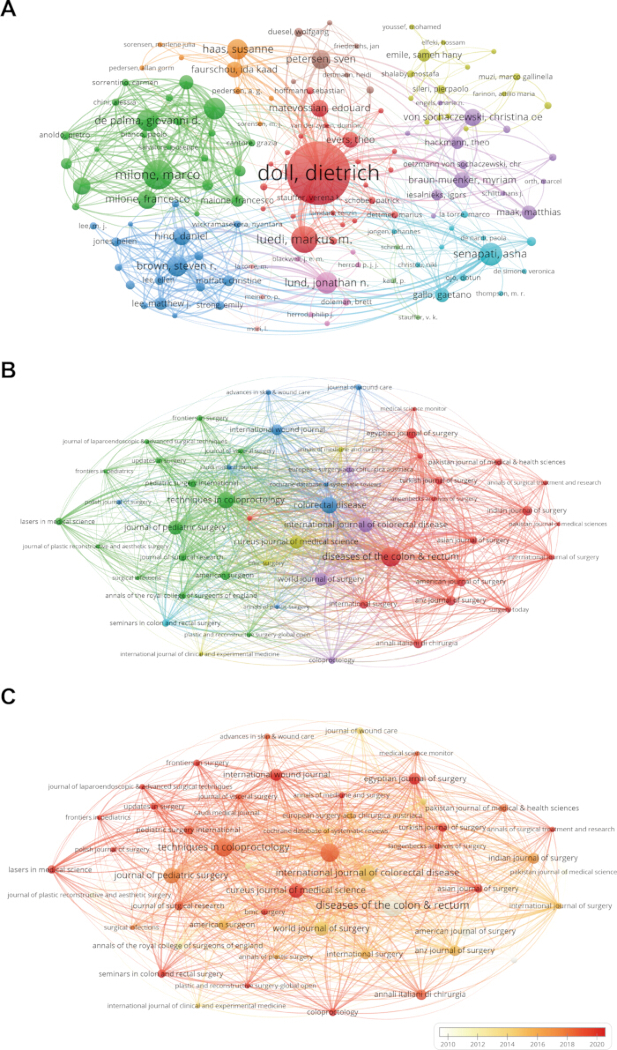
Figure 3: Network maps of prolific authors and journals. (A) Collaborative network visualization of authors. (B) Citation network visualization of contributing journals. (C) Overlay visualization of contributing journals. In (A) and (B), larger nodes represent higher publication volume, node colors indicate different clusters, and thicker lines indicate higher link strength between connected items. In (C), node colors indicate the average publication year of articles in each journal, using a gradient from white (earlier years) to red (later years). Please click here to view a larger version of this figure.
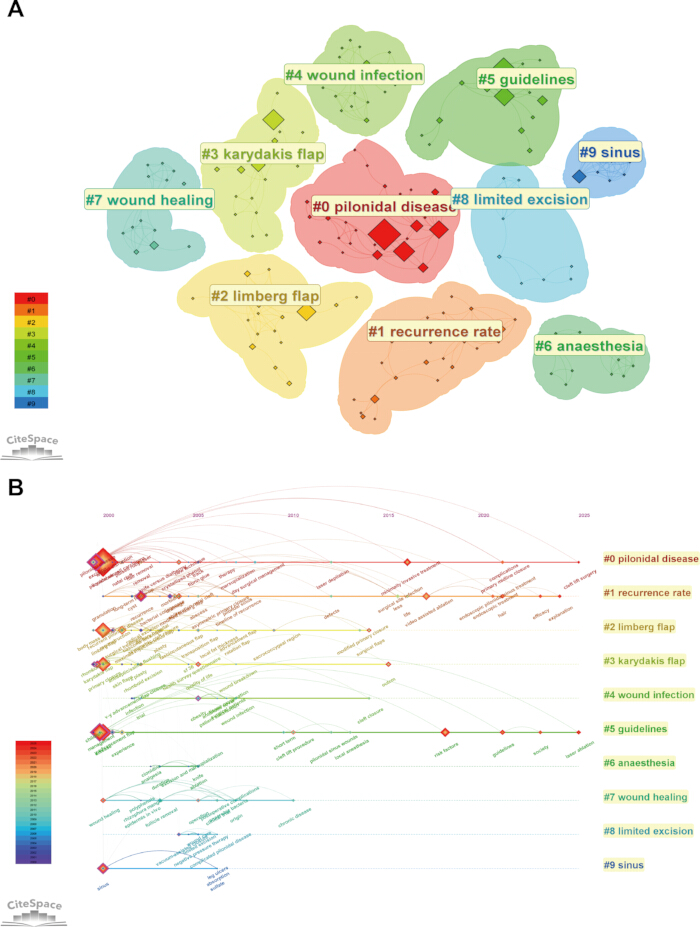
Figure 4: Keyword clustering and temporal evolution. (A) Keyword clustering network generated by CiteSpace, with clusters labeled by the log likelihood ratio (LLR) method. (B) Timeline visualization of keyword clustering analysis, showing the temporal progression of research topics from 2000–2025. Please click here to view a larger version of this figure.
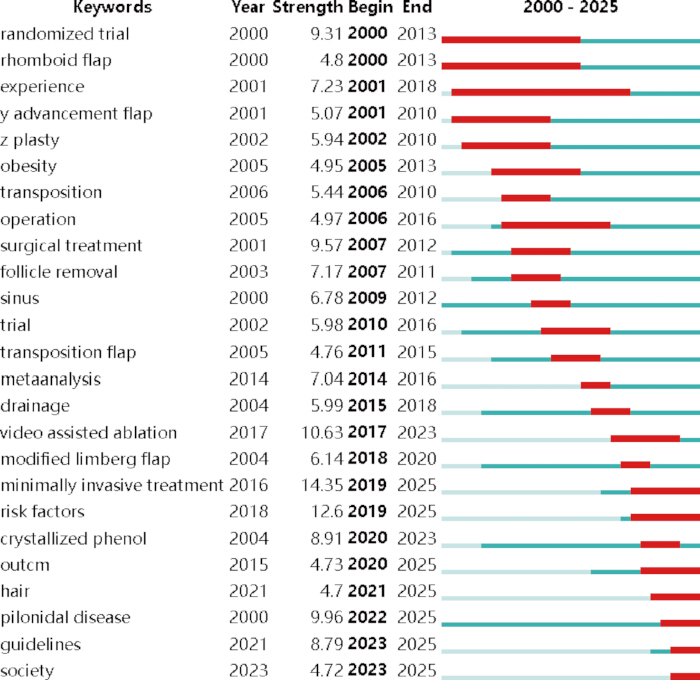
Figure 5: Top 25 keywords with the strongest citation bursts. The dark blue bars indicate the temporal distribution of each keyword, and the red bars denote burst duration. Please click here to view a larger version of this figure.
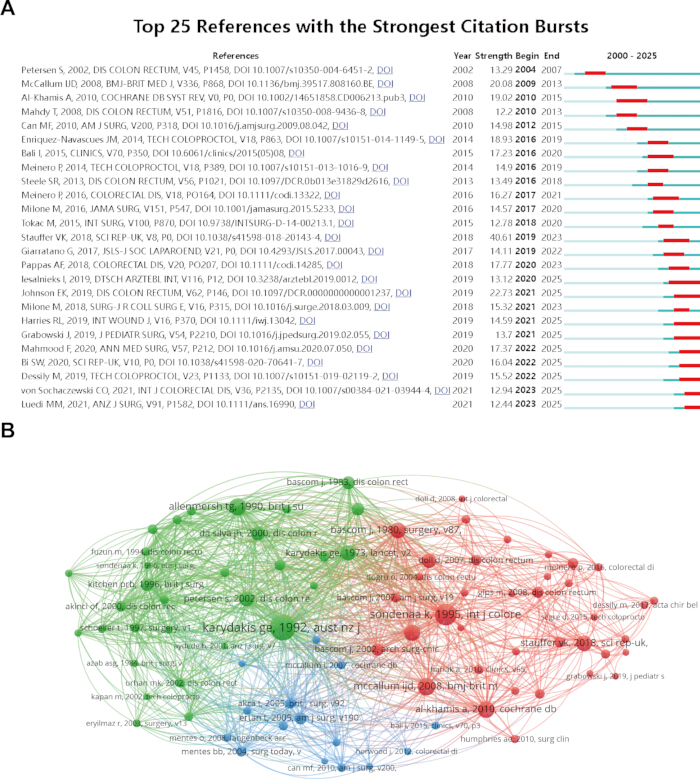
Figure 6: Visualization of references. (A) Top 25 references with the strongest citation bursts. (B) Co-citation network visualization of cited references. In this network, each node represents a cited reference; node size reflects citation frequency; line thickness denotes co‑citation strength; and colors represent thematic clusters. Please click here to view a larger version of this figure.
Table 1: Top 10 most productive countries in SPD research. This table presents country rankings by publication count, total citations, and total link strength. Abbreviations: ACPP = average citations per publication; TC = total citations; TLS = total link strength. Please click here to download this file.
Table 2: Top 10 most prolific institutions in SPD research. This table presents the top 10 institutions ranked according to total citations and total link strength, respectively. Abbreviations: TC = total citations; TLS = total link strength. Please click here to download this file.
Table 3: Top 10 highest-impact authors in SPD research. This table presents the top 10 authors ranked by publication count, total citations, and total link strength. Abbreviations: TC = total citations; TLS = total link strength. Please click here to download this file.
Table 4: Top 10 most productive journals. This table presents the top 10 journals ranked by publication count, with corresponding total citations, average citations per publication, Journal Citation Reports quartile, and impact factor. Abbreviations: ACPP = average citations per publication; IF = impact factor; JCR = Journal Citation Reports; TC = total citations. Please click here to download this file.
Table 5: Top 10 most cited references. This table presents the top 10 references ranked by citation count, including title, first author, journal, and publication year. Please click here to download this file.
Supplementary Table 1: Keywords harmonization. Keyword harmonization and standardization are applied during bibliometric data preprocessing.Please click here to download this file.
Supplementary Table 2: Keywords. The top 30 most frequently occurring keywords in SPD research from 2000 to 2025. Keywords with a greater log-likelihood ratio are more representative of the clusters. Abbreviations: LLR, log-likelihood ratio. Please click here to download this file.
Supplementary Table 3: Keyword clusters. The 10 largest keyword clusters and the top 5 label terms (by log-likelihood ratio) for each cluster.Please click here to download this file.
Supplementary Table 4: Frequency of keywords. All keywords and their frequency of occurrence in each cluster.Please click here to download this file.
Supplementary File 1: Completed BIBLIO checklist for reporting bibliometric reviews.
The checklist details the manuscript page, line, and section corresponding to each BIBLIO reporting item.Please click here to download this file.
Discussie
Deze uitgebreide bibliometrische synthese van 1.014 publicaties schetst het traject van SPD-onderzoek over het eerste kwartaal van de 21e eeuw en onthult een vakgebied met een toenemende publicatieactiviteit, een uitbreidende thematische diversiteit en evoluerende onderzoeksinteresses. Deze studie stelt een macroscopisch, kwantitatief kader voor om niet alleen de expansie van de wetenschappelijke output in kaart te brengen, maar, nog kritischer, om de onderliggende intellectuele architectuur, de collaboratieve dynamiek en de evoluerende onderzoeksthema's die modern SPD-onderzoek kenmerken te deconstrueren16,22. Voorbij de beschrijvende statistieken gaat deze multitool-bibliometrische benadering — waarin prestatieanalyse, science mapping en burst-detectie zijn geïntegreerd — een unieke, systematische synthese bieden van een omvangrijke en gefragmenteerde literatuur. Door het kennisnetwerk te visualiseren, hebben we de belangrijkste bijdragers, de centraliteit van specifieke tijdschriften29 en de heterogene structuur van mondiale collaboratienetwerken30 gekarakteriseerd, waardoor een nuttig referentiekader is ontstaan voor het begrijpen van onderzoekstrends en potentiële richtingen voor toekomstige samenwerking. Deze methodologie, die reeds effectief is gebleken in andere anorectale vakgebieden18,19,20,21, maakt een objectieve beoordeling van onderzoekstrends mogelijk en biedt inzicht in de evolutie van studies die voornamelijk gericht waren op chirurgische technieken naar bredere onderzoeken waarin preventie, bewijssynthese en patiëntgerichte uitkomsten zijn opgenomen1,31.
De bevindingen onthullen een aanzienlijke thematische evolutie, waarbij toenemende onderzoeksaandacht wordt gericht op minimaal invasieve technieken en etiologische preventie, naast voortgezet onderzoek naar conventionele chirurgische benaderingen. De analyses van trefwoordclustering en burst-detectie leveren bewijs voor verschuivende onderzoeksprioriteiten in dit vakgebied1,2,14, met aanhoudende hoogintensieve bursts voor termen als “minimally invasive treatment” en “video-assisted ablation” in recente jaren. De opkomst van deze minder invasieve benaderingen kan wijzen op een groeiende belangstelling voor het verminderen van de behandelingslast en het verbeteren van patiëntgerichte uitkomsten14,30,31. De bibliometrische bevindingen duiden echter primair op verschuivingen in onderzoeksprioriteiten en niet op definitief bewijs voor klinische superioriteit tussen de beschikbare chirurgische technieken. Tegelijkertijd wijst de toename van trefwoorden zoals “risk factors”, “hair” en “guidelines” op een volwassen wordend onderzoekslandschap dat in toenemende mate etiologische factoren verkent, zoals de rol van haarpenetratie bij de ontwikkeling van de ziekte32,33, terwijl het tegelijkertijd de toenemende aandacht voor bewijssynthese en de toekomstige ontwikkeling van richtlijnen weerspiegelt4,34. Deze thematische diversificatie geeft aan dat onderzoek naar SPD zich steeds meer uitbreidt voorbij operatieve technieken om etiologische, preventieve en bewijssynthetische perspectieven te integreren.
De analyse onthult variatie in internationale samenwerkingspatronen binnen het SPD-onderzoekslandschap, wat wijst op mogelijkheden om de internationale connectiviteit binnen de SPD-onderzoeksgemeenschap te versterken. Hoewel Turkije domineert in publicatievolume16, verschilden internationale samenwerkingspatronen aanzienlijk per land, waarbij verschillende West-Europese landen sterkere grensoverschrijdende samenwerkingsverbanden vertoonden. Deze verschillen benadrukken de heterogene structuur van wereldwijde samenwerkingsnetwerken in SPD-onderzoek. Deze ongelijkmatige verdeling van samenwerkingsnetwerken onderstreept de potentiële voordelen van bredere multinationale samenwerking voor toekomstige bewijsvoering30. Eerdere methodologische analyses hebben aangetoond dat het vakgebied afhankelijk blijft van retrospectieve cohorts uit één enkel centrum en meta-analyses van heterogene gegevens, met een zorgwekkend dalend aandeel van gerandomiseerde gecontroleerde trials (RCT's)23. Toekomstig onderzoek kan profiteren van meer internationale samenwerking en goed ontworpen prospectieve studies die in staat zijn om verschillende chirurgische benaderingen te vergelijken over diverse populaties en zorginstellingen heen34.
De potentiële implicaties van deze bevindingen zijn tweeledig: ze bieden onderzoekers en clinici een gestructureerd overzicht van het huidige onderzoekslandschap naar SPD en kunnen helpen bij het identificeren van kennislacunes, opkomende thema's en potentiële gebieden voor toekomstig onderzoek. De identificatie van kern tijdschriften29 en invloedrijke auteurs kan onderzoekers er ook in helpen om gevestigde kennisleveranciers en potentiële collaboratieve netwerken binnen het vakgebied te herkennen. Voor onderzoekers en wetenschappelijke organisaties benadrukt het ontstaan van burst-trefwoorden zoals “guidelines” en “society” gebieden van groeiende onderzoeksinteresse en suggereert dit potentiële richtingen voor toekomstig onderzoek, waaronder bewijssynthese en multicentrische studies11,34. Toekomstige onderzoeksrichtingen kunnen baat hebben bij een verschuiving van beschrijvende chirurgische series naar hypothese-gestuurde collaboratieve studies. Potentiële prioriteiten die door het huidige literatuurlandschap worden gesuggereerd, omvatten: (1) het uitvoeren van goed gefundeerde RCT's die de meest veelbelovende minimaal invasieve technieken vergelijken met gevestigde off-midline flap-procedures, waarbij recidive na 5–10 jaar als primair eindpunt wordt gebruikt34; (2) het ontwikkelen en valideren van gestandaardiseerde, door de patiënt gerapporteerde uitkomstmaten die de volledige impact van de behandeling op de kwaliteit van leven en het psychosociale welzijn vastleggen, in het bijzonder bij adolescenten1,8; en (3) het onderzoeken van de rol van profylactische interventies, zoals laserontharing, bij risicogroepen door middel van robuuste, langdurige cohortstudies om de kosteneffectiviteit bij het voorkomen van primaire en recidiverende aandoeningen te beoordelen.
Methodologische beperkingen van deze synthese moeten worden erkend om deze bevindingen in context te plaatsen. Ten eerste kan de afhankelijkheid van een enkele database (WoS Core Collection) en de beperking tot Engelstalige publicaties onbedoeld significant onderzoek hebben uitgesloten dat is gepubliceerd in andere grote wetenschappelijke databases of in talen andere dan het Engels. Ten tweede, zoals bij alle bibliometrische analyses, worden citatiemetrieken beïnvloed door de natuurlijke accumulatie van citaties in de loop van de tijd, wat inherentten gunstig is voor oudere publicaties en de hedendaagse impact van recente innovaties mogelijk niet volledig vastlegt. Ten slotte zijn citatieaantallen en publicatiefrequentie surrogaatmarkers voor wetenschappelijke aandacht en activiteit, en geen directe maten voor methodologische strengheid of klinisch nut. Toekomstige studies zouden deze beperkingen kunnen beperken door meerdere databases op te nemen en altmetrics te gebruiken om een bredere maatschappelijke en klinische impact vast te leggen, waardoor de traditionele op citaties gebaseerde analyse wordt aangevuld om een holistischer beeld te geven van de evolutie van het vakgebied.
Deze bibliometrische analyse van 1.014 publicaties biedt een uitgebreid en systematisch overzicht van het onderzoek naar sacrococcygeale pilonidalisziekte van 2000 tot 2025, waarbij het mondiale landschap, collaboratieve netwerken, de thematische evolutie en opkomende grensvlakken in kaart worden gebracht. Het vakgebied heeft een sterke en aanhoudende toename van de onderzoeksproductie gekend, waarbij Turkije naar voren kwam als het meest productieve land, terwijl Duitsland, Engeland en de Verenigde Staten relatief prominente rollen vertoonden in internationale samenwerkingsnetwerken. Professor Dietrich Doll onderscheidt zich als de meest productieve en meest geciteerde onderzoeker in dit veld. De thematische evolutie laat een toenemende onderzoeksfocus zien op minimaal invasieve technieken, naast voortdurend onderzoek naar conventionele chirurgische benaderingen, waarbij recidieven een centrale uitkomstmaat blijven in de literatuur. Opkomende onderzoeksthema's — benadrukt door burst-trefwoorden waaronder “minimally invasive treatment”, “risk factors”, “hair” en “guidelines” — wijzen op een groeiende belangstelling voor minder invasieve strategieën, etiologische preventie en bewijssynthese. Door mondiale productiviteitspatronen, collaboratieve structuren en thematische evolutie te integreren, biedt deze studie een kwantitatief referentiekader voor het identificeren van kennislacunes, opkomende onderzoeksprioriteiten en potentiële samenwerkingsmogelijkheden in SPD-onderzoek.
Openbaarmakingen
De auteurs verklaren dat zij geen concurrerende belangen hebben. Artificiële intelligentietools zijn niet gebruikt voor gegevensverzameling, gegevensanalyse, interpretatie van resultaten of het voorbereiden van figuren. ChatGPT (OpenAI) is uitsluitend gebruikt voor taalkundige redactie en het verfijnen van het manuscript.
Dankbetuigingen
De auteurs hebben geen dankbetuigingen te verklaren.
Materialen
| Naam | Bedrijf | Catalogusnummer | Opmerkingen |
|---|---|---|---|
| CiteSpace | Drexel University | versie 6.3.R3 | https://citespace.podia.com/ |
| Microsoft Excel | Microsoft Corporation | versie 2024 | https://www.microsoft.com/nl-nl/microsoft-365/excel |
| Pajek | Universiteit van Ljubljana | versie 6.02 | https://mrvar.fdv.uni-lj.si/pajek/ |
| VOSviewer | Universiteit Leiden | versie 1.6.20 | https://www.vosviewer.com/ |
| Web of Science Core Collection | Clarivate | Omdat er geen brontekst is verstrekt, kan ik geen vertaling genereren. Voer a.u.b. de Engelse tekst in die u vertaald wilt hebben naar het Nederlands. | https://www.webofscience.com/ |
Referenties
- Gil LA, Deans KJ, Minneci PC. Management of Pilonidal Disease: A Review. JAMA Surg. 2023;158(8):875-883.
- Di Castro A, Guerra F, Levi Sandri GB, Ettorre GM. Minimally invasive surgery for the treatment of pilonidal disease. The Gips procedure on 2347 patients. Int J Surg. 2016;36(Pt A):201-205.
- McCallum IJ, King PM, Bruce J. Healing by primary closure versus open healing after surgery for pilonidal sinus: systematic review and meta-analysis. BMJ. 2008;336(7649):868-871.
- Wiinblad IM, Ulrichsen J, Brandstrup B. Outcome After Surgical Treatment for Chronic Pilonidal Sinus Disease: A Systematic Review of Common Surgical Techniques. Dis Colon Rectum. 2025;68(5):515-529.
- Oetzmann von Sochaczewski C, Gödeke J. Pilonidal sinus disease on the rise: a one-third incidence increase in inpatients in 13 years with substantial regional variation in Germany. Int J Colorectal Dis. 2021;36(10):2135-2145.
- Faurschou IK, Erichsen R, Doll D, Haas S. Time trends in incidence of pilonidal sinus disease from 1996 to 2021: A Danish population-based cohort study. Colorectal Dis. 2024;27(1):e17227.
- Brown SR et al. Real-world practice and outcomes in pilonidal surgery: Pilonidal Sinus Treatment Studying The Options (PITSTOP) cohort. Br J Surg. 2024;111(3):znae009.
- Salimi-Jazi F et al. Burden of pilonidal disease and improvement in quality of life after treatment in adolescents. Pediatr Surg Int. 2022;38(10):1453-1459.
- Calikoglu I et al. Phenol Injection Versus Excision With Open Healing in Pilonidal Disease: A Prospective Randomized Trial. Dis Colon Rectum. 2017;60(2):161-169.
- Walker H, Hamid O, Ramirez J, Glancy D. Diagnosis and management of sacrococcygeal pilonidal disease in primary care. BMJ. 2023;382:e071511.
- Johnson EK, Vogel JD, Cowan ML, Feingold DL, Steele SR. Clinical Practice Guidelines Committee of the American Society of Colon and Rectal Surgeons. The American Society of Colon and Rectal Surgeons’ Clinical Practice Guidelines for the Management of Pilonidal Disease. Dis Colon Rectum. 2019;62(2):146-157.
- Vartanian E, Gould DJ, Lee SW, Patel KM. Pilonidal Disease: Classic and Contemporary Concepts for Surgical Management. Ann Plast Surg. 2018;81(6):e12-e19.
- Al-Khamis A, McCallum I, King PM, Bruce J. Healing by primary versus secondary intention after surgical treatment for pilonidal sinus. Cochrane Database Syst Rev. 2010;2010(1):CD006213.
- Tien T, Athem R, Arulampalam T. Outcomes of endoscopic pilonidal sinus treatment (EPSiT): a systematic review. Tech Coloproctol. 2018;22(5):325-331.
- Kumar M, Clay WH, Lee MJ, Brown SR, Hind D. A mapping review of sacrococcygeal pilonidal sinus disease. Tech Coloproctol. 2021;25(6):675-682.
- Doll D, Stauffer V, Diekann M, Van Wyk P, Luedi MM. Turkey is leading in the 21st century pilonidal sinus disease research. Turk J Surg. 2020;36(3):284-290.
- Dhole S, Mahakalkar C. Advancements and Innovations in the Surgical Management of Sacrococcygeal Pilonidal Sinus: A Comprehensive Review. Cureus. 2024;16(5):e61141.
- Chen X. Global knowledge mapping and technological evolution in hemorrhoid therapy: a multi-tool bibliometric analysis. Updates Surg. 2025. doi:10.1007/s13304-025-02460-2.
- Wang Z et al. Top 100 most-cited articles on hemorrhoids: A bibliometric analysis and visualized study. Front Surg. 2022;9:1021534.
- Chen Q, Li Y, Wang X, Li H. Hot topics in global perianal fistula research: A SCOPUS-based bibliometric analysis. Medicine (Baltimore). 2020;99(17):e19659.
- Feng L, Wang M, Li X, Yang Q. A bibliometric analysis of surgical treatment for rectal prolapse. Medicine (Baltimore). 2025;104(32):e43763.
- Şahin A, Şimşek G. The One Hundred Most Cited Articles from Turkey about Pilonidal Disease: A Bibliometric Study. Turk J Colorectal Dis. 2022;32:123-133.
- Doll D et al. One century of pilonidal sinus research: trends in study size and the declining share of randomized controlled trials. Coloproctology. 2025;47:353-359.
- Montazeri A et al. Preliminary guideline for reporting bibliometric reviews of the biomedical literature (BIBLIO): a minimum requirements. Systematic Reviews. 2023;12(1):239.
- Thelwall M. Bibliometrics to webometrics. J Inf Sci. 2008;34(4):605-621.
- van Eck NJ, Waltman L. Software survey: VOSviewer, a computer program for bibliometric mapping. Scientometrics. 2010;84(2):523-538.
- Chen C. Searching for intellectual turning points: progressive knowledge domain visualization. Proc Natl Acad Sci U S A. 2004;101 Suppl 1(Suppl 1):5303-5310.
- Mrvar A, Batagelj V. Analysis and visualization of large networks with program package Pajek. Complex Adapt Syst Model. 2016;4:6.
- Becerra AZ et al. A New Bibliometric Index: The Top 100 Most Disruptive and Developmental Publications in Colorectal Surgery Journals. Dis Colon Rectum. 2022;65(3):429-443.
- Wagner CS, Leydesdorff L. Network structure, self-organization, and the growth of international collaboration in science. Res Policy. 2005;34(10):1608-1618.
- Esposito C et al. Quality of life of pediatric patients operated for pilonidal sinus disease. Eur J Pediatr. 2023;182(1):25-30.
- Halleran DR et al. Recurrence of Pilonidal Disease: Our Best is Not Good Enough. J Surg Res. 2018;232:430-436.
- Karydakis GE. Easy and successful treatment of pilonidal sinus after explanation of its causative process. Aust N Z J Surg. 1992;62(5):385-389.
- Stauffer VK et al. Common surgical procedures in pilonidal sinus disease: A meta-analysis, merged data analysis, and comprehensive study on recurrence. Sci Rep. 2018;8(1):3058.