W tym artykule prezentujemy przygotowanie hydrożeli MOF-żelatynowych, które korzystają z termoorzewalnych właściwości żelatyny, związanych z jej separacją fazową przez koaceratację. Te kompozyty hydrożelowe wykazują wysokie obciążenie MOF, dużą porowatość i dobrą przestrzenną dystrybucję cząstek MOF w macierzy żelatynowej.
Subskrypcja JoVE jest wymagana do oglądania tego materiału. Zaloguj się lub rozpocznij bezpłatny okres próbny.
Artykuł metodologiczny
Przygotowanie żeli metalo-organicznych struktur hydrogeli z żelatyną poprzez koacerwację
W tym artykule
Podsumowanie
Streszczenie
Prezentowana jest oryginalna i powtarzalna strategia syntezy zielonych i przyjaznych dla środowiska kompozytów hydrożelowych z żelatyny i Zr(IV) Metal-Organic Framework (MOF), która jest opisana krok po kroku w całym artykule. Podejście to wykorzystuje termorewersyjną naturę żelatyny i jej zdolność do ulegania separacji fazowej poprzez koaceratację, w połączeniu z in situ tworzeniem MOF-ów typu UiO-66 w łagodnych warunkach. Wykorzystując tę metodologię, obecna praca pokazuje przygotowanie bionanokompozytu na bazie żelatyny i chemicznie stabilnego Zr4⁺ dikarboksylatowego UiO-66 MOF. Co ważne, ta strategia może być rozszerzona na szerszą rodzinę Zr(IV) dikarboksylatowych i fumaranowych MOF-ów (MOF-y typu UiO-66 i MOF-801 odpowiednio), wybrane tak, aby obejmować szeroki zakres równowagi hydrofilowo-hydrofobowo oraz funkcjonalizacji łączników organicznych. Powstałe kompozyty hydrożelowe wykazują kluczowe cechy, takie jak wysokie ładunki MOF (przekraczające 50 wt%), wysoka dostępna porowatość i jednorodna dyspersja nanocząstek MOF w sieci żelatynowej. Te właściwości wynikają z silnej kompatybilności interfejsowej między żelatyną a nanocząstkami MOF, co jest potwierdzane przez uzupełniające zaawansowane techniki charakteryzacji. Dzięki ich mocnemu zachowaniu mechanicznemu w warunkach środowiskowych, kompozyty te mogą być przetwarzane w skali gramów na różne formy makroskopowe, takie jak powłoki czy monolity, umożliwiając ich zastosowanie w różnych zastosowaniach, w tym w łapaniu lub katalitycznej konwersji zanieczyszczeń w wodzie lub powietrzu w warunkach środowiskowych.
Wprowadzenie
Metal–organic frameworks (MOFs) constitute a family of porous, crystalline hybrid materials built from metal ions interconnected by polydentate organic ligands. Owing to their well-defined pore architectures, high internal surface areas, and tunable chemical functionalities, MOFs have attracted considerable scientific attention for diverse applications, including gas storage and separation, sensing, catalysis, biomedicine, and so on1. Despite this strong potential, several limitations still significantly restrict the large-scale transfer of MOFs toward industrial implementation. One of the major challenges lies in the shaping of such materials2. Indeed, conventional MOF syntheses typically yield brittle powders, whose inherent fragility, poor processability, and limited handling properties severely hinder their practical deployment. To address these issues, MOFs have been processed into pellets, granules, beads, fibers, or membranes; however, such shaping procedures often result in a partial or complete loss of accessible porosity2.
A widely explored strategy to overcome these drawbacks involves integrating MOFs with supporting matrices, particularly polymers or carbon-based materials such as carbon nanotubes, graphene, and graphene oxide3,4,5,6. This approach has led to the development of multifunctional composites that combine the intrinsic advantages of MOFs (porosity, crystallinity) with the mechanical robustness and processability of the host materials. In addition, hybridization can introduce new functionalities, including enhanced chemical stability, improved electrical conductivity, or hierarchical porosity3,4,5,6. As a result, MOF-based composites have been extensively investigated for gas adsorption and separation, water purification, catalysis, and bioapplications3,4,5,6,7,8. Nevertheless, a recurring limitation of such composites is the pronounced aggregation of MOF particles, which is generally attributed to poor interfacial compatibility between the MOFs and the supporting matrix. This issue is particularly prevalent in composites prepared by physically blending pre-synthesized MOF particles with polymers or graphene oxide and becomes increasingly severe at high MOF loadings, which are typically required to optimize performance3,4,5,6. To mitigate these challenges, numerous alternative strategies have been proposed to improve the physico-chemical affinity between MOFs and polymeric or carbon-based matrices while preserving MOF porosity. These include surface functionalization of MOF particles, covalent grafting of polymers onto MOF surfaces, in situ growth of MOFs within polymer matrices, polymer-directed MOF crystallization, or the use of polymeric ligands to construct polyMOFs3,4,5,6,7,8,9. Despite these advances, many MOF-polymer composites still suffer from reduced surface areas due to pore blockage by polymer chains and from inhomogeneous MOF dispersion. Moreover, their preparation often relies on multi-step, time-intensive synthetic routes, and the use of petrochemical-derived synthetic polymers raises concerns related to toxicity, sustainability, and environmental impact3,4,5,6.
The purpose of this article is to share the details of the preparation of a hydrogel composite based on a Zr4⁺ dicarboxylate UiO-66–type MOF (UiO = University of Oslo)10and gelatin. This system is selected as a representative example to illustrate a general synthetic strategy that can be extended to a broader family of polycarboxylate porous MOFs, including functionalized UiO-66 derivatives and MOF-801(Zr). Gelatin is a widely employed protein-based biopolymer in industrial applications such as drug and cosmetic microencapsulation, owing to its low cost, biodegradability, non-toxicity, and renewable origin11. In the past few years, MOF-gelatin hydrogels have been primarily investigated for bio-related applications such as tissue engineering, wound healing, drug delivery, and bioimaging12,13,14,15,16,17. These composites were generally prepared by impregnating preformed MOF particles into functionalized gelatin scaffolds or physical gelatin gels. While such materials exhibit promising biological performance, they typically contain very low MOF contents (below 10 wt%), resulting in limited porosity and consequently, restricting the exploitation of MOF-related physicochemical properties12,13,14,15,16,17. The present article describes a completely different strategy that exploits the thermoreversible properties of gelatin and its ability to undergo liquid-liquid phase separation18,19 associated with the room temperature (RT) in-situ formation of MOFs. In the protocol described in this article, critical steps in preparing the UiO-66/gelatin composites will be covered, including the preparation of gelatin solution, the gelatin coacervation process, the RT crystallization of UiO-66 within gelatin, and the shaping of the resulting composites. Such composites have been recently reported by some of us to develop adsorbents for cultural heritage preservation, but their protocol of synthesis was not described in detail20. We hope that the concepts and methodology presented in this article will motivate the research community to explore and develop a wider class of MOF-biopolymer composites. These materials simultaneously exhibit high MOF loadings (exceeding 80 wt%), large accessible porosity, homogeneous dispersion of MOF particles within the gelatin matrix, and tunable hydrophilic-hydrophobic characteristics20. A key advantage of employing biomacromolecules such as gelatin lies in their intrinsic chemical complexity, multifunctionality, and polyelectrolyte nature, which have no direct synthetic equivalents. This unique combination enables the effective integration of both hydrophilic and hydrophobic MOFs within a water-soluble biopolymer matrix.
Dostęp ograniczony. Zaloguj się lub rozpocznij wersję próbną, aby wyświetlić tę treść.
Protokół
1. Przygotowanie roztworów żelatyny
- Należy użyć komercyjnej żelatyny pozyskiwanej ze skóry wieprzowej (typ A), o stopniu Bloom 175 g, średniej masie cząsteczkowej około 40,0 g·mol⁻1 oraz punkcie izoelektrycznym (IEP) wynoszącym 8.
- Przygotować wodny żel żelatynowy o stężeniu 10% wag. poprzez napęcznianie granulek żelatyny w wodzie ultrapurej przez minimum 3 h w temperaturze 5 °C.
- Następnie przygotować wodny roztwór żelatyny, podgrzewając żel żelatynowy do 50 °C. Mieszać roztwór żelatyny za pomocą mieszadła magnetycznego przez 30 min przy prędkości 30 rpm. Po uzyskaniu klarownego roztworu żelatyny utrzymać go w temperaturze 50 °C (Rysunek 1).
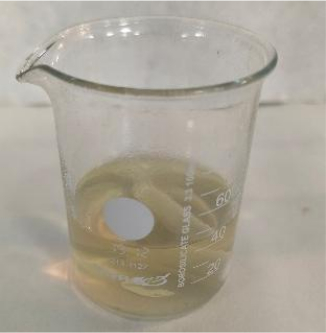
Rycina 1Fotografia wodnego roztworu żelatyny o stężeniu 10% wag. Proszę kliknąć tutaj, aby wyświetlić powiększoną wersję tej ryciny.
2. Synteza kompozytu hydrożelu UiO-6-żelatyna
- Synteza klastra tlenkowego [Zr6O4(OH)4(OAc)12] (OAc = octan)
- Do probówki scyntylacyjnej o pojemności 20 mL dodać 71 µL 70% roztworu propyleksyku cyrkonu w 1-propanolu [Zr(OPrⁿ)₄] (0,0519 g, 0,158 mmol) do 7 mL dimetyloformamidu (DMF) i 4 mL kwasu octowego (4,196 g, 70 mmol) (Rysunek 2A).
- Podgrzewać otrzymaną mieszaninę w bloku aluminiowym na płycie grzejnej w temperaturze 130 °C przez 2 h; w tym czasie zaobserwowano wyraźną zmianę barwy z bezbarwnej na żółtą (Rysunek 2B).
- Pozostawić roztwór do ochłodzenia w temperaturze pokojowej (RT).
- Synteza in situ UiO-6(Zr) w obecności koacerwatu żelatynowego
- Wymieszać 1 mL roztworu klastra tlenkowego {Zr₆} (0,158 mmol) otrzymanego w kroku 2.1 z 0,5 mmol (84 mg) organicznego łącznika kwasu 1,4-benzenodikarboksylowego (1,4-bdc).
- Mieszać mieszaninę przez 15 min aż do uzyskania jednorodnej dyspersji.
- Następnie do roztworu dodać 2 mL 10% (mas.) roztworu żelatyny, przygotowanego w zadaniu 1 w temperaturze 50 °C (Rysunek 3).
- Mieszać mieszaninę w temperaturze pokojowej przez 10 min, a następnie dodać 2 mL etanolu. Roztwór staje się mętny i biały.
- Mieszać otrzymaną mieszaninę w temperaturze pokojowej (20 °C) przez 24 h. Z czasem następuje stopniowy rozdział faz ciecz-ciecz.
UWAGA: Bezpośrednio po dodaniu etanolu początkowy roztwór jest biały i mętny (Rysunek 4A), a następnie z czasem przekształca się w makroskopowo dwufazową próbkę składającą się z rozcieńczonego roztworu żelatyny unoszącego się nad gęstszą, białą, lepką fazą (Rysunek 4B–F). - Aby uzyskać całkowity rozdział faz, dodać do mieszaniny 10 mL etanolu. Po wymieszaniu roztworu wyekstrahować lepką fazę z roztworu naddatku, aby otrzymać kompozyt hydrożelu (Rysunek 5).
- Pozostawić kompozyt do wyschnięcia w temperaturze pokojowej, a następnie poddać go dalszej charakterystyce, łącząc dyfrakcję rentgenowską proszków (PXRD), analizę termograwimetryczną, spektroskopię w podczerwieni z transformacją Fouriera (FT-IR), porozymetrię N2, skaningową i transmisyjną mikroskopię elektronową (SEM i TEM), magnetyczny rezonans jądrowy (NMR) w stanie stałym oraz spektroskopię emisyjną z plazmą sprzężoną indukcyjnie (ICP-AES), zgodnie z wcześniej opisano20 (Rysunek 6).
- Formowanie UiO-66(Zr) / żelatyny w monolity
- Podgrzewać lepką fazę otrzymaną w kroku 2.2.6 wraz z naddatkiem w temperaturze 70 °C przez 15 min, a następnie w 90 °C przez 5 min.
UWAGA: Zabieg ten miał na celu przekształcenie hydrożelu MOF-żelatyna w jednorodną ciecz i lepką mieszaninę, którą można łatwo przelać do formy. - Następnie przelać hydrożel bez roztworu naddatku do formy termostatyzowanej w temperaturze 70 °C.
- Uformować monolit poprzez chłodzenie w temperaturze pokojowej przez 15 min, a następnie przechowywać w temperaturze 2 °C przez 1 dobę (Rysunek 7).
- Podgrzewać lepką fazę otrzymaną w kroku 2.2.6 wraz z naddatkiem w temperaturze 70 °C przez 15 min, a następnie w 90 °C przez 5 min.
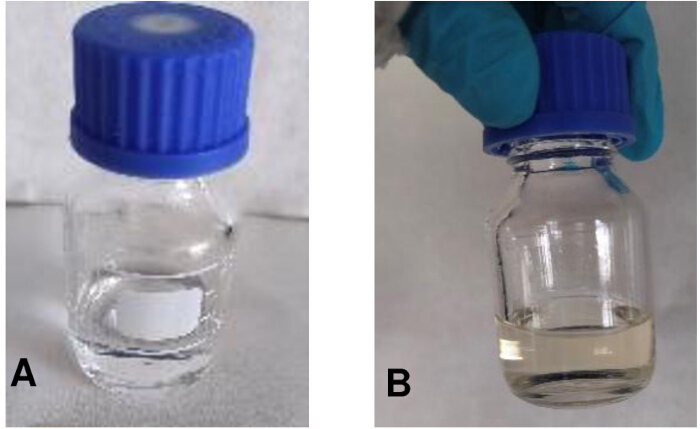
Rycina 2: Zdjęcia roztworu zawierającego 71 µL 70% roztworu propyleksydu cyrkonu w 1-propanolu [Zr(OPrⁿ)₄] (0,0519 g, 0,158 mmol), 7 ml DMF oraz 4 ml kwasu octowego. (A) Przed i (B) po podgrzaniu w temperaturze 130 °C przez 2 h. Kliknij tutaj, aby wyświetlić powiększoną wersję tej ryciny.
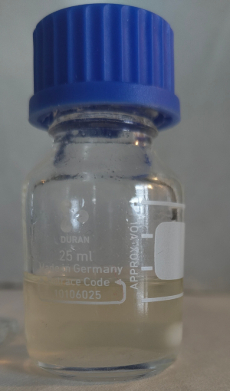
Rycina 3: Fotografia próbki otrzymanej po zmieszaniu 1 ml [Zr6O4(OH)4(OAc)12klastra oxo (0,158 mmol), łącznika 1,4-bdc (0,5 mmol) oraz 2 ml 10% (masowych) wodnego roztworu żelatyny w temperaturze pokojowej. Kliknij tutaj, aby wyświetlić powiększoną wersję tego rysunku.
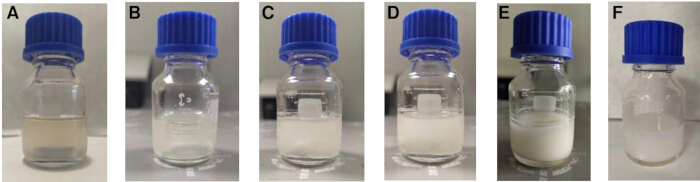
Rysunek 4: Fotografie próbek zawierających [Zr6O4(OH)4(OAc)12klaster tlenkowy, łącznik 1,4-bdc oraz 10% wag. wodny roztwór żelatyny w temperaturze pokojowej po dodaniu 2 ml etanoluFotografie przedstawiają postępujące rozdzielenie faz ciekłych żelatyny podczas starzenia próbek w różnych odstępach czasu: (A) 0 min, (B) 15 min, (C) 1 h, (D) 2 h, (E)18 h, (F) 24 h. Jednocześnie reakcja pomiędzy [Zr6O4(OH)4(OAc)12klaster oxo oraz łącznik 1,4-bdc doprowadziły do powstania nanocząsteczek UiO-6(Zr). Prosimy kliknąć tutaj, aby wyświetlić powiększoną wersję tej ryciny.
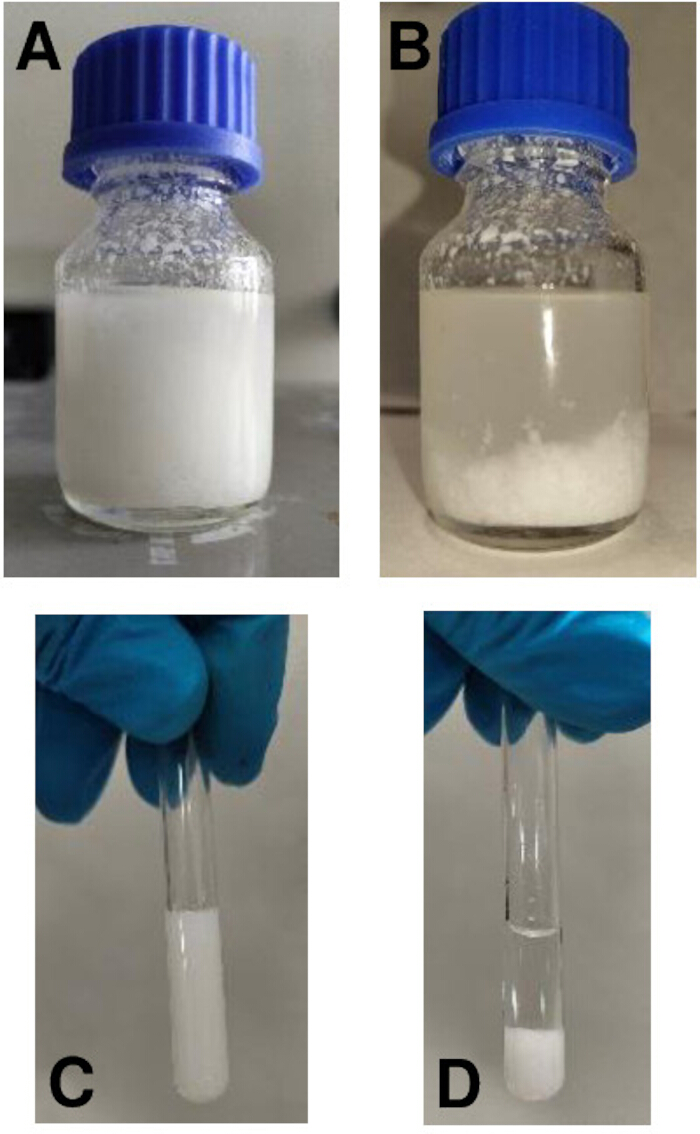
Rycina 5Fotografie próbek zawierających żelatynę i UiO-6(Zr). (A–D) Przed (A,C) oraz po (B,D) dodanie 10 ml etanolu. Roztwór początkowo biały i mętny (A,C) przekształca się w makroskopowo dwufazowe próbki zawierające rozcieńczony roztwór żelatyny oraz lepki hydrożel (B,D). Proszę kliknąć tutaj, aby wyświetlić powiększoną wersję tej ryciny.
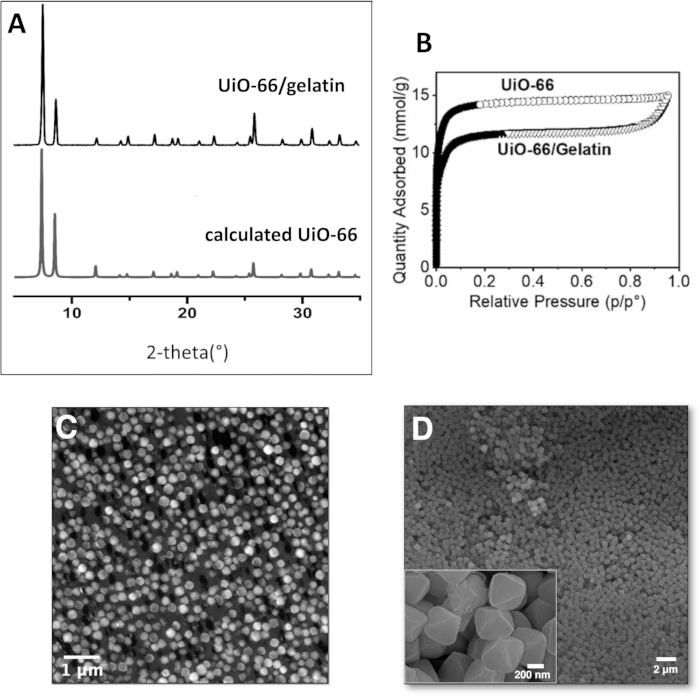
Rysunek 6: Charakterystyka hydrożelu UiO-6/żelatyna. (A) Eksperymentalny dyfraktogram PXRD UiO-6/żelatyny w porównaniu z obliczonym dyfraktogramem UiO-6. (B) N2 porozymetria (adsorpcja, symbole wypełnione; desorpcja, symbole puste) UiO-66/żelatyny w porównaniu z czystymi nanocząstkami UiO-6 w temperaturze 7 K (p°=1 atm). (C) Obraz TEM przekroju o grubości 80 nm, przygotowanego metodą ultramikrotomii, hydrożelu UiO-66/żelatyna. (D) obrazy SEM hydrożelu UiO-6/żelatyna po przemyciu wodą. Rycina ta została przedrukowana (zaadaptowana) za zgodą autorów Biswas i wsp.20. Aby wyświetlić powiększoną wersję tej ryciny, kliknij tutaj.
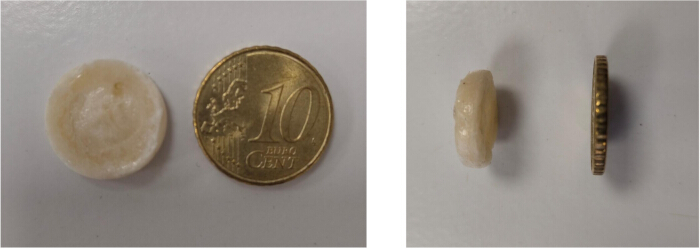
Rysunek 7Zdjęcie uformowanego kompozytu UiO-66/żelatyna. Prosimy o kliknięcie tutaj, aby wyświetlić większą wersję tej figury.
Dostęp ograniczony. Zaloguj się lub rozpocznij wersję próbną, aby wyświetlić tę treść.
Wyniki
Kompozyt z hydrożelem UiO-66(Zr)/żelatyna został zsyntetyzowany poprzez skojarzenie prostej koacerwacji żelatyny z in situ tworzeniem nanocząstek UiO-66(Zr). Protokół syntezy był wielokrotnie powtarzany, aby zapewnić niezawodność, zawsze przynosząc identyczne wyniki (tzn. charakterystyka strukturalna i fizykochemiczna kompozytów) w identycznych warunkach eksperymentalnych. Nanocząstki UiO-66(Zr) były przygotowywane w temperaturze pokojowej zgodnie z wcześniej opisanym protokołem składającym się z dwóch kroków, k...
Dostęp ograniczony. Zaloguj się lub rozpocznij wersję próbną, aby wyświetlić tę treść.
Dyskusja
Kompozyty łączące żelatynę z materiałami nieorganicznymi, takimi jak tlenki metali, hydroksyapatyt i warstwowe podwójne wodorotlenki, przyciągnęły znaczne zainteresowanie ze względu na ich zdolność do integracji biokompatybilności i przetwarzalności żelatyny z funkcjonalnymi właściwościami faz nieorganicznych24,25. Żelatyna zapewnia wszechstronną organiczną matrycę, którą można łatwo kształtować, wiązać sieciowo i przetwarzać w środowiskach wodnych, po...
Dostęp ograniczony. Zaloguj się lub rozpocznij wersję próbną, aby wyświetlić tę treść.
Oświadczenia
Autorzy nie mają nic do ujawnienia.
Podziękowania
SB i NS dziękują za wsparcie finansowe ze strony programu Horyzont 2020 Unii Europejskiej (Projekt Nemosine, umowa o grant nr 760801). SB i NS dziękują za wsparcie finansowe z ANR-11-LABEX-0039 (LabEx charmmmat). IM i NS dziękują za wsparcie finansowe ze strony École Universitaire de Recherche PSGS-HCH Humanités, Création, Patrimoine, Investissement d’Avenir ANR-17-EURE-0021 – Fondation des Sciences du Patrimoine. NNG i NS dziękują za wsparcie finansowe ze strony Francuskiej Narodowej Agencji Badawczej poprzez grant Domino nr ANR-22-CE08-0007.
Dostęp ograniczony. Zaloguj się lub rozpocznij wersję próbną, aby wyświetlić tę treść.
Materiały
| Nazwa | Firma | Numer katalogowy | Komentarze |
|---|---|---|---|
| 1,4 benzene dicarboxylic acid | Acros Organics. | 180720010 | |
| 70% zirconium propoxide [Zr(OPrn)4] solution in 1-propanol | Sigma-Aldrich | 333972-100ML | |
| Acetic acid | Carlo Erba | 524520 | |
| Avance-NEO spectrometer | Bruker | NMR | |
| Dimethyl formamide | Carlo Erba | 528221 | |
| Ethanol | Carlo Erba | 528131 | |
| Gelatin | Sigma-Aldrich | G2625-100G | |
| Magna 550 Nicolet spectrophotometer | Nicolet | 550 series | FTIR |
| Scanning electron microscope | Jeol | JSM-7001F | SEM |
| Thermogravimetric analyzer | Model Perkin Elmer SDA 6000 | ||
| Transmission electron microscope | Jeol | 2100F | TEM |
| X’Pert MDP diffractometer | Siemens | D5000 | XRD |
Bibliografia
- Behera, N., Duan, J., Jin, W., Kitagawa, S. The chemistry and applications of flexible porous coordination polymers. EnergyChem. 3, 100067(2021).
- Liu, X. -M., Xie, L. -H., Wu, Y. Recent advances in the shaping of metal–organic frameworks. Inorg Chem Front. 7 (15), 2840-2866 (2020).
- Schmidt, B. V. K. J. Metal-organic frameworks in polymer science: polymerization catalysis, polymerization environment, and hybrid materials. Macromol Rapid Commun. 41 (1), 1900333(2020).
- Ma, K., et al. Fiber composites of metal–organic frameworks. Chem Mater. 32 (17), 7120-7140 (2020).
- Kalaj, M., et al. MOF-polymer hybrid materials: from simple composites to tailored architectures. Chem Rev. 120 (16), 8267-8302 (2020).
- Dassouki, K., Dasgupta, S., Dumas, E., Steunou, N. Interfacing metal organic frameworks with polymers or carbon-based materials: from simple to hierarchical porous and nanostructured composites. Chem Sci. 14, 12898-12925 (2023).
- Sun, Z., et al. Nanoscale MOFs in nanomedicine applications: from drug delivery to therapeutic agents. J Mater Chem B. 11, 3273-3294 (2023).
- Cheng, Y., Datta, S. J., Zhou, S., Jia, J., Shekhah, O., et al. Advances in metal-organic frameworks-based membranes. Chem Soc Rev. 51, 8300-8350 (2022).
- Mondal, P., Sensharma, D., Cohen, S. M. Tailoring polymer-metal-organic frameworks (polyMOFs) using telechelic poly(octenamer)s. Chem Sci. 16, 21842-21851 (2025).
- Cavka, J. H., et al. A new zirconium inorganic building brick forming metal organic frameworks with exceptional stability. J Am Chem Soc. 130, 13850-13851 (2008).
- Jonker, A. M., Löwik, D. W. P. M., Van Hest, J. C. M. Peptide-and protein-based hydrogels. Chem Mater. 24, 759-773 (2012).
- Deng, Z., et al. Injectable biomimetic hydrogels encapsulating gold/metal–organic frameworks nanocomposites for enhanced antibacterial and wound healing activity under visible light actuation. Chem Eng J. 420, 129668(2021).
- Hsieh, C. T., Ariga, K., Shrestha, L. K., Hsu, S. H. Development of MOF reinforcement for structural stability and toughness enhancement of biodegradable bioinks. Biomacromolecules. 22, 1053-1064 (2021).
- Jiang, Y., et al. Bioinspired adhesive and tumor microenvironment responsive nanoMOFs assembled 3D-printed scaffold for anti-tumor therapy and bone regeneration. Nano Today. 39, 101182(2021).
- Li, J., et al. Cobalt-based metal–organic framework as a dual cooperative controllable release system for accelerating diabetic wound healing. Nano Res. 13, 2268-2279 (2020).
- Sun, Y., et al. Tunable and controlled release of cobalt ions from metal-organic framework hydrogel nanocomposites enhances bone regeneration. ACS Appl Mater Interfaces. 13, 59051-59066 (2021).
- Tang, L., et al. Mechanically strong metal–organic framework nanoparticle-based double network hydrogels for fluorescence imaging. ACS Appl Nano Mater. 5, 1348-1355 (2022).
- Veis, A., Aranyi, C. Phase separation in polyelectrolyte systems. I. complex coacervates of gelatin. J Phys Chem. 64, 1203-1210 (1960).
- Carn, F., Steunou, N., Djabourov, M., Coradin, T., Ribot, F., et al. First example of biopolymer-polyoxometalate complex coacervation in gelatin mixtures. Soft Matter. 4, 735-738 (2008).
- Biswas, S., et al. Engineering of metal–organic frameworks/gelatin hydrogel composites mediated by the coacervation process for the capture of acetic acid. Chem Mater. 34, 9760-9774 (2022).
- DeStefano, M. R., Islamoglu, T., Garibay, S. J., Hupp, J. T., Farha, O. K. Room-temperature synthesis of UiO-66 and thermal modulation of densities of defect sites. Chem Mater. 29, 1357-1361 (2017).
- Khan, S. A., Schneider, M. Improvement of nanoprecipitation technique for preparation of gelatin nanoparticles and potential macromolecular drug loading. Macromol Biosci. 13, 455-463 (2013).
- Joly-Duhamel, C., Hellio, D., Djabourov, M. All gelatin networks: 1. biodiversity and physical chemistry. Langmuir. 18, 7208-7217 (2002).
- Utech, S., Boccaccini, A. R. A review of hydrogel-based composites for biomedical applications: enhancement of hydrogel properties by addition of rigid inorganic fillers. J Mater Sci. 51, 271-310 (2016).
- Steunou, N. Interfacing Gelatin with (Hydr)oxides and Metal Nanoparticles: Design of Advanced Hybrid Materials for Biomedical Engineering Applications. Advanced Materials Interfaces. , John Wiley & Sons. Hoboken, NJ, USA. (2016).
- Carn, F., et al. Assembling vanadium(V) oxide and gelatin into novel bionanocomposites with unexpected rubber-like properties. Chem Mater. 22, 398-408 (2010).
- Christodoulou, J., et al. Screening of aluminium based MOFs for effective in situ immobilization of biomolecules. Inorg Chem. 64, 2545-2553 (2025).
- Zhao, H., et al. Hierarchical superparamagnetic metal-organic framework nanovectors as anti-inflammatory nanomedicines. J Mater Chem B. 11, 3195-3211 (2023).
Dostęp ograniczony. Zaloguj się lub rozpocznij wersję próbną, aby wyświetlić tę treść.
Przedruki i uprawnienia
Przeglądaj więcej artykułów
