Ten protokół opisuje przepływ pracy z meta-ensemble z użyciem głębokiego uczenia się do zautomatyzowanej analizy obrazów planów mieszkań. Procedura obejmuje przetwarzanie danych, przewidywanie atrybutów architektonicznych za pomocą wielu złożonych sieci neuronowych, uczenie zespołowe oparte na stosowaniu, klasyfikację mieszkaniową opartą na zasadach oraz analizę wyjaśnialności za pomocą SHapley Additive exPlanations w celu wsparcia oceny układu mieszkania.
Subskrypcja JoVE jest wymagana do oglądania tego materiału. Zaloguj się lub rozpocznij bezpłatny okres próbny.
Artykuł badawczy
Przewidywanie oparte na głębokim uczeniu atrybutów planu piętra mieszkania dla oceny mieszkań dla osób starszych
W tym artykule
Podsumowanie
Streszczenie
Rosnące zapotrzebowanie na inteligentne rozwiązania mieszkaniowe dla starzejącej się populacji zwiększyło potrzebę automatycznych metod analizy planów mieszkań. Konwencjonalne podejścia do oceny architektonicznej są często manualne, czasochłonne i trudne do skalowania, co podkreśla potrzebę technik opartych na sztucznej inteligencji, które mogą interpretować układy przestrzenne i wspierać ocenę projektowania mieszkaniowego. Niniejszy protokół opisuje meta-ensemble'ową ramę uczenia głębokiego dla zautomatyzowanej analizy obrazów planów mieszkań. Proponowany framework CARE-MIRV-Net integruje cztery uzupełniające się sieci neuronowe konwolucyjne—MobileNetV2, InceptionV3, ResNet101 i VGG16—aby przewidywać atrybuty architektoniczne, w tym powierzchnię, liczbę sypialni, łazienek i garaży. Przewidywania z modeli bazowych są łączone za pomocą meta-ensemble'owego modelu opartego na stosowaniu i następnie używane w warstwie decyzyjnej opartej na regułach do klasyfikacji układów mieszkaniowych jako opieki nad osobami starszymi, opieki medycznej lub ogólnego mieszkania. Ocena eksperymentalna wykazała solidną wydajność predykcyjną dla wielu zmiennych docelowych. Proponowany model osiągnął średni bezwzględny błąd (MAE) wynoszący 432,48 i współczynnik determinacji (R2) wynoszący 0,7053 dla przewidywania powierzchni. Dla przewidywania liczby łazienek, framework osiągnął R2 wynoszący 0,7605, podczas gdy przewidywanie garaży dało najniższy MAE wynoszący 0,1697 i najwyższy R2 wynoszący 0,6958. Analizy jakościowe dodatkowo wykazały zdolność frameworku do generowania przewidywań atrybutów architektonicznych i wspierania oceny układów mieszkaniowych ukierunkowanych na aplikacje. Aby zwiększyć przejrzystość i interpretowalność, SHapley Additive exPlanations zostały włączone, aby sprecyzować wkład każdego modelu bazowego do ostatecznych przewidywań. Proponowany framework zapewnia interpretowalne i skalowalne podejście do analizy planów mieszkań i wsparcia decyzyjnego.
Wprowadzenie
Szybki rozwój technologii inteligentnych miast i inteligentnych środowisk życiowych stworzył rosnące zapotrzebowanie na zautomatyzowane i oparte na danych rozwiązania w projektowaniu mieszkalnym. W szczególności rosnąca liczba osób starszych i popyt na mieszkania zorientowane na opiekę zdrowotną zwiększyły znaczenie projektowania przestrzeni mieszkalnych, które są zarówno funkcjonalne, jak i dostosowane do potrzeb konkretnych grup użytkowników1,2. Konwencjonalne metody analizy planów architektonicznych są często ręczne, czasochłonne i zależne od interpretacji ekspertów; dlatego są nieefektywne i trudne do skalowania. To stworzyło silną potrzebę opracowania inteligentnych systemów zdolnych do automatycznej analizy układów mieszkalnych i wspierania podejmowania świadomych decyzji3.
Ostatnie osiągnięcia w dziedzinie sztucznej inteligencji (AI), w szczególności w uczeniu głębokim (DL) i komputerowej wizji, znacznie poprawiły analizę danych obrazowych. Sieci neuronowe konwolucyjne (CNN) okazały się bardzo skuteczne w ekstrakcji cech przestrzennych i uczeniu się złożonych wzorców wizualnych, co sprawia, że są odpowiednie do analizy obrazów planów lokalu4,5,6. Te modele mogą uczyć się ukrytych reprezentacji struktur pomieszczeń, organizacji układu i relacji przestrzennych, które są niezbędne do przewidywania atrybutów architektonicznych7,8. Jednak poleganie na pojedynczym modelu DL może ograniczać uogólnienie, ponieważ różne architektury mogą koncentrować się na różnych cechach przestrzennych i wykazywać uprzedzenia wynikające z zmienności architektonicznej9. Mimo tych osiągnięć, istniejące podejścia często brakuje zintegrowanej ramy, która łączy wiele modeli, obsługuje wielooutputową predykcję i zapewnia interpretowalność na poziomie aplikacji. Ponadto ocena mieszkań zorientowanych na opiekę zdrowotną i interpretowalność otrzymały stosunkowo niewiele uwagi w systemach analizy planów lokalu. Brak takich kompleksowych ram ograniczał przydatność praktyczną i interpretowalność, szczególnie w domenach, gdzie ważna jest przejrzystość i wsparcie decyzyjne10,11,12.
AI znacząco przyczyniło się również do zautomatyzowanej analizy i generowania planów architektonicznych. Jedno z badań zbadano wykorzystanie uczenia maszynowego (ML) do przekształcania dwuwymiarowych obrazów planów lokalu w trójwymiarowe modele13. Autorzy podkreślili ograniczenia konwencjonalnych metod opartych na komputerowo wspomaganym projekcie (CAD) i podkreślili znaczenie skalowalnych potoków AI do zrozumienia przestrzennego. Ich wyniki wykazały, że DL może skutecznie wyodrębniać informacje strukturalne z planów lokalu, choć nadal istnieją wyzwania związane z uogólnianiem i zmiennością danych. Inne badanie zaproponowało wieloagentowy framework uczenia wzmacniającego w głębokości do zautomatyzowanej generacji planów lokalu14. Chociaż podejście oferuje znaczną elastyczność i dostosowanie do projektowania architektonicznego, koncentruje się głównie na generowaniu projektu, a nie na predykcyjnej analizie istniejących planów lokalu.
Ogólne badanie pobranek planów lokalu zbadano semantyczne, przestrzenne, oparte na kształcie i teksturowych cechy do zrozumienia planów lokalu15. Badanie podkreśliło znaczenie modeli DL, w tym CNN i architektur opartych na transformatorach, do nauki sensownej reprezentacji. Jednak również zidentyfikowano wyzwania związane z hałasem, zniekształceniem i dyskryminacją cech w złożonych układach. Podobnie podejście oparte na ML uwzględniało topologiczne i wizualne relacje do rozpoznawania planów lokalu8. Badanie wykazało, że dostępność wizualna i łączność przestrzenna są ważne dla zrozumienia układów architektonicznych, ale nie uwzględniał wielooutputowej predykcji ani strategii nauki zespołowej. Sztuczna inteligencja generatywna została również zbadana w zastosowaniach architektonicznych. Przegląd sztucznej inteligencji generatywnej w architekturze zbadał zastosowanie sieci generatywnie przeciwników (GAN), enkoderów wariacyjnych (VAE) i modeli dyfuzyjnych do automatyzacji projektowania16. Autorzy podkreślili rosnące zastosowanie narzędzi AI w praktycznych procesach architektonicznych. Jednak skupienie tej pracy było na generowaniu projektu, a nie na modelowaniu predykcyjnym czy zastosowaniach wsparcia decyzyjnego. Interpretowalna AI stała się coraz ważniejsza do interpretacji modeli DL. Badanie zaproponowało ramę opartą na SHapley Additive exPlanations (SHAP) do interpretacji modeli DL w zastosowaniach symulacji miejskiej17. Wyniki wykazały, że SHAP może identyfikować wpływowe cechy i poprawiać interpretowalność zarówno na poziomie globalnym, jak i lokalnym. Chociaż badanie potwierdza wartość SHAP w zastosowaniach przestrzennych, nie zbadano jego integracji z zespołowymi ramami uczenia. Ostatnie osiągnięcia w architekturach DL poprawiły dalsze wyniki w zadaniach obrazowych. Badanie przedstawiło kompleksowy przegląd współczesnych modeli DL, w tym architektur opartych na CNN i
Dostęp ograniczony. Zaloguj się lub rozpocznij wersję próbną, aby wyświetlić tę treść.
Protokół
W niniejszym badaniu wykorzystano publicznie dostępny zestaw danych z platformy Kaggle (Floor Plan Images and Their Details, dostępny pod adresem: https://www.kaggle.com/datasets/adilmohammed/floor-plan-images-and-their-details; dostęp w dniu 16 kwietnia 2026 r.). Badanie nie obejmowało uczestników będących ludźmi, zwierząt ani danych umożliwiających identyfikację osób; w związku z tym nie wymagano zgody komisji etycznej ani świadomej zgody uczestników.
Niniejszy protokół przedstawia oparty na sztucznej inteligencji schemat zautomatyzowanej analizy obrazów planów kondygnacji mieszkań, ze szczególnym uwzględnieniem projektowania zorientowanego na opiekę zdrowotną i świadomego przestrzennie. Kompletny schemat eksperymentalny przedstawiono na Rysunku 1. Protokół został opracowany w celu wypełnienia luki pomiędzy niskopoziomowym przewidywaniem cech architektonicznych a wysokopoziomowym podejmowaniem decyzji zorientowanym na zastosowania. Integruje on uczenie głębokie (DL), modelowanie zespołowe oraz wyjaśnialną AI, aby zapewnić dokładne, solidne i interpretowalne rozwiązanie do analizy układów mieszkań. Schemat składa się z wielu etapów, poczynając od pozyskiwania i przetwarzania wstępnego danych, następnie uczenia cech przy użyciu głębokich sieci CNN, predykcji meta-zespołowej, a na koniec klasyfikacji na poziomie aplikacji. Początkowo obrazy planów kondygnacji oraz odpowiadające im atrybuty architektoniczne są przetwarzane wstępnie poprzez zmianę rozmiaru, normalizację i augmentację danych, aby zapewnić spójność i poprawić generalizację. Wszystkie obrazy planów kondygnacji zostały przeskalowane do rozmiaru 224 × 24 pikseli i znormalizowane do zakresu [0, 1]. Podczas trenowania zastosowano augmentację danych w postaci losowych poziomych odbić lustrzanych, rotacji, powiększeń oraz przesunięć szerokości/wysokości, aby poprawić generalizację modelu i ograniczyć przeuczenie. Nie stosowano odbić pionowych. Pełne parametry augmentacji i szczegóły implementacji znajdują się w Pliku Uzupełniającym 1. Przetworzone dane posłużyły następnie do wytrenowania wielu modeli DL w celu ekstrakcji cech i predykcji. Wszystkie modele bazowe oraz meta-uczeń CARE-MIRV-Net zostały wytrenowane przy użyciu spójnej konfiguracji, obejmującej augmentację danych, wczesne zatrzymanie (early stopping) oraz adaptacyjne harmonogramowanie tempa uczenia. Mechanizm wczesnego zatrzymania monitorował stratę walidacyjną (val_loss) przy wartości cierpliwości (patience) wynoszącej 5 epok, a najlepsze wagi modelu były automatycznie przywracane po zakończeniu trenowania. Adaptacyjne harmonogramowanie tempa uczenia zaimplementowano za pomocą funkcji callback ReduceLROnPlateau, która monitorowała stratę walidacyjną i redukowała tempo uczenia o współczynnik 0,3 po 2 epokach bez poprawy, przy minimalnym tempie uczenia wynoszącym 1 × 10⁻7. Pełne szczegóły implementacji i ustawienia parametrów znajdują się w Pliku Uzupełniającym 1. Zbiór danych został losowo podzielony na zbiory treningowe i testowe w stosunku 80:20. Użyto stałego ziarna losowości (42), aby zapewnić powtarzalność. Pełne szczegóły implementacji znajdują się w Pliku Uzupełniającym 1.
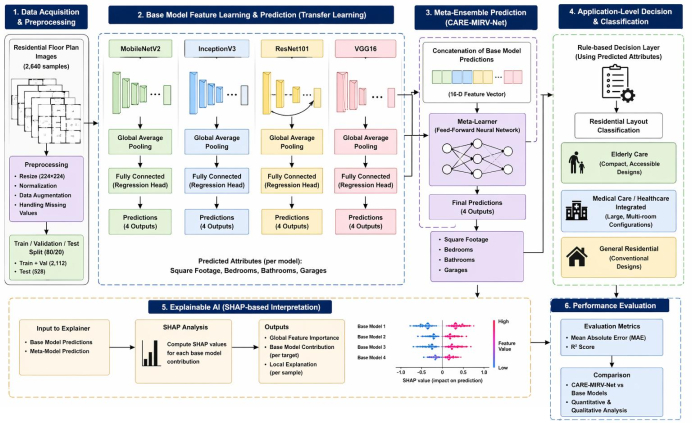
Rycina 1Schemat działania frameworka CARE-MIRV-Net do analizy rzutów kondygnacji budynków mieszkalnych. Schematyczny przegląd proponowanego protokołu. Przepływ pracy obejmuje: (1) pozyskiwanie i wstępne przetwarzanie zbioru danych, (2) uczenie cech i predykcję z wykorzystaniem modeli MobileNetV2, InceptionV3, ResNet101 oraz VGG16, (3) predykcję meta-zespołu opartą na stosowaniu (stacking) z wykorzystaniem CARE-MIRV-Net, (4) klasyfikację układu mieszkań opartą na regułach, (5) analizę interpretowalności opartą na wartościach SHapley Additive exPlanations (SHAP) oraz (6) ocenę wydajności. Aby wyświetlić powiększoną wersję tej ryciny, kliknij tutaj.
W drugim etapie w charakterze learnerów bazowych wykorzystano cztery wstępnie wytrenowane sieci CNN: MobileNetV2, InceptionV3, ResNet101 oraz VGG16. Każdy model został poddany dostrojeniu za pomocą uczenia transferowego w celu przewidywania kluczowych atrybutów architektonicznych, takich jak powierzchnia, liczba sypialni, łazienek i garaży. W przypadku każdego modelu uczenia transferowego dolne warstwy wstępnie wytrenowane pozostały zamrożone, natomiast warstwy górne oraz niestandardowa głowica regresyjna zostały dostrojone podczas procesu uczenia. Szczegółowe konfiguracje dostrojenia dla poszczególnych modeli znajdują się w Supplementary File 1. Modele te wychwytują różne aspekty informacji przestrzennych: MobileNetV2 zapewnia wydajną ekstrakcję cech, InceptionV3 rejestruje wieloskalowe wzorce przestrzenne, ResNet101 uczy się głębokich reprezentacji hierarchicznych, a VGG16 zapewnia stabilne i spójne uczenie cech. Różnorodność tych modeli zwiększa ogólną zdolność reprezentacyjną całego systemu.
W celu dalszego zwiększenia dokładności i odporności predykcji zaproponowano model meta-zespołowy oparty na stosowaniu (stackingu), oznaczony jako CARE-MIRV-Net. Na tym etapie predykcje ze wszystkich modeli bazowych są łączone w celu stworzenia wielowymiarowej przestrzeni cech, która stanowi wejście dla meta-ucznia (meta-learner). Predykcje modeli bazowych są najpierw generowane niezależnie przy użyciu wytrenowanych modeli MobileNetV2, InceptionV3, ResNet101 oraz VGG16. Następnie predykcje te są konkatenowane, tworząc wektor meta-cech wykorzystywany przez meta-ucznia. Aby zapobiec wyciekowi danych, zbiory treningowe i testowe są ściśle rozdzielone, a meta-uczeń jest trenowany wyłącznie na predykcjach wygenerowanych z danych treningowych. Meta-model, będący w pełni połączoną siecią neuronową, jest trenowany w celu wypracowania optymalnej kombinacji wyników modeli bazowych dla uzyskania doprecyzowanych predykcji. Meta-model składa się z dwóch w pełni połączonych warstw z 512 i 256 neuronami z funkcją aktywacji ReLU, po których następują warstwy dropout (0,4 i 0,3) oraz liniowa warstwa wyjściowa. Model jest trenowany przy użyciu optymalizatora Adam (learning rate = 0,001), wielkości partii (batch size) wynoszącej 32 oraz maksymalnie 15 epok. Wdrożono mechanizm wczesnego zatrzymania (early stopping) poprzez monitorowanie straty walidacyjnej (val_loss) z parametrem cierpliwości (patience) wynoszącym 5 epok. Kryterium minimalnej poprawy (min_delta) ustawiono na domyślną wartość TensorFlow wynoszącą 0, a najlepsze wagi modelu były automatycznie przywracane po treningu. Adaptacyjne harmonogramowanie tempa uczenia zostało zaimplementowane za pomocą funkcji zwrotnej (callback) ReduceLROnPlateau, która monitorowała stratę walidacyjną i redukowała tempo uczenia o mnożnik 0,3 po 2 kolejnych epokach bez poprawy. Minimalne tempo uczenia ustawiono na 1 × 10⁻7, a parametr cooldown wykorzystał domyślną wartość TensorFlow wynoszącą 0. Ta metoda zespołowa redukuje błędy systematyczne poszczególnych modeli i poprawia generalizację dzięki komplementarnym zaletom wielu architektur. Szczegółowe informacje dotyczące implementacji znajdują się w Supplementary File 1.
Po przeprowadzeniu predykcji dodawana jest warstwa interpretacyjna, która konwertuje wyniki numeryczne na decyzje na poziomie aplikacji. Układy mieszkań mogą zostać zaklasyfikowane do trzech klas na podstawie przewidywanych cech architektonicznych: opieka nad osobami starszymi, zinterowana opieka zdrowotna (opieka medyczna) oraz ogólne użytkowanie mieszkalne. Klasyfikacja ta jest przeprowadzana z wykorzystaniem zdefiniowanych reguł decyzyjnych opartych na progach, w oparciu o przewidywaną powierzchnię, liczbę sypialni oraz liczbę łazienek. Jako końcową klasyfikację przypisuje się kategorię z najwyższą punktacją, natomiast w przypadku remisów wybierana jest kategoria spełniająca większą liczbę kryteriów decyzyjnych. Pełne reguły punktowania oraz progi klasyfikacji znajdują się w Pliku uzupełniającym 2 (Algorytm 1). Działanie to pozwala systemowi dostarczać praktycznych informacji przydatnych przy projektowaniu budownictwa mieszkaniowego.
Struktura wykorzystuje wyjaśnialną sztuczną inteligencję (explainable AI) z zastosowaniem SHAP w celu zapewnienia przejrzystości i interpretowalności. Komponent ten analizuje wkład predykcji każdego modelu bazowego w wynik modelu meta. Analizę SHAP przeprowadzono przy użyciu SHAP KernelExplainer (SHAP wersja 0.51.0), wykorzystując 10 losowo wybranych próbek treningowych jako zestaw danych tła oraz 50 próbek testowych do generowania wyjaśnień. Pełna konfiguracja SHAP, w tym wybór próbek tła i ustawienia implementacji, znajduje się w Pliku uzupełniającym 1. Warstwa wyjaśnialności pomaga zrozumieć proces podejmowania decyzji poprzez pomiar istotności cech i wyświetlanie wzorców wkładu, co zwiększa przejrzystość i niezawodność modelu. Zaproponowaną strukturę oceniono za pomocą MAE i R2 dla wszystkich zmiennych docelowych. W przypadku predykcji wielowyjściowej MAE obliczono jako średnią różnicę bezwzględną między wartościami rzeczywistymi a przewidywanymi dla wszystkich zmiennych docelowych, natomiast R2 obliczono poprzez porównanie wyjaśnionej wariancji predykcji z odpowiadającymi im wartościami rzeczywistymi dla każdego wyjścia. Analizy ilościowe i jakościowe wskazują, że zaproponowana sieć CARE-MIRV-Net poprawia dokładność predykcji i wspiera klasyfikację układów mieszkań opartą na regułach. Niezawodność klasyfikacji oceniono na podstawie dokładności podstawowych predykcji regresyjnych oraz spójności warstwy decyzyjnej opartej na regułach. Struktura ta stanowi odpowiednie i skalowalne rozwiązanie do inteligentnej analizy planów kondygnacji i może być zastosowana w inteligentnym mieszkalnictwie, planowaniu opieki nad osobami starszymi oraz projektowaniu mieszkań zorientowanym na opiekę zdrowotną. Pełna lista zbiorów danych, pakietów oprogramowania, bibliotek, zasobów sprzętowych i narzędzi obliczeniowych wykorzystanych w tej badaniu znajduje się w Tabeli materiałów. Kod źródłowy, informacje o konfiguracji środowiska, specyfikacje zależności oprogramowania oraz skrypty implementacyjne niezbędne do odtworzenia opisanego przepływu pracy znajdują się w Pliku uzupełniającym 1.
Algorytm protokołu
Zaproponowany schemat przyjmuje wieloetapowe podejście do przetwarzania rzutów mieszkań w formie obrazów oraz generowania wyników na poziomie predykcyjnym i decyzyjnym, zgodnie z przedstawionym w Algorytmie 1 w Pliku uzupełniającym 2. Proces ten rozpoczyna się od preprocessingu danych, w ramach którego obrazy wejściowe są skalowane do standardowej rozdzielczości i normalizowane w celu zapewnienia jednolitości w całym zbiorze danych. Wszystkie obrazy rzutów zostały przeskalowane do rozmiaru 24 × 224 pikseli i znormalizowane do zakresu [0, 1]. Krok ten optymalizuje obrazy pod kątem uczenia przez głębokie sieci neuronowe i poprawia ogólną zbieżność modelu. Druga faza polega na wykorzystaniu kilku modeli DL jako uczniów bazowych, w tym MobileNetV2, InceptionV3, ResNet101 oraz VGG16. Każdy model niezależnie przetwarza obrazy wejściowe i szacuje istotne cechy architektoniczne, takie jak powierzchnia oraz liczba sypialni, łazienek i garaży. Zbiór danych został losowo podzielony na zbiory treningowe i testowe w stosunku 80:20, a w celu zapewnienia powtarzalności zastosowano stałe ziarno losowe. Modele te wychwytują różne właściwości przestrzenne rzutów i dostarczają komplementarne predykcje. Reprezentacja cech jest następnie tworzona poprzez zestawienie wyników każdego modelu bazowego w celu uzyskania pojedynczej reprezentacji cech. Ten wspólny wynik jest następnie przekazywany do modelu meta-zespołowego CARE-MIRV-Net, który jest trenowany, aby łączyć predykcje wszystkich modeli bazowych. Predykcje modeli bazowych były generowane niezależnie i łączone w celu utworzenia wektora meta-cech. Wyciek danych zapobieżono poprzez ścisłą separację zbiorów treningowych i testowych. Meta-model doprecyzowuje te predykcje i generuje końcowe prognozy atrybutów architektonicznych. Meta-model składał się z warstw w pełni połączonych z 512 i 256 neuronami, funkcji aktywacji ReLU, współczynników dropout wynoszących 0,4 i 0,3, optymalizatora Adam (learning rate = 0.01), rozmiaru partii 32 oraz do 15 epok treningowych z zastosowaniem wczesnego zatrzymania (early stopping). Po wykonaniu predykcji warstwa decyzyjna służy do kontekstualizacji wyników. Na podstawie oszacowanych wartości każdy układ mieszkalny jest klasyfikowany jako opieka nad osobami starszymi, opieka medyczna lub ogólne przeznaczenie mieszkalne. Kategorie mieszkalne przypisywano za pomocą zdefiniowanych reguł punktowych opartych na progach, wyprowadzonych z przewidzianych atrybutów rzutów. Jako ostateczną klasyfikację wybrano kategorię z najwyższą liczbą punktów. Pełne progi klasyfikacji i reguły decyzyjne znajdują się w Algorytmie 1 (Plik uzupełniający 2). Na koniec schemat zawiera komponent wyjaśnialności oparty na metodzie SHAP, aby ocenić wpływ każdego modelu bazowego na końcową predykcję. Analizę SHAP przeprowadzono zgodnie z wcześniejszym opisem oraz w Pliku uzupełniającym 1. Komponent ten zwiększa przejrzystość i pomaga w zrozumieniu procesu podejmowania decyzji. Skuteczność i wykonalność proponowanego podejścia oceniono za pomocą standardowych miar wydajności regresji. Wydajność oceniono w ramach jednego przebiegu eksperymentalnego ze stałym ziarnem losowym.
Modele oceny
W tej sekcji przedstawiono modele DL wykorzystane w badaniu, w tym zarówno poszczególne modele bazowe, jak i proponowaną sieć CARE-MIRV-Net. Modele referencyjne wybrano tak, aby reprezentowały różnorodne i powszechnie stosowane architektury DL. MobileNetV2 włączono jako lekką i wydajną obliczeniowo sieć, natomiast InceptionV3 wybrano ze względu na zdolność do wychwytywania wieloskalowych cech przestrzennych. ResNet101 wybrano ze względu na głęboką zdolność uczenia rezydualnego do hierarchicznej ekstrakcji cech, a VGG16 włączono jako uznaną architekturę splotową. Wszystkie modele referencyjne zostały przeszkolone przy użyciu identycznych procedur wstępnego przetwarzania, ustawień augmentacji danych, partycji zbioru danych, parametrów optymalizacji, wielkości partii oraz konfiguracji szkolenia, aby zapewnić rzetelną ocenę porównawczą.
MobileNetV2:
MobileNetV2 to niewielki i kompaktowy system CNN, zaprojektowany tak, aby był szybki, wysokowydajny i charakteryzował się niską złożonością obliczeniową. Wprowadza on kluczowe innowacje, takie jak odwrócone połączenia rezydualne (inverted residual connections) i liniowe wąskie gardła (linear bottlenecks), które umożliwiają efektywną ekstrakcję cech przy zachowaniu wysokiej zdolności reprezentacyjnej. MobileNetV2 może wykorzystywać sploty separowalne głębokościowo (depthwise separable convolutions), aby znacznie zminimalizować całkowitą liczbę parametrów i koszt obliczeniowy tradycyjnych sieci splotowych, dzięki czemu jest on dobrze dostosowany do rozwiązywania złożonych problemów uczenia opartego na obrazach.
MobileNetV2 jest wykorzystywany w sugerowanej strukturze jako jeden z podstawowych modeli DL do przewidywania atrybutów architektonicznych obrazów rzutów mieszkań. Dzięki swojej wydajnej konstrukcji model ten jest w stanie efektywnie uczyć się wzorców przestrzennych, takich jak rozmieszczenie pomieszczeń, gęstość układu oraz organizacja strukturalna występująca na rzutach. Takie wyuczone reprezentacje odgrywają istotną rolę w dokładnym szacowaniu kluczowych cech, takich jak metraż, liczba sypialni, łazienek i garaży. MobileNetV2 jest modelem lekkim, co czyni go odpowiednim kandydatem do włączenia w proponowaną strukturę meta-zespołu. Dostarcza on uzupełniających reprezentacji cech w stosunku do innych modeli DL, co zwiększa ogólną odporność i zdolność generalizacji systemu. Nauka tego modelu jest bardzo ważna w kontekście poprawy dokładności przewidywań oraz pomocy w klasyfikacji projektów mieszkalnych pod kątem opieki zdrowotnej.
Model MobileNetV2 został wytrenowany przy użyciu strategii uczenia transferowego (transfer-learning) z wagami pre-trenowanymi na zbiorze danych ImageNet. Obrazy wejściowe zostały przeskalowane do stałego rozmiaru 24 × 24 × 3, co jest zgodne z architekturą modelu. Obrazy zmieniono do rozmiaru 224 × 24 pikseli, znormalizowano do zakresu [0, 1] i poddano augmentacji poprzez losowe odbicia, rotacje, powiększenia oraz przesunięcia. Podczas treningu zastosowano rozmiar partii (batch size) wynoszący 32. Pierwotna głowica klasyfikacyjna MobileNetV2 została usunięta i zastąpiona głowicą regresyjną. Głowica regresyjna składała się z warstwy Global Average Pooling, po której następowały w pełni połączone warstwy z 512 i 256 neuronami, normalizacja wsadowa (batch normalization), warstwy dropout (0,4 i 0,3) oraz liniowa warstwa wyjściowa z czterema neuronami. Aby ułatwić adaptację domenową, dolne warstwy pre-trenowane zostały zamrożone, natomiast górne warstwy, zaczynając od block_13_expand, oraz niestandardowa głowica regresyjna zostały poddane dostrojeniu (fine-tuning). To selektywne podejście do trenowania pozwala modelowi zachować ogólne cechy wizualne, jednocześnie ucząc się specyficznych dla domeny atrybutów przestrzennych obrazów rzutów kondygnacji. Wyekstrahowane mapy cech są przetwarzane przez warstwę Global Average Pooling oraz w pełni połączone warstwy z 512 i 256 neuronami z zastosowaniem aktywacji ReLU. Aby zwiększyć generalizację i ograniczyć przeuczenie, włączono normalizację wsadową oraz warstwy dropout (0,4 i 0,3). Końcowa warstwa wyjściowa zawiera cztery neurony z liniową aktywacją, odpowiadające przewidywanym atrybutom architektonicznym. Wykorzystano optymalizator Adam z szybkością uczenia 0,01 oraz domyślnymi parametrami TensorFlow/Keras (β₁ = 0,9, β₂ = 0,9, ε = 1 × 10⁻7, amsgrad = False). W przypadku predykcji wielowyjściowej obliczono MAE oraz R2, porównując wartości przewidywane z rzeczywistymi dla każdej zmiennej docelowej, a następnie uśredniając wyniki dla wszystkich wyjść. Zastosowano wczesne zatrzymanie (early stopping) w oparciu o stratę walidacyjną oraz adaptacyjną redukcję szybkości uczenia w celu poprawy zbieżności. Trenowanie przeprowadzono przez maksymalnie 15 epok.
InceptionV3:
InceptionV3 to głęboka architektura CNN, która dzięki zastosowaniu równoległych operacji splotowych jest w stanie wychwytywać cechy w wielu skalach. Opiera się ona na module Inception, który wykorzystuje w tej samej warstwie filtry o różnych rozmiarach, aby jednocześnie ekstrahować cechy drobnoziarniste i gruboziarniste. Taki projekt architektury pozwala sieci uczyć się złożonych hierarchii przestrzennych przy zachowaniu wydajności obliczeniowej. Dodatkowo InceptionV3 wykorzystuje sploty sfaktoryzowane oraz redukcję wymiarowości, co poprawia wydajność i minimalizuje koszty obliczeniowe.
W proponowanym schemacie InceptionV3 jest wykorzystywany jako skuteczny ekstraktor cech do analizy obrazów rzutów mieszkań. Rzuty kondygnacji składają się z różnorodnych wzorców przestrzennych, takich jak wielkości pomieszczeń, plany konstrukcyjne i łączność, co wymaga wieloskalowego uczenia cech. Architektura Inception jest szczególnie odpowiednia do tego zadania ze względu na zdolność do jednoczesnego reprezentowania szczegółów lokalnych (np. małych pomieszczeń) i struktur globalnych (np. organizacji całego układu). W kontekście meta-zespołu InceptionV3 dostarcza reprezentacji uzupełniających względem innych modeli, takich jak MobileNetV2. Różnorodność przewidywań jest zwiększana dzięki zdolności tego modelu do modelowania złożonych relacji przestrzennych, co jest kluczowe dla poprawy wydajności zespołu. Ostatecznie wspomaga to dokładniejsze przewidywanie charakterystyk architektonicznych i wzmacnia późniejszą klasyfikację projektów mieszkań przyjaznych osobom starszym oraz zintegrowanych z opieką zdrowotną.
Model InceptionV3 został wytrenowany przy użyciu podejścia transfer learning z wykorzystaniem wag wstępnie wytrenowanych na zbiorze danych ImageNet. Obrazy wejściowe zostały przeskalowane do rozmiaru 224 × 24 × 3, aby zapewnić kompatybilność z architekturą sieci oraz spójność wszystkich modeli w ramach opracowanego systemu. Obrazy zmieniono do rozmiaru 24 × 24 pikseli, znormalizowano do zakresu [0, 1] i poddano augmentacji poprzez losowe odzwierciedlenia, rotacje, powiększenia oraz przesunięcia. Podczas trenowania zastosowano wielkość partii (batch size) równą 32.
Oryginalne warstwy klasyfikacji modelu InceptionV3 zostały usunięte i wprowadzono niestandardową głowicę regresyjną, aby umożliwić predykcję wielowyjściową. Niestandardowa głowica regresyjna składa się z warstwy Global Average Pooling, po której następują warstwy w pełni połączone z 512 i 256 neuronami, normalizacja wsadowa (batch normalization), warstwy dropout (0,4 i 0,3) oraz liniowa warstwa wyjściowa składająca się z czterech neuronów. Baza splotowa jest częściowo dostrajana (fine-tuned) – dolne, wstępnie wytrenowane warstwy pozostają zamrożone, natomiast górne warstwy wraz z niestandardową głowicą regresyjną są dostrajane w celu nauczenia cech charakterystycznych dla planów kondygnacji, przy jednoczesnym zachowaniu ogólnych reprezentacji wizualnych nabytych podczas wstępnego treningu. Po splotowym rdzeniu warstwa Global Average Pooling przekształca mapy cech w kompaktową reprezentację cech. Następnie zastosowano warstwy w pełni połączone zawierające 512 i 256 neuronów z funkcjami aktywacji ReLU. Aby zminimalizować przeuczenie i poprawić generalizację, zastosowano współczynniki dropout wynoszące 0,4 i 0,3. Końcowa warstwa wyjściowa składa się z czterech neuronów z liniową aktywacją, odpowiadających predykcji powierzchni, liczby sypialni, liczby łazienek oraz liczby garaży. Model jest trenowany przy użyciu optymalizatora Adam z szybkością uczenia 0,001, rozmiarem paczki (batch size) wynoszącym 32 i do 15 epok treningowych z zastosowaniem wczesnego zatrzymania (early stopping) oraz adaptacyjnej redukcji szybkości uczenia w celu zapewnienia stabilnej zbieżności.
ResNet101:
ResNet101 to głęboka struktura sieci CNN, zbudowana w oparciu o zasadę uczenia rezydualnego, która umożliwia trenowanie niezwykle głębokich sieci poprzez rozwiązanie problemu zanikającego gradientu. Wprowadza ona połączenia rezydualne, tzw. połączenia pomijające (skip connections), które pozwalają sieci uczyć się odwzorowań tożsamościowych i zachowywać informacje pomiędzy warstwami. Architektura ta znacznie zwiększa stabilność procesu trenowania i pozwala modelowi uczyć się złożonych cech hierarchicznych. ResNet101 posiada głęboką zdolność reprezentacyjną obejmującą 101 warstw, dzięki czemu jest bardzo skuteczna w zadaniach wymagających zaawansowanych cech przestrzennych.
W proponowanej strukturze ResNet101 zostanie wykorzystany jako wysokowydajny ekstraktor cech, który będzie analizował obrazy rzutów kondygnacji budynków mieszkalnych. Dzięki swojej głębokiej architekturze model ten może być stosowany do reprezentowania złożonych relacji przestrzennych, w tym łączności pomieszczeń, złożoności układu oraz wariacji strukturalnych. Cechy te są kluczowe dla dokonywania precyzyjnych prognoz dotyczących parametrów architektonicznych, takich jak powierzchnia, liczba sypialni, łazienek i garaży. W projekcie meta-zespołu ResNet101 stanowi istotny komponent, dostarczając głębokich i abstrakcyjnych reprezentacji cech. ResNet101 kładzie większy nacisk na szczegółowe cechy strukturalne, dzięki czemu wykazuje większą różnorodność wśród modeli bazowych w porównaniu do lekkich modeli, takich jak MobileNetV2. Ta heterogeniczność odgrywa kluczową rolę w zwiększaniu wydajności zespołu i zapewnianiu stabilnych prognoz, szczególnie w przypadku klasyfikacji budynków mieszkalnych o charakterze opiekuńczym.
Model ResNet101 został przeszkolony z wykorzystaniem podejścia transfer learning z wagami wstępnie wytrenowanymi na zbiorze danych ImageNet. Obrazy wejściowe zostały przeskalowane do rozmiaru 24 × 24 × 3, co zapewnia kompatybilność architektoniczną i spójność wszystkich modeli w ramach struktury. Obrazy zmieniono na wymiary 24 × 224 piksele, znormalizowano do zakresu [0, 1] oraz poddano augmentacji poprzez losowe odbicia lustrzane, obroty, zoomowanie i przesunięcia. Podczas trenowania zastosowano rozmiar partii (batch size) wynoszący 32. Oryginalna głowica klasyfikacyjna modelu ResNet101 została usunięta (include_top=False), a w jej miejsce wprowadzono niestandardową głowicę regresyjną umożliwiającą predykcję wielowyjściową. Głowica regresyjna składała się z warstwy Global Average Pooling, po której następowały w pełni połączone warstwy z 512 i 256 neuronami, normalizacja wsadowa (batch normalization), warstwy dropout (0.4 i 0.3) oraz liniowa warstwa wyjściowa składająca się z czterech neuronów. Aby zrównoważyć ponowne wykorzystanie cech i adaptację do domeny, dolne warstwy wstępnie wytrenowane zostały zamrożone, natomiast głębsze warstwy, począwszy od conv4_block1_1_conv, oraz niestandardowa głowica regresyjna zostały dostrojone (fine-tuned). Ta selektywna strategia trenowania pozwala modelowi zachować ogólne cechy wizualne, adaptując jednocześnie reprezentacje wyższego poziomu do obrazów planów kondygnacji. Wynik z bazy konwolucyjnej jest przekazywany przez warstwę Global Average Pooling w celu wygenerowania kompaktowej reprezentacji cech. Następnie zastosowano w pełni połączone warstwy z 512 i 256 neuronami z funkcjami aktywacji ReLU. W celu stabilizacji uczenia zastosowano normalizację wsadową, a warstwy dropout z parametrami 0.4 i 0.3 włączono, aby zredukować overfitting i poprawić generalizację. Końcowa warstwa wyjściowa zawiera cztery neurony z liniową aktywacją, odpowiadające powierzchni w stopach kwadratowych, liczbie sypialni, łazienek oraz garaży. Zgodnie z konfiguracją trenowania, zastosowano optymalizator Adam z szybkością uczenia (learning rate) wynoszącą 0.01. Augmentacja danych obejmowała losowe odbicia lustrzane, obroty, zoomowanie i przesunięcia w celu poprawy generalizacji modelu. Trenowanie przeprowadzono maksymalnie przez 15 epok z zastosowaniem wczesnego zatrzymania (early stopping) na podstawie straty walidacyjnej oraz adaptacyjnej redukcji szybkości uczenia.
VGG16:
VGG16 to prosta architektura sieci neuronowej typu głębokiej splotowej, która jest efektywna i prosta w zadaniach rozpoznawania obrazów. Składa się ona z 16 warstw o regularnej i homogenicznej budowie, wykorzystujących małe filtry splotowe 3 × 3, co ułatwia sieci naukę hierarchicznych reprezentacji cech. Architektura ta jest zorientowana na głębokość i cechuje się prostotą, co oznacza, że jest zdolna do wychwytywania zarówno szczegółów niskiego poziomu, takich jak krawędzie i tekstury, jak i struktur semantycznych wysokiego poziomu. Dzięki regularnej budowie i wysokiej wydajności VGG16 jest obecnie popularnym wyborem jako sieć bazowa (backbone) podczas stosowania uczenia transferowego w zadaniach związanych z obrazami.
W sugerowanym modelu VGG16 jest wykorzystywany jako bazowy model DL do wyodrębniania cech przestrzennych z obrazów rzutów mieszkań. Jego uporządkowana struktura sprawia, że jest on bardzo użyteczny w przechwytywaniu drobniejszych szczegółów wzorców układu, takich jak granice pomieszczeń, wyrównania strukturalne i organizacja przestrzenna. Cechy te są kluczowe dla efektywnego prognozowania parametrów architektonicznych, takich jak powierzchnia w stopach kwadratowych, liczba sypialni, łazienek i garaży. W systemie meta-zespołowym VGG16 zapewnia stabilne i dobrze uogólnione reprezentacje cech. VGG16 oferuje bardziej zrównoważone podejście do ekstrakcji cech w porównaniu z głębszymi architekturami, takimi jak ResNet101, oraz architekturami wieloskalowymi, takimi jak InceptionV3, co zwiększa różnorodność bazowych uczniów. Ta heterogeniczność jest kluczowa dla poprawy wydajności zespołu oraz wiarygodności prognoz w klasyfikacji mieszkań zorientowanej na opiekę zdrowotną.
Model VGG16 został wytrenowany przy użyciu podejścia transfer learning z wagami pretrained z zestawu danych ImageNet. Obrazy wejściowe zostały przeskalowane do wymiarów 24 × 24 × 3, aby zapewnić kompatybilność z architekturą oraz spójność wszystkich modeli w ramach frameworka. Obrazy zmieniono na rozmiar 24 × 224 pikseli, znormalizowano do zakresu [0, 1] i poddano augmentacji poprzez losowe odwracanie, rotację, powiększanie oraz przesuwanie. Podczas trenowania zastosowano wielkość batcha wynoszącą 32. Oryginalne warstwy klasyfikacyjne zostały usunięte (include_top=False), a w ich miejsce dodano niestandardową głowicę regresyjną w celu dostosowania modelu do predykcji wielowyjściowej. Głowica regresyjna składała się z warstwy Global Average Pooling, po której następowały w pełni połączone warstwy z 512 i 256 neuronami, batch normalization, warstwy dropout (0,4 i 0,3) oraz liniowa warstwa wyjściowa z czterema neuronami. Niższe warstwy pretrained zostały zamrożone, natomiast warstwy począwszy od block4_conv1 oraz niestandardowa głowica regresyjna zostały poddane dostrojeniu (fine-tuning). Strategia ta pozwala modelowi zachować ogólne cechy wizualne przy jednoczesnym uczeniu się reprezentacji specyficznych dla domeny analizy planów pięter. Cechy wyjściowe bazy konwolucyjnej są przekazywane przez warstwę Global Average Pooling w celu wygenerowania kompaktowego wektora cech. Następnie następują w pełni połączone warstwy z 512 i 256 neuronami z funkcjami aktywacji ReLU. Wprowadzono batch normalization oraz warstwy dropout z współczynnikami 0,4 i 0,3, aby ustabilizować trenowanie, zredukować overfitting i poprawić generalizację. Końcowa warstwa wyjściowa zawiera cztery neurony z liniową aktywacją odpowiadającą predykcjom powierzchni w stopach kwadratowych, liczby sypialni, łazienek i garaży. Użyto optymalizatora Adam z tempem uczenia 0,01, zgodnie z opisem w konfiguracji trenowania. Augmentacja danych obejmowała losowe odwracanie, rotację, powiększanie i przesuwanie w celu poprawy generalizacji modelu. Trenowanie przeprowadzono przez maksymalnie 15 epok z zastosowaniem wczesnego zatrzymania (early stopping) na podstawie straty walidacyjnej oraz adaptacyjnej redukcji tempa uczenia.
CARE-MIRV-Net (Proponowany Meta-Zespół Modelu DL):
Sugerowana sieć CARE-MIRV-Net (Context-Aware Residential Ensemble utilising MobileNetV2, InceptionV3, ResNet101, and VGG16 Network) jest opartym na stosowaniu (stacking) meta-zespołowym frameworkiem DL, którego celem jest poprawa szacowania cech architektonicznych na podstawie zdjęć rzutów mieszkań. Architektura ta łączy różne heterogeniczne sieci CNN, wykorzystując ich synergetyczne zalety w ekstrakcji cech. Zaproponowany model opiera się na kombinacji lekkiej, głębokiej i wieloskalowej architektury, co zwiększa wydajność predykcyjną i zapewnia odporność w szerokim zakresie układów mieszkalnych. W przeciwieństwie do tradycyjnych technik opartych na pojedynczym modelu, CARE-MIRV-Net stosuje hierarchiczne podejście do uczenia, w którym modele bazowe dostarczają wstępnych predykcji, które są następnie ulepszane przez meta-uczeń.
W przypadku projektowania budownictwa mieszkaniowego z uwzględnieniem aspektów przestrzennych i zdrowotnych, kluczowe znaczenie ma prawidłowa interpretacja układów rzutów kondygnacji. Pojedyncze modele DL wykazują tendencję do niewystarczającej generalizacji różnych wzorców architektonicznych. Proponowane rozwiązanie pozwoli przezwyciężyć ten problem poprzez zastosowanie czterech różnych architektur: MobileNetV2, InceptionV3, ResNet101 oraz VGG16, z których każda oferuje odmienne możliwości reprezentacyjne. MobileNetV2 pozwala na wydajną ekstrakcję cech i charakteryzuje się lekkością; InceptionV3 uczy się wzorców przestrzennych w wielu skalach; ResNet101 uczy się głębokich reprezentacji hierarchicznych; natomiast VGG16 uczy się cech w sposób spójny i niezawodny. Połączenie tych modeli umożliwia systemowi uwzględnienie zarówno lokalnych, jak i globalnych atrybutów przestrzennych, co zwiększa dokładność i wiarygodność przewidywanych cech, takich jak powierzchnia, liczba sypialni, łazienek i garaży. Powyższe predykcje mogą być również wykorzystane do dalszej klasyfikacji układów mieszkalnych, w tym na budownictwo przyjazne osobom starszym, zintegrowane z opieką zdrowotną oraz ogólne budownictwo mieszkalne.
CARE-MIRV-Net został zaimplementowany przy użyciu dwuetapowej strategii zespołowej opartej na stosowaniu (stacking). W pierwszym etapie cztery modele bazowe niezależnie generują prognozy dla zmiennych docelowych. Dane wejściowe dla meta-ucznia (meta-learner) zostały utworzone poprzez konkatenację wyników predykcji wygenerowanych przez wytrenowane modele bazowe na danych treningowych. Te skonkatenowane predykcje utworzyły 16-wymiarowe wektory meta-cech wykorzystane do trenowania meta-modelu. Wyciek informacji zapobieżono poprzez ścisłą separację zbiorów treningowych i testowych; żadne próbki testowe nie były używane podczas trenowania modeli bazowych ani meta-modelu. W procesie stosowania wykorzystano te same zbiory treningowe i walidacyjne, które posłużyły do trenowania modeli bazowych. Podczas trenowania i wnioskowania 16-wymiarowy wektor meta-cech był konstruowany poprzez konkatenację czterech wyników predykcji wygenerowanych przez MobileNetV2, InceptionV3, ResNet101 oraz VGG16. Ponieważ każdy model generuje czterowymiarowy wektor wyjściowy, reprezentacja skonkatenowana tworzy 16-wymiarowe wejście dla meta-ucznia. Transformacja ta łączy predykcje ze wszystkich modeli bazowych i służy jako wejście do drugiego etapu struktury. Drugi etap polega na zbudowaniu meta-ucznia w postaci w pełni połączonej sieci neuronowej, aby nauczyć się optymalnej kombinacji predykcji modeli bazowych. Meta-uczeń składał się z warstw w pełni połączonych z 512 i 256 neuronami, aktywacją ReLU, normalizacją wsadową (batch normalization), współczynnikami dropout wynoszącymi 0,4 i 0,3 oraz liniową warstwą wyjściową z czterema neuronami. Warstwy dropout o współczynnikach 0,4 i 0,3 zastosowano po warstwach gęstych, aby zredukować przeuczenie i poprawić generalizację. Meta-model został wytrenowany przy użyciu optymalizatora Adam z szybkością uczenia 0,01, rozmiarem wsady 32 i maksymalnie 15 epokami z zastosowaniem wczesnego zatrzymania (early stopping) oraz adaptywnej redukcji szybkości uczenia. Dane walidacyjne posłużyły do monitorowania wydajności modelu podczas trenowania i wyboru modelu o najlepszych parametrach. Po treningu meta-model zespołowy generował końcowe predykcje poprzez łączenie wyników od wszystkich uczniów bazowych. Do oceny wydajności CARE-MIRV-Net wykorzystano MAE oraz R2 . W przypadku predykcji wielowyjściowej wartości MAE i R2 obliczano poprzez porównanie wartości przewidywanych i rzeczywistych dla każdej zmiennej docelowej, a następnie uśrednienie wyników dla wszystkich wyjść. Wyniki uzyskano z pojedynczego uruchomienia eksperymentalnego przy użyciu stałego ziarna losowego (random seed). Zaproponowana struktura poprawia zdolność predykcyjną poprzez łączenie kilku struktur DL za pomocą mechanizmu stosowania i zapewnia interpretowalną analizę planów kondygnacji mieszkań. Dzięki temu CARE-MIRV-Net jest możliwy do zastosowania w kontekście projektowania mieszkań zorientowanych na opiekę zdrowotną i potrzeby osób starszych. Kod źródłowy, informacje o konfiguracji środowiska, specyfikacje zależności oprogramowania oraz dokumentacja implementacyjna znajdują się w Supplementary File 1.
Ocena wydajności
Przeprowadzono analizę wydajności proponowanego modelu w celu określenia jego mocy predykcyjnej, odporności oraz zdolności do generalizacji w odniesieniu do różnych charakterystyk architektonicznych. W celu potwierdzenia użyteczności proponowanego modelu wykonano analizy ilościowe i jakościowe. Procedura oceny obejmuje zarówno standardowe miary regresji, jak i kontrolowane środowiska eksperymentalne, aby umożliwić rzetelne porównanie z modelami bazowymi. Eksperymenty przeprowadzono w ramach pojedynczego uruchomienia z ustalonym ziarnem losowym (random seed), aby zapewnić powtarzalność i spójność we wszystkich modelach referencyjnych oraz proponowanych.
Parametry wydajności:
Do oceny wydajności proponowanego modelu wykorzystano dwa znane miary regresji: MAE oraz R2. MAE mierzy średnią wielkość błędów predykcji i daje jasną informację o bliskości wartości przewidywanych i rzeczywistych. Z kolei wartość R2 służy do oceny proporcji wariancji zmiennych objaśnianych przez model, co odzwierciedla jego ogólną moc predykcyjną. Połączenie tych metryk umożliwia kompleksową ocenę dokładności i zdolności generalizacji dla wszystkich przewidywanych cech architektonicznych. W przypadku predykcji wielowyjściowej wartości MAE i R2 obliczono poprzez porównanie wartości przewidywanych i rzeczywistych dla każdej zmiennej objaśnianej, a następnie wyciągnięto średnią z wyników dla wszystkich wyjść.
Układ doświadczalny:
Eksperymenty przeprowadzono w środowisku obliczeń w chmurze z wykorzystaniem języka Python (wersja 3.12.12). Zaproponowany protokół zaimplementowano przy użyciu bibliotek TensorFlow (wersja 2.19.0), Keras (wersja 3.13.2), NumPy (wersja 2.4.6), Pandas (wersja 2.3.3), Scikit-learn (wersja 1.6.1), Matplotlib (wersja 3.9) oraz SHAP (wersja 0.51.0). Środowisko obliczeniowe wykorzystywało procesor Intel Xeon pracujący z częstotliwością 2.20 GHz z około 31 GB pamięci systemowej. Eksperymenty przeprowadzono w systemie operacyjnym Ubuntu 2.04 LTS z wykorzystaniem dwóch procesorów GPU NVIDIA Tesla T4. Zestaw danych zawiera 2640 obrazów planów pięter mieszkalnych, które zostały poddane wstępnej obróbce i podzielone na zbiory treningowe i testowe. Dane podzielono w stosunku 80:20, co dało 212 próbek treningowych i 528 próbek testowych. MobileNetV2, InceptionV3, ResNet101 oraz VGG16 to cztery modele DL, które zostały przeszkolone przy użyciu podejścia fine-tuning z wykorzystaniem uczenia transferowego (transfer learning). Następnie skonstruowano model meta-zespołowy oparty na stosowaniu (stacking), CARE-MIRV-Net, aby połączyć predykcje z tych modeli bazowych. Każdy model był trenowany w jednolitych warunkach, obejmujących zmianę rozmiaru obrazów do 224 × 24 pikseli, augmentację danych oraz wczesne zatrzymanie (early stopping) w celu ograniczenia przeuczenia. Augmentacja danych obejmowała losowe odwracanie, rotację, zoomowanie i przesuwanie. Zastosowano rozmiar partii (batch size) wynoszący 32 oraz maksymalnie 15 epok treningowych, z wczesnym zatrzymaniem opartym na stracie walidacyjnej i adaptacyjną redukcją tempa uczenia. Końcową analizę przeprowadzono na ukrytym zbiorze testowym, aby zapewnić obiektywną i wiarygodną ocenę wydajności. Ukryty zbiór testowy został utworzony podczas początkowego podziału danych i pozostawał całkowicie odizolowany podczas trenowania i rozwoju modeli, aby zapewnić bezstronną ewaluację wyników.
Opis zbioru danych:
Zestaw danych wykorzystany do wsparcia wyników niniejszego badania jest publicznie dostępny na platformie Kaggle pod tytułem “Floor Plan Images and Their Details”28. Zestaw danych jest dostępny pod adresem: https://www.kaggle.com/datasets/adilmohammed/floor-plan-images-and-their-details (dostęp w dniu 16 kwietnia 2026 r.). Dane składają się z 2640 obrazów rzutów mieszkań oraz uporządkowanych metadanych architektonicznych. Każda próbka stanowi odrębny plan domu, co zapewnia szeroki zakres układów mieszkalnych o różnych rozmiarach, konfiguracjach i rozmieszczeniu przestrzennym. Rozmiar zestawu danych jest wystarczający do trenowania modeli opartych na DL i zawiera różnorodne wzorce architektoniczne. Zestaw danych składa się z dwuwymiarowego obrazu rzutu kondygnacji oraz powiązanych atrybutów liczbowych opisujących charakterystykę konstrukcyjną lokalu. Cechy te obejmują całkowity metraż, liczbę sypialni, liczbę łazienek oraz liczbę garaży. Ponadto każdy rekord zawiera ścieżkę do obrazu, co umożliwia bezpośrednie mapowanie danych wejściowych obrazów na etykiety. Zmienne zestawu danych obejmują obraz rzutu, ścieżkę obrazu, metraż, liczbę sypialni, liczbę łazienek oraz liczbę garaży. Obraz rzutu służy jako cecha wejściowa, natomiast atrybuty architektoniczne są wykorzystywane jako cele predykcji. Zestaw danych jest zatem odpowiedni do uczenia nadzorowanego, gdzie obrazy służą jako cechy wejściowe, a atrybuty architektoniczne jako cele regresji.
Zestaw danych zawiera szeroki wachlarz układów mieszkalnych, od kompaktowych planów z mniejszą liczbą pomieszczeń po duże układy wielopokojowe. Taka zmienność umożliwia wyuczenie znaczących reprezentacji przestrzennych, w tym rozkładu pomieszczeń, gęstości układu oraz złożoności strukturalnej. Różnorodność ta jest szczególnie istotna dla proponowanego modelu, ponieważ wspiera kategoryzację rzutów kondygnacji na układy przyjazne osobom starszym, zintegrowane z opieką zdrowotną oraz ogólne układy mieszkalne. Przed trenowaniem modelu zestaw danych jest poddawany sekwencji procedur wstępnego przetwarzania w celu zapewnienia spójności i kompatybilności z modelami DL. Wszystkie obrazy zostały przeskalowane do rozmiaru 24 × 24 pikseli i znormalizowane do zakresu [0, 1] przed rozpoczęciem uczenia. Następnie zbiór danych jest organizowany poprzez dopasowanie ścieżek obrazów do odpowiadających im metadanych, po czym zostaje on podzielony na podzbiory treningowe i testowe, aby ułatwić analizę wydajności. Zestaw danych został losowo podzielony na zbiór treningowy i testowy w stosunku 80:20. W analizie uwzględniono rekordy zawierające kompletne informacje o obrazach i metadanych, natomiast rekordy niekompletne lub nieprawidłowe zostały wykluczone. Podczas partycjonowania zestawu danych zastosowano stałe ziarno losowości (random seed) w celu zapewnienia reprodukowalności. Zbiór danych stanowi szczegółową podstawę do analizy rzutów kondygnacji mieszkalnych napędzanej przez AI. Połączenie 2 640 adnotowanych obrazów i różnorodnych atrybutów architektonicznych wspiera modelowanie regresji wielowyjściowej i umożliwia integrację inteligencji przestrzennej z procesem podejmowania decyzji projektowych w budownictwie mieszkalnym zorientowanym na opiekę zdrowotną.
Dostęp ograniczony. Zaloguj się lub rozpocznij wersję próbną, aby wyświetlić tę treść.
Wyniki
Przeprowadzono zestaw eksperymentów w celu oceny proponowanego schematu z wykorzystaniem czterech modeli DL: MobileNetV2, InceptionV3, ResNet101 i VGG16, wraz z proponowanym modelem meta-zespołowym CARE-MIRV-Net.
Wyniki pozyskiwania i wstępnego przetwarzania zbioru danych
Etap przetwarzania wstępnego został zaprojektowany w celu przygotowania surowych obrazów rzutów mieszkań oraz powiązanych metadanych do uczenia i ewaluacji z wykorzystaniem modeli ...
Dostęp ograniczony. Zaloguj się lub rozpocznij wersję próbną, aby wyświetlić tę treść.
Dyskusja
To studium przedstawia CARE-MIRV-Net, meta-ensemble'ową strukturę DL opartą na stackowaniu do automatycznej analizy obrazów planów mieszkań. Struktura integruje cztery uzupełniające się się architektury CNN—MobileNetV2, InceptionV3, ResNet101 i VGG16—aby przewidywać kluczowe atrybuty architektoniczne, w tym powierzchnię, liczbę sypialni, łazienek i garażów. Te przewidywania są następnie łączone przez meta-uczące się i używane w warstwie decyzyjnej opartej na zasadach do klasyfikacji układów mieszkaniowych jako dotyczącyc...
Dostęp ograniczony. Zaloguj się lub rozpocznij wersję próbną, aby wyświetlić tę treść.
Oświadczenia
Konflikt interesów:
Autorzy deklarują brak konfliktów interesów.
Wkład autorów:
Ning Zhang zaproponował pomysły badawcze, zaprojektował plany eksperymentów i koordynował proces badań. Yu Bi przeprowadził eksperymenty, zebrał dane, uczestniczył w analizie danych oraz poprawkach do artykułu.
Podziękowania
Autorzy z całą szczerością dziękują za wsparcie finansowe udzielone przez Naukowego Projektu Badawczego Departamentu Edukacji Prowincji Jilin.
FUNDING:
Badania te były finansowane przez Naukowego Projekt Badawczy Departamentu Edukacji Prowincji Jilin (Numer grantu JJKH20240801KJ).
Dostęp ograniczony. Zaloguj się lub rozpocznij wersję próbną, aby wyświetlić tę treść.
Materiały
| Nazwa | Firma | Numer katalogowy | Komentarze |
|---|---|---|---|
| CARE-MIRV-Net implementation package | Supplementary File 1 | Version 1.0 | N/A |
| Figure and table regeneration scripts | Supplementary File 1 | Version 1.0 | N/A |
| Floor Plan Images and Their Details Dataset | Kaggle | Public Dataset | N/A |
| GPU | NVIDIA Corporation | Tesla T4 × 2 | N/A |
| Intel Xeon Processor | Intel Corporation | 2.20 GHz | N/A |
| Keras | Keras Team | Version 3.13.2 | N/A |
| Matplotlib | Matplotlib Development Team | Version 3.9 | RRID:SCR_008624 |
| NumPy | NumPy Developers | Version 2.4.6 | RRID:SCR_008633 |
| Operating System | Linux | Ubuntu 22.04 LTS | N/A |
| Pandas | Pandas Development Team | Version 2.3.3 | RRID:SCR_018214 |
| Python | Python Software Foundation | Version 3.12.12 | RRID:SCR_008394 |
| Scikit-learn | Scikit-learn Developers | Version 1.6.1 | RRID:SCR_002577 |
| SHAP | SHAP Development Team | Version 0.51.0 | N/A |
| System Memory (RAM) | Cloud Computing Environment | 31 GB | N/A |
| TensorFlow | Version 2.19.0 | RRID:SCR_016345 | |
| Training environment configuration file | Supplementary File 1 | Version 1.0 | N/A |
Bibliografia
- Apanavičienė R, Shahrabani MMN. Key factors affecting smart building integration into smart city: technological aspects. Smart Cities. 2023;6(4):1832-1857.
- Li J, et al. The relationship between artificial intelligence (AI) and building information modeling (BIM) technologies for sustainable building in the context of smart cities. Sustainability. 2024;16(24):10848.
- Khade R, Jariwala K, Chattopadhyay C. A comprehensive survey of floor plan image analysis and related applications. Int J Doc Anal Recognit. 2026;29(1):41-59.
- Okuyucu EB, Kösenciğ KÖ. AI-assisted floor plan design incorporating structural constraints. Nexus Netw J. 2025;27(4):947-963.
- Kim H. Evaluation of deep learning-based automatic floor plan analysis technology: an AHP-based assessment. Appl Sci. 2021;11(11):4727.
- Goyal S, Chattopadhyay C, Bhatnagar G. A computational approach to understand building floor plan images using machine learning techniques. In: Internet of Multimedia Things. Elsevier; 2022. p. 233-259.
- Li Y, Chen H, Yu P, Yang L. A review of artificial intelligence in enhancing architectural design efficiency. Appl Sci. 2025;15(3):1476.
- Yıldız B, Çağdaş G, Zincir I. Architectural space classification considering topological and 3D visual spatial relations using machine learning techniques. Build Res Inf. 2024;52(1-2):68-86.
- Albukhari IN. The role of artificial intelligence (AI) in architectural design: a systematic review of emerging technologies and applications. J Umm Al-Qura Univ Eng Archit. 2025;16(4):1457-1476.
- Kumar H, KS KM, SAS AR, VC J. Explainability to image captioning models: an improved post-hoc approach through Grad-CAM. In: 2025 International Conference on Innovation in Computing and Engineering (ICE); 2025. p. 1-6. Available from: https://doi.org/10.1109/ICE63309.2025.10984143
- Alshammeri M, Ahmad Z, Humayun M, Alamri M. Explainable cluster-based predictive framework for early diagnosis of autism spectrum disorder using behavioral biomarkers. Diagnostics. 2025;15(24):3241.
- Zhao T, Zhao Y, Zhou T. Stacking ensemble learning for seabed sediment classification. In: 2024 7th International Conference on Information Communication and Signal Processing (ICICSP); 2024. p. 211-215. Available from: https://doi.org/10.1109/ICICSP62589.2024.10809036
- Bazie IG, et al. Leveraging machine learning techniques in converting 2D floorplans images to 3D models: applications, challenges, and future directions. Procedia Comput Sci. 2025;272:234-241.
- Luo G, et al. Controllable and flexible residential floor plan layout design based on multi-agent deep reinforcement learning with layout prior size and similar experience abandon. Adv Eng Inform. 2025;68:103702.
- Ling H, Luo G, Zhou N, Jiang X. Survey of architectural floor plan retrieval technology based on 3ST features. AI. 2025;6(4):67.
- Memon SA, Shehata W, Rowlinson S, Sunindijo RY. Generative artificial intelligence in architecture, engineering, construction, and operations: a systematic review. Buildings. 2025;15(13):2270.
- Yang C, et al. How can SHAP (SHapley Additive exPlanations) interpretations improve deep learning-based urban cellular automata model? Comput Environ Urban Syst. 2024;111:102133.
- Mienye ID, Swart TG. A comprehensive review of deep learning: architectures, recent advances, and applications. Information. 2024;15(12):755.
- van Engelenburg C, et al. MSD: a benchmark dataset for floor plan generation of building complexes. In: Vedaldi A, Bischof H, Brox T, Frahm JM, editors. Computer Vision – ECCV 2024. Lecture Notes in Computer Science. Cham: Springer Nature Switzerland; 2025. p. 60-75.
- Ganaie MA, et al. Ensemble deep learning: a review. Eng Appl Artif Intell. 2022;115:105151.
- Zhou W, et al. HIDIM: a novel framework of network intrusion detection for hierarchical dependency and class imbalance. Comput Secur. 2025;148:104155.
- Carrera L, et al. The impact of architecturally qualified data in deep learning methods for the automatic generation of social housing layouts. Autom Constr. 2024;158:105238.
- Yang B, et al. Automated semantics and topology representation of residential-building space using floor-plan raster maps. IEEE J Sel Top Appl Earth Obs Remote Sens. 2022;15:7809-7825.
- Rathnayake N, Rathnayake U, Dang TL, Hoshino Y. An efficient automatic Fruit-360 image identification and recognition using a novel modified cascaded-ANFIS algorithm. Sensors. 2022;22(12):4401.
- Alsulami AA, et al. Security strategy for autonomous vehicle cyber-physical systems using transfer learning. J Cloud Comput. 2023;12(1):181.
- Alshammari A. Construction of VGG16 convolution neural network (VGG16_CNN) classifier with NestNet-based segmentation paradigm for brain metastasis classification. Sensors. 2022;22(20):8076.
- Mascarenhas S, Agarwal M. A comparison between VGG16, VGG19 and ResNet50 architecture frameworks for image classification. In: 2021 International Conference on Disruptive Technologies for Multi-Disciplinary Research and Applications (CENTCON); 2021. p. 96-99. Available from: https://doi.org/10.1109/CENTCON52345.2021.9687944
- Kaggle. Floor Plan Images and Their Details [Internet]. Available from: https://www.kaggle.com/datasets/adilmohammed/floor-plan-images-and-their-details. Accessed 2026 Apr 16.
Dostęp ograniczony. Zaloguj się lub rozpocznij wersję próbną, aby wyświetlić tę treść.
Przedruki i uprawnienia
Ten artykuł został opublikowany
Film wkrótce dostępny