This protocol provides a reproducible survey and partial least squares structural equation modeling workflow for assessing association pathways among online learning experience, basic psychological needs, and learning engagement in university students, including questionnaire adaptation, screening, measurement assessment, indirect-association testing, robustness checks, and reproducibility records.
Subskrypcja JoVE jest wymagana do oglądania tego materiału. Zaloguj się lub rozpocznij bezpłatny okres próbny.
Artykuł metodologiczny
A Survey and Protocol for Assessing Online Learning Experience, Basic Psychological Needs, and Learning Engagement in University Students
W tym artykule
Podsumowanie
Streszczenie
Online learning is embedded in higher education, but evaluations often rely on access, satisfaction, or completion indicators that do not identify where engagement problems arise. This article presents a reproducible English-language survey and partial least squares structural equation modeling protocol for assessing association pathways among online learning experience, basic psychological needs, and learning engagement in university students. Online learning experience is measured through platform usability, instructional support, interaction quality, and learning flexibility; basic psychological needs through autonomy, competence, and relatedness; and learning engagement through behavioral, cognitive, and emotional engagement. The workflow specifies item-source mapping, questionnaire adaptation, expert review, pilot testing, electronic consent, eligibility screening, response-quality checks, construct scoring, common method bias diagnostics, higher-order construct estimation, measurement-model assessment, structural pathway testing, indirect-association analysis, psychological-need sensitivity analysis, regression-based robustness checks, and reproducibility file locking. Representative results from 386 valid responses demonstrate acceptable reliability, moderate construct correlations, retained measurement quality, a supported indirect association through basic psychological needs, nonsignificant control paths, and uneven dimensional scores. The protocol supports transparent diagnosis of how online learning experience is associated with psychological need satisfaction and engagement while avoiding causal interpretation from cross-sectional survey data.
Wprowadzenie
Online learning has become part of routine higher education through learning management systems, video platforms, recorded materials, synchronous sessions, and blended course designs. However, many evaluations still rely on access logs, satisfaction ratings, or completion indicators, which show whether students used an online course but do not clarify whether lower engagement is associated with platform usability, instructional support, interaction quality, learning flexibility, psychological need satisfaction, or a specific engagement dimension1. Online learning experience should therefore not be reduced to a single satisfaction score. Prior online engagement research emphasizes learner-content, learner-instructor, and learner-learner interaction as important elements of students’ online learning experience2. The present protocol measures online learning experience through platform usability, instructional support, interaction quality, and learning flexibility.
Learning engagement is also multidimensional. It includes behavioral participation, cognitive investment, and emotional involvement. Online-course engagement instruments show that engagement cannot be fully represented by visible participation or task completion alone3. Broader educational technology research also shows that behavioral engagement is often easier to observe than cognitive or affective engagement4. For this reason, the protocol measures learning engagement through behavioral, cognitive, and emotional engagement rather than collapsing engagement into one undifferentiated score.
Self-determination theory provides the theoretical basis for linking online learning experience with learning engagement. Basic psychological need theory identifies autonomy, competence, and relatedness as central conditions for motivation and adjustment5. In online learning, autonomy refers to perceived choice and control, competence to perceived capability in completing learning tasks, and relatedness to felt connection with instructors and classmates. Prior online learning studies using self-determination theory have linked contextual support, need satisfaction, motivation, and engagement6,7. These findings support examining basic psychological needs as an indirect-association construct between online learning experience and learning engagement, while avoiding causal interpretation because the data are cross-sectional.
A methodological problem in online engagement research is the lack of consistent operational structure. Studies vary in how they define learning conditions, measure engagement, and connect the learning environment to students’ psychological experience8. Self-report surveys are also vulnerable to careless responding, patterned answers, post hoc exclusions, missing-data decisions, and common method bias9. Therefore, this protocol fixes the English-language questionnaire structure, item-source mapping, scoring rules, electronic consent procedure, eligibility screening, attention-check rule, completion-time threshold, straight-lining criterion, long-string response check, missing-data handling, model specification, and dataset-locking procedure before structural analysis begins.
The conceptual framework specifies online learning experience as the independent construct, basic psychological needs as the indirect-association construct, and learning engagement as the outcome construct. The primary pathway tests whether online learning experience is associated with basic psychological needs, whether basic psychological needs are associated with learning engagement, and whether online learning experience remains directly associated with learning engagement after accounting for basic psychological needs. The protocol is guided by four research questions: whether the structured survey protocol can measure the three constructs with acceptable response quality and construct reliability; whether online learning experience is positively associated with basic psychological needs and learning engagement; whether the association between online learning experience and learning engagement is partly carried through basic psychological needs as an indirect association; and whether psychological-need subdimension analyses and regression-based robustness checks support the same interpretation as the primary PLS-SEM workflow.
This article is positioned as a method-focused contribution rather than a conventional explanatory cross-sectional study. The protocol provides a reproducible workflow for questionnaire adaptation, expert review, pilot testing, survey administration, response screening, construct scoring, measurement-model assessment, structural pathway testing, indirect-association analysis, sensitivity analysis, robustness checking, and reproducibility file locking. Transparent educational research workflows require analytic decisions to be documented before final model interpretation10. Partial least squares structural equation modeling is used because it allows measurement and structural components to be examined within one workflow, with reflective first-order constructs and analytically derived higher-order construct scores through a disjoint two-stage approach11. Prior work on online student engagement, social presence, learner support, and retention shows that communication, support, connection, and inclusive course design matter beyond simple access or flexibility12,13. Systematic reviews further indicate that behavioral, cognitive, and emotional engagement may respond differently to online learning conditions14. Representative results are therefore used only to demonstrate the output of the protocol, not to claim causal effects from cross-sectional survey data15.
Dostęp ograniczony. Zaloguj się lub rozpocznij wersję próbną, aby wyświetlić tę treść.
Protokół
Protokół badania został przeanalizowany i zatwierdzony przez Komitet Etyki Badań Universiti Malaya (pozamedyczny) pod numerem zatwierdzenia UM.TNC (P&I)/UMREC_4892 w dniu 7 sierpnia 2025 r. Wszystkie procedury należy przeprowadzać zgodnie z wytycznymi instytucjonalnymi dotyczącymi badań z udziałem ludzi. Przed przeprowadzeniem ankiety należy uzyskać elektroniczną świadomą zgodę. Podczas rekrutacji, przesiewu, punktacji, analizy oraz przechowywania plików należy stosować anonimowe kody uczestników. Narzędzia badawcze i oprogramowanie wymieniono w Tabeli materiałów.
1. Określenie projektu badania i ram analitycznych
- Zastosuj przekrojowy ilościowy projekt badania ankietowego, aby ocenić ścieżki powiązań między doświadczeniem w nauczaniu online, podstawowymi potrzebami psychologicznymi a zaangażowaniem w naukę u studentów uniwersyteckich.
- Zdefiniuj doświadczenie w nauczaniu online jako niezależny konstrukt latentny, podstawowe potrzeby psychologiczne jako pośredni konstrukt latentny powiązań, a zaangażowanie w naukę jako wynikowy konstrukt latentny.
- Określ trzy wielowymiarowe konstrukty przed rozpoczęciem zbierania danych. Reprezentuj doświadczenie w nauczaniu online poprzez użyteczność platformy, wsparcie dydaktyczne, jakość interakcji i elastyczność nauki; podstawowe potrzeby psychologiczne poprzez potrzebę autonomii, potrzebę kompetencji i potrzebę relacyjności; a zaangażowanie w naukę poprzez zaangażowanie behawioralne, zaangażowanie poznawcze i zaangażowanie emocjonalne.
- Wykorzystaj modelowanie równań strukturalnych metodą najmniejszych kwadratów częściowych (PLS-SEM) jako główną metodę analityczną w celu oceny jakości pomiaru, wyników konstruktów wyższego rzędu, ścieżek strukturalnych oraz uprzednio określonej ścieżki pośredniej.
- Określ główną ścieżkę przed analizą: doświadczenie w nauczaniu online → podstawowe potrzeby psychologiczne, podstawowe potrzeby psychologiczne → zaangażowanie w naukę oraz doświadczenie w nauczaniu online → zaangażowanie w naukę.
- Traktuj wszystkie ścieżki strukturalne jako szacunki powiązań. Nie interpretuj żadnej ścieżki jako przyczynowej, ponieważ wszystkie zmienne są mierzone w jednym punkcie czasowym. Przeprowadź a priori weryfikację wielkości próby i mocy statystycznej przed rekrutacją. Przyjmij co najmniej 380 prawidłowych odpowiedzi jako docelową próbę i 350 prawidłowych odpowiedzi jako minimalną dopuszczalną próbę po screeningu.
- Przedstaw schemat procedury na Rysunku 1, obejmujący rekrutację, wyrażenie zgody, przeprowadzenie ankiety, recenzję ekspercką, testy pilotażowe, screening odpowiedzi, zamknięcie zbioru danych, ocenę pomiaru, testowanie strukturalne, analizę powiązań pośrednich, sprawdzanie odporności oraz przygotowanie plików reprodukowalności.
UWAGA: Zachowaj model koncepcyjny i ścieżki strukturalne bez zmian od momentu konstrukcji kwestionariusza aż do końcowej analizy.
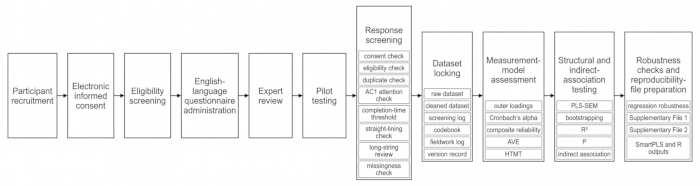
Rycina 1: Operacyjny schemat oceny doświadczeń w nauce online, podstawowych potrzeb psychologicznych i zaangażowania w naukę. Rycina przedstawia przepływ protokołu od rekrutacji, zgody, przeprowadzenia ankiet, przeglądu eksperckiego, testów pilotażowych, przesiewania odpowiedzi i blokowania zbioru danych, aż po ocenę pomiarów, testowanie strukturalne, analizę powiązań pośrednich, kontrolę odporności i przygotowanie plików reprodukowalności. Kliknij tutaj, aby wyświetlić powiększoną wersję tej ryciny.
2. Rekrutacja kwalifikujących się uczestników
- Zrekrutować studentów uniwersytetu, którzy uczestniczyli w co najmniej jednym kursie online lub w modelu mieszanym (blended learning) w bieżącym lub ostatnim semestrze akademickim.
- Do badania włączyć uczestników, którzy ukończyli 18 lat, są obecnie studentami studiów licencjackich, magisterskich lub podyplomowych, mieli styczność z nauką online lub mieszaną, potrafią przeczytać kwestionariusz w języku angielskim i wyrażają zgodę na udzielenie elektronicznej świadomej zgody.
- Odrzucić odpowiedzi w przypadku braku potwierdzenia zgody, niespełnienia kryteriów kwalifikowalności, błędnej odpowiedzi na pytanie kontrolne (attention-check), wykrycia duplikatu zgłoszenia, czasu wypełnienia poniżej określonego progu, wykrycia schematycznego zaznaczania odpowiedzi (straight-lining) lub wystąpienia nierozwiązanej niespójności w kryteriach kwalifikowalności.
- Rekrutować uczestników za pośrednictwem uniwersyteckich platform edukacyjnych, grup komunikacyjnych kursów, studenckich list mailingowych oraz instytucjonalnych kanałów komunikacji ze studentami.
- Nie gromadzić bezpośrednich identyfikatorów, w tym imion i nazwisk, numerów indeksów, numerów telefonów, prywatnych adresów e-mail, dokładnych adresów zamieszkania, adresów IP, identyfikatorów urządzeń ani identyfikatorów kont.
- Rejestrować daty rekrutacji, kanały rekrutacyjne, przesłane odpowiedzi, liczbę wykluczeń w podziale na kategorie, zachowane odpowiedzi oraz ostateczną wielkość poprawnej próby w dzienniku prac terenowych i dzienniku przesiewowym.
PUNKT PRZERWANIA: Tygodniowo sprawdzać postępy w rekrutacji. Analizować wyłącznie liczbę odpowiedzi, zasięg kanałów rekrutacyjnych oraz wstępny wskaźnik wykluczeń. Podczas rekrutacji nie analizować wyników konstruktów, korelacji ani szacunków ścieżek.
3. Konstrukcja kwestionariusza
- Przygotować ustrukturyzowany kwestionariusz w języku angielskim zawierający elektroniczną zgodę świadomą, przesiew kryteriów kwalifikowalności, informacje o danych demograficznych uczestników, merytoryczne elementy skali oraz jedno pytanie kontrolne sprawdzające uważność oparte na instrukcji.
- Zastosować 5-stopniową skalę Likerta dla wszystkich elementów merytorycznych: 1 = zdecydowanie się nie zgadzam, 2 = nie zgadzam się, 3 = neutralny, 4 = zgadzam się i 5 = zdecydowanie się zgadzam.
- Zaadaptować elementy dotyczące doświadczeń w nauce online z wcześniejszych narzędzi pomiaru postrzegania nauki online, wsparcia dydaktycznego, jakości interakcji, użyteczności platformy oraz elastyczności nauki. Zaadaptować elementy dotyczące podstawowych potrzeb psychologicznych z uznanych narzędzi pomiaru autonomii, kompetencji i relacyjności. Zaadaptować elementy dotyczące zaangażowania w naukę z uznanych narzędzi pomiaru zaangażowania behawioralnego, poznawczego i emocjonalnego.
- Zmienić sformułowania pytań wyłącznie w celu dopasowania ich do kontekstu nauki online i hybrydowej na uniwersytecie. Stosować jasne, nie sugerujące odpowiedzi sformułowania i unikać treści sugerujących, że oczekiwane jest wysokie zadowolenie, wysokie zaspokojenie potrzeb psychologicznych lub wysokie zaangażowanie.
- Przed testowaniem pilotażowym przygotować tabelę mapowania źródeł elementów. Dla każdego elementu merytorycznego odnotować kod elementu, konstrukt, wymiar, zaadaptowane sformułowanie, podstawę źródłową, notatkę dotyczącą adaptacji, język kwestionariusza oraz kierunek punktowania.
- Wykorzystać 33 merytoryczne elementy w skali Likerta: 12 dla doświadczeń w nauce online, dziewięć dla podstawowych potrzeb psychologicznych oraz 12 dla zaangażowania w naukę. Zastosować trzy elementy dla każdego wymiaru doświadczeń w nauce online, trzy elementy dla każdego wymiaru podstawowych potrzeb psychologicznych oraz cztery elementy dla każdego wymiaru zaangażowania w naukę.
- Umieścić jedno pytanie kontrolne sprawdzające uważność oparte na instrukcji po bloku podstawowych potrzeb psychologicznych. Wykorzystać ten element wyłącznie do weryfikacji jakości odpowiedzi i wykluczyć go z punktowania konstruktów, analizy niezawodności, analizy trafności, estymacji PLS-SEM, testowania powiązań pośrednich oraz analizy odporności.
- Utrzymać przewidywany czas wypełniania kwestionariusza w granicach 8–12 min podczas testowania pilotażowego. Wykorzystać Tabelę 1 do udokumentowania domen konstruktów, wymiarów, kodów elementów, liczby elementów, skali odpowiedzi, kierunku punktowania i podstawy adaptacji. Wykorzystać Plik uzupełniający 1 w celu przedstawienia pełnego kwestionariusza, mapowania źródeł elementów, kodowania zmiennych i zasad punktowania.
UWAGA: Utrzymać konceptualne rozróżnienie między elementami predyktora, powiązań pośrednich i wyników.
Tabela 1: Domeny konstruktów, wymiary, struktura kwestionariusza i zasady punktacji. Tabela ta podsumowuje strukturę kwestionariusza, w tym domeny i wymiary konstruktów, kody i numery pozycji, przykładowe pytania, podstawę adaptacji, skalę odpowiedzi oraz zasady punktacji. Pozycja sprawdzająca uważność została zidentyfikowana jako pytanie służące wyłącznie do przesiewu. Kliknij tutaj, aby pobrać tę tabelę.
4. Przeprowadzenie recenzji eksperckiej i testów pilotażowych
- Zaproś od trzech do pięciu ekspertów z zakresu psychologii edukacyjnej, e-learningu, metodologii ilościowej, badań nad szkolnictwem wyższym lub projektowania ankiet w celu dokonania przeglądu kwestionariusza.
- Poproś ekspertów o ocenę jasności pytań, istotności konstruktu, redundantności sformułowań, obciążenia respondenta, odpowiedniości kulturowej, przejrzystości językowej oraz spójności każdego pytania z przypisanym mu wymiarem.
- Zapisuj wyniki przeglądu eksperckiego w dzienniku rewizji pytań, uwzględniając oryginalne sformułowanie, uwagi recenzenta, decyzję o zmianie, ostateczne sformułowanie oraz uzasadnienie pozostawienia, poprawy lub usunięcia pytania.
- Zredaguj pytania, które są dwuznaczne, wielokrotne (double-barreled), zbyt podobne, nieodpowiednie kulturowo, słabo powiązane z docelowym wymiarem lub niespójne z kontekstem ankiety w języku angielskim.
- Przeprowadź test pilotażowy z udziałem 30–50 studentów uniwersyteckich, którzy spełniają te same kryteria kwalifikowalności co uczestnicy badania głównego. Poproś uczestników pilotażu o wskazanie niejasnych sformułowań, problemów z wyświetlaniem technicznym, nadmiernej długości, powtarzających się treści lub dyskomfortu wywołanego przez jakiekolwiek pytanie w kwestionariuszu.
- Zapisuj czas wypełnienia ankiety dla każdego uczestnika pilotażu. Zdefiniuj próg minimalnego czasu wypełnienia dla badania właściwego jako wartość większą spośród 3 min oraz jednej trzeciej mediany czasu wypełnienia w pilotażu.
- Oblicz wstępną spójność wewnętrzną dla każdego konstruktu i sprawdź korelacje pytanie-całość po zakończeniu testu pilotażowego. Poprawiaj lub usuwaj słabe pytania tylko wtedy, gdy ich usunięcie poprawia jakość pomiaru i nie osłabia zakresu pokrycia konstruktu.
- Sfinalizuj i zablokuj kwestionariusz, książkę kodową, mapowanie źródeł pytań, dziennik przeglądu eksperckiego, rekord testu pilotażowego, próg czasu wypełnienia, regułę kontroli uwagi, regułę wykrywania duplikatów oraz kryteria wykluczenia przed rozpoczęciem formalnej rekrutacji.
PUNKT PRZERWANIA: Nie rozpoczynaj formalnej rekrutacji, dopóki wszystkie kwestionariusze, pliki przesiewowe i pliki kodowania nie zostaną zablokowane.
5. Przeprowadzenie ankiety online
- Opracuj kwestionariusz w systemie ankiet online, który obsługuje anonimowy udział, potwierdzenie zgody, weryfikację kryteriów kwalifikowalności, ustawienia wymaganych odpowiedzi, rejestrację czasu odpowiedzi, ograniczenia dotyczące powtórnych zgłoszeń bez identyfikacji użytkownika, rozmieszczenie pytań kontrolnych uwagi oraz eksport do arkusza kalkulacyjnego.
- Umieść elektroniczną zgodę świadomą przed weryfikacją kwalifikowalności i pytaniami kwestionariuszowymi. Pozwól uczestnikom przejść dalej dopiero po potwierdzeniu dobrowolnego udziału i przedstaw cel badania w neutralnym języku. Określ, że badanie analizuje spostrzeżenia studentów na temat nauki online, zaspokojenie potrzeb psychologicznych oraz zaangażowanie w naukę.
- Ustaw zgodę, pytania o kwalifikowalność oraz wszystkie 33 merytoryczne pytania w skali Likerta jako pola wymagane. Wyłącz pola służące do bezpośredniej identyfikacji. Nie proś o nazwiska, numery albumów, numery telefonów, prywatne adresy e-mail, dokładne adresy zamieszkania, adresy IP, identyfikatory urządzeń ani identyfikatory kont.
- Umożliwij uczestnikom wyjście z kwestionariusza przed ostatecznym przesłaniem bez żadnych konsekwencji. Ogranicz powtórne przesyłanie ankiet wyłącznie za pomocą nieidentyfikujących ustawień platformy ankietowej, jeśli są one dostępne. Pozostaw kwestionariusz otwarty przez 4–6 tygodni. Monitoruj liczbę odpowiedzi dwa razy w tygodniu i dokumentuj postępy w rekrutacji w dzienniku prac terenowych.
UWAGA: Nie przekazuj indywidualnych wyników po przesłaniu kwestionariusza.
6. Eksport i zabezpieczenie surowych danych
- Niezwłocznie po zakończeniu rekrutacji wyeksportuj wszystkie przesłane odpowiedzi w formatach .xlsx oraz .csv.
- Zapisz jeden niezmieniony plik .xlsx jako RawData_OnlineLearning_BPN_Engagement_YYYYMMDD.xlsx oraz jeden niezmieniony plik .csv jako RawData_OnlineLearning_BPN_Engagement_YYYYMMDD.csv.
- Utwórz kopię roboczą do celów przesiewania, kodowania i analizy. Nazwij ją WorkingData_OnlineLearning_BPN_Engagement_YYYYMMDD.xlsx. Przypisz każdej przesłanej odpowiedzi anonimowy kod uczestnika w formacie P001, P002, P003 i tak dalej.
- Przechowuj surowy zbiór danych w folderze tylko do odczytu i utwórz sumę kontrolną, zapis wersji pliku lub instytucjonalny zapis historii wersji przed rozpoczęciem przesiewania.
- Przechowuj zanonimizowane archiwum przesłanych rekordów oraz metadane z przesiewania w chronionym instytucjonalnym folderze weryfikacyjnym. Nie dołączaj do manuskryptu ani plików uzupełniających przesyłanych do publikacji surowych rekordów wykluczonych, informacji umożliwiających bezpośrednią identyfikację ani surowych danych na poziomie uczestnika.
PUNKT PRZERWANIA: Nie rozpoczynaj przesiewania, dopóki surowy plik .xlsx, surowy plik .csv, dziennik prac terenowych, zapis wersji danych surowych oraz chroniony folder danych surowych nie zostaną zapisane.
7. Przesiewanie odpowiedzi i stosowanie reguł wykluczania
- Zastosuj wszystkie reguły wykluczania przed analizą korelacji konstruktów, wyników modelu pomiarowego, ścieżek strukturalnych lub szacunków powiązań pośrednich. Usuń odpowiedzi bez potwierdzenia zgody lub bez danych dotyczących wieku, zapisu, ekspozycji na naukę online lub spełnienia kryteriów dotyczących języka kwestionariusza.
- Usuń duplikaty odpowiedzi zgodnie z uprzednio określoną regułą wykrywania duplikatów. Identyfikuj potencjalne duplikaty wyłącznie na podstawie nieidentyfikujących znaczników duplikatów platformy ankietowej oraz anonimowych informacji o wzorcach odpowiedzi. W przypadku zidentyfikowania duplikatów zachowaj najwcześniejszą kompletną odpowiedź.
- Usuń odpowiedzi, które nie przeszły kontrolnego pytania sprawdzającego uważność lub zostały ukończone w czasie krótszym niż ustalony dla badania próg minimalnego czasu wypełnienia. Zdefiniuj zjawisko straight-liningu jako wybieranie tej samej opcji odpowiedzi w co najmniej 90% z 33 merytorycznych pozycji w skali Likerta. Usuń odpowiedzi spełniające to kryterium.
- Oznaczaj wzorce odpowiedzi w postaci długich ciągów, gdy ta sama opcja odpowiedzi została wybrana dr 20 lub więcej następujących po sobie merytorycznych elementów skali Likerta. Usuń oznaczone odpowiedzi tylko wtedy, gdy wykazują one również nieprawdopodobnie krótki czas wypełniania, niezdany test uwagi, tzw. straight-lining (wybieranie tej samej odpowiedzi w każdym punkcie) lub inne uprzednio określone naruszenie jakości.
- Oznacz niespójne odpowiedzi w danych demograficznych w przypadku, gdy uczestnik zgłasza brak kontaktu z nauką online lub hybrydową, a jednocześnie wskazuje liczbę godzin nauki online w tygodniu powyżej zera. Usuń odpowiedzi z nierozwiązaną niespójnością dotyczącą kryteriów kwalifikowalności.
- Każdy przypadek wykluczony należy odnotować w zanonimizowanym dzienniku przesiewowym, podając anonimowy kod uczestnika, kategorię wykluczenia, przyczynę wykluczenia, datę badania przesiewowego oraz decyzję o wykluczeniu.
- Zastosowanie Tabela 2 w celu udokumentowania przesłanych odpowiedzi, kategorii wykluczeń, liczby wykluczeń, zachowanych odpowiedzi oraz końcowej wielkości próby walidacyjnej. Jeśli surowe liczby wykluczeń dla reprezentatywnego zbioru danych nie mogą zostać zrekonstruowane, należy to wyraźnie zaznaczyć.
UWAGA: Wykluczaj przypadki wyłącznie zgodnie z uprzednio określonymi zasadami dotyczącymi zgody, kwalifikowalności, duplikatów, pytań kontrolnych, czasu wypełniania, wzorców odpowiedzi, braków danych lub spójności. Nie rozpoczynaj kodowania do momentu, aż surowy zbiór danych, oczyszczony zbiór danych, dziennik przesiewowy, plik zasad wykluczania, dziennik prac terenowych oraz rejestr wersji zbioru danych zostaną zapisane oddzielnie i zablokowane.
Tabela 2: Przesiewowe badanie odpowiedzi, reguły wykluczania i decyzje dotyczące przetwarzania danych. Tabela ta podsumowuje z góry określone reguły przesiewowe i decyzje dotyczące przetwarzania danych w zakresie zgody, kwalifikowalności, powielonych odpowiedzi, kontroli uwagi, czasu wypełnienia, weryfikacji wzorców odpowiedzi, brakujących danych oraz blokady zbioru danych. Reguły wykluczania są stosowane przed zbadaniem korelacji konstruktów, wyników modelu pomiarowego, ścieżek strukturalnych lub szacunków powiązań pośrednich. Każda wykluczona odpowiedź jest zapisywana w zanonimizowanym dzienniku przesiewowym z użyciem anonimowego kodu uczestnika, kategorii wykluczenia, powodu wykluczenia, daty przesiewu oraz decyzji o przesiewie. Kliknij tutaj, aby pobrać tę tabelę.
8. Obsługa brakujących danych
- Zapobieganie brakującym wartościom w zgodzie, pytaniach o kwalifikowalność oraz 33 merytorycznych elementach skali Likerta poprzez ustawienie tych pól jako wymagane w systemie ankietowym. Po przeprowadzeniu przesiewu należy sprawdzić oczyszczony zbiór danych pod kątem brakujących wartości.
- Brakujące wartości w opcjonalnych zmiennych opisowych należy traktować jako „nie podano”. Nie należy imputować opcjonalnych zmiennych demograficznych lub opisowych.
- Zmienną opisową należy wykluczyć z analizy kowariantów, jeśli wskaźnik brakujących danych przekracza 10%. Zmienną opisową należy zachować jako kowariant tylko wtedy, gdy wskaźnik brakujących danych wynosi 10% lub mniej, a zmienna jest istotna teoretycznie.
- Nie należy imputować brakujących wartości w 33 merytorycznych elementach skali Likerta. Jeśli mimo ustawień wymaganych odpowiedzi wykryto braki w elementach merytorycznych, przed sfinalizowaniem oczyszczonego zbioru danych należy ustalić, czy problem wynika z eksportu ankiety, logiki ankiety czy obsługi niekompletnych zgłoszeń.
UWAGA: Należy udokumentować kontrolę brakujących danych. Należy zaraportować liczbę brakujących wartości oraz wskaźnik braków dla kodów uczestników, zmiennych opisowych, merytorycznych elementów skali Likerta, wyników wymiarowych oraz wyników konstrukcji globalnych.
9. Kodowanie zmiennych i obliczanie wyników
- Zakoduj wszystkie merytoryczne pozycje w skali Likerta od 1 do 5: 1 = zdecydowanie nie zgadzam się, 2 = nie zgadzam się, 3 = neutralnie, 4 = zgadzam się i 5 = zdecydowanie zgadzam się. Zakoduj płeć, poziom akademicki, rok studiów, kategorię dyscypliny, tygodniową liczbę godzin nauki online oraz wcześniejsze doświadczenie w nauce online zgodnie z ustalonym kodem.
- Przejrzyj wszystkie zmienne pod kątem wartości spoza zakresu przed obliczeniem wyników dla wymiarów lub globalnych konstruktów.
- Oblicz wyniki dla wymiarów doświadczenia w nauce online jako średnie z pozycji: użyteczność platformy = mean(OLE_PU1–OLE_PU3), wsparcie dydaktyczne = mean(OLE_IS1–OLE_IS3), jakość interakcji = mean(OLE_IQ1–OLE_IQ3) oraz elastyczność nauki = mean(OLE_LF1–OLE_LF3).
- Oblicz wyniki dla wymiarów podstawowych potrzeb psychologicznych jako średnie z pozycji: potrzeba autonomii = mean(BPN_AU1–BPN_AU3), potrzeba kompetencji = mean(BPN_CO1–BPN_CO3) oraz potrzeba relacyjności = mean(BPN_RE1–BPN_RE3).
- Oblicz wyniki dla wymiarów zaangażowania w naukę jako średnie z pozycji: zaangażowanie behawioralne = mean(LE_BE1–LE_BE4), zaangażowanie poznawcze = mean(LE_CE1–LE_CE4) oraz zaangażowanie emocjonalne = mean(LE_EE1–LE_EE4).
- Oblicz wyniki dla globalnych konstruktów jako średnie z wymiarów: doświadczenie w nauce online = mean (użyteczność platformy, wsparcie dydaktyczne, jakość interakcji, elastyczność nauki); podstawowe potrzeby psychologiczne = mean (potrzeba autonomii, potrzeba kompetencji, potrzeba relacyjności); oraz zaangażowanie w naukę = mean (zaangażowanie behawioralne, zaangażowanie poznawcze, zaangażowanie emocjonalne).
- Zachowaj dane na poziomie pozycji do oceny modelu pomiarowego, wyniki wymiarów do szacowania konstruktów wyższego rzędu i analizy podwymiarów oraz wyniki globalnych konstruktów do statystyk opisowych, analizy korelacji, weryfikacji modelu strukturalnego i analizy odporności opartej na regresji.
UWAGA: Nie uwzględniaj pozycji kontrolnej uwagi w żadnym wyniku, analizie niezawodności, analizie trafności, szacowaniu PLS-SEM, analizie powiązań pośrednich ani analizie odporności. Nie standaryzuj oryginalnych wyników 1–5 przed analizą opisową.
10. Kontrola i ocena typowych błędów systematycznych metody
- Przed analizą zastosuj kontrole proceduralne, wykorzystując anonimowe odpowiedzi, neutralne sformułowania, oddzielone bloki konstruktów, jeden element sprawdzający uważność oparty na instrukcji, ustawienia wymagające odpowiedzi oraz ograniczony dostęp do surowych danych.
- Po przesiewowej analizie odpowiedzi przeprowadź jednoczynnikowy test Harmana, aby sprawdzić, czy jeden nieobrócony czynnik odpowiada za dominującą część wariancji elementów. Wynik uznaj za akceptowalny, gdy pierwszy nieobrócony czynnik wyjaśnia mniej niż 50% całkowitej wariancji.
- Oblicz wartości pełnego współczynnika inflacji wariancji kolinearności dla głównych konstruktów. Wartości poniżej 3,30 uznaj za wskazujące na niskie prawdopodobieństwo wystąpienia silnego błędu wspólnej metody. Odnotuj błąd wspólnej metody jako ograniczenie badania, jeśli pierwszy nieobrócony czynnik wyjaśnia 50% lub więcej całkowitej wariancji lub jeśli jakikolwiek pełny współczynnik inflacji wariancji kolinearności wynosi 3,30 lub więcej.
UWAGA: Nie stwierdzaj, że błąd wspólnej metody nie występuje. Określ jedynie, czy diagnostyka wskazuje na silne dowody istnienia dominującego wspólnego czynnika metodycznego.
11. Przeprowadzenie analizy opisowej i wstępnych kontroli
- Użyj programu R 4.4.1 do obliczenia statystyk opisowych, sprawdzenia rozkładów, analizy korelacji oraz analizy odporności opartej na regresji. Oblicz częstości i wartości procentowe dla kategorycznych cech uczestników.
- Oblicz średnią, odchylenie standardowe, minimum, maksimum, skośność i kurtozę dla pozycji merytorycznych, wyników wymiarowych oraz wyników konstrukcji globalnych.
- Przeanalizuj rozkłady pozycji i wyników pod kątem efektu podłogi, efektu sufitu oraz silnej nienormatywności. Potencjalny efekt podłogi lub sufitu zdefiniuj jako sytuację, w której ponad 20% uczestników wybrało najniższą lub najwyższą opcję odpowiedzi dla danej pozycji merytorycznej.
- Oblicz korelacje Pearsona pomiędzy konstrukcjami globalnymi a wynikami wymiarowymi. Korelacje traktuj wyłącznie jako wstępne dowody opisowe i nie używaj ich jako zamiennika dla wcześniej określonego modelu strukturalnego.
UWAGA: Odnotuj efekty podłogi lub sufitu jako cechy danych. Nie usuwaj przypadków z powodów związanych z rozkładem, chyba że naruszają one również wcześniej określone zasady jakości odpowiedzi.
12. Estymacja modelu pomiarowego wyższego rzędu
- Użyj programu Smart PLS 4.1 do przeprowadzenia głównej analizy PLS-SEM i zaimportuj oczyszczony zbiór danych na poziomie pozycji. Określ użyteczność platformy, wsparcie dydaktyczne, jakość interakcji, elastyczność uczenia się, potrzebę autonomii, potrzebę kompetencji, potrzebę relacyjności, zaangażowanie behawioralne, zaangażowanie poznawcze oraz zaangażowanie emocjonalne jako refleksyjne konstrukty pierwszego rzędu.
- Zastosuj rozłączne podejście dwuetapowe. W pierwszym etapie oszacuj refleksyjne konstrukty pierwszego rzędu i zapisz wyniki zmiennych latentnych.
- W drugim etapie wykorzystaj wyniki zmiennych latentnych dla użyteczności platformy, wsparcia dydaktycznego, jakości interakcji i elastyczności uczenia się do reprezentacji doświadczenia uczenia się online; wyniki zmiennych latentnych dla potrzeby autonomii, potrzeby kompetencji i potrzeby relacyjności do reprezentacji podstawowych potrzeb psychologicznych oraz wyniki zmiennych latentnych dla zaangażowania behawioralnego, zaangażowania poznawczego i zaangażowania emocjonalnego do reprezentacji zaangażowania w naukę.
- Traktuj wyniki konstruktów wyższego rzędu jako analitycznie wyprowadzone reprezentacje konstruktów wielowymiarowych. Nie opisuj ich jako formatywne, chyba że model formatywny został wyraźnie określony i uzasadniony. Zapisz ustawienia pierwszego etapu, ustawienia drugiego etapu, wyniki zmiennych latentnych oraz pliki z wynikami modelu w folderze weryfikacyjnym.
UWAGA: Zastosuj tę samą procedurę dla konstruktów wyższego rzędu w głównym modelu strukturalnym, analizie subwymiarów potrzeb psychologicznych oraz analizie odporności opartej na regresji.
13. Ocena modelu pomiarowego
- Oceń model pomiarowy przed interpretacją modelu strukturalnego. Przeanalizuj standaryzowane ładunki zewnętrzne dla wszystkich zachowanych wskaźników. Zachowaj wskaźniki o ładunkach wynoszących co najmniej 0.70, jeśli jest to możliwe.
- Przejrzyj wskaźniki o ładunkach mieszczących się w przedziale od 0.40 do 0.70. Usuń wskaźnik tylko wtedy, gdy jego usunięcie poprawia niezawodność lub trafność zbieżną i nie osłabia zakresu treści. Usuń wskaźniki poniżej 0.40, chyba że istnieje udokumentowane uzasadnienie teoretyczne wspierające ich zachowanie.
- Oceń spójność wewnętrzną, korzystając z alfa Cronbacha oraz niezawodności złożonej. Wartości między 0.70 a 0.95 uznaj za akceptowalne. Oceń trafność zbieżną, korzystając ze średniej wariancji wyodrębnionej. Wartości wynoszące co najmniej 0.50 uznaj za akceptowalne.
- Oceń trafność różnicującą, korzystając z wskaźnika heterotrait-monotrait. Przyjmij 0.85 jako konserwatywny próg, a 0.90 jako maksymalny akceptowalny próg dla konstruktów teoretycznie sąsiadujących.
- Zapisz zachowane wskaźniki, standaryzowane ładunki zewnętrzne, alfę Cronbacha, niezawodność złożoną, średnią wariancję wyodrębnioną, wartości heterotrait-monotrait oraz wszelkie decyzje o usunięciu pozycji w zablokowanym pliku wynikowym modelu pomiarowego.
UWAGA: Nie usuwaj pozycji wyłącznie w celu poprawy wartości statystycznych. Usuń pozycję tylko wtedy, gdy udokumentowano zarówno słabość statystyczną, jak i redundancję konceptualną.
PUNKT PRZYSTANKU: Nie rozpoczynaj testowania strukturalnego, dopóki zachowane wskaźniki, wartości ładunków, wartości niezawodności, trafność zbieżna, trafność różnicująca, wpisy w księdze kodowej oraz wartości z wyników pomiarowych nie zostaną sprawdzone z zablokowanymi plikami analizy.
14. Przetestowanie modelu strukturalnego i ścieżki mediacji
- Określ trzy ścieżki strukturalne: doświadczenie nauki online → podstawowe potrzeby psychologiczne, podstawowe potrzeby psychologiczne → zaangażowanie w naukę oraz doświadczenie nauki online → zaangażowanie w naukę.
- Uwzględnij tygodniową liczbę godzin nauki online oraz wcześniejsze doświadczenie w nauce online jako zdefiniowane wcześniej zmienne kontrolne. Płeć, poziom akademicki, rok studiów oraz kategorię dyscypliny traktuj jako zmienne opisowe, chyba że zostaną one włączone do zdefiniowanego wcześniej modelu analizy wrażliwości.
- Zbadaj współliniowość modelu strukturalnego przed interpretacją współczynników ścieżek. Wartości współczynnika inflacji wariancji (VIF) poniżej 3,30 traktuj jako wskazujące na niskie prawdopodobieństwo wystąpienia szkodliwej współliniowości.
- Oszacuj standaryzowane współczynniki ścieżek, wartości t, wartości p oraz 95% przedziały ufności, wykorzystując 5 000 prób bootstrapowych z testowaniem dwustronnym. Stosuj przedziały ufności skorygowane o obciążenie, jeśli są dostępne.
- Oszacuj ścieżkę pośrednią od doświadczenia nauki online do zaangażowania w naukę poprzez podstawowe potrzeby psychologiczne. Uznaj ścieżkę powiązania pośredniego za potwierdzoną, gdy bootstrapowy przedział ufności dla efektu pośredniego nie obejmuje zera.
- Zapisz efekt bezpośredni, efekt pośredni, efekt całkowity, wartości R2, skorygowane wartości R2, wielkości efektu f2, wartości współczynnika inflacji wariancji modelu strukturalnego oraz ścieżki zmiennych kontrolnych w zablokowanym wyniku modelu strukturalnego. Wszystkie szacunki strukturalne interpretuj jako ścieżki oparte na powiązaniach, a nie jako efekty przyczynowe.
UWAGA: Nie usuwaj zdefiniowanej wcześniej ścieżki z powodu jej nieistotności statystycznej. Zachowaj zdefiniowany wcześniej model, chyba że zidentyfikowano błąd kodowania lub błąd specyfikacji modelu.
15. Analiza podwymiarów potrzeb psychologicznych
- Zastąp globalny konstrukt podstawowych potrzeb psychologicznych potrzebą autonomii, potrzebą kompetencji oraz potrzebą relacyjności jako równoległe konstrukty powiązań pośrednich. Oszacuj oddzielnie ścieżki pośrednie z doświadczenia w nauczaniu online do zaangażowania w naukę poprzez potrzebę autonomii, potrzebę kompetencji i potrzebę relacyjności.
- Użyj 5 000 prób bootstrapowych dla każdej ścieżki subwymiaru. Porównaj kierunek, wielkość i przedział ufności każdej pośredniej ścieżki subwymiaru. Potraktuj tę analizę jako analizę wrażliwości, a nie model główny.
UWAGA: Nie reinterpretuj analizy wrażliwości subwymiarów jako nowego modelu głównego.
16. Przeprowadzenie analizy odporności w oparciu o regresję
- Wyeksportuj oczyszczony zbiór danych wyników konstruktów i zapisz go jako ConstructScores_OnlineLearning_BPN_Engagement_YYYYMMDD.csv. Użyj programu R 4.4.1, aby przeprowadzić regresję globalnych podstawowych potrzeb psychologicznych względem globalnego doświadczenia w nauce online, tygodniowej liczby godzin nauki online oraz wcześniejszego doświadczenia w nauce online.
- Przeprowadź regresję globalnego zaangażowania w naukę względem globalnego doświadczenia w nauce online, globalnych podstawowych potrzeb psychologicznych, tygodniowej liczby godzin nauki online oraz wcześniejszego doświadczenia w nauce online. Oszacuj ścieżkę pośrednią, wykorzystując 5 000 bootstrapowych prób ponownych.
- Porównaj ścieżkę pośrednią opartą na regresji ze ścieżką pośrednią PLS-SEM. Klasyfikuj ścieżkę jako odporną tylko wtedy, gdy kierunek pozostaje spójny, a interpretacja merytoryczna nie ulega zmianie. Zapisz skrypt R, ustawienia bootstrapowania oraz wyniki analizy odporności w folderze weryfikacyjnym.
PUNKT PRZERWANIA: Nie rozpoczynaj ostatecznego blokowania plików do czasu wzajemnej weryfikacji modelu strukturalnego, analizy podwymiarów oraz analizy odporności opartej na regresji.
17. Postępowanie w przypadku suboptymalnych wyników analitycznych
- Jeśli współczynnik alfa Cronbacha lub niezawodność złożona są poniżej 0,70, należy sprawdzić korelacje pozycji z sumą oraz standaryzowane ładunki zewnętrzne. Jeśli średnia wariancja wyodrębniona (AVE) jest poniżej 0,50, należy przeanalizować zachowane wskaźniki i zidentyfikować, czy jeden lub więcej z nich osłabia trafność zbieżną.
- Jeśli wartości heterotrait-monotrait przekraczają określony próg, należy sprawdzić sformułowania pozycji pod kątem nakładania się semantycznego między teoretycznie bliskimi konstruktami. Słabą pozycję należy usunąć tylko wtedy, gdy jest ona statystycznie słaba i konceptualnie redundantna. Utrzymanie rozdzielności teoretycznie sąsiadujących konstruktów jest konieczne, gdyż ich scalenie zmniejszyłoby przejrzystość konceptualną.
- Jeśli ścieżka pośrednia nie znajduje potwierdzenia, wynik należy odnotować jako niepotwierdzony związek pośredni. Jeśli zmienne kontrolne wykazują nieistotne statystycznie związki, wyniki należy odnotować bez nadmiernej interpretacji.
UWAGA: Nie należy modyfikować modelu teoretycznego po przeprowadzeniu analizy w celu wymuszenia silniejszego potwierdzenia hipotez.
18. Blokowanie wyników oprogramowania i plików reprodukowalności
- Utwórz końcowy folder weryfikacji instytucjonalnej o nazwie Verification_OnlineLearning_BPN_Engagement_YYYYMMDD.
- W folderze weryfikacji zapisz archiwum surowego zbioru danych, oczyszczony zbiór danych, zbiór wyników konstruktów, księgę kodową (codebook), kwestionariusz, tabelę mapowania źródeł pozycji, log recenzji eksperckiej, zapis testu pilotażowego, log prac terenowych, log przesiewowy, plik reguł wykluczania, zapis progu czasu wypełniania, wyniki z programu Smart PLS, skrypty R, tabele wyników R, zapis wersji oprogramowania oraz log zmian wersji.
- Pliki projektu Smart PLS 4.1 oraz wyeksportowane wyniki modelu pomiarowego, modelu strukturalnego, bootstrapu i analizy heterotrait-monotrait zapisz w podfolderze o nazwie SmartPLS_Output. Skrypty R oraz tabele wyników R zapisz w podfolderze o nazwie R_Output. Kwestionariusz, mapowanie źródeł pozycji, kodowanie zmiennych oraz reguły punktacji zapisz jako Supplementary File 1.
- Weryfikację końcowego analitycznego zbioru danych, podsumowanie przesiewu, zapis brakujących danych, diagnostykę błędu wspólnej metody (common method bias), wyniki modelu pomiarowego, wyniki modelu strukturalnego, wyniki powiązań pośrednich, analizę subwymiarów, zapis odporności (robustness) oparty na regresji, ustawienia oprogramowania oraz zapis wersji zapisz jako Supplementary File 2.
- Nie zamieszczaj bezpośrednio identyfikowalnych informacji, surowych rekordów wykluczonych ani surowych danych na poziomie uczestnika w manuskrypcie ani w plikach uzupełniających przesyłanych do publikacji. Zablokuj końcowy folder weryfikacji po sprawdzeniu spójności. Późniejsze korekty zapisuj jako nowe, datowane wersje i dokumentuj ich przyczynę w logu zmian wersji.
Dostęp ograniczony. Zaloguj się lub rozpocznij wersję próbną, aby wyświetlić tę treść.
Wyniki
Końcowy zestaw danych analitycznych i charakterystyka uczestników
Końcowy zbiór danych analitycznych objął 386 studentów uniwersytetu. Formalna rekrutacja była prowadzona od 18 sierpnia 2025 r. do 26 września 2025 r. za pośrednictwem uniwersyteckich platform edukacyjnych, grup komunikacyjnych kursów, list mailingowych studentów oraz instytucjonalnych kanałów studenckich. Przesianych zostało łącznie 432 przesłanych odpowiedzi, z czego zachowano 386, co dało współczynnik poprawn...
Dostęp ograniczony. Zaloguj się lub rozpocznij wersję próbną, aby wyświetlić tę treść.
Dyskusja
This protocol provides a reproducible methodological workflow for assessing association pathways among online learning experience, basic psychological needs, and learning engagement in university students. Rather than treating online learning as a single condition, the protocol separates the perceived learning environment into platform usability, instructional support, interaction quality, and learning flexibility. This structure allows researchers to identify which part of the online learning experience is most closely ...
Dostęp ograniczony. Zaloguj się lub rozpocznij wersję próbną, aby wyświetlić tę treść.
Oświadczenia
The authors declare that they have no financial or personal relationships that could have influenced the work reported in this paper.
Podziękowania
We sincerely thank all participating students for their time, cooperation, and valuable responses. We also thank the relevant academic and administrative staff for their support throughout the survey process.
Dostęp ograniczony. Zaloguj się lub rozpocznij wersję próbną, aby wyświetlić tę treść.
Materiały
| Nazwa | Firma | Numer katalogowy | Komentarze |
|---|---|---|---|
| Qualtrics online survey platform | Qualtrics | Institutional account; version not applicable | Used to administer the anonymous English-language questionnaire, including consent confirmation, eligibility screening, required-response settings, AC1 attention-check item, response-time recording, and data export. |
| Microsoft Excel for Microsoft 365 | Microsoft Corporation | Microsoft 365 institutional version | Used to store the raw exported dataset, cleaned dataset, codebook, screening log, construct-score file, and verification records in .xlsx and .csv formats. |
| G*Power | Heinrich Heine University Düsseldorf | G*Power 3.1.9.7 | Used for a priori sample-size and power checking before recruitment. |
| SmartPLS | SmartPLS GmbH | SmartPLS 4.1 Professional | Used for the primary PLS-SEM workflow, including disjoint two-stage higher-order construct estimation, measurement-model assessment, structural-pathway testing, bootstrapping, R², f², and model-output export. |
| R statistical software | R Foundation / CRAN | R 4.4.1 | Used for descriptive statistics, Pearson correlations, common method bias diagnostics, and regression-based robustness analysis. |
| R package: psych | CRAN | psych 2.4.6 | Used for descriptive statistics, reliability checks, and psychometric summaries. |
| R package: boot | CRAN | boot 1.3-30 | Used for bootstrap-based regression robustness checks. |
| R package: semPlot | CRAN | semPlot 1.1.6 | Used only for optional path-diagram cross-checking when R-based visual verification is needed. |
| OneDrive for Business or SharePoint version history | Microsoft Corporation | Microsoft 365 institutional account | Used to store the verification folder and preserve version history for raw data, cleaned data, codebook, screening log, SmartPLS outputs, R scripts, and supplementary files. |
| Questionnaire and coding file | Author-prepared study file | Supplementary File 1 | Contains the final questionnaire, item-source mapping, variable names, coding rules, dimension-score formulas, global construct-score formulas, and data-handling rules. |
| Screening and reproducibility record | Author-prepared study file | Supplementary File 2 | Contains final dataset verification, screening checks, missing-data record, reliability results, common method bias diagnostics, measurement-model output, structural-model output, indirect-association results, sensitivity analysis, robustness record, and final consistency checklist. |
| Figure-preparation software | Adobe Illustrator or equivalent vector-editing software | Institutional version | Used to prepare publication-ready workflow and structural-model figures. |
Bibliografia
- Organization for Economic Co-operation and Development. OECD digital education outlook 2021: pushing the frontiers with artificial intelligence, blockchain and robots. Paris: OECD Publishing; 2021. doi:10.1787/589b283f-en.
- Martin F, Bolliger DU. Engagement matters: student perceptions on the importance of engagement strategies in the online learning environment. Online Learn. 2018;22(1):205-222. doi:10.24059/olj.v22i1.1092.
- Dixson MD. Measuring student engagement in the online course: the Online Student Engagement scale (OSE). Online Learn. 2015;19(4). doi:10.24059/olj.v19i4.561.
- Bond M, Buntins K, Bedenlier S, Zawacki-Richter O, Kerres M. Mapping research in student engagement and educational technology in higher education: a systematic evidence map. Int J Educ Technol High Educ. 2020;17(1):2. doi:10.1186/s41239-019-0176-8.
- Vansteenkiste M, Ryan RM, Soenens B. Basic psychological need theory: advancements, critical themes, and future directions. Motiv Emot. 2020;44(1):1-31. doi:10.1007/s11031-019-09818-1.
- Chen KC, Jang SJ. Motivation in online learning: testing a model of self-determination theory. Comput Human Behav. 2010;26(4):741-752. doi:10.1016/j.chb.2010.01.011.
- Chiu TKF. Applying the self-determination theory to explain student engagement in online learning during the COVID-19 pandemic. J Res Technol Educ. 2022;54(sup1):S14-S30. doi:10.1080/15391523.2021.1891998.
- Bedenlier S, Bond M, Buntins K, Zawacki-Richter O, Kerres M. Facilitating student engagement through educational technology in higher education: a systematic review in the field of arts and humanities. Australas J Educ Technol. 2020;36(4):126-150. doi:10.14742/ajet.5477.
- Ward MK, Meade AW. Dealing with careless responding in survey data: prevention, identification, and recommended best practices. Annu Rev Psychol. 2023;74:577-596. doi:10.1146/annurev-psych-040422-045007.
- Zawacki-Richter O, Kerres M, Bedenlier S, Bond M, Buntins K, editors. Systematic reviews in educational research: methodology, perspectives and application. Wiesbaden: Springer VS; 2020. doi:10.1007/978-3-658-27602-7.
- Hair JF, Hult GTM, Ringle CM, Sarstedt M. A primer on partial least squares structural equation modeling. 3rd ed. Thousand Oaks: Sage Publications; 2022.
- Wut TM, Ng PML, Low MP. Engaging university students in online learning: a regional comparative study from the perspective of social presence theory. J Comput Educ. 2024;11(3):763-789. doi:10.1007/s40692-023-00278-8.
- Stone C, O’Shea S. Older, online and first: recommendations for retention and success. Australas J Educ Technol. 2019;35(1):57-69. doi:10.14742/ajet.3913.
- Salas-Pilco SZ, Yang Y, Zhang Z. Student engagement in online learning in Latin American higher education during the COVID-19 pandemic: a systematic review. Br J Educ Technol. 2022;53(3):593-619. doi:10.1111/bjet.13190.
- Maxwell SE, Cole DA. Bias in cross-sectional analyses of longitudinal mediation. Psychol Methods. 2007;12(1):23-44. doi:10.1037/1082-989X.12.1.23.
- Richardson JC, Maeda Y, Lv J, Caskurlu S. Social presence in relation to students’ satisfaction and learning in the online environment: a meta-analysis. Comput Human Behav. 2017;71:402-417. doi:10.1016/j.chb.2017.02.001.
- Meade AW, Craig SB. Identifying careless responses in survey data. Psychol Methods. 2012;17(3):437-455. doi:10.1037/a0028085.
- Deci EL, Ryan RM. The “what” and “why” of goal pursuits: human needs and the self-determination of behavior. Psychol Inq. 2000;11(4):227-268. doi:10.1207/S15327965PLI1104_01.
- Fredricks JA, Blumenfeld PC, Paris AH. School engagement: potential of the concept, state of the evidence. Rev Educ Res. 2004;74(1):59-109. doi:10.3102/00346543074001059.
- Garrison DR, Anderson T, Archer W. Critical inquiry in a text-based environment: computer conferencing in higher education. Internet High Educ. 2000;2(2-3):87-105. doi:10.1016/S1096-7516(00)00016-6.
- Cole DA, Maxwell SE. Testing mediational models with longitudinal data: questions and tips in the use of structural equation modeling. J Abnorm Psychol. 2003;112(4):558-577. doi:10.1037/0021-843X.112.4.558.
- Podsakoff PM, MacKenzie SB, Lee JY, Podsakoff NP. Common method biases in behavioral research: a critical review of the literature and recommended remedies. J Appl Psychol. 2003;88(5):879-903. doi:10.1037/0021-9010.88.5.879.
- Gašević D, Dawson S, Siemens G. Let’s not forget: learning analytics are about learning. TechTrends. 2015;59(1):64-71. doi:10.1007/s11528-014-0822-x.
Dostęp ograniczony. Zaloguj się lub rozpocznij wersję próbną, aby wyświetlić tę treść.
Przedruki i uprawnienia
Ten artykuł został opublikowany
Film wkrótce dostępny