
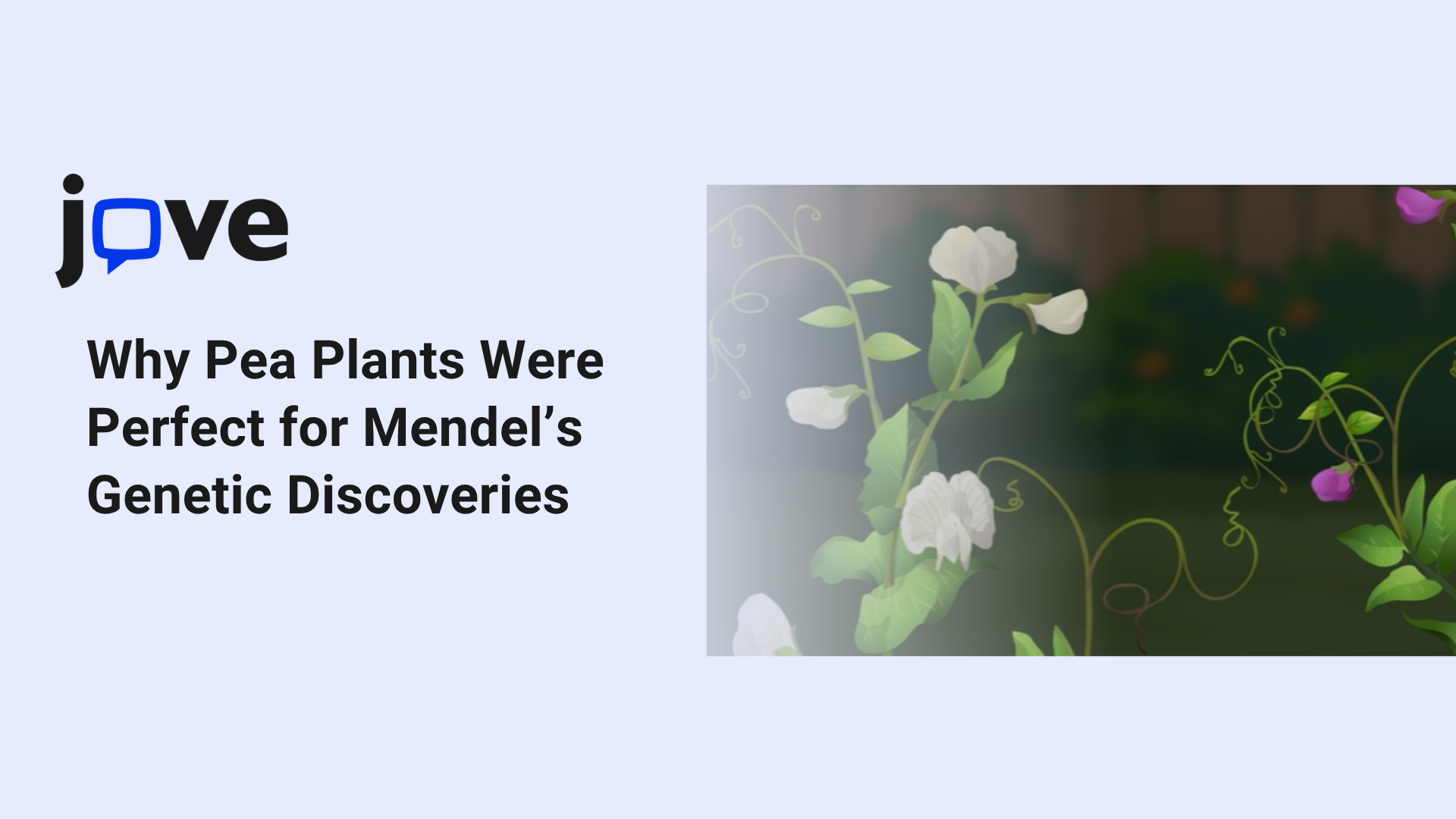
Why Pea Plants Were Perfect for Mendel’s Genetic Discoveries
Pea plants were ideal for Mendel’s genetics experiments because they had clear, visible traits and could be easily cross-pollinated.
It might seem strange that modern genetics started with a garden, but that’s exactly what happened. In the mid-1800s, Gregor Mendel’s work with pea plant genetics changed how we understand inheritance forever.
Why Mendel Used Pea Plants
Let’s start with the question: why Mendel used pea plants?
Here’s why they were the perfect choice:
- Fast growth cycle – multiple generations within a year
- Controlled breeding – Mendel could prevent or allow cross-pollination
- Visible traits – like flower color, seed shape, and pod texture
- Consistent results – they bred true, making patterns easier to detect
🎥 JoVE’s genetics videos show the experimental setup and the traits that made peas ideal. Middle schoolers can follow along with visuals instead of just reading terms on a page.
Traits of Pea Plants for Genetics
Mendel focused on seven traits of pea plants for genetics because each trait had two easily distinguishable forms. This made it easier to observe patterns of inheritance and lay the foundation for modern genetics.
Here are the seven traits Mendel studied, along with their dominant and recessive variations:
- Seed shape: Round (dominant) vs. Wrinkled (recessive)
- Seed color: Yellow (dominant) vs. Green (recessive)
- Pod shape: Inflated (dominant) vs. Constricted (recessive)
- Pod color: Green (dominant) vs. Yellow (recessive)
- Flower color: Purple (dominant) vs. White (recessive)
- Flower position: Axial (dominant) vs. Terminal (recessive)
- Stem length: Tall (dominant) vs. Short (recessive)
Mendel chose these traits because they followed clear dominant/recessive inheritance patterns — no intermediate or “blended” forms to complicate the results.
This precision in trait selection is why Mendel’s experiments were so successful and why these traits remain a gold standard when teaching Mendelian genetics today.
📽️ Consider pairing this overview with a JoVE animation that visually illustrates how these traits are passed down across generations.
Why Were Pea Plants Ideal for Mendel’s Studies?
Here’s why were pea plants ideal for Mendel’s studies:
- Easily observable traits
- Rapid reproduction
- Ability to self-pollinate and cross-pollinate
- Low chance of external genetic interference
- Clear, consistent inheritance patterns
These conditions allowed Mendel to control variables and spot mathematical patterns in trait inheritance — which later became Mendel’s Laws.
How Pea Plant Traits Helped Discover Inheritance Patterns
Mendel noticed that when crossing two true-breeding pea plants (e.g., round seeds × wrinkled seeds), one trait would disappear in the first generation and reappear in the second.
This observation led to:
- The Law of Segregation – traits are inherited independently
- The Law of Independent Assortment – traits don’t affect each other’s inheritance
How pea plant traits helped discover inheritance patterns lies in their predictability. Students can clearly track trait dominance across generations with tools like Punnett squares.
Classroom Genetics Activity with Pea Plant Traits
Try this classroom genetics activity with pea plant traits to reinforce the lesson:
Activity: Pea Plant Trait Tracker
- Assign students imaginary parent pea plants (e.g., RR × rr for seed shape)
- Use Punnett squares to predict offspring (F1 and F2)
- Graph results and discuss dominant vs. recessive traits
Pair it with:
🎥 A JoVE video explaining how pea plants genetics shaped inheritance science
🧬 A visual aid of all seven Mendelian traits.
Teaching Mendel’s Laws Through Pea Plants
Teaching Mendel’s laws through pea plants is a great entry point into genetics for grades 6–8.
Focus on:
- Law of Segregation – use seed shape as an example
- Law of Independent Assortment – show how flower color and plant height vary independently.
Conclusion: Small Plants, Big Discoveries
Pea plants genetics helped unlock the science of heredity — not because they were extraordinary plants, but because they were ideal for experimentation.
By combining JoVE’s video lessons with hands-on classroom activities, you can help students see what made Mendel’s garden so groundbreaking — and why genetics still starts with peas.
🎓 Book a Free Demo to explore JoVE’s full genetics collection, Punnett square tutorials, and trait modeling videos — built for middle school NGSS classrooms.
Bring JoVE to your classroom starting as low as $2 per student.*
Explore funding resources to learn how your school can start using JoVE’s complete STEM video library today.
*Pricing based on 1,500 students.

