
What Are Dark Reactions? Explaining the Second Stage of Photosynthesis
The dark reactions — also known as the Calvin Cycle — are the second stage of the photosynthesis process. They don’t need sunlight directly, but they rely on the energy created during the light reactions. This is the part of photosynthesis where plants use carbon dioxide from the air to build glucose — real plant food!
When teaching this concept in middle school science, it’s helpful to show how plants turn invisible gases into something tangible using energy captured from light.
How to Teach Dark Reactions in Middle School
To teach dark reactions in middle school, begin with this big idea:
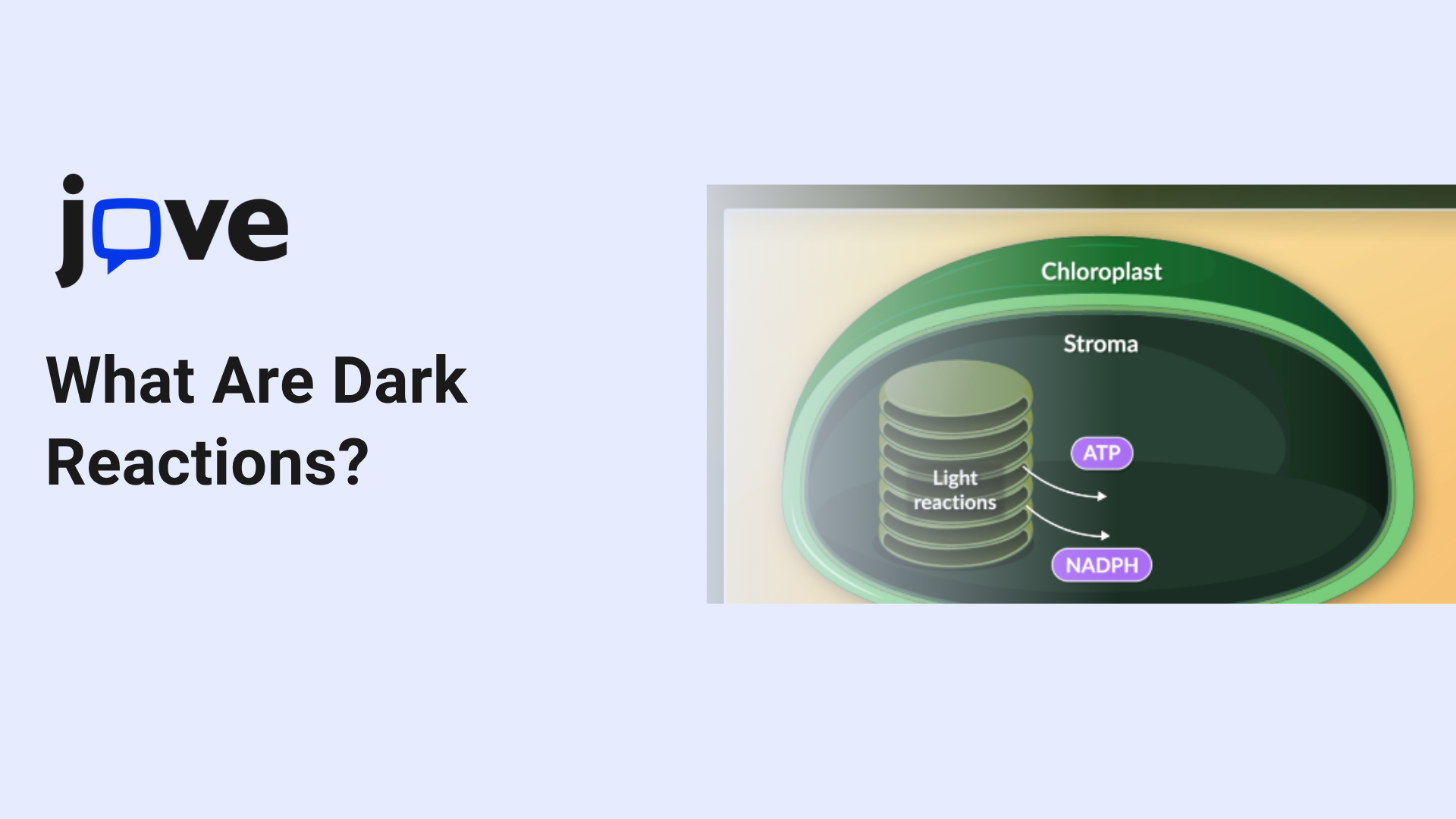
Dark reactions use ATP (adenosine triphosphate) and NADPH (nicotinamide adenine dinucleotide phosphate) from the light reactions along with carbon dioxide to make glucose.
Key points for students:
- These reactions occur in the stroma of the chloroplast.
- They use energy, not light, so they can happen day or night.
- The process is called the Calvin Cycle. It’s a repeating system that builds sugar molecules.
JoVE’s science videos illustrate how ATP and NADPH are ‘spent’ to convert carbon into something useful: glucose, the plant’s energy source.
Calvin Cycle Classroom Activity
Activity: Carbon Conversion Relay
Materials:
- Index cards labeled with CO₂, ATP, NADPH, Glucose
- Chart of the Calvin Cycle steps
Instructions:
- Create small student teams.
- Students race to collect cards in the correct order to complete the cycle.
- After each round, discuss which molecules are inputs and outputs.
This kinesthetic activity reinforces that the dark reactions are a step-by-step process — not a random mix. It also helps students remember which parts come from the light reactions.
To support this, JoVE’s Dark Reactions video clearly shows how ATP and NADPH are used to turn carbon dioxide into glucose inside the chloroplast stroma.
You can also revisit JoVE’s Light Reactions video before this activity to remind students where the energy molecules (ATP and NADPH) come from.
These videos offer a visual step-by-step guide that pairs perfectly with the relay, making the Calvin Cycle easier to grasp through movement and repetition.
Difference Between Light and Dark Reactions
Students often mix up these two processes. Here’s a quick comparison to help clarify:
Aspect | Light Reactions | Dark Reactions (Calvin Cycle) |
Location | Thylakoid membranes in chloroplasts | Stroma of chloroplasts |
Requires light | Yes | No (uses stored energy) |
Main inputs | Sunlight, water | CO₂, ATP, NADPH |
Main outputs | Oxygen, ATP, NADPH | Glucose (sugar) |
Energy role | Creates energy | Uses energy |
JoVE’s concept videos make this table come alive with visuals showing how these reactions happen inside plant cells.
Carbon Fixation in Plants Explained Simply
Carbon fixation may sound complex, but it just means plants take carbon from the air and ‘fix’ it into solid glucose. This is how plants grow!
Use this analogy:
- Imagine CO₂ as puzzle pieces floating in the air.
- The Calvin Cycle “grabs” them and connects them into a solid object — glucose.
- That glucose becomes part of leaves, stems, and fruits.
Show students how plants are carbon-capturing machines, turning invisible gas into real matter.
Conclusion: Teaching Dark Reactions Visually
Dark reactions are essential for understanding how plants store energy and grow. With JoVE’s solutions and simple classroom models, students can see how the Calvin Cycle fuels life.
Book a Free Demo to explore JoVE’s visual lessons on photosynthesis and plant biology.
Bring JoVE to your classroom starting at just $2 per student.*
*Pricing based on 1,500 students.

