
Enhancing Science Education- Aligning Lesson Plans with NGSS
In the era of Next Generation Science Standards (NGSS), teachers are encouraged to go beyond lectures and rote memorization. Innovative, inquiry-driven instruction is crucial for engaging students and deepening understanding. However, educators often face challenges in implementing creative yet standards-aligned lessons. Many lack ready-to-use NGSS resources or sufficient training, making it difficult to design engaging activities around mandated standards. Despite these hurdles, research highlights the payoff of innovative NGSS teaching: in one multi-year program, over 90% of teachers reported positive effects on student learning when using NGSS’s student-driven approaches (source) This suggests that investing in creative, standards-aligned strategies can substantially boost student outcomes, underscoring the importance of innovation in standards-based science teaching.
Why Innovation Matters in Standards-Driven Science Teaching
Research is already validating the benefits of NGSS-aligned instruction. Early evidence shows that NGSS-based teaching fosters strong student engagement and deeper learning, particularly for students historically underserved by traditional instruction. One multi-district initiative reported that over 90% of teachers saw positive effects on low-performing students when shifting to NGSS’s student-driven, phenomena-based approach. Crucially, NGSS’s focus on inquiry and problem-solving also nurtures critical thinking and creativity—skills essential in STEM curriculum alignment fields and beyond.
Key Benefits of NGSS-Aligned Lesson Plans
✔ Encourages hands-on learning through experimental activities.
✔ Enhances student engagement with phenomena-driven instruction.
✔ Develops problem-solving skills critical for STEM fields.
Steps to Develop NGSS-Aligned Lesson Plans
1. Identify NGSS Performance Expectations
Each NGSS-aligned lesson should be structured around the three dimensions of learning:
- Science & Engineering Practices (SEPs) – Engaging students in scientific inquiry and hands-on experimentation.
- Disciplinary Core Ideas (DCIs) – Teaching fundamental principles across life, physical, and earth sciences.
- Crosscutting Concepts (CCCs) – Encouraging students to connect scientific principles across different disciplines.
2. Implement Inquiry-Based Science Education
Inquiry-based learning encourages students to design experiments, ask questions, and develop scientific reasoning. Instead of passively receiving information, students actively engage with phenomena and real-world applications.
- Example: Instead of lecturing about chemical reactions, have students observe oxidation by conducting rust experiments on different metals.
JoVE Resource: Studying Photosynthesis by Leaf Disc Experiment offers a vivid example of using video to teach a complex biological concept through a hands-on activity.
3. Use Phenomena-Based Teaching to Spark Curiosity
Phenomena-based learning allows students to explore real-world science applications before diving into core principles.
- Example: Introduce climate science by having students analyze local temperature variations and discuss global climate change impacts.
- JoVE Resource: Climate Change shows how to interpret environmental data to make predictions.
4. Integrate STEM Concepts for Cross-Disciplinary Learning
NGSS encourages educators to bridge science with engineering, technology, and mathematics for holistic learning experiences.
- Example: In a physics and engineering unit, have students design and test bridge models using mathematical calculations.
- JoVE Resource: Group Behavior: Hawk-Dove Game and Trading Exercise video provides a ready-made framework for an interactive, class-wide simulation of competition vs. cooperation in a biology or psychology context
5. Evaluate Student Learning Through NGSS-Aligned Assessments
Assessment should measure conceptual understanding, inquiry skills, and practical application rather than rote memorization.
- Project-Based Learning: Have students design and present their own science investigations.
- Performance-Based Evaluations: Encourage students to demonstrate experiments and analyze outcomes.
- Peer Collaboration & Reflection: Use student discussions and self-assessment journals.
- JoVE Resource: Experimental Design & Scientific Inquiry helps students refine their research and experimental analysis skills.
The Impact of NGSS-Aligned Science Teaching on Student Performance
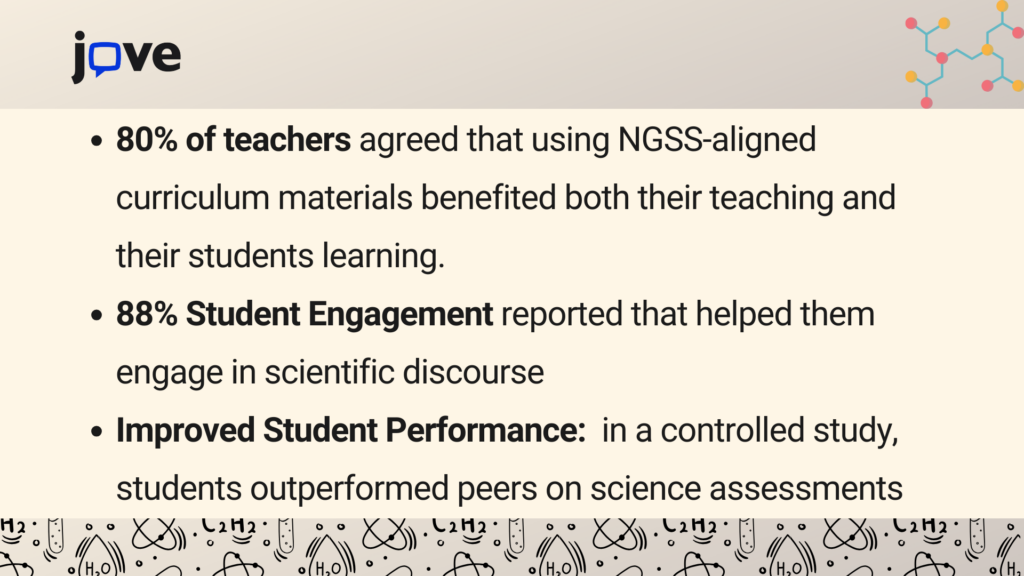
Source: 2022 efficacy study on NGSS curriculum implementation (source).
Case Study: Real-World Success with NGSS Innovation
Teachers in the California NGSS Early Implementers program observed greater student engagement and deeper learning when they moved to inquiry-based, phenomena-focused. Classrooms that once relied on textbook Q&As transformed into lively environments where students collaborated on experiments and discussed real-world science problems. Both the UCLA case and the NGSS school initiative demonstrate a key point: when educators use creative strategies and high-quality multimedia aligned to standards, students respond with higher interest and achievement. The success story is clear – standards-driven science teaching need not be stifling. On the contrary, it can be innovative and highly effective, especially with resources like JoVE that bring concepts to life. Educators can take inspiration from these examples to confidently implement NGSS in ways that truly benefit students, quantitatively and qualitatively (in this case, nearly tripling test scores and significantly increasing engagement). (source).
Conclusion: The Future of Science Education is Standards-Aligned and Inquiry-Based
Crucially, educators do not have to do this alone. Platforms like JoVE’s Middle & High School library are specifically designed to support innovative NGSS-aligned teaching. JoVE offers a wealth of curriculum-mapped videos, simulations, and lab tutorials that make it easier to bring inquiry and visualization into any lesson. With these resources, teachers can save time on lesson preparation while confidently covering standards in an interactive way. The examples provided – from the scientific method video to climate change activities – illustrate how JoVE materials can turn standards into exciting lessons. As you plan your next science unit, consider tapping into JoVE’s extensive collection to enrich your instructional toolkit.
Ready to take your science teaching to the next level?
Explore JoVE’s NGSS-aligned science videos today by booking a free demo right now!

