
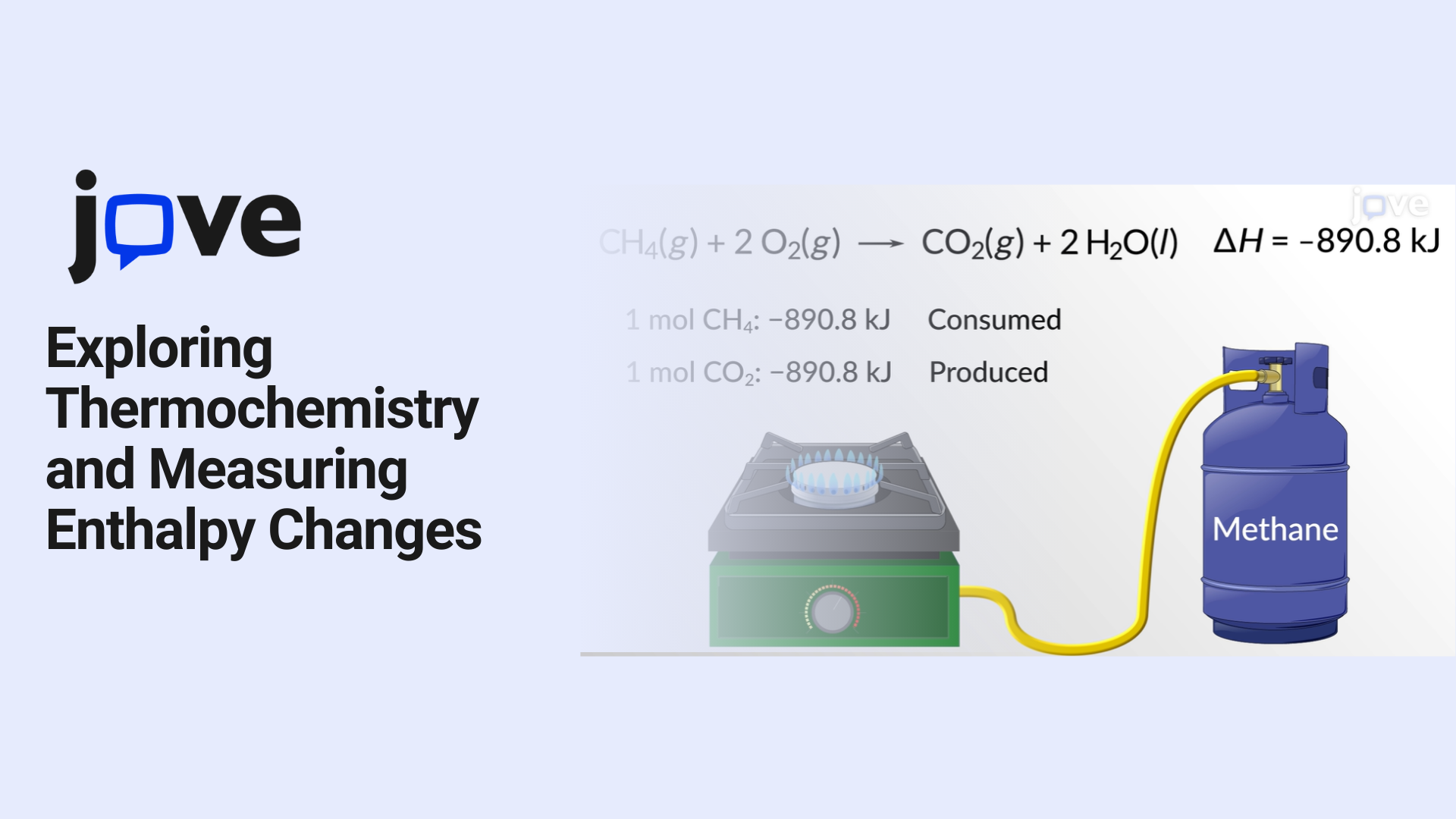
Exploring Thermochemistry and Measuring Enthalpy Changes
Introduction: Why Does Hand Warmer Gel Heat Up Instantly?
During a winter field trip, a student activated a hand warmer by snapping the metal disk inside. Within seconds, the pouch heated up, surprising the class.
“How does that tiny disc make the whole pack warm?” one student asked.
The answer lies in thermochemistry — the study of heat energy changes during chemical reactions. In this case, the hand warmer triggered an exothermic reaction, releasing heat as a result of molecular changes.
According to the Royal Society of Chemistry (RSC), integrating visual demonstrations and interactive learning tools significantly improves students’ understanding of complex thermochemistry concepts like enthalpy change and heat energy transfer. Using resources such as JoVE’s educational videos can help high school students visualize energy changes, improving comprehension and retention.
In this blog, we’ll explore key thermochemistry concepts, explain enthalpy changes, and provide a hands-on classroom experiment to bring these ideas to life.
What is Thermochemistry?
Thermochemistry is the branch of chemistry that studies the relationship between chemical reactions and energy changes.
In every chemical reaction:
✅ Exothermic reactions release heat energy (e.g., combustion, hand warmers)
✅ Endothermic reactions absorb heat energy (e.g., photosynthesis, cooking food)
Understanding thermochemistry helps high school students explain everyday phenomena — from why ice melts to how rocket fuel powers spacecraft.
In JoVE’s Thermochemistry Video, students can watch visual demonstrations of energy flow during chemical reactions, reinforcing key concepts.
Understanding Enthalpy Changes
Enthalpy (ΔH) represents the heat energy change in a system at constant pressure. It determines whether a reaction is exothermic or endothermic.
Exothermic Reactions
- Release heat to the surroundings
- The surroundings get warmer
- Example: Combustion, hand warmers, and neutralization reactions
ΔH is negative for exothermic reactions.
Endothermic Reactions
- Absorb heat from the surroundings
- The surroundings feel cooler
- Example: Melting ice, boiling water, and photosynthesis
ΔH is positive for endothermic reactions.
In JoVE’s enthalpy change demonstration, students can visualize how heat transfers during reactions, reinforcing the difference between exothermic and endothermic processes.
Common Misconceptions About Thermochemistry
Students often struggle with thermochemistry concepts. Some common misconceptions include:
❌ Thinking that exothermic reactions always feel hot — in reality, heat released may dissipate gradually.
❌ Assuming that bond breaking releases energy — breaking bonds requires energy, while forming bonds releases energy.
❌ Believing that enthalpy change equals temperature change — temperature measures heat intensity, while enthalpy represents total heat energy change.
Hands-On Classroom Activity: Measuring Enthalpy Change with a Simple Experiment
This experiment helps students calculate the enthalpy change during a neutralization reaction.
Materials:
- Hydrochloric acid (HCl) solution (1M)
- Sodium hydroxide (NaOH) solution (1M)
- Polystyrene cup (as a calorimeter)
- Thermometer
- Measuring cylinder
Steps:
- Prepare the Solutions: Measure 50 mL of HCl and 50 mL of NaOH using a measuring cylinder.
- Record the Starting Temperature: Pour the HCl into the polystyrene cup and record its temperature.
- Mix and Measure: Add the NaOH solution to the acid. Stir gently and measure the highest temperature reached.
- Calculate Enthalpy Change: Use the formula:
q=mcΔTq = mc\Delta Tq=mcΔT
Where:
- q = heat energy change (in joules)
- m = mass of the solution (in grams)
- c = specific heat capacity of water (4.18 J/g°C)
- ΔT = temperature change (in °C)
- Determine Enthalpy Change:
ΔH=−qn\Delta H = -\frac{q}{n}ΔH=−nq
Where:
- ΔH = enthalpy change per mole
- q = heat energy change (from step 4)
- n = number of moles of the limiting reactant
In JoVE’s calorimetry experiment video, students can watch step-by-step instructions to reinforce the heat energy calculation process.
Real-World Applications of Thermochemistry
Thermochemistry concepts are essential in various real-world applications:
✅ Cooking: Understanding heat absorption helps improve cooking techniques.
✅ Energy Production: Power plants rely on exothermic combustion reactions to generate energy.
✅ Medical Science: Hand warmers and cold packs use exothermic and endothermic reactions to manage body temperature.
In JoVE’s real-world chemistry videos, students can see how these concepts apply to practical situations.
Conclusion: Making Thermochemistry Engaging with JoVE Videos
Thermochemistry can feel challenging for high school students, but with clear visual demonstrations and interactive activities, these concepts become easier to grasp.
By combining JoVE’s engaging videos with hands-on experiments like the enthalpy change experiment, educators can improve student understanding and make learning memorable.
Next Steps:
- Explore JoVE’s thermochemistry videos to simplify energy change concepts
- Try the enthalpy change experiment to reinforce student understanding
- Encourage students to identify exothermic and endothermic reactions in their daily lives
With the right resources, students can master thermochemistry — understanding not just how reactions happen, but why they feel hot, cold, or even explosive!
Curious to see how JoVE’s standards aligned interactive science videos can simplify complex chemistry concepts for your students?
Unlock full access to JoVE’s library for free. Book a demo with us today and engage your students with powerful visual learning tools!

