
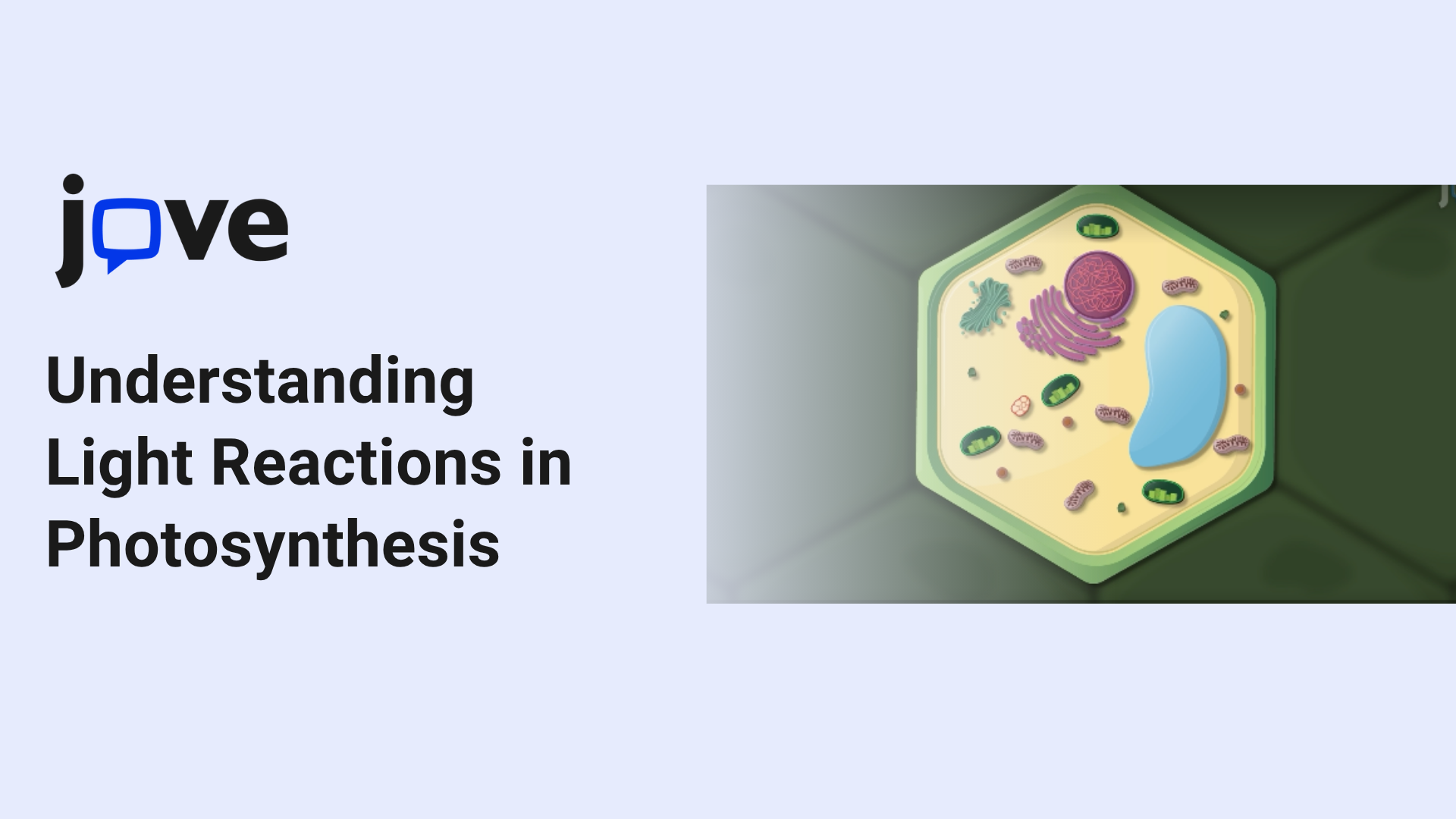
Understanding Light Reactions in Photosynthesis: How Plants Capture Energy
Light reactions are the first step in the photosynthesis process, and they’re also one of the most exciting to teach. These reactions occur inside chloroplasts, where plants use sunlight to make energy-rich molecules like ATP and NADPH. For middle school students, this process can seem invisible — until they see it through engaging visuals and classroom activities.
How to Teach Light Reactions in Middle School
To teach light reactions to middle school students, start with this core idea:
Light reactions capture energy from sunlight and convert it into chemical energy.
Here’s what students should learn:
- These reactions take place in the thylakoid membranes of chloroplasts.
- Chlorophyll absorbs sunlight, triggering a chain of reactions.
- Water (H₂O) is split, releasing oxygen.
- The energy is stored in molecules: ATP (energy) and NADPH (electron carrier).
JoVE’s Light Reactions video clearly shows how sunlight triggers this entire process inside chloroplasts. It’s an ideal visual introduction to this topic for middle school classrooms.
Pair this with JoVE’s Photosynthesis video for a big-picture view before zooming into the light-dependent reactions.
Visual Activity to Explain Photosynthesis Light Reactions
Activity: Build a Chloroplast Model
Materials:
- Paper plates (as chloroplasts)
- Colored paper to represent thylakoids, sunlight, water, and molecules like ATP/NADPH
- Markers and labels
Instructions:
- Use the paper plate as the chloroplast.
- Add stacked green discs for thylakoids.
- Draw sunlight hitting the discs and label arrows for ATP and NADPH.
- Show oxygen bubbling off from water splitting.
Let students act out the light reactions using the model, with different roles for sunlight, water, and energy carriers. This makes the invisible process come alive.
Chlorophyll and Sunlight: The Power Behind Photosynthesis
Help students understand why plants are green — it’s chlorophyll absorbing red and blue light and reflecting green.
Key facts to teach:
- Light energy excites electrons in chlorophyll.
- This kickstarts the movement of electrons through a chain.
- That electron flow powers ATP production (like charging a battery).
JoVE’s science videos showing how light intensity affects photosynthesis are ideal here. They reinforce how sunlight is the power source and why more light means more energy production.
ATP and NADPH Production Explained Simply
This is where students often get stuck, helping them visualize ATP and NADPH as delivery trucks carrying energy and electrons.
Use this analogy:
- Chlorophyll = Solar panel
- Sunlight = Power source
- ATP & NADPH = Batteries or energy-packed packages
Explain that these energy carriers move from the light reaction stage to power the second stage of photosynthesis (dark reactions). They don’t store energy for long — they pass it along to help make glucose.
JoVE’s Dark Reactions video complements this step by showing where ATP and NADPH are used next. This helps clarify the role of energy carriers in the full photosynthesis cycle.
Conclusion: Make Light Reactions Shine in Class
By teaching light reactions with JoVE’s concept videos and hands-on models, students begin to see photosynthesis as a system — not just a term in a textbook. They understand the chloroplast’s role in capturing light, breaking water, and fueling life with energy molecules.
Book a Free Demo to access JoVE’s full video library and science lesson tools.
Bring JoVE to your classroom starting at just $2 per student.*
*Pricing based on 1,500 students.

