
Exploring Newton’s First Law
Why Does the Tablecloth Trick Work?
You’ve probably seen the trick — someone yanks a tablecloth out from under a full set of dishes, and nothing moves. No magic — just physics.
This surprising moment demonstrates Newton’s First Law of Motion: an object at rest stays at rest, and an object in motion continues in motion unless acted upon by an external force.
But simply teaching Newton’s First Law through definitions isn’t enough. Students need to see and feel it. That’s where JoVE’s visual learning tools shine—turning abstract science into visible, tangible understanding.
What Is Newton’s First Law?
Definition: Newton’s First Law — also known as the Law of Inertia — states that an object will maintain its state of rest or constant motion unless a net external force changes it.
First Law of Motion Examples:
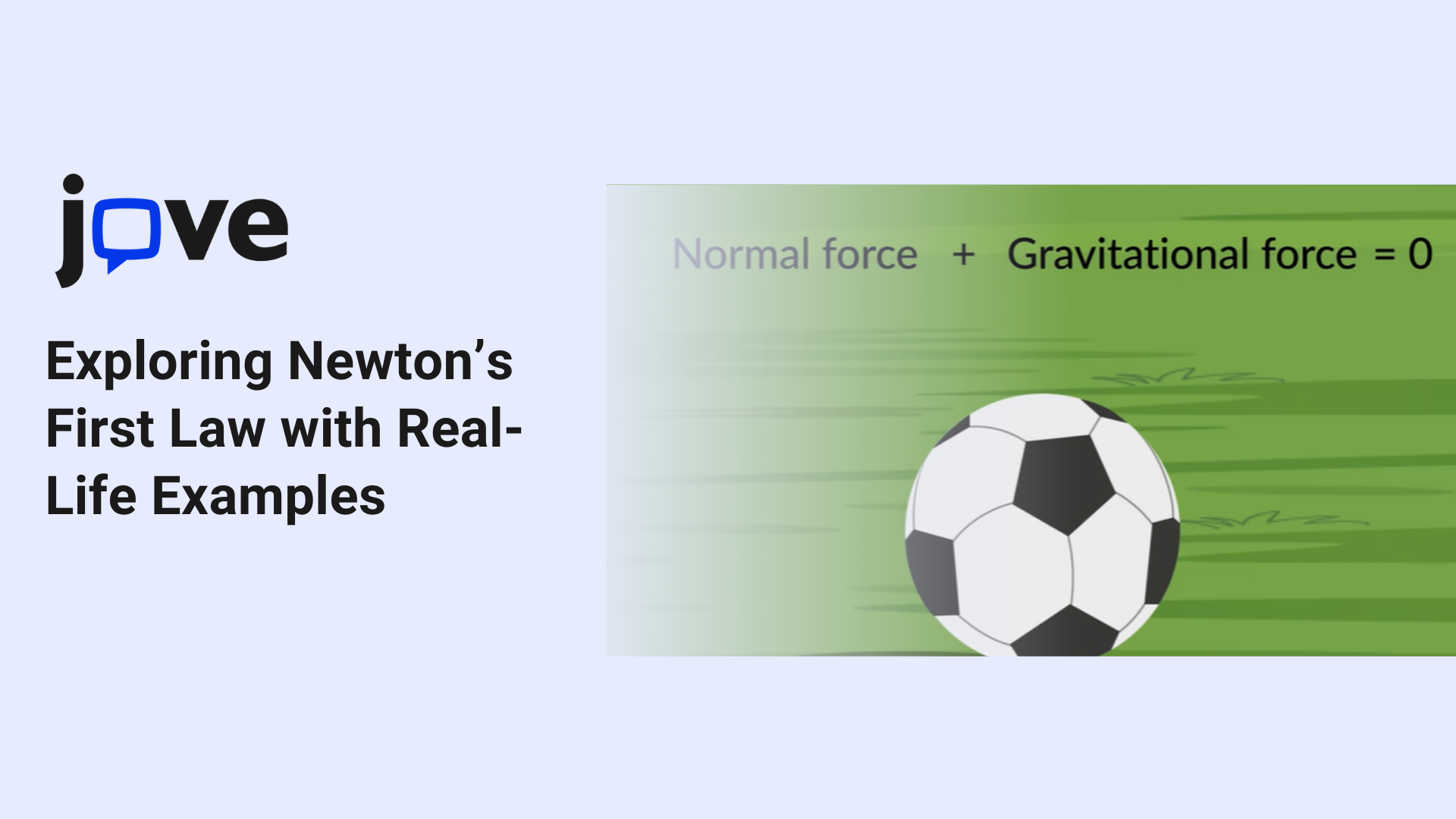
- A soccer ball remains still until kicked
- A moving car keeps rolling until brakes stop it
- A coin on a card stays still even when the card is removed
These first law of motion examples help students understand inertia, or an object’s resistance to changes in motion.
Newton’s First Law Experiment: The Coin and Index Card
This is a perfect hands-on experiment for inertia using items found in most classrooms.
Objective:
Deliver a practical Newton’s First Law experiment using everyday materials to demonstrate inertia in action.
Materials:
- Glass cup
- Index card
- Coin
Steps:
- Place the index card flat across the glass opening.
- Set the coin on top of the card, centered.
- Flick the card quickly sideways.
- Watch the coin drop straight into the cup!
Explanation: The coin resists motion due to inertia and falls straight down once the card is removed.
📌 Aligns with NGSS Standard MS-PS2-2 — a great way to plan and conduct an investigation around force and motion.
Curious how the rest of Newton’s Laws build on this concept? Don’t miss our explanations of Newton’s Second Law and Newton’s Third Law.
Inertia Classroom Activity Ideas to Extend Learning
Looking for more ways to reinforce inertia in the classroom? Try these inquiry-based ideas.
Activity 1: The Sliding Book Test
Slide a book across different surfaces—tile, carpet, and rubber—and record distances. Discuss how friction, an external force, breaks inertia.
Activity 2: The Rolling Ball Challenge
Roll a ball and observe when and why it slows. Use this to reinforce the concept of Newton’s First Law of Motion and how forces act on moving objects.
Activity 3: Car Crash Models
Use toy cars to simulate crashes. Emphasize how inertia keeps objects moving even when the vehicle stops—helping students see why seatbelts are essential.
These inertia classroom activities turn abstract laws into memorable experiments.
Common Misconceptions When Teaching Newton’s First Law
❌ “Objects stop because they run out of force.”
✅ They actually stop due to external forces like friction or air resistance.
❌ “Heavier objects always resist motion more.”
✅ While mass relates to inertia, it doesn’t affect gravitational acceleration.
JoVE’s visual experiments help educators teach Newton’s First Law effectively by correcting these common misunderstandings.
Why Visual Learning Matters for Inertia
Students are twice as likely to grasp Newton’s First Law experiments when supported by video and interactive tools.
📊 A JoVE study showed test scores improved from 28.2% to 89.5% after introducing visual content.
With JoVE videos, students:
- Understand abstract physics concepts
- Retain information better
- Stay engaged in hands-on learning
- Connect science to real-life motion
These benefits help students build a lasting understanding of motion—making Newton’s First Law both visible and memorable in the classroom.
Real-Life Motion: Newton’s First Law in Action
Show students how Newton’s First Law is part of everyday life:
- Car Accidents – Passengers keep moving forward unless seatbelt forces stop them
- Elevators – Sudden jolts reflect inertia in action
- Skateboarding – Riders fly forward if their board stops suddenly
Challenge students to bring in their own first law of motion examples from daily life!
Connect to Standards with JoVE
JoVE supports three-dimensional NGSS-aligned science teaching through:
✅ NGSS-Aligned Physics Videos
✅ Auto-graded Quizzes & Assessments
✅ Lesson Planning Resources for Teachers
Reinforce Key Dimensions of NGSS
By using JoVE’s NGSS-aligned resources, teachers can effectively address all three dimensions of the Next Generation Science Standards (NGSS):
- DCI PS2.A – Forces and Motion
Help students visualize key physics concepts like inertia and motion using real-life examples. - SEP – Planning and Carrying Out Investigations
Guide students through structured, video-modeled experiments that build inquiry skills. - CCC – Cause and Effect
Show how forces lead to motion changes, helping students grasp core scientific reasoning.
Conclusion – Help Students Feel the Laws of Motion
Newton’s First Law isn’t just something to memorize—it’s something students can experience.
By pairing real-world demonstrations with JoVE’s video library, teachers can deliver engaging, standards-aligned lessons that stick.
Bring JoVE to your classroom starting at just $2 per student*.
Schools can use a wide range of funding sources—state and local options, or federal options like Title I, III, IV, and EdTech—to support access.
📎 Explore funding resources or book a demo to learn how your school can start using JoVE’s complete STEM video library today.
*Pricing based on 1,500 students.

