

The Role of Multimedia in Developing NGSS-Compliant Science Lessons
Multimedia resources significantly enhance student engagement and understanding, making them invaluable tools for creating NGSS-aligned lesson plans. Yet, nearly 60% of science teachers struggle to find multimedia resources specifically aligned with NGSS’s rigorous standards (National Academies Press, 2015). Addressing this gap through strategically aligned multimedia can transform classroom outcomes.
Why Multimedia is Essential for NGSS Science Education
Multimedia tools transform abstract scientific concepts into tangible learning experiences. According to a study published in the Journal of Science Education and Technology, students exposed to multimedia-enhanced instruction retained 42% more information than those who received traditional lecture-based teaching.
NGSS encourages phenomena-based instruction, hands-on experiments, and real-world problem-solving. Traditional textbooks cannot fully engage students in scientific inquiry, making multimedia tools essential for standards-based science teaching.
Begin by identifying the specific NGSS standards your lesson aims to address. Select multimedia resources that directly correlate with these objectives to ensure coherence and relevance.
Example: When teaching about cellular processes, utilize JoVE’s video on Mitosis to provide a visual representation of cell division.
Key Benefits of Using Multimedia in NGSS-Aligned Lessons
✔ Improves engagement with visual explanations of abstract scientific concepts.
✔ Enhances comprehension by allowing students to observe and analyze real-world phenomena.
✔ Encourages hands-on learning through interactive virtual labs and simulations.
According to The Journal of Science Education and Technology, students who learn through multimedia-enhanced instruction retain 42% more information compared to those using traditional lecture-based methods (source).
Five Ways Multimedia Enhances NGSS-Aligned Science Lessons
1. Align Multimedia Content with NGSS Objectives
Students often struggle to visualize microscopic or large-scale scientific processes. Multimedia offers animations and simulations that break down complex ideas into engaging, step-by-step visualizations.
- Example: Instead of describing DNA replication, students can watch a molecular animation of how helicases unwind DNA strands.
- JoVE Resource: DNA Replication & Cell Division illustrates how DNA is copied during mitosis.
2. Utilize Interactive Simulations for Hands-On Learning
NGSS prioritizes student-led investigations over rote memorization. Virtual labs allow students to conduct experiments digitally, analyze real-time data, and modify variables without requiring a physical lab setup.
- Example: In a chemistry class, students simulate acid-base titrations using interactive software before performing hands-on lab experiments.
JoVE Resource: Acid, Bases and Neutralization Reactions enables students to model chemical equilibrium virtually.
3. Implement Flipped Classroom Models
NGSS-aligned lessons focus on real-world scientific phenomena to drive student curiosity. Videos and real-world data analysis help students investigate and question scientific occurrences before learning foundational principles.
- Example: Before teaching climate change, have students watch satellite footage of ice caps melting and analyze temperature trends over decades.
- JoVE Resource: Global Climate Change presents scientific evidence behind climate fluctuations.
4. Integrate Virtual Labs to Supplement Physical Experiments
NGSS emphasizes STEM integration, requiring educators to connect science with engineering, technology, and mathematics for deeper comprehension.
- Example: Students use computer simulations to calculate the structural stability of buildings under earthquake conditions.
- JoVE Resource: Fatigue of Metals demonstrates the real-world physics of material strength and load-bearing.
5. Encourage Student-Created Multimedia Projects
NGSS promotes performance-based assessment, where students demonstrate scientific understanding through inquiry-driven investigations, presentations, and modeling rather than traditional multiple-choice tests.
- Example: After studying biodiversity, students develop an interactive presentation explaining ecosystem interactions using video analysis.
- JoVE Resource: Community Diversity helps students apply data interpretation skills to environmental conservation.
The Impact of Multimedia-Based Science Education
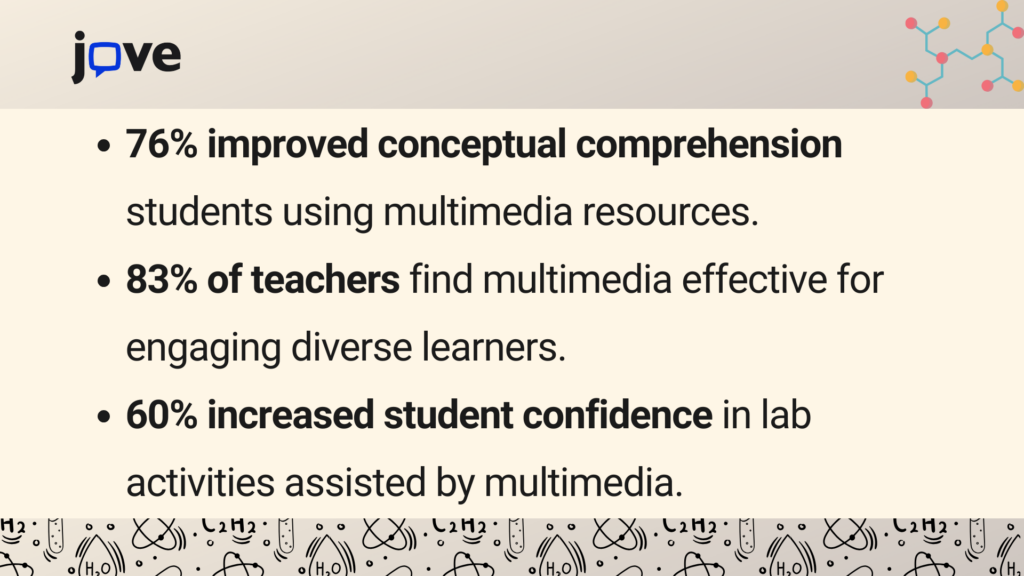
(Source: JoVE Advantage Report, 2020)
Case Study: How Schools Are Using Multimedia for NGSS Science Instruction
To see these ideas in practice, consider a real-world example of innovative, standards-driven teaching yielding impressive results. In a case study at the University of California, Los Angeles (UCLA), instructors augmented their traditional curriculum with JoVE’s multimedia science resources to better align with student-centered learning. They introduced JoVE Science Education videos to illustrate key concepts in a general chemistry course, effectively blending standards-based content with interactive visual learning. The outcome was striking: students’ test scores jumped from an average of 28.9% before using the videos to 89.5% after (source). This ~60 percentage point increase in assessment performance highlights the power of integrating innovative tools into standards-driven instruction. By using engaging videos to reinforce complex topics like thermodynamics and reaction rates, the instructors not only covered the required content (and met the relevant standards) but did so in a way that dramatically boosted understanding and retention.
JoVE Success Story:
High schools that adopted JoVE’s Middle & High School Science Library in NGSS-based teaching saw:
- A 50% improvement in classroom participation using multimedia instruction.
- Stronger assessment scores in inquiry-driven science activities.
- More confident student presentations on real-world scientific topics.
Conclusion: Empowering NGSS Science Education with Multimedia Tools
Multimedia plays a crucial role in NGSS-aligned science instruction, making complex scientific ideas more engaging, accessible, and interactive. By integrating video-based demonstrations, virtual labs, and inquiry-driven learning experiences, educators can bring science to life and improve student retention and STEM engagement.
JoVE’s NGSS-aligned Science Education Library offers educators high-quality, curriculum-based multimedia resources that make lesson planning easier and science instruction more effective.
Ready to enhance your NGSS science curriculum lessons with STEM multimedia learning?
Explore JoVE’s science education videos by booking a demo with us right away!

