
Theory vs. Law: 5 Tips to Help Students Understand Scientific Theories
Scientific theories are often misunderstood, especially by middle school students. When students hear the word ‘theory,’ they may think it means a wild guess. That’s why teaching the scientific theory vs law distinction is so important early on.
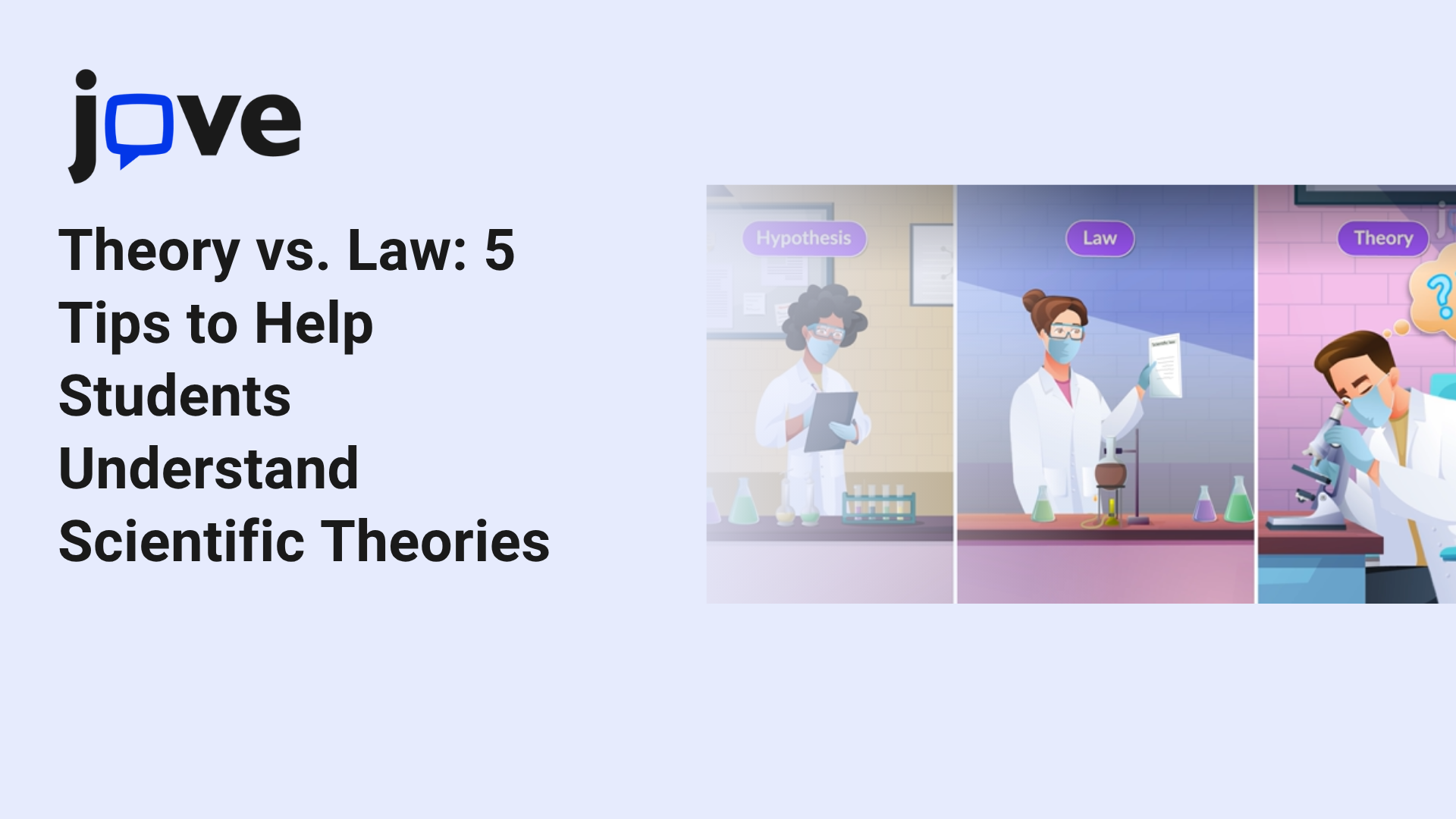
Fortunately, JoVE’s video on Scientific Theories clearly illustrates the difference between theories, laws, and hypotheses. It’s a great way to support your students’ understanding with visual, real-world examples.
🎬 Show this JoVE video to clarify scientific theory definition and debunk misconceptions
Here are five teacher-approved tips to help your students confidently navigate one of science’s most misunderstood concepts.
1. Start by Defining Terms Clearly
How to explain scientific theories to students
Kick off the lesson by breaking down key definitions in simple language:
- A scientific theory is a well-substantiated explanation backed by evidence.
- A scientific law describes patterns observed in nature.
- A hypothesis is a testable prediction.
Use anchor charts or sorting cards so students can see the difference between scientific theory vs hypothesis vs law examples.
2. Use Real-World Analogies and Misconceptions
Correcting common misunderstandings
Students may say things like, ‘It’s just a theory,’ so clarify that in science, theories are supported by data. Analogies help:
- A theory is like a detective’s case file with evidence.
- A law is the predictable pattern (e.g., the sun rises each morning).
- A hypothesis is a clue worth testing.
This helps clear up science misconceptions about what scientists really mean.
3. Show Theories and Laws Working Together
Give classroom-friendly examples
Use real-world science examples that connect to topics students already explore in class. Here are pairs of theories and laws you can introduce, with corresponding JoVE videos:
Newton’s Laws of Motion vs Theory of Gravity
- Law example: Newton’s Second Law explains how force, mass, and acceleration relate.
▶️ Watch: Force, Mass, and Acceleration - Theory example: While Newton’s law describes how gravity works, Einstein’s theory of general relativity explains why gravity happens due to space-time curvature.
Use this comparison to show how both are accepted — just operating at different scales.
Cell Theory vs Law of Conservation of Mass
- Cell Theory video:
▶️ What’s Inside a Cell? Understanding Organelles - Law of Conservation of Mass video (linked via experiments):
▶️ Chemical Reactions in Everyday Life
This law can be demonstrated through experiments showing that mass is neither created nor destroyed in chemical reactions — even in cellular processes like respiration.
Theory of Evolution vs Mendel’s Laws of Inheritance
- Theory of Evolution video:
▶️ Using Videos to Explore Genetics and Evolution
Mendel’s Laws video:
▶️ Understanding Mendel’s Law of Segregation
Use Punnett squares and trait prediction activities to show how Mendel’s laws describe how traits are passed down, while the theory of evolution explains how these traits change in populations over time.
4. Reinforce Through Hands-On Activities
Make abstract concepts concrete
Create an activity where students classify examples as a theory, law, or hypothesis. For instance:
- “All organisms are made of cells” → Theory
- “Matter cannot be created or destroyed” → Law
- “If plants get more light, they’ll grow faster” → Hypothesis
This interactive approach supports a scientific theory for middle school and engages kinesthetic learners.
5. Use Visuals to Anchor Understanding
Why videos boost clarity
The JoVE Scientific Theories video is an excellent visual summary. Students can see how theories develop over time with evidence and testing. Watching this helps solidify the scientific theory definition and builds confidence.
Pair the video with a quick reflection activity: “How is a theory more than a guess?”
FAQ: Scientific Theory vs Law
A law describes what happens; a theory explains why it happens. Both are based on evidence.
It’s a well-supported explanation built from repeated experiments and observations.
Use common science content: gravity, atoms, cells, motion. Discuss what is explained (theory) vs what is described (law).
It helps students think critically, respect evidence, and understand how science evolves.
Conclusion: Help Students Think Like Scientists
Teaching scientific theory vs law isn’t just about memorizing definitions — it’s about reshaping how students view science. With clear examples, engaging activities, and helpful visuals like JoVE’s videos, you can help students move past misconceptions and think like real scientists.
Empower your teaching with JoVE’s science videos – try JoVE for free by booking a demo and help your students master tricky concepts like theory vs. law.
JoVE’s science video library starts at just $2 per student*. Explore funding options now.
*Pricing based on 1,500 students

